Listen to this Post
Introduction:
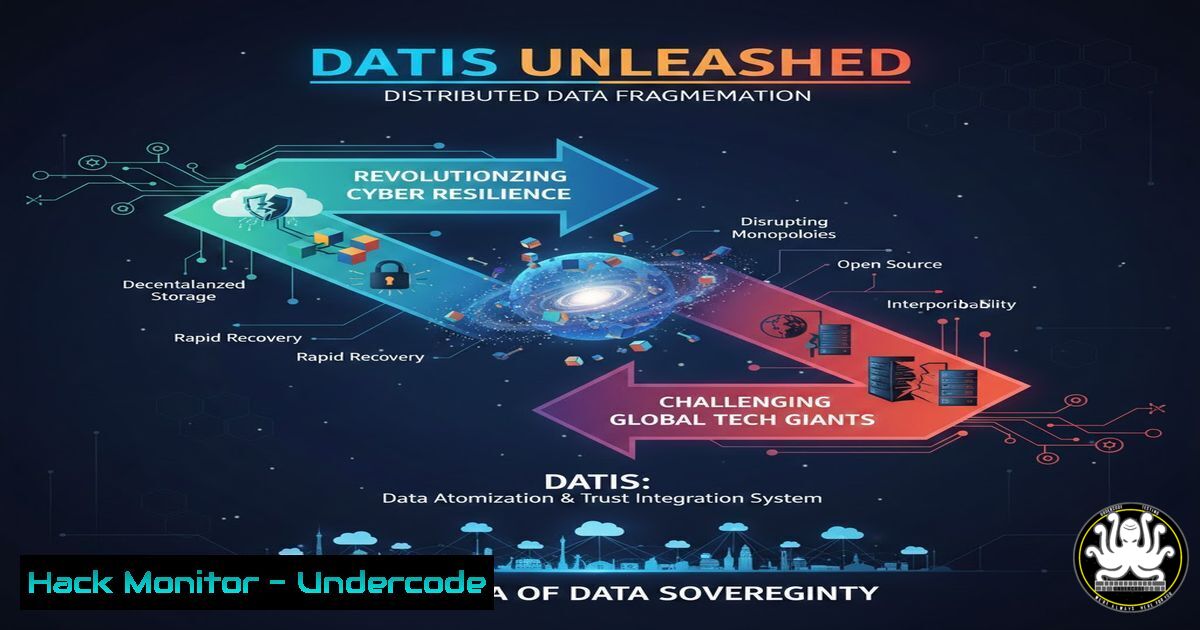
The escalating data breach landscape demands a fundamental paradigm shift beyond conventional perimeter defenses. At the forefront of this movement is a sovereign French innovation showcased at the Cybersecurity Business Convention (CBC): DATIS by Inspeere. This solution re-architects data backup and recovery by leveraging a distributed, fragmentary model, rendering traditional ransomware and exfiltration attacks obsolete against its core architecture. This article deconstructs the technical principles behind this approach and provides a actionable framework for understanding its implementation.
Learning Objectives:
- Understand the core mechanics of distributed, encrypted data fragmentation for cyber resilience.
- Learn how to simulate core DATIS principles using common Linux and Windows command-line tools.
- Analyze the threat model and security posture of a distributed data storage system versus centralized models.
- Grasp the operational procedures for data restoration in a fragmented environment.
- Evaluate the applicability of sovereign cloud technologies in your organization’s security strategy.
You Should Know:
- The Architecture of Unbreakable Backups: Distributed Data Fragmentation
The foundational principle of solutions like DATIS is a departure from monolithic data storage. Instead of storing a complete file in one location, the system employs a process of fragmentation, encryption, and distribution.
Step 1: Data Ingestion and Fragment Creation
The source file is split into multiple, non-contiguous fragments. Using a tool like `split` on Linux or a custom PowerShell script on Windows, we can simulate this.
Linux:
 Create a sample file
echo "This is highly sensitive corporate data." > original_data.txt
 Split the file into 4 fragments of 10 bytes each
split -b 10 -d original_data.txt data_fragment_
 This creates files: data_fragment_00, data_fragment_01, ...
Windows (PowerShell):
 Create sample file
"This is highly sensitive corporate data." | Out-File -FilePath .\original_data.txt
 Read and split into fragments (simplified example)
$data = Get-Content .\original_data.txt -Raw
$fragmentSize = 10
for ($i=0; $i -lt $data.Length; $i+=$fragmentSize) {
$fragment = $data.Substring($i, [bash]::Min($fragmentSize, $data.Length - $i))
$fragment | Out-File -FilePath "data_fragment_$i.txt"
}
Step 2: Military-Grade Encryption of Individual Fragments
Each fragment is then encrypted individually before dispersal. This ensures that even if a fragment is intercepted, it is cryptographically secure.
Linux (using OpenSSL):
 Encrypt each fragment with AES-256
for fragment in data_fragment_; do
openssl enc -aes-256-cbc -salt -in $fragment -out $fragment.enc -pass pass:MyStrongPassword
done
Windows (PowerShell using .NET Cryptography):
 A simplified example using secure strings (for demonstration, not production)
Get-ChildItem .\data_fragment_.txt | ForEach-Object {
$content = Get-Content $_ -Raw
$secureContent = ConvertTo-SecureString $content -AsPlainText -Force
$encryptedContent = ConvertFrom-SecureString $secureContent
$encryptedContent | Out-File -FilePath "$($_.BaseName).enc"
}
2. The Dispersal Model: On-Premise Client Networks
DATIS innovates by dispersing these encrypted fragments across a network of participating clients’ on-premise storage, not in a central data center.
Step-by-Step Dispersal Logic:
- Metadata Creation: A secure index is created that maps the original file to its list of encrypted fragments and their storage locations. This index is itself highly protected and distributed.
- Policy-Driven Distribution: Fragments are distributed according to a policy ensuring no single client or jurisdiction holds a quorum of fragments needed for reconstruction.
- Geographic & Jurisdictional Dispersion: By storing fragments with different partners in different legal jurisdictions, the data becomes resilient to localized legal seizures, outages, or targeted attacks.
-
Threat Modeling a Fragmentary System: The “Minuscule Fragment” Attack
As highlighted in the original post, the threat model changes dramatically. A breach of one client’s storage does not constitute a data breach.
Step-by-Step Impact Analysis:
- Scenario: An attacker compromises Client A’s systems and exfiltrates all stored data.
- Attacker’s Loot: The attacker gains possession of multiple encrypted fragments (e.g.,
data_fragment_01.enc,data_fragment_17.enc). - Cryptographic Analysis: Without the encryption keys and all other fragments, these files are useless. They are:
Inutilisable: Cannot be decrypted or understood.
Non Attributable: The fragment content does not reveal which original file it belongs to or who the other data owners are.
4. Conclusion: The risk is contained and managed. The confidentiality of the original dataset remains intact.
4. Data Restoration in a Distributed World
Recovery is the critical counterpart to dispersal. The process is reverse-engineered from the dispersal logic.
Step-by-Step Restoration Guide:
- Index Retrieval: Access the secure, distributed metadata index to identify all fragments belonging to the file and their locations.
- Fragment Recall: The system requests the required fragments from the distributed client network.
- Integrity Check & Decryption: Once a quorum (not necessarily 100%) of fragments is retrieved, their integrity is verified. Each is then decrypted using the secure key management system.
- Reassembly: The decrypted fragments are reassembled into the original file.
Linux Reassembly Simulator:
 Decrypt all fragments
for frag in .enc; do
openssl enc -d -aes-256-cbc -in $frag -out ${frag%.enc}.dec -pass pass:MyStrongPassword
done
 Reassemble the original file
cat data_fragment_.dec > restored_data.txt
 Verify integrity
diff original_data.txt restored_data.txt && echo "Restoration Successful."
- Sovereign Tech and the Future of Enterprise IT Procurement
The post underscores a growing trend: the maturity and competitive advantage of sovereign technological solutions.
Step-by-Step Evaluation for Security Teams:
- Audit Dependencies: Map your organization’s critical dependencies on non-sovereign tech stacks (e.g., major US cloud providers for core backup).
- Evaluate Sovereign Alternatives: Actively research and test solutions from local providers, assessing them against criteria like feature parity, security certifications, and data jurisdiction.
- Conduct a POC: Run a proof-of-concept with a sovereign solution like DATIS for a non-critical but sensitive data set to evaluate real-world performance and integration.
- Develop a Hybrid/Migration Strategy: Create a phased plan to integrate sovereign technologies, reducing strategic risk and aligning with emerging regulations like the EU’s Cyber Resilience Act.
What Undercode Say:
- The Unit of Defense has Shifted from the File to the Fragment. The most profound security innovations are no longer about building bigger walls but about changing the fundamental nature of what is being protected. By making data inherently useless in a compromised state, you neutralize the attacker’s primary incentive.
- Resilience is the New Compliance. While GDPR and similar regulations focus on breach notification, architectures like DATIS focus on making breaches irrelevant. Future-forward security strategies will prioritize inherent resilience as a core feature, not an add-on, moving beyond checkbox compliance.
The analysis from the CBC event indicates a maturation point for the European cybersecurity sector. It’s not just about catching up but about pioneering architectures born from a distinct threat and regulatory landscape. The success of DATIS and similar platforms signals to the market that innovation in core infrastructure is not the exclusive domain of a few Silicon Valley giants. This fosters a more robust, diverse, and competitive ecosystem, which ultimately benefits all organizations by providing more strategic choice and reducing systemic risk.
Prediction:
The distributed, fragmentary data model pioneered by companies like Inspeere will become a foundational element of next-generation data protection strategies within the next 3-5 years, particularly for critical infrastructure and highly sensitive intellectual property. We will see this architecture integrated directly into major cloud providers’ service offerings as a premium tier and mandated in certain government and industrial contracts. This approach will significantly raise the cost and complexity for attackers, forcing a shift in their tactics towards targeting the metadata index and key management systems, making the security of those components the new central battleground in data protection.
🎯Let’s Practice For Free:
IT/Security Reporter URL:
Reported By: UgcPost 7399913534639202304 – Hackers Feeds
Extra Hub: Undercode MoN
Basic Verification: Pass ✅


