Listen to this Post
Introduction:
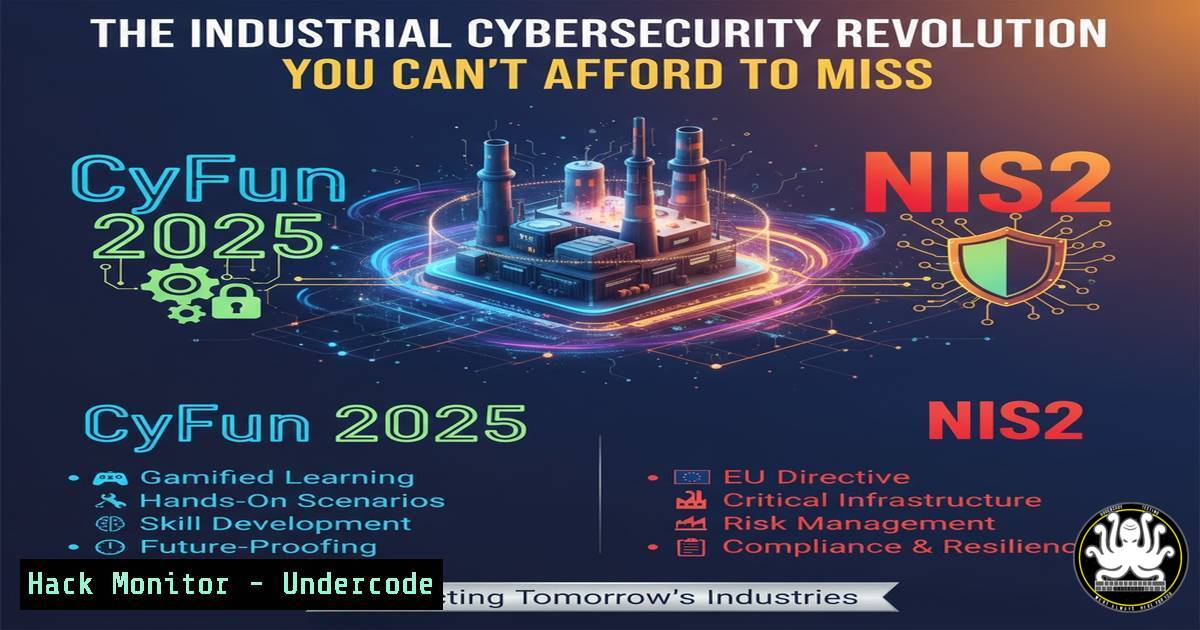
The convergence of Operational Technology (OT) and Information Technology (IT) has created a new frontier of cyber vulnerabilities in critical infrastructure and industrial environments. The European NIS2 Directive is the regulatory hammer forcing organizations to mature their cybersecurity posture, and CyFun 2025 emerges as the critical framework providing the actionable blueprint for compliance and resilience. This article deconstructs the technical controls and practical implementations necessary to bridge the gap between policy and protection in industrial control systems (ICS).
Learning Objectives:
- Understand the core technical domains of the CyFun 2025 framework and how they map to NIS2 compliance.
- Implement practical asset discovery, network segmentation, and monitoring controls in an OT/ICS environment.
- Apply secure configuration management and incident response procedures tailored for industrial systems.
You Should Know:
1. Foundational Asset Discovery and Inventory
You cannot protect what you cannot see. A comprehensive, dynamic asset inventory is the absolute foundation of both CyFun 2025 and NIS2 compliance, requiring specialized tools to identify fragile OT devices without causing disruptions.
Verified Commands & Tools:
 Nmap Scripting Engine (NSE) for safe device discovery
nmap -sn 192.168.1.0/24
nmap --script s7-enumerate -p 102 192.168.1.50
nmap --script modbus-discover -p 502 192.168.1.100

Using Masscan for high-speed surveying of large networks (Use with Caution)
masscan 10.0.0.0/8 -p80,443,102,502,44818 --rate=10000

Using OSS tool 'PLCScan' for specific Siemens S7 discovery
python plcscan.py -t 192.168.1.50
Step-by-step guide:
- Define Scope: Clearly delineate your OT network ranges. Never run discovery scans from the corporate IT network without proper firewalling.
- Passive Discovery First: Deploy a network tap or SPAN port and use a tool like `Rumble` or `Wireshark` with OT dissectors to passively listen for network traffic and identify devices without sending a single packet.
- Active Discovery with Care: Use `nmap` with OT-specific scripts (
s7-enumerate,modbus-discover) during planned maintenance windows. Start with a simple ping sweep (-sn) to find live hosts, then target common OT ports like 102 (Siemens S7), 502 (Modbus), 44818 (Allen-Bradley). - Consolidate and Categorize: Import all discovered assets into a Configuration Management Database (CMBD), tagging them with criticality (e.g., “PLC controlling pressure valve”), IP address, model, and firmware version.
2. Enforcing Zero-Trust with Micro-Segmentation
Flat OT networks are a legacy threat. CyFun 2025 mandates segmentation to contain breaches and prevent lateral movement. The goal is to create isolated zones, often following the Purdue Model, where communication is explicitly allowed, not implicitly trusted.
Verified Commands & Configurations:
 Example iptables rules on an OT network Linux-based firewall
 Allow only HMI (192.168.1.10) to talk to PLC (192.168.1.50) on port 102
iptables -A FORWARD -s 192.168.1.10 -d 192.168.1.50 -p tcp --dport 102 -j ACCEPT
iptables -A FORWARD -s 192.168.1.50 -d 192.168.1.10 -p tcp --sport 102 -j ACCEPT

Explicitly drop all other traffic between the Control and Supervisory zones
iptables -A FORWARD -s 192.168.1.0/24 -d 192.168.2.0/24 -j DROP

Windows Firewall (via PowerShell) to restrict engineering workstation access
New-NetFirewallRule -DisplayName "Block S7 except from Engineering PC" -Direction Inbound -Protocol TCP -LocalPort 102 -RemoteAddress "192.168.1.10" -Action Allow
New-NetFirewallRule -DisplayName "Block all other S7" -Direction Inbound -Protocol TCP -LocalPort 102 -Action Block
Step-by-step guide:
- Map Communication Flows: Document all required communications between assets (e.g., HMI to PLC, Historian to Data Server). Use network logs from your discovery phase.
- Define Zones and Conduits: Group assets into security zones (e.g., Level 3 – Operations, Level 2 – Supervisory, Level 1 – Basic Control). The paths between zones are conduits.
- Implement Firewall Rules: On your next-generation firewalls or industrial demilitarized zone (IDMZ) appliances, create whitelist rules that only permit the documented, required traffic. Block all other traffic by default.
- Test Thoroughly: After implementing rules, conduct functional tests to ensure operational processes are not interrupted. Validate that unauthorized communication attempts are logged and blocked.
3. Proactive Vulnerability and Patch Management
Industrial systems often run on unsupported OSs and cannot be patched frequently. CyFun 2025 requires a risk-based approach, prioritizing mitigation through compensating controls when immediate patching is not feasible.
Verified Commands & Tools:
 Using OpenVAS (Greenbone) to scan for vulnerabilities (Target OT network carefully)
omp -u admin -w password --target "OT Network" --config "Full and fast"
omp -u admin -w password --start-task "OT Network Scan"

Using Nessus with ICS policies
 Command-line to start a scan (ensure you use a custom policy with safe checks)
nessuscli scan launch --policy "Safe ICS Audit" --targets 192.168.1.0/24

PowerShell to check for missing patches on a Windows-based HMI/Server
Get-HotFix | Sort-Object InstalledOn -Descending | Select-Object -First 10
Get-WmiObject -Class Win32_Product | Format-List Name, Version, Vendor
Step-by-step guide:
- Deploy Specialized Scanners: Use vulnerability scanners like Tenable Nessus (with ICS plugins) or OpenVAS with policies configured for OT environments to avoid device crashes.
- Prioritize by CVSS and Operational Impact: Do not treat all CVEs equally. A Critical CVE on a non-critical component is less important than a Medium CVE on a primary control PLC. Use the CVSS score in conjunction with operational context.
- Apply the Patch-Mitigate-Isolate Model: For each identified vulnerability, first determine if a vendor patch can be safely applied during a maintenance window. If not, implement a mitigation (e.g., firewall rule to block exploit traffic) or isolate the asset further.
- Document the Risk: Formally document any unpatched vulnerabilities, the rationale for not patching, and the compensating controls in place. This is critical for NIS2 audits.
4. Secure Configuration and Hardening of ICS Assets
Default configurations of industrial devices are inherently insecure. CyFun 2025 emphasizes hardening based on industry standards like the CIS Benchmarks to reduce the attack surface.
Verified Commands & Configurations:
 Linux-based OT Server Hardening (Example checks)
grep "^PermitRootLogin" /etc/ssh/sshd_config  Should be 'no'
systemctl status sshd  Is SSH running? Should it be?
ps aux | grep -i "telnet"  Is telnet running? Must be removed.

Windows-based Station Hardening (PowerShell)
Get-Service | Where-Object {$_.Name -like "Telnet"} | Stop-Service -PassThru | Set-Service -StartupType Disabled
Set-NetFirewallProfile -Profile Domain,Public,Private -Enabled True
Auditpol /set /category:"Account Logon","Logon/Logoff","Object Access" /success:enable /failure:enable
Step-by-step guide:
- Establish a Baseline: Use tools like the `CIS-CAT` profiler or manual checklists to assess your current configuration against a hardened benchmark (e.g., CIS Benchmark for Windows 10, or for your specific PLC model if available).
- Change Default Credentials: This is the most critical step. Change all default, vendor-supplied passwords on HMIs, PLCs, and network equipment. Use a privileged access management (PAM) solution to vault them.
- Disable Unnecessary Services: Turn off unused network services and ports (e.g., FTP, Telnet, HTTP). Enforce encrypted protocols like SSHv2, SFTP, and HTTPS/TLS 1.2+.
- Implement Logging and Auditing: Ensure system and security logs are enabled and being collected by a central SIEM. Configure audit policies to track logon events and critical object access.
5. Implementing Anomaly Detection with OT-Aware SIEM
Traditional IT SIEM rules are blind to OT-specific attacks. Configuring your monitoring to detect malicious activity in industrial protocols is essential for early threat detection.
Verified Tools & Configurations:
 Example Sigma rule for detecting PLC stop commands (conceptual YAML)
title: Siemens S7 STOP Command Detected
logsource:
product: siemens
service: s7comm
detection:
selection:
function: 'PLC_STOP'
condition: selection
falsepositives:
- Planned maintenance
level: high

Snort IDS rule for detecting Modbus function code 05 (Force Single Coil) - a potential attack
alert tcp any any -> any 502 (msg:"Modbus Force Single Coil Attempt"; content:"|00 00 00 00 00 06|"; depth:6; content:"|FF|"; within:1; offset:12; byte_test:1,&,1,11; sid:1000001; rev:1;)
Step-by-step guide:
- Ingest OT Logs: Connect your SIEM (e.g., Splunk, Elastic SIEM, IBM QRadar) to data sources like industrial firewalls, historian databases, and protocol-aware network monitors.
- Develop OT-Specific Correlations: Create alerts for activities like: programming software being run outside of a specific engineering workstation, a `STOP` command sent to a PLC, multiple failed logins to an HMI, or communication from an IT IP address to a controller in the control zone.
- Tune for Low False Positives: OT environments are sensitive. Work closely with operations staff to baseline “normal” behavior and tune your alerts to avoid nuisance alarms that lead to alert fatigue.
- Integrate with Incident Response: Ensure that alerts trigger a defined playbook in your incident response plan, specifying who to contact (including OT personnel) and the immediate containment steps that are safe for the process.
6. Building an ICS-Specific Incident Response Playbook
A cyber incident in an OT environment requires a different response than an IT breach. The primary goal is to maintain safety and availability, not just to contain and eradicate.
Verified Commands & Procedures:
 Isolating a compromised HMI from the network (Windows)
netsh advfirewall firewall add rule name="QUARANTINE" dir=in action=block enable=yes
netsh advfirewall firewall add rule name="QUARANTINE" dir=out action=block enable=yes

Creating a forensic image of a potentially compromised server (Linux)
dd if=/dev/sda of=/mnt/securestorage/forensic_image.img bs=4M status=progress
 Or using a more advanced tool like 'dcfldd'
dcfldd if=/dev/sda hash=sha256,md5 log=/mnt/securestorage/hashes.txt of=/mnt/securestorage/forensic_image.img
Step-by-step guide:
- Pre-Identification: Have contact lists for OT engineers, vendors, and management. Keep offline copies of network diagrams and asset inventories.
- Detection & Analysis: The SIEM alert triggers. The IR team confirms it’s not a false positive. The first call is to the OT operations lead to assess the potential impact on the physical process.
- Containment (OT-Safe): Immediate containment may involve logically isolating the asset via firewall rules rather than pulling the plug, which could cause a dangerous process shutdown. The OT team must approve all containment actions.
- Eradication & Recovery: After preserving forensic evidence, the compromised system is wiped and restored from a known-good backup. The system is then re-integrated into the network only after thorough testing and validation by the operations team.
- Post-Incident Review: Conduct a lessons-learned session with both IT and OT stakeholders to update the playbook and technical controls, closing the loop on the security lifecycle.
What Undercode Say:
- Key Takeaway 1: CyFun 2025 is not just a checklist but an operational mandate that forces the technical hardening of industrial networks, moving beyond policy to practical implementation of segmentation, monitoring, and secure configuration.
- Key Takeaway 2: Success hinges on the symbiotic relationship between IT security teams and OT operations personnel; neither can achieve NIS2 compliance alone, as technical controls must be applied without compromising process safety and reliability.
The analysis reveals that frameworks like CyFun 2025 are finally providing the missing “how” to the NIS2 “what.” The technical commands and procedures outlined are the tangible building blocks for this new era of industrial cybersecurity. Organizations that treat this as a mere compliance exercise will fail. Those that embed these technical practices into their daily operations will not only pass audits but will genuinely build a resilient defense against increasingly sophisticated threats targeting critical infrastructure. The integration of IT security tooling, adapted for OT sensitivity, is the central technical challenge of the next decade.
Prediction:
The stringent technical and reporting requirements of NIS2, operationalized through frameworks like CyFun 2025, will create a two-tiered industrial landscape by 2028. Organizations that successfully implement granular network segmentation, OT-specific anomaly detection, and automated asset management will achieve a significantly lower risk profile and cyber insurance premiums. Those that fail will face not only massive regulatory fines but also catastrophic operational disruptions, as state-sponsored and criminal groups increasingly weaponize IT-born exploits against physically vulnerable OT environments, leading to the first wave of widespread, financially-motivated industrial sabotage.
🎯Let’s Practice For Free:
IT/Security Reporter URL:
Reported By: Trustindigital Microsoft – Hackers Feeds
Extra Hub: Undercode MoN
Basic Verification: Pass ✅


