Listen to this Post
Introduction:
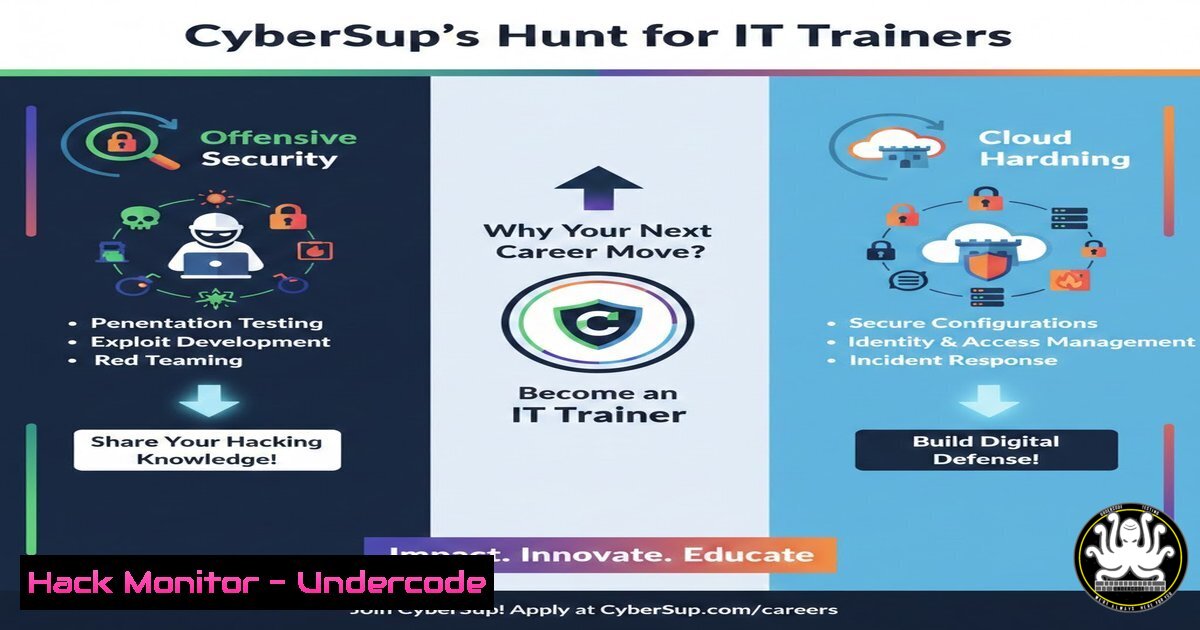
The cybersecurity industry faces a paradoxical crisis: a massive talent shortage alongside a glut of underqualified applicants. While most discourse focuses on entry-level hiring, a French institution, Cybersup, is targeting the root cause by recruiting senior professionals to train the next generation. This call for experts in cybersecurity, cloud, DevOps, AI, and governance highlights a critical market shift. For the seasoned professional, transitioning to pedagogy is not just a career change; it is a force multiplier for the entire industry. This article explores the technical domains where these trainers are needed and provides the hard skills—from Linux command-line forensics to cloud compliance checklists—that define the curriculum of the future.
Learning Objectives:
- Analyze the core technical domains (Network, Cloud, AI, Governance) required for modern IT education.
- Execute basic Linux and Windows commands essential for system hardening and security instruction.
- Understand the intersection of DevOps pipelines and API security in a training context.
- Identify key compliance frameworks (RGPD, Privacy by Design) and their technical implementation.
You Should Know:
1. Systèmes & Réseaux: The Command-Line Foundation
Cybersup’s search for “réseau & systèmes” trainers implies a need for educators who can bridge the gap between theory and raw terminal access. Whether teaching defense or offense, mastery of the command line is non-negotiable. A trainer must be able to demonstrate persistence and enumeration live.
For Linux (Hardening & Forensics):
A trainer should be able to walk students through a compromise assessment using native tools.
` Check for suspicious user logins and authentication failures
last -F | head -20
sudo lastb | awk ‘{print $3}’ | sort | uniq -c | sort -nr`
` Identify world-writable files (a common misconfiguration)
find / -type f -perm -o+w -ls 2>/dev/null`
Audit running processes and network connections for reverse shells

<h2 style="color: yellow;">ss -tunap</h2>

<h2 style="color: yellow;">lsof -i -P -n | grep ESTABLISHED
For Windows (Active Directory Security):
Understanding AD is critical. Trainers must show how to audit for Kerberoasting or legacy protocols.
` PowerShell: Check for users with unconstrained delegation
Get-ADUser -Filter -Properties TrustedForDelegation | where {$_.TrustedForDelegation -eq $true} | Select Name`
Check SMB signing status (crucial for NTLM relay prevention)

<h2 style="color: yellow;">Get-SmbServerConfiguration | Select EnableSecuritySignature, RequireSecuritySignature
- Cloud & DevOps: Infrastructure as Code and Pipeline Hardening
The shift to DevOps requires trainers to move beyond static servers. They must teach how to secure CI/CD pipelines and containerized environments. A common exercise involves exploiting a misconfigured Docker socket or a Kubernetes RBAC error.
Tool Configuration (Kubernetes Auditing):
Instructors should demonstrate how to enable and parse audit logs to detect anomalies.
` Example audit policy snippet (Linux control plane)
apiVersion: audit.k8s.io/v1
kind: Policy
rules:
- level: Metadata
resources:
- group: “”
resources: [“secrets”, “configmaps”]`
Cloud Hardening (AWS S3):
Trainers must cover the “Privacy by Design” concept mentioned in the job post. This involves teaching students to automate the detection of publicly exposed buckets.
` AWS CLI command to check bucket ACLs
aws s3api get-bucket-acl –bucket example-bucket –query “Grants[?Grantee.URI==’http://acs.amazonaws.com/groups/global/AllUsers’]”`
- API Security & Développement: Beyond the OWASP Top 10
With the rise of AI and interconnected services, API security is paramount. A trainer must show how to exploit and fix Broken Object Level Authorization (BOLA). This involves hands-on coding demonstrations.
Vulnerability Exploitation/Mitigation (Python/Flask example):
Demonstrate an insecure direct object reference (IDOR).
` Vulnerable Code
@app.route(‘/api/user/‘)
def get_user(user_id):
No check if the logged-in user matches the requested user_id
user = User.query.get(user_id)
return user.to_json()`
` Mitigation Code
from flask_login import current_user
@app.route(‘/api/user/‘)
def get_user(user_id):
if current_user.id != user_id:
return abort(403) Forbidden
user = User.query.get(user_id)
return user.to_json()`
- Data & Intelligence Artificielle: Governance and Pipeline Security
Training in AI isn’t just about algorithms; it’s about securing the data pipeline. Concepts like model poisoning and data leakage are emerging fields. A trainer should cover secure data handling aligned with RGPD.
Compliance Command (Data Discovery):
Teaching students how to locate sensitive data (PII) on a file system before moving it to a data lake.
Linux: Recursively grep for French phone numbers or email patterns

<h2 style="color: yellow;">grep -r -E '\b(0[1-9])([-. ]?[0-9]{2}){4}\b' /path/to/data/
` Or using PowerShell on Windows
Get-ChildItem -Recurse -File | Select-String -Pattern “\b[\w\.-]+@[\w\.-]+\.\w+\b”`
5. Gouvernance, Audit & Conformité: Automating RGPD Checks
The call for “protection des données & RGPD (DPO)” trainers requires a technical edge. Modern DPOs don’t just write policies; they audit technical implementations. This involves using OpenSCAP or similar tools to check system compliance.
Linux Compliance Check (using OpenSCAP):
` Install and run a standard compliance scan
sudo apt install libopenscap8 scap-security-guide
oscap xccdf eval –profile xccdf_org.ssgproject.content_profile_anssi_np_nt28_high –results scan-results.xml /usr/share/xml/scap/ssg/content/ssg-ubuntu2004-ds.xml`
This command checks a Ubuntu system against the French ANSSI (National Cybersecurity Agency of France) recommendations, linking technical controls directly to governance frameworks.
What Undercode Say:
- The Pedagogy Gap: Cybersup’s strategy highlights that the industry has focused too long on certifications rather than mentorship. The most valuable training comes from those who have survived real-world incidents, not just passed exams.
- Transversal Skills are Key: The job description lumps “réseau” with “cloud” and “data” with “conformité.” This confirms the death of the siloed expert. To train effectively, one must understand how a misconfigured Kubernetes cluster violates GDPR data residency rules.
Analysis:
This recruitment drive is a microcosm of the broader IT labor market. Companies are realizing that university theory is insufficient without the “professional du terrain” experience. For the expert considering this path, it offers a chance to standardize best practices. However, the challenge lies in translating complex, tacit knowledge (like the “feel” of a network intrusion) into structured lesson plans. The success of this initiative depends on whether Cybersup can balance academic schedules with the unpredictable reality of the experts’ primary jobs. It is a bet on quality over quantity, hoping that experienced professionals can shorten the learning curve for students by years.
Prediction:
Over the next three years, we will see the rise of the “TrainedSec” professional—individuals who, despite having fewer years of experience, possess a higher practical aptitude due to direct mentorship from senior incident responders. This will widen the gap between traditional academic programs and private, practitioner-led institutions like Cybersup, forcing certification bodies to update their practical exam requirements to include cloud-native and AI-specific attack vectors. The demand for “trainers who hack” will outpace the demand for “consultants who audit.”
▶️ Related Video (72% Match):
🎯Let’s Practice For Free:
IT/Security Reporter URL:
Reported By: Laurent Biagiotti – Hackers Feeds
Extra Hub: Undercode MoN
Basic Verification: Pass ✅


