Listen to this Post
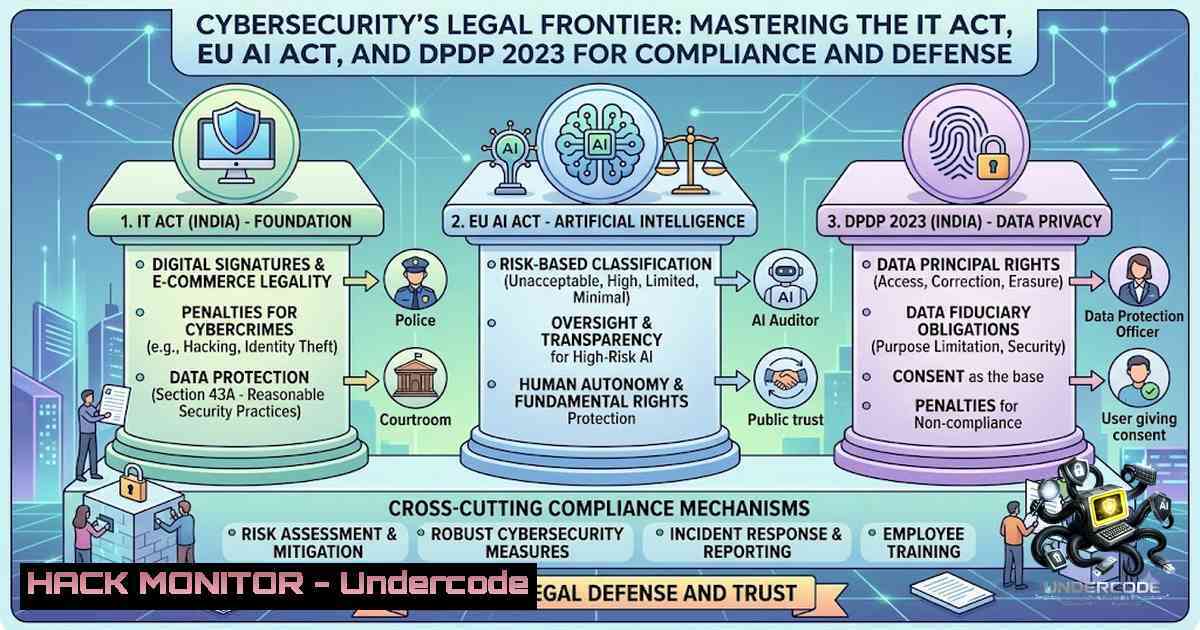
Introduction:
As technology rapidly outpaces traditional legal frameworks, professionals across cybersecurity, IT, and legal domains find themselves at a critical intersection. The digital landscape is no longer just a technical battleground—it is a complex web of regulatory obligations, where understanding the IT Act 2000, the EU AI Act 2024, and India’s Digital Personal Data Protection (DPDP) Act 2023 is as essential as mastering firewalls or encryption. This article provides a technical deep dive into these pivotal regulations, offering actionable insights and practical commands to navigate the evolving world of cyber law, AI governance, and data privacy compliance.
Learning Objectives:
- Understand the key provisions and penalties under India’s Information Technology Act, 2000, including sections related to hacking, data breaches, and ransomware.
- Navigate the risk-based classification and compliance requirements of the EU AI Act, with a focus on technical documentation and logging.
- Implement consent frameworks and data fiduciary duties as mandated by the Digital Personal Data Protection (DPDP) Act, 2023.
You Should Know:
- Cyber Law & Offences: Decoding the IT Act, 2000
The Information Technology Act, 2000, serves as India’s primary legislation for combating cybercrimes, yet it struggles to keep pace with modern threats like AI-enabled frauds and ransomware. For cybersecurity professionals, understanding the technical and legal ramifications of this act is crucial for incident response and digital forensics.
Step‑by‑step guide: Analyzing a Potential Data Breach Under the IT Act
- Step 1: Identify the Offence – Determine if the incident falls under Section 43 (penalty for damage to computer system) or Section 66 (hacking with criminal intent). Section 66 penalizes hacking with imprisonment of up to three years and/or a fine of up to five lakh rupees.
- Step 2: Preserve Digital Evidence – Use forensic tools to create a bit-for-bit copy of affected systems. On Linux, use `dd` to create an image:
sudo dd if=/dev/sda of=/mnt/evidence/disk_image.dd bs=4M status=progress. On Windows, utilize `FTK Imager` to acquire a forensic image. - Step 3: Analyze Logs for Unauthorized Access – Check authentication logs for anomalies. On Linux, review `/var/log/auth.log` or use `last` to see recent logins. Use `grep “Failed password” /var/log/auth.log` to identify brute-force attempts.
- Step 4: Document the Chain of Custody – Maintain a detailed log of who handled the evidence, when, and for what purpose, to ensure admissibility in court under the Indian Evidence Act.
- Step 5: Report to CERT-In – Under the IT Act, certain types of breaches must be reported to the Indian Computer Emergency Response Team (CERT-In) within a specified timeframe. Use their portal to file a complaint.
Jurisdictional challenges further complicate enforcement, as cybercrimes often span multiple countries with conflicting laws. Encryption and anonymization techniques used by attackers (e.g., Tor, VPNs) make attribution difficult, requiring law enforcement to rely on Mutual Legal Assistance Treaties (MLATs) and cross-border digital evidence requests.
2. AI Governance: Implementing the EU AI Act
The EU AI Act (Regulation 2024/1689) is the world’s first comprehensive AI law, classifying AI systems into four risk tiers: unacceptable, high-risk, limited, and minimal. High-risk systems (e.g., those used in critical infrastructure, employment, or law enforcement) face the heaviest compliance obligations, including risk management, data governance, technical documentation, and human oversight.
Step‑by‑step guide: Operationalizing EU AI Act Compliance
- Step 1: Classify Your AI System – Determine your system’s risk tier. Use the EU AI Act Compliance Kit, an open-source toolkit that classifies AI systems via a YAML descriptor. Install it using
pip install eu-ai-act-compliance-kit. - Step 2: Validate and Classify – Create a descriptor file (e.g.,
medical_diagnosis.yaml) and run: `ai-act validate examples/medical_diagnosis.yaml` followed byai-act classify examples/medical_diagnosis.yaml --json. - Step 3: Generate Compliance Checklists – For high-risk systems, generate a detailed checklist of obligations:
ai-act checklist examples/medical_diagnosis.yaml --format md -o checklist.md. - Step 4: Implement Technical Documentation (Art. 11) – Prepare technical documentation BEFORE placing the system on the market. This must be machine-readable and kept up-to-date.
- Step 5: Enable Automatic Logging (Art. 12) – The EU AI Act requires automatic event logging during operation as an active, ongoing record. Implement structured logging in your application (e.g., using Python’s `logging` module with JSON formatter) to capture all significant events, including inputs, outputs, and errors.
- Step 6: Set Up CI/CD Gates – Integrate compliance checks into your pipeline. The EU AI Act Compliance Kit can be used as a pre-push gate: if the system is classified as high-risk and has non-compliant items, the build fails.
- Data Privacy Compliance: Mastering India’s DPDP Act, 2023
The Digital Personal Data Protection Act, 2023, applies to any entity processing digital personal data in India, with no turnover or size exemption. It introduces a notice-and-consent model, requiring data fiduciaries to obtain free, specific, and informed consent from data principals. Non-compliance can result in penalties of up to ₹250 crore per instance.
Step‑by‑step guide: Building a DPDP-Compliant Consent Management System
- Step 1: Map Your Data Flows – Identify all personal data collected, stored, and processed. Document the purpose, storage location, and retention period for each data element.
- Step 2: Implement a Consent Manager – The DPDP Act requires intermediaries (Consent Managers) through which users give, track, and withdraw consent. Design a system that records consent timestamps, purposes, and withdrawal actions.
- Step 3: Draft a Clear Privacy Notice – The notice must be in clear, plain language and specify the purpose of data processing, the data principal’s rights, and the mechanism for grievance redressal.
- Step 4: Enable Consent Withdrawal and Data Erasure – Once consent is withdrawn, the data fiduciary must cease processing and erase personal data unless retention is required by another law. Develop automated scripts to handle data deletion requests.
- Step 5: Conduct a Gap Assessment – Compare your current processes against DPDP requirements. The DPDP Rules, 2025, provide operational details, including breach response timelines (notify the Board and affected individuals within Rule 7 timelines).
- Step 6: Prepare for the Transitional Period – By May 13, 2027, all covered businesses must fully comply with the DPDP Act. Use this time to update privacy policies, train staff, and implement technical controls.
What Undercode Say:
- Key Takeaway 1: The IT Act 2000 is a foundational but aging framework; its provisions on hacking (Section 66) and data breaches (Section 43) remain relevant but are insufficient to address AI-driven threats and sophisticated ransomware attacks. Cybersecurity professionals must integrate legal knowledge into their incident response plans.
- Key Takeaway 2: The EU AI Act shifts compliance from a post-hoc audit to a design requirement. Treating it as an engineering lifecycle framework—with integrated risk management, technical documentation, and logging—is essential for market access.
Analysis: The convergence of law and technology is creating a new breed of professional—one who can speak both “cybersecurity” and “compliance.” The Into Legal World Foundation’s certification course highlights a growing demand for such expertise, particularly as the DPDP Act imposes significant financial penalties and the EU AI Act sets a global standard for AI governance. For IT and security teams, this means moving beyond technical controls to embrace legal and regulatory requirements as core components of system architecture. The ability to draft privacy policies, conduct gap assessments, and implement consent mechanisms is no longer optional—it’s a competitive advantage.
Prediction:
- +1: The DPDP Act will drive a surge in demand for Data Protection Officers (DPOs) and privacy engineers in India, creating a new job market for professionals with combined legal and technical skills.
- +1: The EU AI Act will accelerate the adoption of AI governance toolkits and CI/CD compliance gates, making automated compliance a standard feature in AI development pipelines.
- -1: The jurisdictional challenges in enforcing cyber laws will worsen as cybercriminals exploit fragmented international legal frameworks, leading to an increase in untraceable cross-border attacks.
- -1: Organizations that delay DPDP compliance face not only hefty fines but also reputational damage, as data breaches become public and erode consumer trust.
▶️ Related Video (74% Match):
🎯Let’s Practice For Free:
🎓 Live Courses & Certifications:
Join Undercode Academy for Verified Certifications
🚀 Request a Custom Project:
Secure, high-velocity infrastructure and disruptive technological engineering. Contact our engineering team for high-tier development and proprietary systems:
[email protected]
💎 Smart Architecture | 🛡️ Secure by Design | ⭐ Trusted by Thousands
IT/Security Reporter URL:
Reported By: https://lnkd.in/p/e4mHcKH4 – Hackers Feeds
Extra Hub: Undercode MoN
Basic Verification: Pass ✅


