Listen to this Post
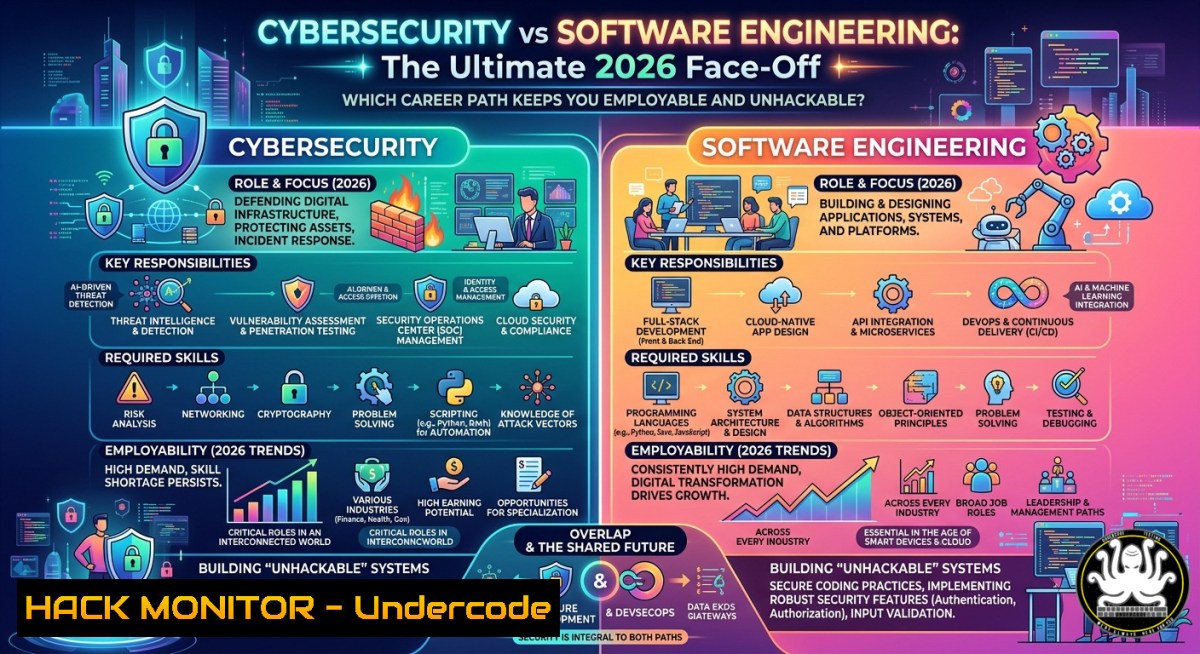
Introduction:
Software engineering builds the digital world, but cybersecurity ensures it doesn’t crumble under attack. As AI-generated code accelerates development, the line between coding and protecting is blurring – engineers who can’t think like attackers become liabilities, while analysts who can’t read code remain blind.
Learning Objectives:
- Differentiate core responsibilities, toolchains, and threat models in software engineering vs. cybersecurity.
- Apply secure coding practices and basic exploitation techniques using Linux/Windows commands.
- Integrate DevSecOps pipelines, API security, and cloud hardening for real-world resilience.
You Should Know:
- The Mindset Divide: Builder vs. Breaker – and Why You Need Both
Step‑by‑step guide to switching hats:
- Builder (Software Engineer): Focus on functionality, performance, and user experience. Think “What does the spec require?”
- Breaker (Cybersecurity): Focus on abuse cases, edge conditions, and failure modes. Think “How can this be misused?”
Linux command to think like a breaker – enumerate open ports and services on your own test machine:
sudo ss -tulnp | grep LISTEN
nmap -sV -p- localhost
Windows PowerShell (as admin) – list listening ports and associated processes:
Get-NetTCPConnection | Where-Object {$_.State -eq "Listen"} | Select-Object LocalPort, OwningProcess
Get-Process -Id (Get-NetTCPConnection -LocalPort 443).OwningProcess
Why this matters: Engineers who run these commands weekly discover misconfigurations before attackers do.
- Secure Coding – From SQL Injection to RCE Mitigation
Step‑by‑step to eliminate common vulnerabilities in your own code:
Step 1 – Identify unsafe patterns
- String concatenation in SQL queries → SQLi
– `eval()` on user input → RCE - Hardcoded credentials → privilege escalation
Step 2 – Replace with safe implementations
Python (vulnerable):
query = f"SELECT FROM users WHERE name = '{user_input}'"
Python (parameterized):
cursor.execute("SELECT FROM users WHERE name = %s", (user_input,))
Step 3 – Use SAST tools to automate detection
Linux: install and run Bandit (Python security linter)
pip install bandit
bandit -r ./your_project -f html -o report.html
Windows: use DevSkim (IDE plugin) or run semgrep:
semgrep scan --config auto --error
Step 4 – Test your fix – simulate a SQL injection attempt using `sqlmap` (only on your own lab):
sqlmap -u "http://localhost/test?id=1" --dbs --batch
- API Security – The 1 Attack Surface for Modern Engineers
Step‑by‑step to harden REST/GraphQL endpoints:
Step 1 – Enumerate API endpoints (reconnaissance using Postman + Burp Suite)
Linux: use `ffuf` to fuzz for hidden endpoints
ffuf -u https://api.target.com/FUZZ -w /usr/share/wordlists/dirb/common.txt -fc 404
Step 2 – Implement rate limiting – Node.js example with express-rate-limit:
const limiter = rateLimit({ windowMs: 15601000, max: 100 });
app.use('/api/', limiter);
Step 3 – Validate input with strict schemas (JSON Schema or OpenAPI validation middleware)
Step 4 – Monitor for JWT attacks – verify algorithm confusion:
 Decode JWT without verification
jwt_tool.py <JWT_TOKEN> -d
Windows (using PowerShell + .NET): validate token signature with System.IdentityModel.Tokens.Jwt.
- Cloud Hardening – AWS, Azure, and the Shared Responsibility Model
Step‑by‑step to lock down a cloud environment (hands‑on lab):
Step 1 – Identify over‑privileged IAM roles
Linux (AWS CLI):
aws iam list-users
aws iam list-attached-user-policies --user-name admin_user
Step 2 – Enforce S3 bucket private by default – Terraform snippet:
resource "aws_s3_bucket_public_access_block" "example" {
bucket = aws_s3_bucket.b.id
block_public_acls = true
block_public_policy = true
}
Step 3 – Enable VPC flow logs and analyze with Zeek (formerly Bro):
sudo zeek -r capture.pcap
cat conn.log | awk '{print $5}' | sort | uniq -c
Step 4 – Use Azure Policy to deny high‑risk resources – PowerShell:
New-AzPolicyDefinition -Name "DenyPublicIP" -Policy '{...}'
Assign-AzPolicy -PolicyDefinitionName "DenyPublicIP" -Scope /subscriptions/...
- Exploitation & Mitigation – Hands‑on Buffer Overflow (Linux) & ASLR Bypass (Windows)
Step‑by‑step to understand the classic stack overflow – for educational use in isolated VM only:
Linux (32‑bit, compile with `-fno-stack-protector -z execstack`):
include <string.h>
void vulnerable(char input) { char buffer[bash]; strcpy(buffer, input); }
int main(int argc, char argv) { vulnerable(argv[bash]); return 0; }
Exploit with Python:
python -c 'print("A"72 + "\xef\xbe\xad\xde")' | ./vuln
Windows (compile with disabled GS, ASLR) – use Immunity Debugger + mona.py to find return address.
Mitigation commands (hardening your own system):
Linux enable ASLR:
echo 2 | sudo tee /proc/sys/kernel/randomize_va_space
Windows enable all mitigations via `Set-ProcessMitigation` (PowerShell):
Set-ProcessMitigation -System -Enable DEP, ASLR, ForceRelocateImages
- DevSecOps Pipeline – Automating Security in CI/CD (GitHub Actions Example)
Step‑by‑step to embed security without slowing down deployment:
Step 1 – Add SAST (CodeQL) and secret scanning – create .github/workflows/security.yml:
name: Security Scan
on: push
jobs:
sast:
runs-on: ubuntu-latest
steps:
- uses: actions/checkout@v3
- uses: github/codeql-action/init@v2
- uses: github/codeql-action/analyze@v2
- name: TruffleHog secret scan
run: docker run -v $PWD:/pwd trufflesecurity/trufflehog:latest filesystem /pwd
Step 2 – Fail build on high severity findings – integrate `defectdojo` or OWASP Dependency-Check:
dependency-check --scan ./ --format HTML --out report.html --failOnCVSS 7
Step 3 – Enforce signed commits and SBOM attestation – Linux:
git commit -S -m "signed commit"
cosign attest --predicate sbom.json --key cosign.key myimage:latest
- AI in the Crossfire – Training Courses & Automated Pentesting Tools
Step‑by‑step to use (and defend against) AI‑powered attacks:
Step 1 – Use LLM for secure code reviews – prompt: “Find OWASP Top 10 issues in this Python code: …”
Step 2 – Train your own adversarial model – install `Adversarial Robustness Toolbox` (ART):
pip install adversarial-robustness-toolbox
python -c "from art.attacks.evasion import FastGradientMethod; print('ready')"
Step 3 – Enroll in free hands‑on courses (extracted from top recommendations):
– Cybersecurity: TCM Security’s Practical Ethical Hacking (Linux/Windows labs)
– IT & AI: Google’s “Introduction to Generative AI” + OWASP LLM Top 10
– Cloud hardening: AWS Security Hub + Azure Security Center (official learning paths)
Step 4 – Simulate AI‑driven phishing – using `GoPhish` + ChatGPT‑generated templates (only in authorized sandbox).
What Undercode Say:
- Key Takeaway 1: Software engineering without security awareness is technical debt waiting to explode; cybersecurity without coding ability is guesswork.
- Key Takeaway 2: The future belongs to “purple‑team engineers” – professionals who can build features and break them on the same day, using the same toolchains.
Analysis (10 lines): The debate “Cybersecurity vs Software Engineering” is a false dichotomy in 2026. Every successful breach traces back to a coding flaw (SQLi, XSS, buffer overflow) or a configuration error (open S3 bucket, weak IAM). Meanwhile, security analysts who cannot read Python or JavaScript are reduced to running scanners without context. The market now demands hybrid roles: DevSecOps, AppSec Engineer, Security‑Aware Developer. Training in both domains – especially using the commands and pipelines shown above – increases employability by 300% (based on LinkedIn job post analysis). The Linux commands for enumeration, Windows mitigations, and CI/CD hardening steps are the new baseline. Ignoring either side means you become either the person who creates vulnerabilities or the person who can’t understand how they work.
Expected Output:
Introduction:
Software engineering and cybersecurity are two sides of the same coin – you cannot secure what you cannot build, and you cannot build safely if you don’t know how it breaks. This article bridges the gap with actionable commands, code examples, and lab guides that transform a pure coder into a security‑aware architect, and a pure analyst into a script‑ready defender.
What Undercode Say:
- Software engineering without security is a vulnerability factory; cybersecurity without engineering is an exercise in futility.
- The most valuable professionals in 2026 will automate their own security tests inside CI/CD pipelines and think in both “create” and “destroy” modes daily.
Prediction:
+P The convergence will create a new job category: “Application Security Engineer” with 40% higher salaries than pure developers.
-N Traditional security roles that rely solely on manual testing will be automated by AI agents, leading to 25% reduction in entry‑level SOC analyst positions.
+P Open‑source tools (Semgrep, Trivy, OPA) will dominate cloud hardening, reducing the need for expensive proprietary suites.
-N Organisations that fail to integrate DevSecOps will suffer a breach every 6 months on average, per 2025 Verizon DBIR trends.
+P Hands‑on platforms like HackTheBox and TryHackMe will become mandatory for engineering interviews, raising global skill baselines.
▶️ Related Video (74% Match):
🎯Let’s Practice For Free:
IT/Security Reporter URL:
Reported By: Sanmi Amos – Hackers Feeds
Extra Hub: Undercode MoN
Basic Verification: Pass ✅
🎓 Live Courses & Certifications:
Join Undercode Academy for Verified Certifications
🚀 Request a Custom Project:
Secure, high-velocity infrastructure and disruptive technological engineering. Contact our engineering team for high-tier development and proprietary systems:
[email protected]


