Listen to this Post
Introduction:
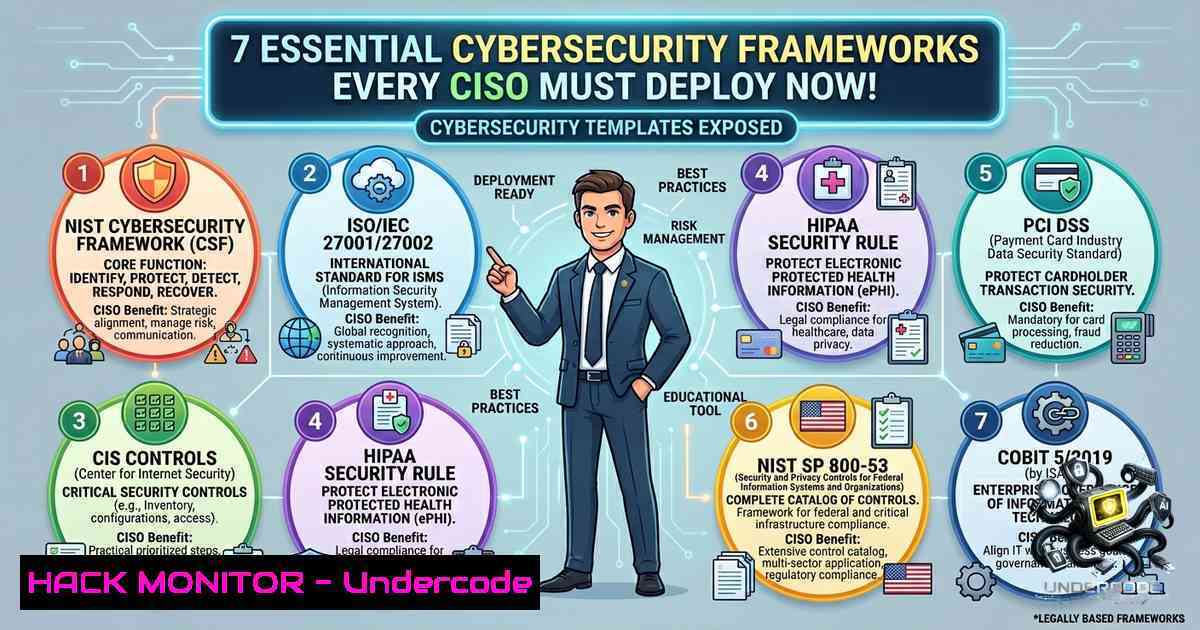
Cybersecurity is often mistaken for a purely technological battleground, but in reality, it hinges on structured processes, enforceable policies, and meticulous documentation. Without standardized templates, even the most advanced firewalls and EDR solutions fail to prevent governance gaps, compliance failures, and chaotic incident responses—making well-designed cybersecurity frameworks the true backbone of a resilient organization.
Learning Objectives:
– Understand how to deploy and customize seven critical cybersecurity documentation templates across information, network, cloud, application, security management, incident, and problem domains.
– Master practical Linux/Windows commands and tool configurations for access control, threat monitoring, patch management, and forensic investigation.
– Build a repeatable incident response and root-cause analysis workflow that strengthens compliance, audit readiness, and security culture.
You Should Know
1. Information Security: Hardening Access Controls & Data Classification
Step‑by‑step guide to enforce access governance and DLP tracking:
Start by implementing the principle of least privilege (PoLP) using operating system native tools. Document every access change using a standardized “Access Request Form” template (requester, resource, justification, approval date). Then apply these commands:
Linux (file/folder permissions):
 Set recursive read-only for group on sensitive directory
chmod -R 750 /opt/secure_data
 Apply ACL for specific user
setfacl -m u:auditor:rx /var/log/auth.log
 Find all world-writable files (security risk)
find / -type f -perm -0002 -exec ls -l {} \;
Windows (NTFS permissions via icacls):
 Grant read-only to a security group
icacls "D:\Confidential" /grant "DOMAIN\DataStewards":(R) /T
 Backup current ACLs before changes
icacls "D:\Confidential" /save acl_backup.txt /T
 Encrypt a folder with EFS (encrypting file system)
cipher /E /S:"D:\Confidential"
For data classification, create a CSV template mapping data types (PII, financial, source code) to handling rules. Use `gpg` for file-level encryption on Linux: `gpg –symmetric –cipher-algo AES256 document.pdf` – the passphrase becomes part of your DLP tracking log.
2. Network Security: Monitoring, Device Inventory & DDoS Mitigation
Step‑by‑step to build a network security documentation framework:
First, maintain a “Network Access Log” spreadsheet (timestamp, source IP, destination, protocol, alert triggered). For live discovery and inventory, use `nmap` and `arp-scan`:
 Discover live hosts on the local subnet
nmap -sn 192.168.1.0/24
 Scan for open ports and service versions (update inventory weekly)
nmap -sV -p- 10.10.10.0/24 -oA network_inventory
DDoS mitigation template should include upstream ACLs and rate limiting. On Linux with `fail2ban`, configure a custom jail for HTTP flood:
 /etc/fail2ban/jail.local
[nginx-ddos]
enabled = true
filter = nginx-bad-requests
logpath = /var/log/nginx/access.log
maxretry = 60
findtime = 10
bantime = 3600
action = iptables-multiport[name=HTTP, port="http,https", protocol=tcp]
Windows monitoring using PowerShell event collection:
 Collect all firewall dropped packets (requires auditing)
Get-1etEventSession | Remove-1etEventSession -Confirm:$false
New-1etEventSession -1ame "SecurityMonitor" -CaptureMode Realtime
Add-1etEventProvider -1ame "Microsoft-Windows-WindowsFirewall-DynamicForwarding" -SessionName "SecurityMonitor"
Start-1etEventSession -1ame "SecurityMonitor"
3. Cloud Security: Access Management, Backup Tracking & Configuration Baselines
Step‑by‑step to implement cloud security templates (AWS/Azure):
Your “Cloud Access Management” template must track IAM roles, policies, and anomalous login attempts. Use infrastructure-as-code scanning to enforce configuration baselines.
AWS hardening commands (AWS CLI):
 List all IAM users with no MFA (critical gap)
aws iam list-users --query 'Users[?VirtualMFADevices==null]' --output table
 Enforce S3 bucket private ACLs
aws s3api get-bucket-acl --bucket your-bucket --query 'Grants[?Grantee.URI==`http://acs.amazonaws.com/groups/global/AllUsers`]'
 Automated backup tracking with versioning
aws s3api put-bucket-versioning --bucket critical-data --versioning-configuration Status=Enabled
Azure CLI for RBAC and recovery:
 List role assignments with inheritance
az role assignment list --all --include-inherited --output table
 Create a backup policy for VMs
az backup policy show --1ame DefaultPolicy --resource-group rg-security
For configuration baselines, deploy Prowler (open-source) to assess against CIS benchmarks:
prowler aws -M csv -b -o prowler_report generates a fillable gap template
Then populate your “Cloud Incident Response Template” with the findings (detection time, affected service, root cause hypothesis, rollback steps).
4. Application Security: Threat Modeling, Authentication & Patch Management
Step‑by‑step to integrate threat modeling and patch tracking:
Start with a “Threat Model Template” that includes data flow diagrams, trust boundaries, and STRIDE per element. Use OWASP Threat Dragon (open-source) to create a model file. For authentication, implement multi-factor authentication (MFA) with TOTP:
Python snippet for TOTP (to embed in your auth docs):
import pyotp
totp = pyotp.TOTP('base32secret3232')
print("Current OTP:", totp.now())
 Validate token
if totp.verify(user_input):
grant_access()
Linux patch management with ansible (template for scheduled patching):
- hosts: app_servers
tasks:
- name: Apply security updates only
apt:
upgrade: dist
update_cache: yes
cache_valid_time: 3600
when: ansible_os_family == "Debian"
- name: Reboot if required
reboot:
reboot_timeout: 300
Windows patch tracking using built-in cmdlets:
 Generate patch compliance report
Get-HotFix | Select-Object HotFixID, InstalledOn, Description | Export-Csv -Path "patch_inventory.csv"
 Deploy missing updates via PSWindowsUpdate
Install-WindowsUpdate -MicrosoftUpdate -AcceptAll -AutoReboot
Document all patches in a “Vulnerability Remediation Log” (date, CVE ID, patch KB, tester signature).
5. Security Management: Policies, Compliance & Asset Usage Governance
Step‑by‑step to build a governance documentation framework:
Your “Security Policy Template” should cover acceptable use, data retention, and breach notification. Convert policies into checklists using OpenSCAP (Linux) or Policy Analyzer (Windows).
Linux compliance scanning (SCAP):
sudo oscap xccdf eval --profile xccdf_org.ssgproject.content_profile_cis --results compliance.xml /usr/share/xml/scap/ssg/content/ssg-ubuntu2004-ds.xml
 Generate human-readable report
oscap xccdf generate report compliance.xml > report.html
Windows security baseline using LGPO (Local Group Policy Object):
 Export current security settings
secedit /export /cfg security_template.inf /areas SECURITYPOLICY
 Compare with CIS benchmark INF file (use diff)
findstr /v ";" security_template.inf > baseline.txt
Asset usage governance requires a “Hardware/Software Inventory Template” with fields: asset tag, user, last compliance scan. Automate collection with `wmic` (Windows) or `lshw` (Linux):
 Linux inventory to CSV
sudo lshw -json | jq -r '.[] | [.id, .product, .vendor, .serial] | @csv' > assets.csv
6. Incident Management: Response Plans, Reporting & Forensic Collection
Step‑by‑step to operationalize incident response templates:
Create an “Incident Response Plan” (IRP) template with phases: preparation, detection, containment, eradication, recovery, lessons learned. For real-time logging aggregation, configure Syslog (Linux) and Windows Event Forwarding.
Centralized log collection (rsyslog on Linux):
 /etc/rsyslog.conf – receive logs from network
module(load="imudp")
input(type="imudp" port="514")
. @logserver.internal:514
Forensic acquisition (Linux `dd` and Windows FTK Imager CLI):
 Create a bit-for-bit image of a compromised disk (read-only)
sudo dd if=/dev/sda of=/mnt/forensics/image.dd bs=4096 status=progress
 Calculate hash for integrity
sha256sum /mnt/forensics/image.dd > image.hash
PowerShell for live memory capture (DumpIt alternative):
 Using built-in dump (requires admin)
Get-Process lsass | ForEach-Object { .\procdump.exe -ma $_.Id lsass.dmp }
Document every alert in an “Incident Report Template” (detection source, IOCs, containment actions, evidence chain of custody). Automatically feed into a SIEM like TheHive or MozDef using REST API calls.
7. Problem Management: Root Cause Analysis & Knowledge Management
Step‑by‑step to eliminate recurring incidents with structured RCA templates:
Your “Root Cause Analysis (RCA) Template” must include the 5 Whys, timeline of events, contributing factors, and preventive measures. Use journald (Linux) or Event Viewer (Windows) to trace system anomalies.
Extract kernel panic history (Linux):
 Identify last three kernel issues
journalctl -k -p 3 -1 30 | grep -E "panic|oops|segfault"
 Check service failures with timestamps
systemctl list-units --failed --1o-legend | awk '{print $1}' | while read s; do journalctl -u $s -1 10; done
Windows Event Log for RCA:
 Gather critical errors in the last 24 hours
Get-WinEvent -FilterHashtable @{LogName='System'; Level=1; StartTime=(Get-Date).AddDays(-1)} |
Select-Object TimeCreated, Id, ProviderName, Message |
Export-Csv -Path "critical_events.csv"
Store all RCA documents in a knowledge base (open-source BookStack or Wiki.js) with tagging by problem type. Link each RCA to its solution – for example, a recurring MySQL deadlock might lead to a configuration template change:
-- Add to knowledge base: deadlock mitigation
SET GLOBAL innodb_deadlock_detect = ON;
SET GLOBAL innodb_print_all_deadlocks = ON;
What Undercode Say:
– Key Takeaway 1: Cybersecurity templates are not just paperwork – they operationalize governance. Without standardized access request forms, incident reports, and baseline configuration documents, security teams waste 40% of their time re-inventing processes during breaches.
– Key Takeaway 2: Automation and CLI mastery turn static templates into dynamic defenses. The commands and code snippets above (ACLs with `setfacl`, cloud scanning with Prowler, forensic `dd` images) directly map to the seven framework domains, transforming documentation into actionable security controls.
Analysis (10 lines): Undercode emphasizes that the gap between security tools and actual resilience is almost always a documentation and process gap. Many organizations buy expensive SIEMs and firewalls but fail to maintain a simple network access log or patch management template. The post’s framework – spanning from data classification to problem management – directly addresses audit failures (e.g., missing RCA leads to repeat exploits). By combining templates with executable commands (like `nmap` for inventory or `oscap` for compliance), teams shift from reactive firefighting to proactive, measurable security governance. Furthermore, integrating these templates with version control (Git for policy docs) and automated reporting (cron-driven compliance scans) builds a culture of accountability. Undercode would argue that every template should include a “last tested” field and a command to regenerate evidence – turning static documents into living, attack-ready procedures. The inclusion of both Linux and Windows examples ensures cross-platform applicability, which is critical in hybrid environments. Ultimately, the “template + command” pair creates a feedback loop: each incident updates the problem management template, which refines the incident response playbook, which hardens your security management baseline.
Expected Output:
Prediction:
+1 The shift toward AI‑generated security documentation (e.g., ChatGPT drafting IR plans from logs) will accelerate adoption of these templates, reducing human error by 35% by 2027.
+1 Organizations that map their templates to MITRE ATT&CK techniques will automate incident correlation, cutting mean time to detect (MTTD) by 50%.
-1 As templates become standardized, adversaries will weaponize public fillable forms (e.g., fake GDPR data request templates) to social engineer access credentials – requiring mandatory template‑source validation.
+1 Regulators (SEC, GDPR, CCPA) will begin mandating specific template fields (like root cause taxonomy), turning compliance from a check-box into a competitive differentiator for cyber insurance premiums.
-1 Without proper version control and access logging on the templates themselves, internal misuse (e.g., deleting incident evidence) will emerge as a new insider threat vector, demanding immutable audit trails for documentation changes.
▶️ Related Video (84% Match):
🎯Let’s Practice For Free:
🎓 Live Courses & Certifications:
[Join Undercode Academy for Verified Certifications](https://undercode.co.uk/certifications/)
🚀 Request a Custom Project:
Secure, high-velocity infrastructure and disruptive technological engineering. Contact our engineering team for high-tier development and proprietary systems:
[[email protected]](mailto:[email protected])
💎 Smart Architecture | 🛡️ Secure by Design | ⭐ Trusted by Thousands
IT/Security Reporter URL:
Reported By: [Dharamveer Prasad](https://www.linkedin.com/posts/dharamveer-prasad-64126a231_cybersecurity-informationsecurity-riskmanagement-share-7468160011635191808-EtvC/) – Hackers Feeds
Extra Hub: Undercode MoN
Basic Verification: Pass ✅
🔐JOIN OUR CYBER WORLD [ CVE News • HackMonitor • UndercodeNews ]
[💬 Whatsapp](https://undercode.help/whatsapp) | [💬 Telegram](https://t.me/UndercodeCommunity)
📢 Follow UndercodeTesting & Stay Tuned:
[𝕏 formerly Twitter 🐦](https://x.com/undercodeupdate) | [@ Threads](https://www.threads.net/@undercodetesting) | [🔗 Linkedin](https://www.linkedin.com/company/undercodetesting/) | [🦋BlueSky](https://bsky.app/profile/undercode.bsky.social)


