
Listen to this Post
Introduction:
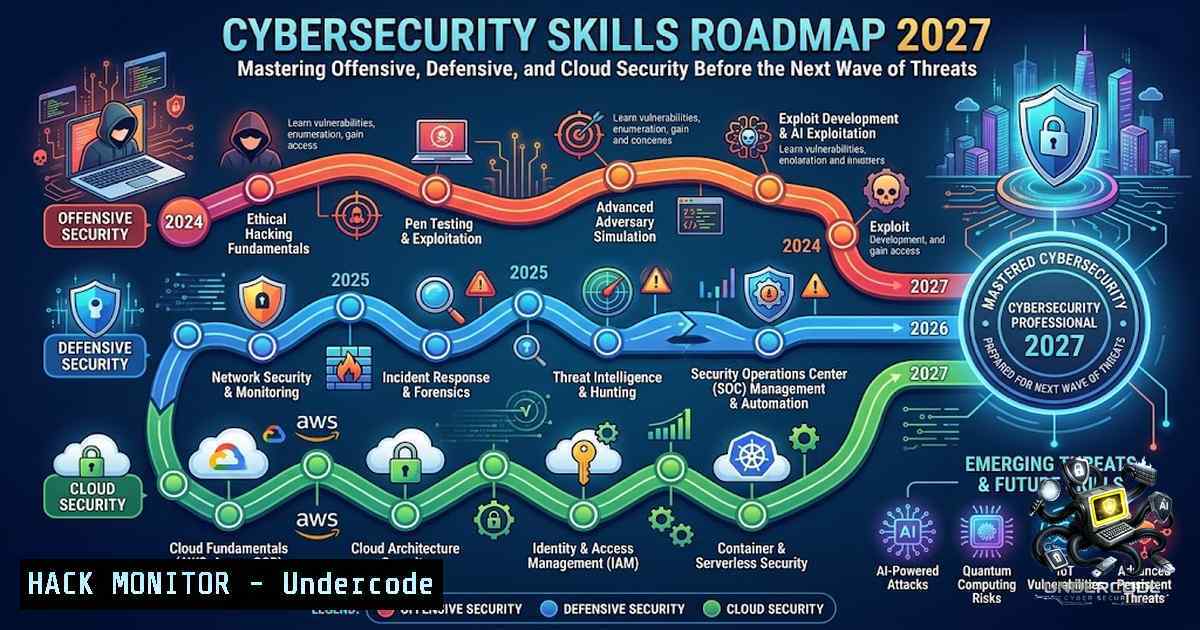
The cybersecurity landscape is evolving at an unprecedented pace, driven by the proliferation of AI-powered attacks, cloud-1ative infrastructures, and sophisticated ransomware syndicates. For professionals aiming to remain relevant through 2027, a hybrid skillset spanning offensive exploitation, defensive monitoring, and cloud hardening is no longer optional—it is mandatory. This roadmap distills the essential technical competencies, from foundational networking to advanced threat intelligence, providing a structured pathway to master the tools and tactics that will define the next generation of digital defense.
Learning Objectives & Secrets:
- Objective 1: Build a Robust Foundation in Networking & System Architecture. Master the TCP/IP stack, OSI model, subnetting, and routing protocols. Secret Tip: Go beyond theory by analyzing live packet captures in Wireshark to identify anomalous traffic patterns, such as DNS tunneling or ARP spoofing, to bridge the gap between textbook knowledge and real-world detection.
- Objective 2: Master Offensive Tradecraft with Modern Exploitation Frameworks. Gain proficiency in Metasploit, Burp Suite, and custom exploit development. Secret Tip: Focus on “living off the land” (LOTL) techniques using native Windows/Linux binaries (e.g.,
powershell,wmic,curl) to evade endpoint detection and response (EDR) solutions, simulating sophisticated adversary behavior. - Objective 3: Operationalize Defensive Security with SIEM and Threat Hunting. Deploy and manage SIEM solutions (Splunk, Elastic) to correlate logs across hybrid environments. Secret Tip: Develop “hypothesis-driven hunting” by leveraging MITRE ATT&CK mappings to proactively search for TTPs (Tactics, Techniques, and Procedures), specifically focusing on credential dumping (T1003) and lateral movement (T1021) anomalies.
You Should Know:
- Windows & Linux System Hardening and Command-Line Mastery
System hardening remains the bedrock of infrastructure security. For Windows environments, implementing the Local Group Policy Object (GPO) to restrict PowerShell script execution and enable Windows Defender Application Control (WDAC) is critical. For Linux, configuring AppArmor or SELinux policies and disabling root SSH login are non-1egotiable baselines.
Step‑by‑Step: Windows Security Configuration (PowerShell as Administrator)
- Disable SMBv1: `Set-SmbServerConfiguration -EnableSMB1Protocol $false -Force` – Mitigates legacy ransomware propagation vectors.
- Enable LSA Protection: `Set-ItemProperty -Path “HKLM:\SYSTEM\CurrentControlSet\Control\Lsa” -1ame “RunAsPPL” -Value 1` – Prevents credential dumping via Mimikatz.
- Linux Hardening (Bash): `sudo ufw enable` – Enables Uncomplicated Firewall; `sudo chmod 600 /etc/ssh/ssh_host__key` – Restricts private key permissions; `sudo systemctl disable rsh` – Disables obsolete remote shells.
- Offensive Web Application Security: Exploiting OWASP Top 10 Vulnerabilities
The 2027 threat landscape will emphasize API abuse and GraphQL injection. Understanding SQL Injection (SQLi), Cross-Site Scripting (XSS), and Insecure Direct Object References (IDOR) remains paramount. Automation via Burp Suite’s Intruder and custom Python scripts is essential for large-scale assessments.
Step‑by‑Step: Exploiting SQLi with `sqlmap` (Kali Linux)
- Intercept Request: Capture the target HTTP request (e.g.,
GET /product?id=1) using Burp Suite. - Test Payload: `sqlmap -u “http://target.com/product?id=1” –dbs` – Enumerate databases.
- Extract Data: `sqlmap -u “http://target.com/product?id=1” -D customers –tables` – Dump credentials.
- Mitigation: Validate stored procedures, implement parameterized queries, and enforce WAF rules (e.g., ModSecurity) to block SQLi patterns.
3. Defensive Security: SIEM Deployment and Log Analysis
Effective security operations demand centralized log aggregation. Splunk or the ELK Stack (Elasticsearch, Logstash, Kibana) must be configured to ingest Windows Event Logs (Security, System, Application), Linux syslog, and cloud audit logs (AWS CloudTrail). Tuning correlation rules reduces false positives.
Step‑by‑Step: Setting Up ELK Stack for Threat Detection (Ubuntu 22.04)
– Install Elasticsearch: wget -qO - https://artifacts.elastic.co/GPG-KEY-elasticsearch | sudo apt-key add -; sudo apt-get install elasticsearch.
– Enable Filebeat: `sudo filebeat modules enable system` – Activates system log parsing.
– Create Detection Rule (KQL): `event.code: 4624 AND winlog.event_data.LogonType: 3 AND NOT user.name: SYSTEM` – Alerts on suspicious network logons.
– Visualize: Create Dashboards in Kibana for geographic IP mapping and anomaly detection.
4. Cloud Security and Misconfiguration Exploitation
By 2027, misconfigured S3 buckets and overly permissive IAM roles will remain primary attack vectors. Security engineers must audit cloud environments for public exposure, insecure storage, and excessive permissions. Tools like `ScoutSuite` and `Prowler` automate these audits.
Step‑by‑Step: Auditing AWS Security Using AWS CLI & Prowler
– Install Prowler: pip install prowler.
– Run Assessment: `prowler aws -M csv` – Generates a compliance report.
– Manual Check (CLI): `aws s3 ls s3://[bucket-1ame] –1o-sign-request` – Checks for public listability.
– Revoke Access: `aws s3api put-bucket-acl –bucket [bucket-1ame] –acl private` – Enforces private ACL.
– IAM Hardening: Enforce MFA for root user; implement least-privilege IAM policies.
5. Threat Intelligence Integration and MITRE ATT&CK Mapping
Modern SOCs leverage threat intelligence feeds (e.g., MISP, AlienVault OTX) to enrich alerts. Understanding the MITRE ATT&CK matrix allows analysts to map detected behavior to adversary TTPs, facilitating proactive defense.
Step‑by‑Step: Integrating MISP with Splunk (Python Script)
- Fetch IoCs: Use MISP API to retrieve latest indicators.
- Ingest into Splunk: Convert JSON to CIM-compliant format using the Splunk HTTP Event Collector (HEC).
- Example Python Snippet:
import requests url = "https://misp.local/attributes/restSearch" headers = {"Authorization": "YOUR_API_KEY"} response = requests.get(url, headers=headers) for attr in response.json()['response']['Attribute']: if attr['type'] == 'ip-src': print(f"Block IP: {attr['value']}") - Automate Blocks: Trigger firewall rules (e.g.,
iptables -A INPUT -s [bash] -j DROP) via custom scripts.
What Undercode Say:
- Key Takeaway 1: The 2027 cybersecurity professional must transcend tool-specific knowledge to master the “process” of security—understanding the lifecycle of an attack from reconnaissance to data exfiltration.
- Key Takeaway 2: Automation is the force multiplier. Analysts who proficiently script their detection and response pipelines (using Python, Bash, or PowerShell) will outperform peers who rely solely on GUI interfaces.
Analysis: The roadmap accurately identifies the dual necessity of offensive and defensive skills. However, it underemphasizes the rising importance of AI security—specifically, the defensive measures against prompt injection and model inversion attacks in generative AI systems. As organizations rapidly adopt LLMs, securing the AI supply chain (including vector databases and inference APIs) will likely emerge as a distinct career track. The emphasis on “continuous learning” is prudent, but professionals should also focus on “certifiable” vendor-specific knowledge (AWS Security Specialty, CISSP) to validate their skills in the job market. The inclusion of hard skills (networking, scripting) alongside soft skills (communication, reporting) is critical, as technical findings are useless without effective executive communication.
Prediction:
- +1: The rise of XDR (Extended Detection and Response) platforms will unify siloed security tools, reducing alert fatigue and accelerating Mean Time to Respond (MTTR).
- -1: The proliferation of “AI-powered” security products will paradoxically increase the attack surface, introducing vulnerabilities in API integrations and automated decision-making processes.
- +1: Generative AI will become a primary tool for red teams, enabling rapid creation of polymorphic malware and sophisticated phishing lures, forcing blue teams to adapt to AI-vs-AI warfare.
- -1: The cybersecurity skills gap will widen as entry-level roles are automated, demanding mid-level proficiency in DevSecOps and cloud-1ative architectures.
- +1: Compliance frameworks (PCI-DSS v4.0, GDPR) will tighten requirements for encryption and breach disclosure, boosting demand for security consultants and auditors.
- -1: The cost of cybersecurity insurance will skyrocket for organizations lacking robust MFA and Zero Trust architectures, financially penalizing outdated practices.
- +1: Quantum-resistant cryptography standards (post-quantum algorithms) will begin to emerge in enterprise environments, creating a new niche for cryptography engineers.
- -1: State-sponsored attacks will increasingly target critical infrastructure (energy, healthcare), necessitating specialized ICS/OT security training beyond traditional IT.
▶️ Related Video (76% Match):
🎯Let’s Practice For Free:
🎓 Live Courses & Certifications:
Join Undercode Academy for Verified Certifications
🚀 Request a Custom Project:
Secure, high-velocity infrastructure and disruptive technological engineering. Contact our engineering team for high-tier development and proprietary systems:
[email protected]
💎 Smart Architecture | 🛡️ Secure by Design | ⭐ Trusted by Thousands
IT/Security Reporter URL:
Reported By: https://lnkd.in/p/eAJs3jvj – Hackers Feeds
Extra Hub: Undercode MoN
Basic Verification: Pass ✅


