Listen to this Post
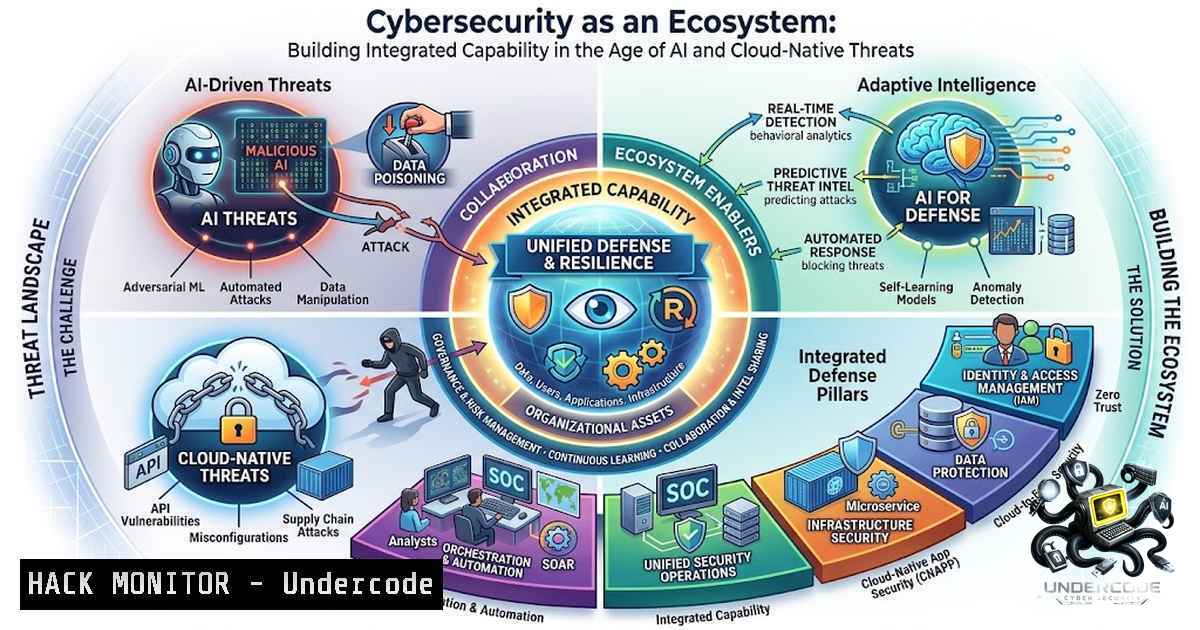
Introduction:
The cybersecurity profession has evolved far beyond the traditional boundaries of penetration testing and antivirus deployment. In 2026, the field has transformed into a complex ecosystem spanning offensive security, defensive operations, cloud infrastructure, AI security, threat intelligence, and DevSecOps automation. With a global talent gap of 3.4 million unfilled positions and 87% of organizations reporting AI-driven cyberattacks in the past year, professionals who can operate across multiple domains are no longer a luxury—they are a necessity.
Learning Objectives:
- Understand the comprehensive cybersecurity ecosystem and its interconnected domains, from Red Teaming to Blue Teaming to Cloud Security
- Master essential security tools and their practical applications across offensive, defensive, and cloud-1ative environments
- Develop a strategic approach to building hands-on capability through labs, projects, and certification pathways that prioritize practical skill over theoretical knowledge
You Should Know:
1. The Cybersecurity Ecosystem: Beyond Silos
The modern security landscape demands exposure across multiple disciplines. Traditional penetration testing now coexists with AI security engineering, cloud-1ative defense, and automated DevSecOps pipelines. The broad split between offensive (red team) and defensive (blue team) operations forms the foundation, but cloud and AI security have grown fast enough to become their own disciplines.
Defensive operations—SOC analysts, threat hunters, and incident responders—represent the largest hiring volume. Offensive security—penetration testers, red team operators, and application security engineers—offers higher salary uplift and strong career portability. Cloud and DevSecOps is the fastest-growing track in 2026, with cloud security engineers earning upwards of $165,000 in the US market.
The demand is shifting from talent shortages to a capability gap. Organizations are hiring engineers who can think adversarially, work across cloud and infrastructure, and embed security into platforms from the ground up. This requires a different approach to both career development and skill acquisition—one that prioritizes hands-on capability over certification collection.
2. Building Practical Capability with Essential Tools
Tools such as Nmap, Wireshark, Burp Suite, Metasploit, and Kali Linux remain foundational. However, practical knowledge requires understanding what these tools actually do—not just memorizing commands. For example, mastering Nmap means understanding the packets it sends, how it interprets silence, and what it can reveal about network behavior.
Step‑by‑step guide: Setting up a Kali Linux penetration testing lab
- Install Kali Linux in a virtual environment using VirtualBox or VMware. Allocate at least 4GB RAM and 40GB storage.
-
Configure network settings to use NAT or host-only networking for isolated testing.
-
Update the system: `sudo apt update && sudo apt full-upgrade -y`
4. Install essential tools if not already present:
sudo apt install nmap wireshark burpsuite metasploit-framework -y
5. Perform network reconnaissance with Nmap:
nmap -sV -sC -O -A <target-IP>
This performs version detection, default scripts, OS detection, and aggressive scanning.
- Capture and analyze traffic with Wireshark. Filter for suspicious patterns using display filters like `http.request.method == “GET”` or
tcp.port == 443. -
Intercept web traffic using Burp Suite. Configure your browser to use the Burp proxy (127.0.0.1:8080) and begin intercepting requests for analysis.
-
Practice exploitation on intentionally vulnerable targets like Metasploitable2 or DVWA using Metasploit:
msfconsole
use exploit/windows/smb/ms17_010_eternalblue
set RHOSTS <target-IP>
exploit
3. Certification Strategy: What Actually Matters
Certifications such as OSCP, CEH, eJPT, CPENT, CCNA, and CompTIA can strengthen a resume, but hands-on labs and problem-solving ability separate real skill from credential collection. The certification industry generates billions annually, and beginners often spend $1,000+ on certificates that employers regard as irrelevant.
Step‑by‑step guide: Building a certification roadmap for 2026
- Entry level: Start with CompTIA Security+ ($392). It remains the highest-demand entry certification and meets DoD requirements. For penetration testing specifically, eJPT ($200) is widely regarded as the best first cert.
-
Working professional: For SOC roles, pursue BTL1 (~$500). For cloud security, consider AWS Security Specialty ($300) or Microsoft SC-200 (~$165). For offensive security, HTB CPTS (~$210) offers strong practical validation.
-
Senior level: OSCP ($1,499) remains the gold standard for penetration testing. CISSP ($749) is the highest-impact senior credential by hiring mentions and salary uplift.
-
Critical principle: A cert is a filter for HR. A portfolio is proof for hiring managers. The cert gets the interview. The portfolio wins the job. Build a GitHub repository with CTF write-ups, detection rules, and exploit chains.
4. Cloud-1ative Security and Zero Trust
The cloud-1ative era adds AWS, Azure, Google Cloud, Kubernetes, Docker, and Zero Trust architectures to the security professional’s toolkit. With 60% of organizations expected to embrace Zero Trust as a starting point by 2025, understanding these principles is essential.
Step‑by‑step guide: Hardening a Kubernetes cluster for production
- Implement RBAC with minimum-privilege roles and bindings. Avoid legacy ABAC:
kubectl create role pod-reader --verb=get,list,watch --resource=pods
kubectl create rolebinding read-pods --role=pod-reader --user=john
-
Enforce Pod Security Admission at the `restricted` level for non-system namespaces:
kubectl label namespace <namespace> pod-security.kubernetes.io/enforce=restricted
-
Apply Network Policies with default-deny ingress/egress per namespace.
-
Scan container images in CI pipelines using Trivy or similar tools before promotion:
trivy image <image-1ame>:<tag> --severity HIGH,CRITICAL
-
Implement admission control with Kyverno or OPA Gatekeeper to enforce security policies.
6. Drop unnecessary capabilities from containers:
securityContext:
capabilities:
drop: ["NET_RAW", "SYS_ADMIN"]
- Enable audit logging and send to SIEM for continuous monitoring.
-
Configure IAM properly: No long-lived access keys. Use short-lived federation (OIDC, IRSA, Workload Identity). Enable MFA on every human user.
5. AI Security: The New Attack Surface
Emerging AI/LLM security is creating another layer of attack surfaces and defensive challenges. The OWASP Top 10 for LLM Applications 2026 maintains core threats like Prompt Injection and Sensitive Information Disclosure while elevating risks like Excessive Agency and Hidden Context Exposure. AI applications now interact directly with enterprise systems, retrieve data, invoke tools via APIs, and execute high-impact workflows.
Step‑by‑step guide: Defending against prompt injection attacks
- Understand the attack: Prompt injection occurs when malicious instructions embedded in user input or external content manipulate LLM behavior.
-
Implement input sanitization and validation. Treat all user inputs as potentially malicious.
-
Apply defense-in-depth with multiple detection layers. Frameworks like MCP-Guard employ three-stage detection pipelines.
-
Limit model agency: Restrict what actions the AI system can take. Avoid excessive permissions or autonomy.
-
Protect system prompts and hidden context: Internal configurations, tool schemas, and permission models should not be exposed to the model’s context window.
-
Use runtime protection: Deploy inline protection across user prompts and model responses to stop threats across the kill chain.
-
Continuous red-teaming: Regularly test LLM applications with adversarial inputs using tools like garak or PyRIT.
6. DevSecOps and Security Automation
DevSecOps and security automation represent the integration of security into the software development lifecycle. Modern CI/CD pipelines require multiple security controls at different layers.
Step‑by‑step guide: Implementing DevSecOps pipeline security
- Secrets detection: Deploy TruffleHog to block hardcoded secrets before they reach remote branches:
trufflehog git file://. --only-verified
-
Source code security: Use Semgrep for SAST to identify injection flaws and broken authentication at PR creation:
semgrep --config auto .
-
Infrastructure as Code validation: Implement Checkov to catch misconfigurations (e.g., open S3 buckets, missing encryption) before `terraform apply` runs:
checkov -d .
-
Container and dependency scanning: Use Trivy to flag CVEs in container images and lock files:
trivy fs . --severity HIGH,CRITICAL
-
Pipeline automation: Integrate security tools into CI/CD workflows so vulnerabilities are caught at the commit stage rather than after merge.
-
Generate compliance evidence automatically with each pipeline run.
7. Threat Intelligence, DFIR, and Continuous Monitoring
Modern security operations rely on SIEM platforms like Splunk, threat hunting, and digital forensics and incident response (DFIR). The ability to reconstruct attacks, hunt for threats, and respond to incidents is critical for blue team professionals.
Step‑by‑step guide: Setting up a basic threat hunting workflow with Splunk
- Install Splunk and configure Universal Forwarders on target systems.
-
Enable Windows Event Logging: Configure auditing for critical events like logon (Event ID 4624), account changes, and process creation.
-
Create baseline queries in Splunk Search Processing Language (SPL):
index=windows EventCode=4624 | stats count by Account_Name, Workstation_Name
-
Hunt using IOCs: Search for known malicious indicators across logs.
-
Map adversary activity to the MITRE ATT&CK framework and Cyber Kill Chain.
-
Implement detection engineering: Write detection rules based on behavioral patterns rather than static signatures.
-
Integrate threat intelligence: Use frameworks like Splunk Enterprise Security Threat Intelligence Framework for cloud-based aggregation and enrichment from open-source and premium providers.
What Undercode Say:
-
Cybersecurity is an ecosystem, not a single skill. Modern professionals need exposure across offensive, defensive, cloud, AI, and DevSecOps domains. The field now covers dozens of roles that have almost nothing in common—a SOC analyst and a reverse engineer both work in “cybersecurity” the same way a GP and a surgeon both work in “medicine”.
-
Hands-on capability beats certification collection. Practical, hands-on certs (BTL1, CPTS, PNPT, OSCP) prove you can do something. Multiple-choice memorization certs (CEH, Security+) prove you can pass a test. Build a portfolio of real work—labs you broke, hunts you ran, exploits you chained, detections you tuned.
The industry has moved past the “talent shortage” conversation and into a capability race. Organizations are no longer simply looking for bodies to fill seats—they need professionals who can operate across both offensive and defensive AI, embed security into cloud platforms from the ground up, and think adversarially about emerging threats. With 64% of 2026 security job listings now requiring AI or automation skills, the professionals who thrive will be those who continuously build practical capability across multiple domains rather than collecting certifications in a single lane.
Prediction:
- +1 The demand for integrated security professionals who can operate across offensive, defensive, cloud, and AI domains will continue to outpace supply, driving significant salary growth and career opportunities through 2027 and beyond.
-
+1 AI security will become a standalone discipline with dedicated roles, frameworks, and certification pathways as LLM adoption accelerates across enterprise environments.
-
+1 DevSecOps automation and pipeline security will become mandatory rather than optional as supply chain attacks emerge as the 1 threat vector.
-
-1 The capability gap between what organizations need and what professionals can deliver will widen before it narrows, creating significant security risks for understaffed and underskilled teams.
-
-1 Professionals who rely solely on theoretical knowledge or certification memorization will find themselves increasingly unemployable as practical, hands-on skills become the primary differentiator in hiring decisions.
-
+1 Zero Trust architecture will become the default security model, with 60% of organizations embracing it as a starting point by 2025, creating massive demand for implementation expertise.
▶️ Related Video (78% Match):
https://www.youtube.com/watch?v=-dsmXgUiT30
🎯Let’s Practice For Free:
🎓 Live Courses & Certifications:
Join Undercode Academy for Verified Certifications
🚀 Request a Custom Project:
Secure, high-velocity infrastructure and disruptive technological engineering. Contact our engineering team for high-tier development and proprietary systems:
[email protected]
💎 Smart Architecture | 🛡️ Secure by Design | ⭐ Trusted by Thousands
IT/Security Reporter URL:
Reported By: https://lnkd.in/p/eVTJPSKy – Hackers Feeds
Extra Hub: Undercode MoN
Basic Verification: Pass ✅


