
Listen to this Post
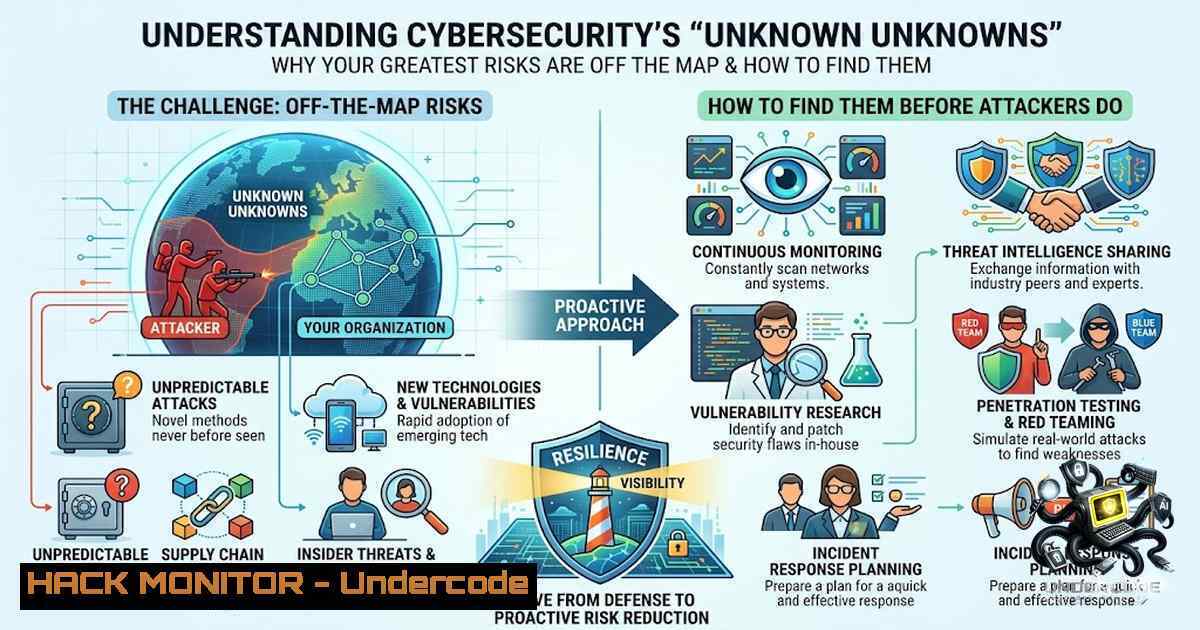
Introduction:
Conventional cybersecurity programs are built on evidence from the past – threat feeds, vulnerability databases, compliance checklists, and detection rules all operate inside the domain of the known. But attackers don’t live there. They live in the gap between what we believe is secure and what we have never thought to question. As Juan Pablo Castro, VP at TrendAI and creator of the Cybersecurity Compass and CROC frameworks, puts it: “It’s not what you’re missing that hurts you. It’s what you don’t even know you’re missing”. The real attack surface is not your infrastructure – it is the gap between what you believe is secure and what attackers prove is not.
Learning Objectives:
- Understand the concept of “unknown unknowns” in cybersecurity and why they represent the most dangerous category of cyber risk
- Learn how to identify hidden assumptions, blind spots, and undocumented attack surfaces within your organization
- Master practical techniques – including Linux/Windows commands, exposure management tools, and AI-driven risk assessment – to surface and mitigate unknown risks before adversaries exploit them
You Should Know:
1. Understanding the Unknown Unknowns Problem
The concept of “unknown unknowns” was popularized by former U.S. Secretary of Defense Donald Rumsfeld, but in cybersecurity, it takes on a deadly serious meaning. Known knowns are the vulnerabilities you have identified and patched. Known unknowns are the weaknesses you are aware of but haven’t yet addressed. Unknown unknowns are the risks you don’t even know exist – the assumptions you never questioned, the misconfigurations you never noticed, the shadow IT you never discovered.
Most security programs are built to address known threats. Vulnerability scanners check against CVE databases. SIEM tools look for known attack signatures. Compliance frameworks ensure you meet checklist items. But attackers don’t follow checklists. They follow breadcrumbs that complexity leaves behind. They exploit assumptions, not just code. They probe the gap between what you believe is secure and what you have never thought to question.
To begin surfacing unknown unknowns, start by mapping your entire digital estate:
 Linux: Discover all listening ports and services (attack surface discovery)
sudo netstat -tulpn | grep LISTEN
sudo ss -tulpn

Linux: Find all SUID/SGID binaries (potential privilege escalation vectors)
sudo find / -perm -4000 -type f 2>/dev/null
sudo find / -perm -2000 -type f 2>/dev/null

Linux: Identify all running services and their dependencies
systemctl list-units --type=service --state=running

Windows (PowerShell): Discover all open ports and listening services
Get-1etTCPConnection | Where-Object {$_.State -eq "Listen"} | Format-Table LocalPort, OwningProcess

Windows: Find all services running with SYSTEM privileges
Get-Service | Where-Object {$_.Status -eq "Running"} | Select-Object Name, DisplayName, StartType

Windows: Discover all scheduled tasks (potential persistence mechanisms)
Get-ScheduledTask | Where-Object {$_.State -1e "Disabled"} | Select-Object TaskName, State, Actions
These commands reveal what is actually running on your systems – not what you think is running. The difference between these two lists is where unknown unknowns often hide.
2. Exposure Management: Shifting from Reactive to Proactive
Traditional vulnerability management is reactive – it waits for CVEs to be published and then scrambles to patch. Exposure management takes a different approach. It continuously discovers, prioritizes, and mitigates all exposures across your entire attack surface, including those that haven’t been assigned a CVE.
Step-by-step guide to implementing an exposure management program:
- Discover all assets – This includes cloud instances, containers, IoT devices, APIs, and shadow IT. Use tools like Shodan, Censys, or your cloud provider’s asset inventory.
 Linux: Use Nmap to discover live hosts in your network
nmap -sn 192.168.1.0/24

Linux: Use Masscan for rapid internet-facing asset discovery
masscan -p80,443,8080,8443 0.0.0.0/0 --rate=10000

Windows: Use PowerShell to scan local network
1..254 | ForEach-Object { Test-Connection -ComputerName "192.168.1.$_" -Count 1 -Quiet }
- Map all attack paths – Understand how an attacker could move from an initial entry point to your crown jewels. This requires understanding identity, network segmentation, and application dependencies.
 Linux: Map network routes and firewall rules
ip route show
sudo iptables -L -1 -v

Windows: View routing table and firewall rules
route print
netsh advfirewall firewall show rule name=all
- Prioritize based on business impact – Not all exposures are equal. Focus on those that could lead to a material breach. Use a risk-based scoring model that considers exploitability, business criticality, and potential financial impact.
-
Continuously validate – Run automated breach and attack simulation (BAS) tools to test your defenses against real-world attack scenarios.
-
The Assumption Audit: Questioning What You Think You Know
Attackers exploit assumptions. “Our firewall blocks all inbound traffic” – but what about outbound? “We have MFA enabled everywhere” – but what about service accounts? “Our cloud storage is private” – but is it really?
Step-by-step guide to conducting an assumption audit:
- Document every security control – List all the controls you believe are in place. Include network firewalls, WAFs, endpoint protection, IAM policies, encryption, and monitoring.
-
Verify each control independently – Don’t trust the configuration; test it.
 Linux: Test if a firewall rule actually blocks traffic
nc -zv <target_ip> <port>
hping3 -S <target_ip> -p <port> -c 1

Linux: Verify cloud storage bucket permissions (AWS example)
aws s3api get-bucket-acl --bucket <bucket_name>
aws s3api get-bucket-policy --bucket <bucket_name>

Windows: Test Windows Firewall rules
Test-1etConnection -ComputerName <target_ip> -Port <port>
- Identify single points of failure – What happens if one control fails? Do you have defense in depth?
-
Test incident response plans – Run tabletop exercises that simulate scenarios your team has never considered. What if your SIEM is compromised? What if your backup system is encrypted?
4. Adversary Assumption: Thinking Like the Attacker
To find unknown unknowns, you must think like an attacker. Attackers don’t care about your compliance checklist. They care about what works. They chain together seemingly minor weaknesses to achieve major objectives.
Step-by-step guide to adversary assumption modeling:
- Map the attacker’s kill chain – For each phase (reconnaissance, weaponization, delivery, exploitation, installation, command and control, actions on objectives), ask: “What would an attacker do here that we haven’t anticipated?”
-
Use MITRE ATT&CK as a baseline – Then go beyond it. What TTPs (Tactics, Techniques, and Procedures) are emerging that aren’t yet in the framework?
 Linux: Search for potential living-off-the-land (LOL) binaries
which curl wget nc python perl ruby php
ls -la /usr/bin/ | grep -E "(curl|wget|nc|python|perl|ruby|php)"

Windows: Identify LOLBins (Windows)
Get-Command -CommandType Application | Where-Object {$_.Source -match "system32"} | Select-Object Name
- Simulate real-world attacks – Use tools like Caldera, Atomic Red Team, or Stratus Red Team to emulate adversary behavior.
 Linux: Deploy Caldera (open-source adversary emulation)
git clone https://github.com/mitre/caldera.git
cd caldera
pip install -r requirements.txt
python server.py

Run Atomic Red Team tests (Linux)
git clone https://github.com/redcanaryco/atomic-red-team.git
cd atomic-red-team/atomics
./invoke-atomicredteam.ps1 -ShowDetails
- Analyze assumptions – For each defense, ask: “What assumption does this defense rely on? What if that assumption is wrong?”
5. Continuous Validation and AI-Driven Risk Management
The unknown unknowns problem is not solved by a one-time assessment. It requires continuous validation and a mindset shift from compliance to resilience. AI can help by analyzing vast amounts of data to identify patterns that humans would miss.
Step-by-step guide to continuous validation:
- Deploy automated attack surface monitoring – Use tools that continuously scan for new assets, open ports, exposed credentials, and misconfigurations.
 Linux: Use TruffleHog to scan for exposed secrets in Git repos
trufflehog git https://github.com/your-repo.git

Linux: Use Nuclei for continuous vulnerability scanning
nuclei -u https://yourdomain.com -t ~/nuclei-templates/

Linux: Use OWASP ZAP for API security scanning
zap-cli quick-scan --self-contained --start-options '-config api.disablekey=true' https://api.yourdomain.com
- Integrate threat intelligence with your security stack – Don’t just collect IOCs; use threat intelligence to inform your defensive priorities.
-
Measure what matters – Move beyond counting vulnerabilities to measuring risk reduction. Quantify cyber risk in financial terms to enable better business decisions.
 Linux: Use OpenFAIR (Factor Analysis of Information Risk) tools
 Calculate annualized loss expectancy (ALE)
 ALE = SLE (Single Loss Expectancy) x ARO (Annualized Rate of Occurrence)

Example: Calculate ALE for a ransomware event
 SLE = $500,000 (average ransom + recovery costs)
 ARO = 0.2 (20% chance per year)
 ALE = $100,000
- Build a culture of curiosity – Encourage your team to question assumptions, challenge the status quo, and look for what’s missing. The most dangerous unknown unknown is the one no one is looking for.
6. API Security: The Overlooked Attack Surface
APIs are the connective tissue of modern applications, yet they are often overlooked in security programs. Attackers are actively probing APIs for misconfigurations, broken authentication, and business logic flaws that aren’t covered by traditional vulnerability scanners.
Step-by-step guide to API security hardening:
- Discover all APIs – Use tools to find both documented and undocumented APIs.
 Linux: Use ffuf to fuzz for API endpoints
ffuf -u https://api.target.com/FUZZ -w /usr/share/wordlists/dirb/common.txt

Linux: Use Kiterunner to discover API endpoints
kr scan https://api.target.com -w ~/api-routes.txt

Windows: Use Postman or Burp Suite to map API endpoints
- Test for common API vulnerabilities – OWASP API Security Top 10 includes broken object level authorization (BOLA), broken authentication, excessive data exposure, and more.
 Linux: Use OWASP ZAP to scan APIs
zap-cli api-scan -t https://api.target.com/v1/ -f openapi

Linux: Use Arjun to detect HTTP parameters
arjun -u https://api.target.com/endpoint -m POST

Linux: Use JWT tool to test for token vulnerabilities
jwt_tool <token>
- Implement API security controls – Use API gateways with rate limiting, authentication, and authorization. Validate all inputs. Implement proper logging and monitoring.
 Example: NGINX rate limiting for API
 In nginx.conf:
limit_req_zone $binary_remote_addr zone=api_limit:10m rate=10r/s;
location /api/ {
limit_req zone=api_limit burst=20 nodelay;
proxy_pass http://backend;
}
- Continuously monitor API traffic – Look for anomalies that could indicate abuse or reconnaissance.
7. Cloud Hardening: Closing the Gaps
Cloud environments introduce unique unknown unknowns due to their dynamic nature. Resources are created and destroyed constantly, IAM policies are complex, and misconfigurations are common.
Step-by-step guide to cloud hardening:
- Review IAM policies – Least privilege is the goal, but it’s rarely achieved.
 AWS: List all IAM users and their attached policies
aws iam list-users
aws iam list-attached-user-policies --user-1ame <username>

AWS: Identify overly permissive policies
aws iam get-account-authorization-details --filter Policy

Azure: List all role assignments
az role assignment list --all

GCP: List all IAM policies
gcloud projects get-iam-policy <project-id>
- Check storage permissions – Publicly exposed S3 buckets, Azure Blobs, and GCP buckets are a common entry point.
 AWS: Check all S3 bucket permissions
aws s3 ls
aws s3api get-bucket-acl --bucket <bucket-1ame>
aws s3api get-bucket-policy --bucket <bucket-1ame>

Azure: Check blob container permissions
az storage container list --account-1ame <account-1ame>
az storage container show-permission --1ame <container-1ame> --account-1ame <account-1ame>
- Enable and review logging – CloudTrail, Azure Monitor, and GCP Cloud Logging are essential for detection.
 AWS: Enable CloudTrail in all regions
aws cloudtrail create-trail --1ame <trail-1ame> --s3-bucket-1ame <bucket-1ame> --is-multi-region-trail

Azure: Enable diagnostic settings
az monitor diagnostic-settings create --1ame <settings-1ame> --resource <resource-id> --logs '[{"category":"AuditEvent","enabled":true}]'
- Implement infrastructure as code (IaC) scanning – Check your Terraform, CloudFormation, or ARM templates for misconfigurations before deployment.
 Linux: Use Checkov to scan Terraform
checkov -d /path/to/terraform/

Linux: Use tfsec for Terraform security scanning
tfsec /path/to/terraform/

Linux: Use Terrascan
terrascan scan -i terraform -d /path/to/terraform/
What Undercode Say:
- Key Takeaway 1: The most dangerous cyber risks are not the ones you know about – they are the ones you don’t even know exist. Attackers thrive in the gap between what you believe is secure and what you have never questioned.
-
Key Takeaway 2: Conventional security tools – vulnerability scanners, SIEMs, compliance frameworks – were never designed to surface unknown unknowns. They operate inside the domain of the known. To find what’s missing, you must shift from reactive vulnerability management to proactive exposure management and continuous validation.
Analysis:
Juan Pablo Castro’s framework – the Cybersecurity Compass and CROC (Cyber Risk Operations Center) – represents a paradigm shift from compliance-driven security to risk-driven security. The core insight is that attackers don’t follow rules; they follow opportunities. They chain together minor weaknesses to achieve major objectives. They exploit not just code, but assumptions. This means that even organizations with perfect patch management and zero CVEs can still be breached – because the breach doesn’t come through a known vulnerability. It comes through an unknown unknown.
The practical implication is that security teams must spend less time checking boxes and more time questioning assumptions. They must continuously discover and validate their attack surface. They must think like attackers. And they must measure what matters: not the number of vulnerabilities, but the reduction in actual risk. Castro’s emphasis on measuring cyber risk in financial terms – “measuring your digital vulnerability in pesos, dollars, or any other currency” – is particularly powerful because it translates security into the language of business. This is how security becomes a business enabler rather than a cost center.
The rise of AI in both attack and defense further amplifies the unknown unknowns problem. Attackers are adopting AI without ethical, regulatory, or bureaucratic constraints, creating an unprecedented asymmetry in the history of digital security. Defenders must respond with AI-driven risk management that can identify patterns and anomalies that humans would miss. But AI is not a silver bullet – it introduces its own unknown unknowns. The era of rogue AI is upon us, and the risks are growing as AI systems become increasingly autonomous and powerful.
Prediction:
- +1 Organizations that embrace exposure management and continuous validation will reduce their breach risk by 60-80% within three years, as they surface and mitigate unknown unknowns before attackers can exploit them.
-
-1 Organizations that remain stuck in compliance-driven, reactive security models will experience a significant increase in successful breaches, as attackers leverage AI and novel techniques to exploit unknown unknowns that traditional tools cannot detect.
-
+1 The cybersecurity industry will shift from selling “vulnerability management” to selling “exposure management,” with a new generation of tools that continuously discover, prioritize, and validate all exposures – not just those with CVEs.
-
-1 The gap between attackers and defenders will widen as attackers adopt AI faster than defenders, creating an unprecedented asymmetry that will result in a wave of high-impact breaches targeting the assumptions and blind spots of even well-resourced organizations.
-
+1 Cyber risk quantification in financial terms will become standard practice, enabling CISOs to communicate risk to boards in the language of business and secure the resources needed to address unknown unknowns.
-
-1 The complexity of modern IT environments – cloud, hybrid, multi-cloud, IoT, APIs, AI – will continue to create new unknown unknowns faster than organizations can identify them, requiring a fundamental shift in how we approach security.
-
+1 Frameworks like the Cybersecurity Compass and CROC will become industry standards, providing structured approaches to navigating the complex cybersecurity landscape before, during, and after a breach.
-
-1 Organizations that fail to conduct regular assumption audits and adversary simulations will remain blind to their most critical risks, leaving them vulnerable to attacks that exploit what they don’t even know they’re missing.
The real attack surface is not your infrastructure. It is the gap between what you believe is secure and what attackers prove is not. Start questioning your assumptions today.
▶️ Related Video (62% Match):
🎯Let’s Practice For Free:
🎓 Live Courses & Certifications:
Join Undercode Academy for Verified Certifications
🚀 Request a Custom Project:
Secure, high-velocity infrastructure and disruptive technological engineering. Contact our engineering team for high-tier development and proprietary systems:
[email protected]
💎 Smart Architecture | 🛡️ Secure by Design | ⭐ Trusted by Thousands
IT/Security Reporter URL:
Reported By: Jpcastro Cyberrisk – Hackers Feeds
Extra Hub: Undercode MoN
Basic Verification: Pass ✅


