Listen to this Post
Introduction:
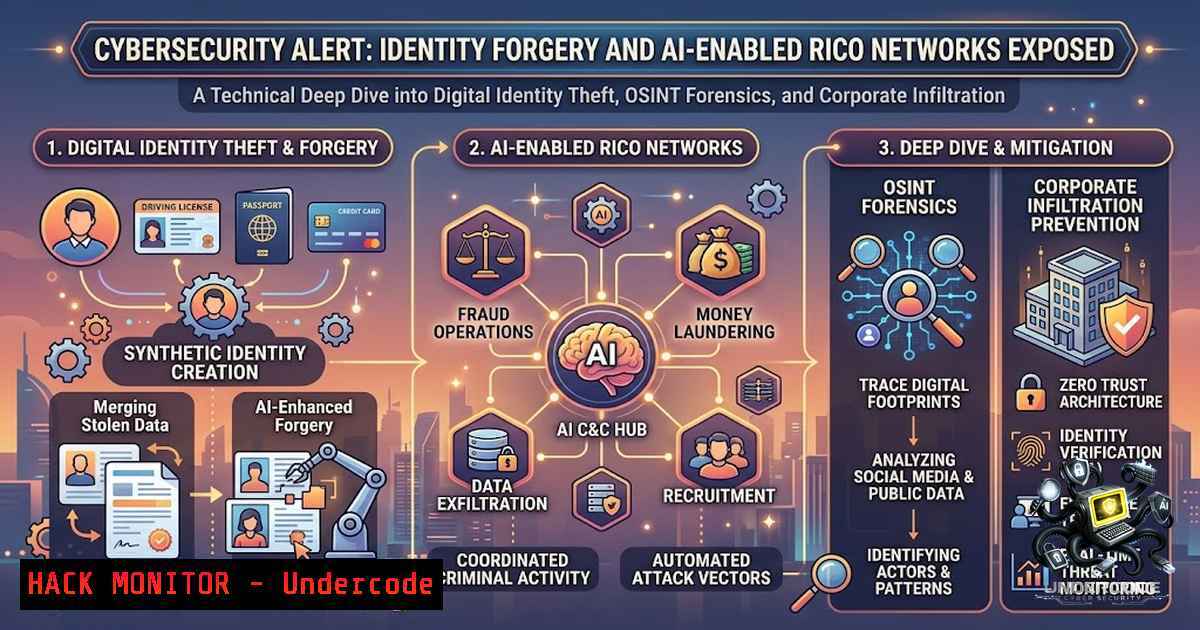
The convergence of artificial intelligence, digital identity systems, and organized crime has given rise to a new class of cyber-enabled fraud: RICO-style networks that systematically forge executive identities, fabricate credentials, and infiltrate corporate boards for monetary gain. Recent exposés reveal a sprawling operation spanning Bangalore, Pune, Chandigarh, Jaipur, Dubai, and California, where identity theft is weaponized as a business model—leveraging AI-generated personas, compromised HR systems, and social engineering to place fake executives in positions of trust. This article examines the technical mechanisms behind such attacks, provides actionable forensics and hardening strategies, and outlines defensive measures for organizations to detect and dismantle identity-based infiltration campaigns.
Learning Objectives:
- Understand the technical architecture of identity forgery networks, including OSINT gathering, credential fabrication, and AI-powered persona generation.
- Master forensic techniques to verify executive identities, detect synthetic personas, and trace digital footprints across corporate ecosystems.
- Implement cloud and API security controls to prevent unauthorized access, credential misuse, and insider threats from forged identities.
You Should Know:
- OSINT and Digital Footprint Mapping: How Attackers Build Synthetic Identities
Attackers begin by harvesting publicly available information (PAI) from LinkedIn, corporate websites, regulatory filings, and breached databases to construct detailed profiles of real individuals. In the exposed network, six women across six cities had their identities stolen and repurposed—indicating a systematic OSINT operation that cross-referenced professional histories, social connections, and organizational charts.
Step‑by‑step guide to detect OSINT-based identity fabrication:
- Step 1: Conduct reverse image searches on profile photos using tools like Google Images or TinEye to detect reused or AI-generated avatars.
- Step 2: Cross-verify employment timelines against public records (e.g., SEC filings, press releases, company blogs) to identify discrepancies.
- Step 3: Analyze social graph consistency—check if the claimed connections (e.g., “ex-IAS,” “ex-Defence”) have mutual verifiable interactions.
- Step 4: Use domain WHOIS and DNS history to identify if associated email domains were recently registered or have suspicious registration patterns.
- Step 5: Query breach databases (HaveIBeenPwned, Dehashed) to see if the identity’s email or phone appears in past leaks, which attackers often use to seed synthetic profiles.
Linux command for OSINT aggregation:
 Use theHarvester to gather emails, domains, and subdomains associated with a target organization
theHarvester -d targetcompany.com -b all -l 500 -f report.html

Use Recon-1g for social media footprint analysis
recon-1g
marketplace install recon/contacts-links/social_contact
recon/contacts-links/social_contact
Windows PowerShell for domain reputation check:
 Check domain age and reputation using Resolve-DnsName
Resolve-DnsName targetcompany.com -Type SOA

Query VirusTotal API for domain intelligence (requires API key)
$apiKey = "YOUR_API_KEY"
$domain = "targetcompany.com"
Invoke-RestMethod -Uri "https://www.virustotal.com/api/v3/domains/$domain" -Headers @{"x-apikey"=$apiKey}
- AI-Generated Personas and Deepfake Credentials: Detection and Mitigation
The network reportedly leveraged AI to fabricate identities, with one entity explicitly named “Human.ai”. Attackers use generative AI to create realistic but entirely synthetic LinkedIn profiles, resume documents, and even video introductions. These personas are then placed as board members or collaborators to legitimize money laundering and fraudulent business activities.
Step‑by‑step guide to detect AI-generated synthetic identities:
- Step 1: Examine profile metadata—check the account creation date, posting frequency, and engagement patterns. New accounts with sudden high-level connections are red flags.
- Step 2: Analyze linguistic patterns using tools like GPTZero or Originality.ai to detect AI-generated text in resumes, cover letters, or LinkedIn summaries.
- Step 3: Verify educational credentials directly with issuing institutions via their official verification portals (e.g., National Student Clearinghouse).
- Step 4: Conduct video call verification with live, unscripted questions to assess coherence and consistency with the claimed background.
- Step 5: Use facial recognition APIs (Amazon Rekognition, Microsoft Face API) to compare profile photos against known databases or detect deepfake artifacts.
API security configuration to block AI-generated bot accounts:
 Python script to integrate with LinkedIn API for anomaly detection
import requests

def check_profile_anomaly(profile_url, api_key):
headers = {"Authorization": f"Bearer {api_key}"}
 Hypothetical endpoint for profile risk scoring
response = requests.get(f"https://api.linkedin.com/v2/riskScore?url={profile_url}", headers=headers)
if response.status_code == 200:
return response.json().get("risk_score", 0)
return None
Cloud hardening: Implement Zero Trust identity verification:
- Enforce Multi-Factor Authentication (MFA) with FIDO2/WebAuthn for all executive accounts.
- Use Azure AD Identity Protection or Google Cloud’s Identity-Aware Proxy (IAP) to flag anomalous sign-ins.
- Configure conditional access policies that block logins from high-risk countries or Tor exit nodes.
- Corporate Infiltration via Compromised HR and Onboarding Systems
The exposed network exploited HR platforms (e.g., PeopleStrong, Taggd, People Matters) to place forged identities into organizations. Attackers likely leveraged weak API security, insider collusion, or social engineering to bypass background checks.
Step‑by‑step guide to harden HR and onboarding APIs:
- Step 1: Audit all third-party HR APIs for OAuth 2.0 implementation—ensure tokens are short-lived and scoped minimally.
- Step 2: Implement API gateway rate limiting to prevent brute-force attacks on credential verification endpoints.
- Step 3: Enable detailed audit logging for all profile creation, document upload, and role assignment actions.
- Step 4: Require cryptographic signing of all digital certificates and offer letters using enterprise PKI.
- Step 5: Conduct periodic access reviews to ensure terminated employees or contractors no longer have active accounts.
Linux command to monitor API access logs for anomalies:
 Monitor Nginx access logs for suspicious API calls (e.g., excessive POST requests)
tail -f /var/log/nginx/access.log | grep "POST /api/onboarding" | awk '{print $1, $7, $9}'

Use fail2ban to block IPs with repeated failed verification attempts
fail2ban-client set api-onboarding banip 192.168.1.100
Windows Event Viewer query for unauthorized account creations:
 Query Security Event Log for new user creation events (Event ID 4720)
Get-WinEvent -FilterHashtable @{LogName='Security'; ID=4720} | Select-Object TimeCreated, Message
4. RICO-Style Money Laundering and Fake Business Entities
The post alleges that forged identities were used to establish fake RICO businesses and launder money through equity and real estate purchases. From a technical standpoint, this involves creating shell companies with fabricated director information, often using compromised or synthetic identities.
Step‑by‑step guide to detect shell companies and fake entity registrations:
- Step 1: Query corporate registries (e.g., MCA in India, SEC EDGAR in US) for companies with overlapping directors or suspicious address patterns.
- Step 2: Use blockchain analytics (Elliptic, Chainalysis) to trace cryptocurrency transactions that may be used for illicit payments.
- Step 3: Monitor beneficial ownership registers for discrepancies between declared owners and actual controllers.
- Step 4: Implement KYC/AML checks with biometric verification for all C-suite and board appointments.
- Step 5: Use network analysis tools (Gephi, Neo4j) to visualize connections between entities and identify hidden relationships.
API integration for real-time company verification:
 Use OpenCorporates API to fetch company data
curl -X GET "https://api.opencorporates.com/v0.4/companies/search?q=SignoraWare" -H "Authorization: Token YOUR_API_KEY"
- Digital Forensics and Evidence Preservation for Legal Action
The post mentions that “every proof is available” and that legal action (FIR) is imminent. Preserving digital evidence in a forensically sound manner is critical for prosecuting identity forgery and RICO cases.
Step‑by‑step guide for digital evidence collection:
- Step 1: Capture full browser history, cookies, and cache from compromised systems using tools like FTK Imager or Autopsy.
- Step 2: Preserve email headers and metadata to trace the origin of phishing or social engineering attempts.
- Step 3: Create cryptographic hashes (SHA-256) of all relevant documents, emails, and logs to establish chain of custody.
- Step 4: Use memory forensics (Volatility) to detect malware or keyloggers that may have captured credentials.
- Step 5: Engage a certified digital forensics examiner to produce admissible evidence for court.
Linux commands for forensic acquisition:
 Create a disk image using dd
dd if=/dev/sda of=/mnt/evidence/disk_image.dd bs=4M status=progress

Generate SHA-256 hash for integrity verification
sha256sum /mnt/evidence/disk_image.dd > /mnt/evidence/disk_image.sha256

Use strings to extract human-readable text from binary files
strings /mnt/evidence/disk_image.dd | grep -i "password|credential|login"
Windows PowerShell for email forensics:
 Export mailbox items for a specific user in Exchange Online
Get-MailboxFolderStatistics -Identity [email protected] | Export-Csv -Path "mailbox_stats.csv"

Search for suspicious email patterns
Search-Mailbox -Identity [email protected] -SearchQuery "subject:'credentials' OR subject:'verify'" -TargetMailbox [email protected] -TargetFolder "Suspicious"
What Undercode Say:
- Key Takeaway 1: Identity forgery is no longer a isolated crime—it is a systemic, AI-enabled enterprise that demands a multi-layered defense combining OSINT, biometric verification, and continuous monitoring.
-
Key Takeaway 2: Organizations must treat executive identity as a critical asset, implementing Zero Trust principles not just for network access but for human identity verification at every onboarding and promotion cycle.
Analysis: The exposed network illustrates how cybercriminals have professionalized identity theft, moving beyond simple phishing to full-scale persona fabrication and corporate infiltration. The use of AI to generate convincing synthetic identities, combined with exploitation of HR platforms and insider collusion, represents a paradigm shift in cyber-enabled fraud. Defensive strategies must evolve accordingly—traditional background checks are insufficient; organizations need continuous identity verification, behavioral analytics, and proactive threat hunting. The cross-border nature of these networks (India, UAE, US) also highlights the need for international collaboration and shared threat intelligence. Legal frameworks like RICO provide a mechanism for prosecution, but technical controls remain the first line of defense. The involvement of ex-IAS and ex-Defence personnel underscores the insider threat dimension—privileged access and knowledge of government processes can amplify the impact of such schemes.
Prediction:
- +1 Regulatory bodies will mandate biometric KYC for all C-suite appointments within the next 18 months, driving adoption of identity verification APIs and blockchain-based credentialing.
-
+1 AI-powered identity verification tools will become standard in HR tech stacks, creating a new market segment for deepfake detection and synthetic identity scoring.
-
-1 The sophistication of AI-generated personas will outpace detection capabilities in the short term, leading to a wave of high-profile corporate infiltrations before defenses catch up.
-
-1 Insider collusion with identity forgery networks will increase, as economic pressures drive employees to sell access or verification privileges, necessitating stronger insider threat programs.
-
+1 International task forces modeled on joint cybercrime units will emerge to target cross-border identity fraud networks, leveraging shared OSINT and forensic databases.
-
-1 Small and mid-sized enterprises without dedicated security teams will remain vulnerable, as attackers shift focus to softer targets with less rigorous verification processes.
▶️ Related Video (62% Match):
https://www.youtube.com/watch?v=ARpwpKqEhSA
🎯Let’s Practice For Free:
🎓 Live Courses & Certifications:
Join Undercode Academy for Verified Certifications
🚀 Request a Custom Project:
Secure, high-velocity infrastructure and disruptive technological engineering. Contact our engineering team for high-tier development and proprietary systems:
[email protected]
💎 Smart Architecture | 🛡️ Secure by Design | ⭐ Trusted by Thousands
IT/Security Reporter URL:
Reported By: https://lnkd.in/p/e3pt-5Ge – Hackers Feeds
Extra Hub: Undercode MoN
Basic Verification: Pass ✅


