Listen to this Post
Introduction:
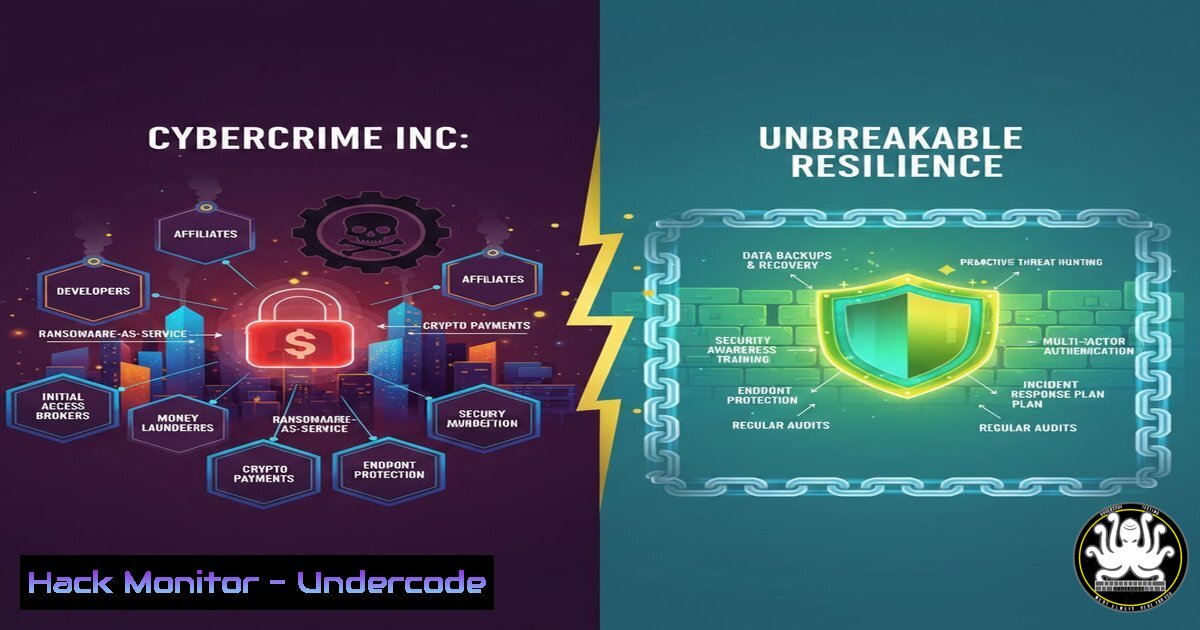
The digital underground has evolved from a disorganized collection of hackers into a highly efficient, corporate-like shadow economy known as “Cybercrime Inc.” This industrial-scale operation employs Ransomware-as-a-Service (RaaS), franchised distribution, and dedicated R&D, systematically targeting organizations globally. Consequently, the foundational cybersecurity paradigm must shift from mere prevention to assured resilience, ensuring operational continuity even during and after a sophisticated breach.
Learning Objectives:
- Decode the structure and business model of the modern Ransomware-as-a-Service (RaaS) ecosystem.
- Implement proactive, resilience-focused technical controls across IT infrastructure.
- Develop and validate a rapid recovery protocol to minimize operational downtime post-incident.
You Should Know:
- Deconstructing the RaaS Business Model: It’s Not Just Malware
The modern ransomware attack is a service chain. Affiliates pay to use polished ransomware strains, gain access to target lists and phishing kits, and receive 24/7 support. The developers take a cut of every ransom paid. This model lowers the barrier to entry and scales attacks exponentially.
Step‑by‑step guide:
Step 1: Intelligence Gathering (For Defenders). Use threat intelligence platforms to track RaaS groups. Monitor their data leak sites.
Command/Tool: Use `curl` and `jq` to query threat intelligence APIs from a Linux security server.
 Example using a generic threat intel feed (replace API_KEY and URL)
curl -s -H "Authorization: Bearer API_KEY" https://api.threatintelplatform.com/v1/indicators/ransomware | jq '.data[] | select(.malware_family=="LockBit")'
Step 2: Understand the Kill Chain. Map their typical Tactics, Techniques, and Procedures (TTPs) to the MITRE ATT&CK framework. This informs where to place defenses.
2. Fortifying Initial Access: Beyond the Firewall
Attackers often enter via phishing, exploited vulnerabilities, or insecure remote services. Resilience starts by making initial compromise extraordinarily difficult.
Step‑by‑step guide:
Step 1: Harden Remote Access. Mandate phishing-resistant MFA (e.g., FIDO2 keys) for all remote access (VPN, RDP, cloud apps). Disable legacy protocols.
Step 2: Patch Relentlessly. Automate vulnerability management. For critical systems where patching is delayed, use compensating controls.
Command (Linux): Automate auditd to monitor for exploitation attempts on unpatched services.
 Add a rule to auditd to watch for a specific binary execution (example)
sudo auditctl -w /usr/bin/openssl -p x -k potential_cve_exploit
Command (Windows): Use PowerShell to verify the installation status of critical patches.
Get-HotFix | Where-Object {$_.InstalledOn -gt (Get-Date).AddDays(-30)} | Select-Object HotFixID, InstalledOn
- Implementing Zero Trust Segmentation: Contain the Blast Radius
Assume breach. Prevent lateral movement by segmenting the network. A compromised workstation should not be able to talk directly to your domain controller or backup server.
Step‑by‑step guide:
Step 1: Map Critical Data Flows. Identify which systems need to communicate for business operations.
Step 2: Enforce Micro-Segmentation. Use host-based firewalls and next-gen network controls to enforce least-privilege communication.
Command (Windows Firewall – Advanced Security): Create a rule to block all, then allow only specific subnets/ports.
New-NetFirewallRule -DisplayName "Allow-Domain-CTRL-Only" -Direction Inbound -Protocol TCP -LocalPort 445 -RemoteAddress 10.0.1.0/24 -Action Allow
4. Mastering Immutable Backups: The Ultimate Recovery Tool
If Cybercrime Inc. encrypts your data, your last line of resilience is a backup they cannot touch. Immutability and air-gapping are non-negotiable.
Step‑by‑step guide:
Step 1: Follow the 3-2-1-1-0 Rule. 3 copies, on 2 different media, 1 offsite, 1 immutable/air-gapped, 0 errors.
Step 2: Configure Immutable Object Storage. Use S3 Object Lock (Compliance mode) on AWS, Immutable Blob Storage on Azure, or a dedicated hardened Linux repository.
Command (AWS CLI – S3 Object Lock):
 Enable Object Lock on a bucket (must be done at creation)
aws s3api create-bucket --bucket my-immutable-backups --region us-east-1 --object-lock-enabled-for-bucket
 Apply a retention policy
aws s3api put-object-retention --bucket my-immutable-backups --key critical-db-backup.tar.gz --retention '{"Mode":"COMPLIANCE", "RetainUntilDate":"2024-12-31T00:00:00"}'
- Orchestrating Incident Response (IR) with Cybercrime Inc. in Mind
Your IR playbook must account for an adversary that is persistent, well-resourced, and may have dwell time inside your network.
Step‑by‑step guide:
Step 1: Establish Clear Communication & Isolation Protocols. Have offline contact lists and pre-authorized isolation scripts ready.
Step 2: Conduct Forensic Triage. Quickly identify the initial entry point and scope of compromise to prevent re-entry.
Command (Linux – Triaging): Collect process, network, and user login data quickly.
sudo netstat -tunap > /var/forensics/network_connections.txt
sudo ps auxwww > /var/forensics/running_processes.txt
sudo last -a > /var/forensics/user_logins.txt
Step 3: Execute the Recovery Decision Tree. Have a pre-defined, leadership-approved criteria for when to restore from backups vs. other options.
6. Building Resilience Through Continuous Validation
Preparedness is not a checklist; it’s a capability measured through constant testing.
Step‑by‑step guide:
Step 1: Schedule Regular “Fire Drills.” Conduct tabletop exercises that simulate a full-scale RaaS attack.
Step 2: Test Backup Restoration Quarterly. Randomly select a critical server or dataset and perform a full restoration to a sandbox environment. Measure the Recovery Time Objective (RTO).
What Undercode Say:
- Resilience is the New Security KPI. The primary metric for modern security programs must shift from “number of breaches prevented” to “Mean Time To Recovery (MTTR).” Your organization’s survival depends on how fast it can return to normal operations.
- Assume Sophistication, Plan for Commoditization. Defend against the advanced persistent tactics of elite groups, but expect to be hit by the scalable, franchise-model attacks they enable. Your defenses must hold against both.
Prediction:
The industrialization of cybercrime will accelerate, driven by AI. We will see AI-powered vulnerability discovery, automated social engineering at scale, and dynamic malware that adapts to its environment. Simultaneously, the “Cybercrime Inc.” model will further fragment, with specialized vendors offering Initial Access, Persistence-as-a-Service, and Negotiation-as-a-Service. The future battleground will be in the speed of autonomous response: defensive AI systems that can detect, contain, and initiate recovery from an AI-driven attack faster than human-led teams, making fully automated resilience orchestration the next critical investment for enterprise defense.
▶️ Related Video (82% Match):
🎯Let’s Practice For Free:
IT/Security Reporter URL:
Reported By: Richardstaynings Cybercrime – Hackers Feeds
Extra Hub: Undercode MoN
Basic Verification: Pass ✅


