Listen to this Post
Introduction:
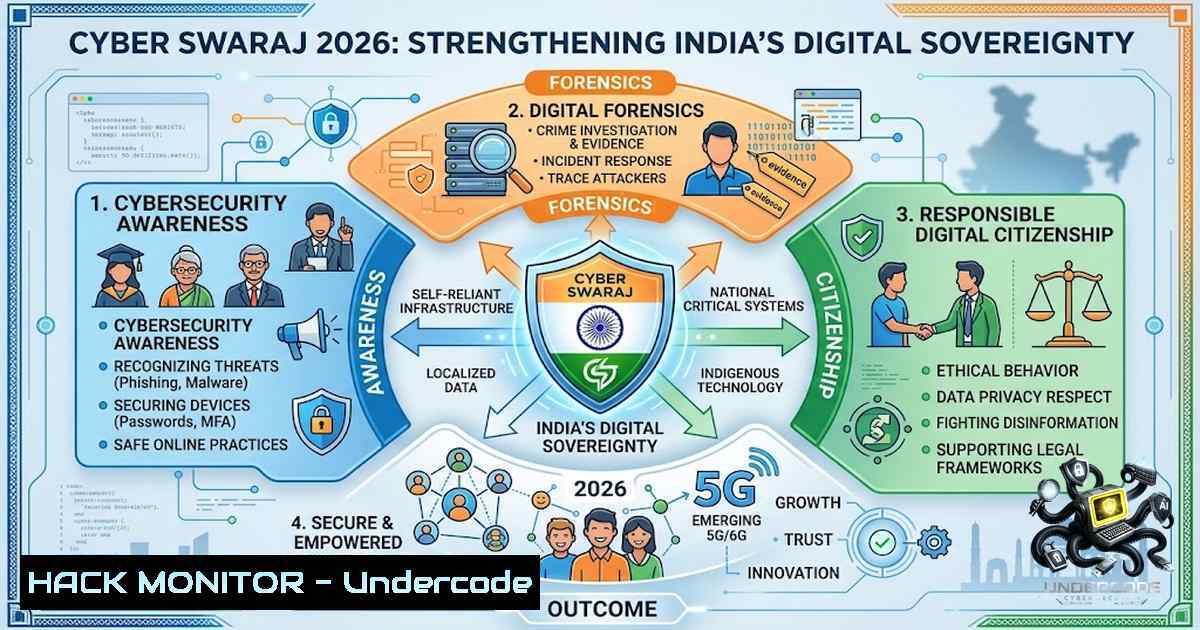
On August 15, 2026, India’s 80th Independence Day, Forensico hosted the Cyber Swaraj 2026 – Independence Day Special Awareness Webinar, a pivotal event dedicated to advancing cybersecurity literacy, digital safety, and online scam prevention across the nation. The webinar brought together industry experts—including cybersecurity educators, digital forensics investigators, anti-cybercrime strategists, and AI cyber psychologists—to address the growing complexities of today’s threat landscape. As cyberattacks become more sophisticated and AI-driven threats blur the line between reality and fiction, initiatives like Cyber Swaraj 2026 serve as critical platforms for educating citizens, empowering professionals, and building a resilient digital ecosystem.
Learning Objectives:
- Understand the core pillars of cybersecurity awareness, digital safety, and responsible online behavior in the context of India’s digital transformation.
- Gain practical knowledge of digital forensics techniques, incident response workflows, and tools used to investigate cybercrimes.
- Learn how to identify, mitigate, and prevent common cyber threats—including phishing, social engineering, and AI-generated scams—using both technical controls and human-centric strategies.
You Should Know:
1. Digital Forensics Fundamentals: Evidence Collection and Analysis
Digital forensics is the backbone of modern cybercrime investigation. It involves the identification, preservation, extraction, and documentation of digital evidence from computers, mobile devices, networks, and cloud environments. During the Cyber Swaraj 2026 webinar, experts emphasized the importance of maintaining chain of custody, using write-blockers to prevent data alteration, and leveraging open-source forensic tools for analysis.
Step‑by‑Step Guide: Basic Disk Imaging with `dd` (Linux)
This command creates a bit-for-bit copy of a storage device, preserving evidence without modifying the original.
 Identify the target device
sudo fdisk -l

Create a forensic image (replace /dev/sdb with your target)
sudo dd if=/dev/sdb of=/path/to/evidence.img bs=4096 conv=noerror,sync status=progress

Generate a SHA-256 hash for integrity verification
sha256sum /path/to/evidence.img > evidence.hash
What this does: The `dd` utility reads raw data from the source device (if) and writes it to an image file (of). The `bs=4096` optimizes block size for faster copying, while `conv=noerror,sync` ensures the process continues despite read errors—critical when dealing with damaged drives. Always verify the hash to confirm the image matches the original.
Windows Equivalent: Use FTK Imager (free) or WinHex to create forensic images with a graphical interface. FTK Imager also generates hash reports automatically.
2. Phishing Detection and Email Header Analysis
Phishing remains one of the most prevalent attack vectors, responsible for over 80% of reported security incidents. The webinar highlighted the importance of teaching users to identify suspicious links, avoid credential-harvesting attempts, and report anomalies promptly.
Step‑by‑Step Guide: Analyzing Email Headers in Linux
Email headers contain routing information that can reveal the true origin of a message.
 Save the full email headers to a file (e.g., headers.txt)
 Then extract key fields:
grep -E "^Received:|^From:|^Return-Path:|^Reply-To:" headers.txt

Trace the delivery path using the "Received" fields (read from bottom to top)
 Check SPF, DKIM, and DMARC results:
grep -E "spf=|dkim=|dmarc=" headers.txt
What this does: The `grep` commands filter out critical header lines. `Received` fields show each mail server the message passed through—the bottom-most entry is the origin. SPF, DKIM, and DMARC authentication results indicate whether the email passed domain-based verification. Failed checks strongly suggest spoofing or phishing.
Windows Alternative: In Outlook, open the message, click File → Properties, and copy the Internet headers for analysis. Use Microsoft Message Header Analyzer (online tool) for a visual breakdown.
3. Social Engineering and AI-Powered Psychological Manipulation
Ms. Shonal D., an Anti-Cybercrime Strategist and AI Cyber Psychologist, addressed the growing threat of AI-generated deepfakes and psychologically engineered attacks. Attackers now use generative AI to craft convincing voice clones, video impersonations, and personalized phishing lures that exploit human emotions—fear, urgency, curiosity, and trust.
Step‑by‑Step Guide: Verifying Media Authenticity with Open-Source Tools
 Install Forensic Image Analysis tools (Linux)
sudo apt-get install exiftool ffmpeg mediainfo

Extract metadata from an image or video
exiftool suspicious_file.jpg

Check for signs of AI manipulation using video frame analysis
ffmpeg -i suspicious_video.mp4 -vf "select=eq(n\,0)" -vsync vfr frame0.png
mediainfo suspicious_video.mp4 | grep -E "Writing library|Encoder|Software"
What this does: `exiftool` reveals hidden metadata—camera model, GPS coordinates, software used—that can indicate whether a file was generated or edited. `ffmpeg` extracts a single frame for closer inspection. `mediainfo` with `grep` filters for encoder signatures; many AI-generated videos leave traces like “libx264” or specific software watermarks. Always cross-reference with known-good sources before trusting sensitive media.
Windows Tools: Use IrfanView (with plugins) for metadata viewing or FFmpeg via command line for frame extraction. Online tools like Forensically or FotoForensics can also help detect anomalies.
- Responsible Digital Citizenship: Privacy Hardening and Secure Communication
Digital citizenship goes beyond technical skills—it encompasses ethical behavior, privacy protection, and understanding the societal impact of one’s online actions. The webinar stressed the need for individuals to adopt secure communication practices, use strong, unique passwords, enable multi-factor authentication (MFA), and think critically before sharing personal information.
Step‑by‑Step Guide: Hardening Your Digital Footprint (Cross-Platform)
- Password Management: Use a password manager (e.g., Bitwarden, KeePassXC) to generate and store complex passwords. Never reuse passwords across sites.
-
Enable MFA: Activate TOTP-based two-factor authentication (e.g., Google Authenticator, Aegis) on all critical accounts—email, banking, social media.
-
Browser Privacy: Install privacy extensions like uBlock Origin and Privacy Badger. Regularly clear cookies and use private/incognito mode for sensitive browsing.
-
Email Security: Configure PGP/GPG encryption for sensitive correspondence. On Linux:
sudo apt-get install gnupg
gpg --full-generate-key
gpg --encrypt --recipient "[email protected]" message.txt
On Windows, use Gpg4win or Mailvelope (browser extension) for email encryption.
-
Social Media Hygiene: Review privacy settings on every platform. Limit public visibility of personal details—birthdate, location, employer—to minimize OSINT (Open-Source Intelligence) exposure.
5. Cybersecurity Career Pathways and Continuous Learning
The Strategic Squad CTF Team, recognized as a key contributor to the webinar, exemplifies the value of practical, competition-based learning in cybersecurity. Capture The Flag (CTF) challenges simulate real-world attack and defense scenarios, helping participants develop hands-on skills in vulnerability exploitation, cryptography, reverse engineering, and incident response.
Step‑by‑Step Guide: Getting Started with CTF Platforms
- Choose a Platform: Register on TryHackMe, HackTheBox, or picoCTF—all offer beginner-friendly rooms and challenges.
-
Set Up a Lab Environment: Use VirtualBox or VMware to run a Kali Linux VM. Install essential tools:
sudo apt update && sudo apt install nmap burpsuite john hydra metasploit-framework wireshark
3. Practice Core Skills:
- Reconnaissance: Use `nmap -sV -p- target_ip` to discover open ports and services.
- Web Exploitation: Intercept requests with Burp Suite; test for SQL injection, XSS, and IDOR.
- Cryptography: Use `hashcat` or `john` to crack password hashes.
- Forensics: Analyze PCAP files with Wireshark or tshark.
- Join a Community: Participate in CTF teams, attend local meetups, and follow cybersecurity blogs and podcasts to stay updated on emerging threats and techniques.
What Undercode Say:
- Cybersecurity is a shared responsibility. The Cyber Swaraj 2026 webinar reinforced that digital safety is not just the duty of IT professionals—it requires active participation from every citizen, educator, and policymaker.
- Human factors remain the weakest link. Even the most robust technical controls can be bypassed through social engineering and psychological manipulation. AI-powered attacks amplify this risk, making cyberpsychology an essential discipline alongside traditional security measures.
Analysis: The convergence of AI, digital forensics, and human-centric security strategies marks a paradigm shift in how we approach cyber defense. While tools like dd, exiftool, and GPG provide technical safeguards, the real challenge lies in cultivating a culture of vigilance and ethical responsibility. Events like Cyber Swaraj 2026 bridge this gap by democratizing cybersecurity knowledge and making it accessible to diverse audiences—from students and educators to law enforcement and corporate leaders. However, the rapid evolution of AI-driven threats demands continuous upskilling and cross-sector collaboration. India’s digital sovereignty depends not only on advanced technology but also on an informed, proactive, and resilient citizenry.
Prediction:
- +1 Cybersecurity awareness initiatives like Cyber Swaraj 2026 will become a national priority, with increased government funding and integration into school curricula, fostering a generation of digitally literate citizens by 2030.
- +1 The demand for professionals skilled in both cybersecurity and cyberpsychology will surge, creating new interdisciplinary career paths and specialized training programs across universities and private institutions.
- -1 As AI-generated deepfakes and voice clones become more sophisticated and accessible, nation-states and cybercriminal groups will weaponize them for large-scale disinformation campaigns, election interference, and financial fraud, outpacing current detection capabilities.
- -1 The shortage of qualified cybersecurity professionals—exacerbated by rapid digital transformation—will leave many organizations underprotected, leading to a spike in ransomware attacks and data breaches targeting critical infrastructure and SMEs.
- +1 Open-source forensic tools and CTF-style training will gain wider adoption among law enforcement agencies, improving incident response times and evidentiary standards in cybercrime investigations.
- -1 Without sustained public-private partnerships and continuous awareness campaigns, the digital divide will widen, leaving rural and underserved communities disproportionately vulnerable to online scams and identity theft.
▶️ Related Video (76% Match):
🎯Let’s Practice For Free:
🎓 Live Courses & Certifications:
Join Undercode Academy for Verified Certifications
🚀 Request a Custom Project:
Secure, high-velocity infrastructure and disruptive technological engineering. Contact our engineering team for high-tier development and proprietary systems:
[email protected]
💎 Smart Architecture | 🛡️ Secure by Design | ⭐ Trusted by Thousands
IT/Security Reporter URL:
Reported By: https://lnkd.in/p/e5mXpR8q – Hackers Feeds
Extra Hub: Undercode MoN
Basic Verification: Pass ✅


