Listen to this Post
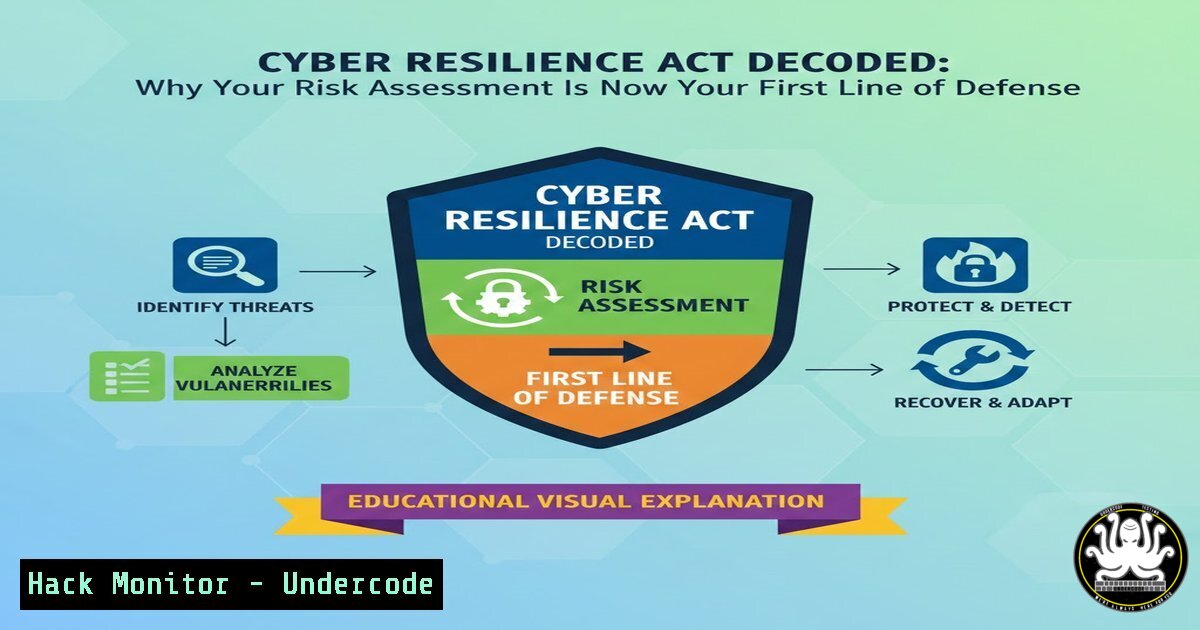
Introduction:
The European Union’s Cyber Resilience Act (CRA) is set to fundamentally reshape how digital products are developed and brought to market, moving beyond mere technical safeguards to a culture of continuous risk management. For cybersecurity professionals and legal teams alike, the era of vague “best efforts” in security is over, replaced by a mandated, documented risk analysis. This article breaks down the technical and procedural steps required to transition from a mindset of obligation of means to one of risk appreciation, ensuring compliance and building genuine cyber resilience.
Learning Objectives:
- Understand the core mandate of the CRA and its emphasis on risk assessment as a primary, non-negotiable step.
- Learn how to implement a practical, technical risk assessment framework aligned with CRA’s 13 security requirements.
- Develop actionable strategies for integrating continuous security validation and threat modeling into the product lifecycle.
You Should Know:
- The CRA Mandate: From “Best Effort” to Risk-Based Security
The CRA dismantles the traditional legal distinction between an “obligation of means” and an “obligation of result” in the context of cybersecurity. It is legally impossible to guarantee 100% security; therefore, compliance is judged on the rigor and depth of your risk analysis processes. Before implementing any specific technical controls listed in Annex I of the CRA, you must first demonstrate a systematic approach to identifying, evaluating, and treating risks.
Step-by-step guide:
- Define the System Boundary: Clearly document the product’s architecture, data flows, and trust boundaries. Use tools like draw.io or Lucidchart to create diagrams.
- Asset Identification: Catalog all critical assets, including software components, hardware, APIs, and sensitive data (e.g., PII, credentials).
Linux Command Example (Discovering assets on a server):List all listening network services ss -tuln Find files containing potential secrets find /opt/yourapp -name ".json" -o -name ".yml" -o -name ".env" | xargs grep -l "password|key|token"
- Threat Identification: Utilize structured frameworks like STRIDE (Spoofing, Tampering, Repudiation, Information Disclosure, Denial of Service, Elevation of Privilege) to brainstorm potential threats against each asset.
2. Implementing a Technical Risk Assessment Framework
A formalized framework ensures your risk assessment is repeatable, measurable, and defensible to auditors. The NIST Cybersecurity Framework (CSF) provides an excellent structure for this.
Step-by-step guide:
- Identify: Create a comprehensive inventory of all digital assets, software bills of materials (SBOMs), and external dependencies.
Command Example (Generating a simple SBOM with a package manager):For a Node.js project, list all dependencies and their versions npm list --all > sbom.txt
- Protect: Based on your initial risk assessment, define baseline security controls. This maps directly to the CRA’s 13 requirements, such as secure default configurations and vulnerability management.
- Detect: Implement tooling to identify security events. This includes logging, monitoring, and intrusion detection systems.
- Respond & Recover: Develop and document playbooks for incident response and disaster recovery, ensuring you can maintain operations during and after an attack.
3. Hardening Products Against Annex I Requirements
The CRA’s Annex I outlines specific security properties. Your risk assessment must inform how you implement these technically.
Step-by-step guide:
- Secure by Default: Enforce the principle of least privilege. Default configurations should be secure out-of-the-box.
Windows Command Example (Disabling a non-essential service):
 Disable the SMBv1 protocol to mitigate a specific risk
Disable-WindowsOptionalFeature -Online -FeatureName SMB1Protocol
2. Vulnerability Management: Establish a continuous process for identifying, prioritizing, and remediating vulnerabilities.
Command Example (Scanning a local container image with Trivy):
trivy image your-app:latest
3. Cryptography: Ensure all sensitive data is encrypted at rest and in transit. Your risk assessment must identify what data qualifies and the appropriate cryptographic controls.
4. Integrating Threat Modeling into the SDLC
Threat modeling is not a one-off exercise for the CRA; it must be integrated into every stage of your Software Development Lifecycle (SDLC).
Step-by-step guide:
- Design Phase: Conduct a high-level threat modeling session for new features or products using a tool like the OWASP Threat Dragon or Microsoft Threat Modeling Tool.
- Development Phase: Use SAST (Static Application Security Testing) tools to catch vulnerabilities as code is written.
- Pre-Production Phase: Employ DAST (Dynamic Application Security Testing) and penetration testing to validate security controls against the identified threats.
5. Continuous Security Validation and Monitoring
Compliance is not a point-in-time certificate. The CRA implies a duty of continuous vigilance.
Step-by-step guide:
- Implement Continuous Monitoring: Use tools like Wazuh or the Elastic Stack (ELK) to aggregate and analyze logs from your products.
- Conduct Periodic Red-Teaming: Schedule regular simulated attacks to test your detection and response capabilities against the risks outlined in your assessment.
- Automate Compliance Checks: Use OpenSCAP or similar tools to automatically check system configurations against a security policy benchmark.
Command Example (Running an OpenSCAP scan):
 Fetch and run a standard compliance scan
oscap xccdf eval --profile xccdf_org.ssgproject.content_profile_cis_server_l1 --results results.xml --report report.html https://github.com/ComplianceAsCode/content/releases/latest/download/ssg-alinux2-ds.xml
What Undercode Say:
- Risk is the New Currency of Compliance: The CRA makes your documented risk assessment the primary artifact for proving compliance. A perfect technical implementation is meaningless without the paper trail that justifies why you implemented it that way.
- Legal and Technical Convergence: The wall between legal departments and cybersecurity teams must come down. Lawyers need to understand technical risk, and technologists must grasp the legal implications of their security decisions. The traditional French legal concepts of obligation are no longer sufficient in the digital age.
The CRA signals a tectonic shift from reactive, checkbox compliance to proactive, evidence-based security governance. It acknowledges that absolute security is a fantasy and instead legislates for intelligent, managed risk. For organizations, this means the quality of your processes—your threat models, your risk registers, your mitigation rationales—will be scrutinized more than any single security feature. Failing to build a robust, living risk assessment process is not just a technical failure; it is a direct legal and financial liability under the new regime.
Prediction:
The principles enshrined in the CRA will become the global de facto standard for product security regulation within the next five years, influencing similar legislation in North America and Asia. We will see a surge in “risk assessment-as-a-service” platforms and AI-driven tools designed to automate and audit these processes. Furthermore, liability for cyber incidents will increasingly fall on organizations that cannot produce a defensible, CRA-aligned risk assessment, moving litigation away from the question of “was there a breach?” to “was the risk appropriately managed and documented?”. This will inevitably extend beyond traditional IT products to encompass AI systems, IoT devices, and critical infrastructure, making cyber resilience a foundational component of corporate governance.
🎯Let’s Practice For Free:
IT/Security Reporter URL:
Reported By: Marc Antoine – Hackers Feeds
Extra Hub: Undercode MoN
Basic Verification: Pass ✅


