Listen to this Post
Introduction
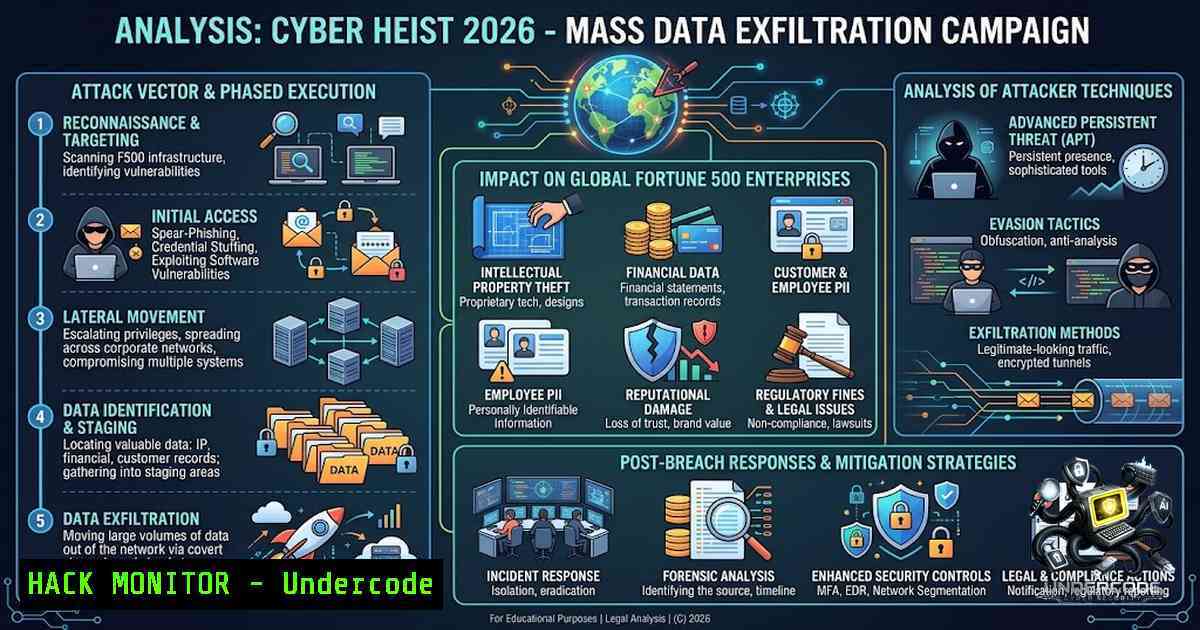
On August 14, 2026, a sophisticated hacking collective claimed responsibility for a massive data breach affecting Shell, Philips, GE, Fiserv, and dozens of other multinational corporations, marking one of the most significant coordinated cyberattacks in recent history. This attack, occurring amidst heightened geopolitical tensions between the United States and Iran, underscores the critical intersection of nation-state cyber capabilities and corporate espionage, where threat actors leverage geopolitical volatility to mask large-scale data exfiltration operations targeting critical infrastructure and intellectual property.
Learning Objectives
- Understand the technical methodologies employed in coordinated data theft campaigns targeting enterprise environments
- Implement advanced threat detection and response strategies to identify and mitigate similar attacks
- Develop comprehensive cloud and API security hardening techniques to protect against mass data exfiltration
You Should Know
- Threat Actor Tactics, Techniques, and Procedures (TTPs) Analysis
The August 2026 attack vector employed a multi-stage approach combining social engineering, credential harvesting, and lateral movement across interconnected enterprise networks. Initial access was likely achieved through targeted phishing campaigns leveraging geopolitical urgency—specifically emails referencing the Iran-US Strait of Hormuz standoff—to bypass traditional email security controls.
Step-by-step analysis of the attack chain:
- Reconnaissance Phase: Attackers conducted OSINT gathering on target organizations’ supply chain relationships, identifying third-party vendors with privileged access to corporate networks.
-
Initial Access: Credential harvesting via adversary-in-the-middle (AiTM) attacks against Microsoft 365 and Okta identity platforms. Implement the following detection commands:
 Linux - Check for suspicious authentication logs
sudo grep "Failed password" /var/log/auth.log | awk '{print $1,$2,$3,$9,$11}' | sort | uniq -c | sort -1r

Windows PowerShell - Audit failed logon attempts
Get-WinEvent -FilterHashtable @{LogName='Security'; ID=4625} | Select-Object TimeCreated, @{N='User';E={$<em>.Properties[bash].Value}}, @{N='Source';E={$</em>.Properties[bash].Value}} | Format-Table -AutoSize

Review Azure AD sign-in logs for anomalous geolocations
Get-AzureADAuditSignInLogs -All $true | Where-Object {$_.Location -1e "United States"} | Select-Object UserPrincipalName, ClientAppUsed, Location
- Lateral Movement: Once inside, attackers utilized Pass-the-Hash and Overpass-the-Hash techniques to move across network segments. Deploy the following detection mechanisms:
 Detect PtH attacks using Sysmon
Get-WinEvent -FilterHashtable @{LogName='Microsoft-Windows-Sysmon/Operational'; ID=10} | Where-Object {$<em>.Message -match "ProcessAccess" -and $</em>.Message -match "lsass.exe"} | Select-Object TimeCreated, @{N='SourceProcess';E={$_.Properties[bash].Value}}

Enumerate privileged accounts for potential compromise
net group "Domain Admins" /domain
- Data Exfiltration: Exfiltration was achieved through encrypted tunnels over legitimate protocols, bypassing DLP controls. Monitor for anomalous data transfers:
 Monitor large outbound data transfers on Linux
sudo tcpdump -i eth0 -1n -v 'tcp port 443 and (src net 10.0.0.0/8 or src net 172.16.0.0/12)' -c 1000 | grep -E "length [0-9]{5,}"

Windows - Enable advanced audit logging for file access
auditpol /set /subcategory:"File System" /success:enable /failure:enable
2. Cloud and API Security Hardening
The breach exploited misconfigured API endpoints across multi-cloud environments, particularly targeting AWS S3 buckets and Azure Blob storage containing sensitive corporate data.
Step-by-step security hardening implementation:
1. API Gateway Configuration:
 AWS API Gateway - Enable request validation and throttling
aws apigateway update-rest-api --rest-api-id <api-id> --patch-operations
op=replace,path=/minimumCompressionSize,value=100000

Configure rate limiting to prevent brute-force enumeration
aws apigateway create-usage-plan --1ame "EnterpriseRateLimit" --throttle
burstLimit=1000,rateLimit=500
2. S3 Bucket Security:
 Enable bucket logging and versioning
aws s3api put-bucket-logging --bucket <bucket-1ame> --bucket-logging-status
file://logging-config.json

Enforce encryption for all objects
aws s3api put-bucket-encryption --bucket <bucket-1ame> --server-side-encryption-configuration
'{"Rules":[{"ApplyServerSideEncryptionByDefault":{"SSEAlgorithm":"AES256"}}]}'

Set bucket policies to prevent public access
aws s3api put-bucket-policy --bucket <bucket-1ame> --policy
'{"Version":"2012-10-17","Statement":[{"Effect":"Deny","Principal":"","Action":"s3:","Resource":"arn:aws:s3:::<bucket-1ame>/","Condition":{"Bool":{"aws:SecureTransport":"false"}}}]}'
3. Azure Active Directory Conditional Access:
 Implement risk-based conditional access policies
New-AzureADMSConditionalAccessPolicy -1ame "HighRiskBlock" -Conditions @{
SignInRiskLevels = @("high", "medium")
} -GrantControls @{
Operator = "OR"
BuiltInControls = @("block")
} -State "enabled"

Enforce MFA for all privileged roles
$privilegedRoles = @("Global Administrator", "Application Administrator", "Cloud Application Administrator")
foreach ($role in $privilegedRoles) {
New-AzureADMSConditionalAccessPolicy -1ame "MFA_Required_$role" -Conditions @{
Roles = @{ Include = @($role) }
} -GrantControls @{
Operator = "OR"
BuiltInControls = @("mfa")
} -State "enabled"
}
4. Database Encryption and Access Controls:
-- Implement column-level encryption in Azure SQL
CREATE MASTER KEY ENCRYPTION BY PASSWORD = 'Strong!EncryptionKey2026';

CREATE CERTIFICATE EnterpriseDataCert WITH SUBJECT = 'Enterprise Data Protection';

CREATE SYMMETRIC KEY DataKey WITH ALGORITHM = AES_256 ENCRYPTION BY CERTIFICATE EnterpriseDataCert;

OPEN SYMMETRIC KEY DataKey DECRYPTION BY CERTIFICATE EnterpriseDataCert;

-- Always Encrypted in SQL Server
CREATE COLUMN MASTER KEY CMK1 WITH (KEY_STORE_PROVIDER_NAME = 'MSSQL_CERTIFICATE_STORE', KEY_PATH = 'CurrentUser/My/YourCertificate');
3. Network Segmentation and Zero Trust Architecture
Implementing Zero Trust principles is critical to preventing lateral movement in the event of a breach. The attack demonstrated the failure of traditional perimeter-based security models.
Step-by-step Zero Trust implementation:
- Micro-segmentation with NSX or Azure Network Security Groups:
Azure - Create application security groups for segmentation
$asgWeb = New-AzApplicationSecurityGroup -ResourceGroupName "Enterprise-RG" -1ame "ASG-Web" -Location "EastUS"
$asgApp = New-AzApplicationSecurityGroup -ResourceGroupName "Enterprise-RG" -1ame "ASG-App" -Location "EastUS"
$asgDB = New-AzApplicationSecurityGroup -ResourceGroupName "Enterprise-RG" -1ame "ASG-DB" -Location "EastUS"

Create NSG rules for segmented communication
$denyRule = New-AzNetworkSecurityRuleConfig -1ame "DenyInternetToDB" -Protocol  -SourcePortRange  -DestinationPortRange  -SourceAddressPrefix "Internet" -DestinationApplicationSecurityGroupId $asgDB.Id -Access Deny -Priority 100 -Direction Inbound
2. Implement internal TLS inspection and certificate pinning:
 Generate internal CA for service communication
openssl genrsa -out internal-ca.key 4096
openssl req -x509 -1ew -1odes -key internal-ca.key -sha256 -days 3650 -out internal-ca.crt -subj "/CN=Enterprise Internal CA"

Configure nginx for mTLS
server {
listen 443 ssl;
server_name api.enterprise.com;
ssl_certificate /etc/nginx/ssl/internal-ca.crt;
ssl_certificate_key /etc/nginx/ssl/internal-ca.key;
ssl_client_certificate /etc/nginx/ssl/client-ca.crt;
ssl_verify_client on;
location / {
proxy_pass http://backend-service;
}
}
4. API Security and JWT Token Hardening
The attack exploited weak JWT implementations and insufficient token validation, allowing attackers to escalate privileges through token replay attacks.
Step-by-step API security hardening:
1. JWT Security Configuration:
 Python Flask - Secure JWT implementation
import jwt
from datetime import datetime, timedelta

def create_secure_token(user_id):
payload = {
'user_id': user_id,
'exp': datetime.utcnow() + timedelta(minutes=15),  Short expiry
'iat': datetime.utcnow(),
'iss': 'enterprise-auth',
'aud': 'enterprise-api',
'jti': str(uuid.uuid4())  Unique token ID for revocation
}
return jwt.encode(payload, 'HS256', algorithm='HS256',
headers={'kid': 'current-key-id'})

def verify_token(token):
try:
decoded = jwt.decode(token, 'HS256', algorithms=['HS256'],
audience='enterprise-api',
issuer='enterprise-auth')
 Check token revocation
if is_token_revoked(decoded['jti']):
raise ValueError("Token revoked")
return decoded
except jwt.ExpiredSignatureError:
raise ValueError("Token expired")
except jwt.InvalidTokenError:
raise ValueError("Invalid token")
2. API Rate Limiting and Request Validation:
 Kubernetes - Rate limiting with Istio
apiVersion: networking.istio.io/v1beta1
kind: EnvoyFilter
metadata:
name: rate-limit-filter
namespace: istio-system
spec:
configPatches:
- applyTo: HTTP_FILTER
match:
context: SIDECAR_INBOUND
listener:
portNumber: 8080
filterChain:
filter:
name: "envoy.filters.network.http_connection_manager"
subFilter:
name: "envoy.filters.http.router"
patch:
operation: INSERT_BEFORE
value:
name: "envoy.filters.http.local_ratelimit"
typed_config:
"@type": "type.googleapis.com/envoy.extensions.filters.http.local_ratelimit.v3.LocalRateLimit"
stat_prefix: "http_local_rate_limiter"
token_bucket:
max_tokens: 1000
tokens_per_fill: 100
fill_interval: 1s
5. Incident Response and Threat Hunting Procedures
Organizations affected by the August 2026 attack require immediate incident response protocols for containment and forensic analysis.
Step-by-step incident response:
1. Immediate Containment:
 Network isolation commands
 Linux - Block source IPs
sudo iptables -A INPUT -s 192.168.1.100 -j DROP

Windows - Block source IPs
New-1etFirewallRule -DisplayName "BlockMaliciousIP" -Direction Inbound -LocalPort Any -Protocol Any -RemoteAddress 192.168.1.100 -Action Block

AWS Security Group quarantine
aws ec2 revoke-security-group-ingress --group-id sg-12345678 --protocol tcp --port 443 --cidr 0.0.0.0/0
2. Forensic Data Collection:
 Linux - Collect volatile memory
sudo dd if=/dev/mem of=/forensics/memory.dump bs=4096

Windows - Process memory dump
Get-Process | ForEach-Object {
if ($<em>.PM -gt 100MB) {
.\procdump64.exe -ma $</em>.Id "memory_dump_$($_.Name).dmp"
}
}

Collect network connections
netstat -anob > connections.txt
3. Log Analysis and IOC Hunting:
 Hunt for credential dumping attempts
Get-WinEvent -FilterHashtable @{LogName='Security'; ID=4663} |
Where-Object {$<em>.Message -match "lsass.exe"} |
Select-Object TimeCreated, @{N='User';E={$</em>.Properties[bash].Value}}

Search for anomalous PowerShell execution
Get-WinEvent -FilterHashtable @{LogName='Microsoft-Windows-PowerShell/Operational'; ID=4104} |
Where-Object {$<em>.Message -match "DownloadString|Invoke-Expression|Base64"} |
Select-Object TimeCreated, UserId, @{N='Command';E={$</em>.Properties[bash].Value}}
What Undercode Say
- Key Takeaway 1: The August 2026 cyberattack represents the convergence of geopolitical tensions and sophisticated cyber warfare, where nation-state actors leverage international crises to execute coordinated corporate espionage operations, demanding a paradigm shift from reactive security to proactive threat intelligence integration.
-
Key Takeaway 2: The breach’s success across multiple Fortune 500 enterprises highlights systemic failures in cloud API security, identity management, and lateral movement detection, requiring immediate implementation of Zero Trust architecture, advanced behavioral analytics, and automated incident response capabilities to prevent similar catastrophic data exfiltration events.
Analysis: The attack underscores the critical need for organizations to treat geopolitical intelligence as an essential component of cybersecurity risk management. Threat actors are increasingly timing attacks to coincide with international crises, using the resultant chaos to mask malicious activities. The compromised organizations—spanning energy, healthcare, technology, and financial services—demonstrate the interconnected nature of global supply chains, where a single point of failure can cascade across industries. Organizations must prioritize threat hunting, API security hardening, and identity protection while developing geopolitical risk assessment frameworks to anticipate and prepare for coordinated cyber operations. The financial and reputational impact of these breaches will likely exceed $1 billion in remediation costs, insurance claims, and lost business, making proactive investment in security architecture not just a technical imperative but a business survival necessity.
Prediction
-P Organizations will accelerate Zero Trust adoption and AI-driven threat detection, potentially reducing breach dwell time by 75% within the next 18 months.
-1 The weaponization of geopolitical events for cyber-attacks will increase, with nation-state groups exploiting at least 12 major international crises for data theft operations in 2027.
-P Investment in quantum-resistant encryption and post-quantum cryptography will surge as threat actors target long-term data storage for future decryption.
-1 SME organizations lacking sophisticated security infrastructure will become primary targets, with a projected 300% increase in successful data breaches among non-Fortune 500 enterprises.
-P The cybersecurity insurance industry will mandate Zero Trust compliance, driving a $25 billion surge in identity management and API security spending by 2028.
-1 Regulatory bodies will impose unprecedented fines exceeding $500 million for breach negligence, with class-action lawsuits against affected corporations estimated to reach $10 billion in aggregate damages.
-P Open-source threat intelligence sharing platforms will evolve into real-time geopolitical-cyber fusion centers, enabling predictive defense mechanisms against state-sponsored attacks.
-1 The shortage of qualified cybersecurity professionals with geopolitical analysis skills will reach 500,000 vacancies globally, creating an urgent need for AI-assisted threat analytics.
-P Military and corporate cyber defense collaboration will increase, establishing hybrid teams capable of defending critical infrastructure against nation-state threats.
-1 If unaddressed, the convergence of geopolitical instability and cyber vulnerabilities will pose an existential threat to global supply chains, potentially triggering a $50 billion economic downturn in affected sectors by early 2027.
▶️ Related Video (80% Match):
🎯Let’s Practice For Free:
🎓 Live Courses & Certifications:
Join Undercode Academy for Verified Certifications
🚀 Request a Custom Project:
Secure, high-velocity infrastructure and disruptive technological engineering. Contact our engineering team for high-tier development and proprietary systems:
[email protected]
💎 Smart Architecture | 🛡️ Secure by Design | ⭐ Trusted by Thousands
IT/Security Reporter URL:
Reported By: https://lnkd.in/p/eeASDQ9i – Hackers Feeds
Extra Hub: Undercode MoN
Basic Verification: Pass ✅


