Listen to this Post
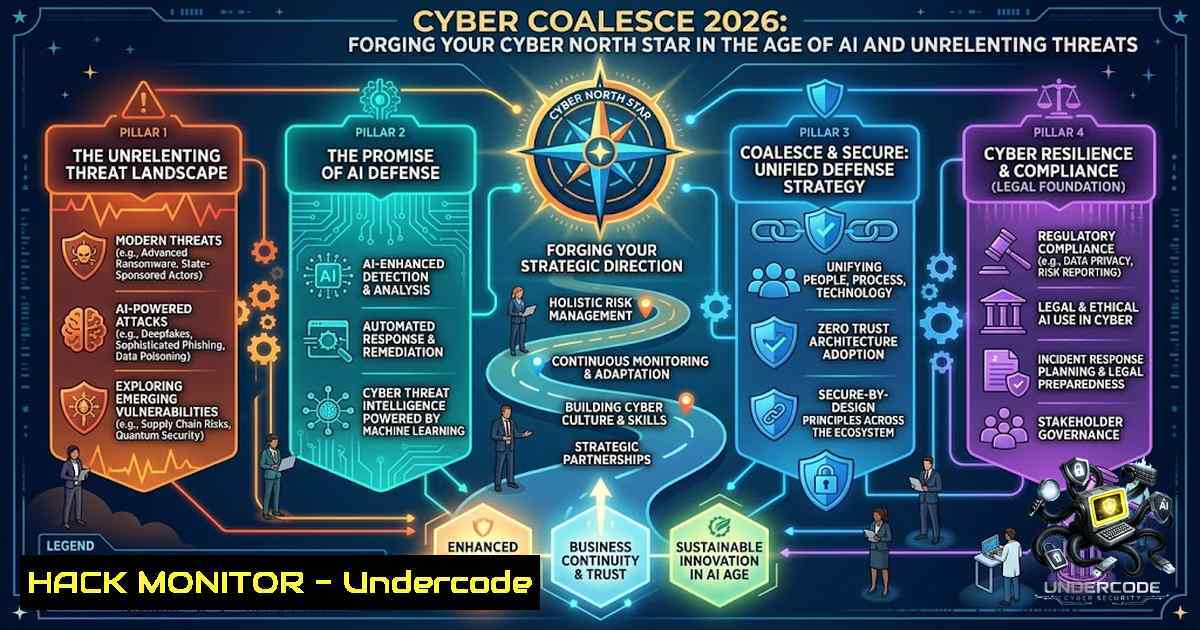
Introduction:
As organizations hurtle toward an AI-first future, the cybersecurity landscape is undergoing a seismic shift where traditional defense-in-depth strategies are no longer sufficient. The inaugural Cyber Coalesce 2026 in Bengaluru, themed “Finding your North Star,” challenges leaders to move beyond reactive security postures and instead architect a resilient, trust-centric framework that aligns cyber resilience with business growth. This article distills the core principles from this seminal event into a actionable technical blueprint, bridging the gap between visionary strategy and hardened execution across cloud, AI, and identity domains.
Learning Objectives:
- Master the implementation of a “Cyber North Star” framework that translates high-level business objectives into measurable security controls and Zero Trust architecture.
- Acquire hands-on techniques for hardening AI pipelines, securing API ecosystems, and automating threat intelligence using Linux and Windows command-line utilities.
- Develop a resilient incident response playbook that integrates design-thinking principles to minimize dwell time and business impact from sophisticated cyberattacks.
You Should Know:
- Defining and Deploying Your Cyber North Star: A Strategic Technical Framework
The “North Star” concept in cybersecurity is not merely an abstract vision but a tangible, business-aligned objective that anchors every security decision. At Cyber Coalesce 2026, leaders emphasized that this guiding principle must bridge the gap between the C-suite’s risk appetite and the security team’s technical execution. To operationalize this, organizations must establish a clear security mission tied to quantifiable outcomes, such as reducing Mean Time to Detect (MTTD) or achieving a specific compliance threshold.
Step-by-Step Guide to Establishing Your North Star:
- Conduct a Business Impact Analysis (BIA): Identify critical assets (crown jewels) and map the financial and operational impact of their compromise. Use tools like Microsoft’s Threat Modeling Tool or OWASP Threat Dragon to create data flow diagrams.
- Define Quantifiable Security Objectives (QSOs): Instead of vague goals like “improve security,” set QSOs such as “Achieve 99.9% coverage of CISA KEV (Known Exploited Vulnerabilities) patching within 48 hours of disclosure.”
- Map Controls to Frameworks: Align your QSOs with NIST CSF 2.0 or ISO 27001:2022. For example, to achieve the patching QSO, implement automated patch management using Windows Server Update Services (WSUS) or Linux’s Unattended Upgrades.
– Linux Command (Automated Patching): `sudo apt-get update && sudo apt-get upgrade -y` (Debian/Ubuntu) or `sudo dnf update -y` (RHEL/CentOS). To automate, configure /etc/apt/apt.conf.d/20auto-upgrades.
– Windows Command (Check Patch Status): `wmic qfe list brief /format:table` (lists all installed updates).
4. Establish a Cyber Resilience Scorecard: Develop a dashboard (using Splunk, Elastic, or Power BI) that tracks these QSOs in real-time, providing a single pane of glass for leadership to gauge the “health” of the North Star strategy.
- Securing the AI Pipeline: From Model Training to Inference
The integration of AI into business processes introduces a massive attack surface, from poisoned training data to adversarial prompt injection. The Cyber North Star for Emerging Technologies, as discussed by Deloitte partners, mandates that security be embedded from the design stage of AI projects. This requires a shift-left approach to AI security, treating model weights and training datasets as critical infrastructure.
Step-by-Step Guide to Hardening Your AI/ML Pipeline:
- Secure the Data Lake: Implement strict access controls to training data repositories. Use Azure Role-Based Access Control (RBAC) or AWS IAM policies to enforce least privilege.
– Linux Command (Verify File Integrity): Use `sha256sum /path/to/training_data.csv` to generate a hash of datasets before and after ingestion to detect tampering.
2. Harden the Model Registry: Restrict access to model artifacts (e.g., in MLflow or S3). Implement code signing for models.
– Windows Command (Check Open Ports on ML Server): `netstat -ano | findstr :5000` (commonly used for MLflow) to ensure no unauthorized listeners.
3. Implement Input Validation and Sanitization: Deploy an AI firewall or use libraries like `langchain` with output parsers to validate user inputs and prevent prompt injection.
– Python Code Snippet (Basic Input Sanitization): `import re; user_input = re.sub(r'[^\w\s]’, ”, user_input)` to strip potentially malicious characters before feeding to the LLM.
4. Continuous Monitoring of Model Drift: Use tools like Evidently AI or WhyLabs to monitor model performance and data drift, which could indicate a poisoning attack. Automate alerts when accuracy drops below a defined threshold.
5. Apply Zero Trust for AI Agents: Adopt frameworks like Anthropic’s “Zero Trust for AI Agents,” which mandate that every API call made by an AI agent must be authenticated and authorized contextually. This involves implementing OAuth 2.0 or mTLS for inter-service communication.
- Cultivating Cyber Resilience and Digital Trust Through Design Thinking
Resilience is not just about surviving an attack; it’s about maintaining trust with customers and partners during and after a breach. The design-thinking workshops at Cyber Coalesce 2026 highlighted that effective security solutions must be user-centered to be adopted. A complex security protocol that hinders productivity will be bypassed, creating more risk. Therefore, resilience is a human-centered engineering challenge.
Step-by-Step Guide to Building a Human-Centric Resilience Program:
- Empathy Mapping for Incident Response: Conduct workshops where security, IT, and business units map out the “user journey” of an incident. Who is affected? What are their pain points? This helps design a response plan that minimizes friction for end-users.
- Gamified Tabletop Exercises: Move beyond traditional “slideware” drills. Use platforms like Immersive Labs or RangeForce to run interactive, gamified simulations that challenge teams to respond to realistic attack scenarios (e.g., ransomware, supply chain compromise).
- Automate Repetitive Response Tasks: Use SOAR (Security Orchestration, Automation, and Response) platforms like Palo Alto Cortex XSOAR or Splunk Phantom to automate low-level tasks (e.g., IP blocking, user isolation).
– Linux Command (Automated IP Blocking with iptables): sudo iptables -A INPUT -s $MALICIOUS_IP -j DROP. This can be triggered by a SOAR playbook upon alert.
– Windows Command (Automated User Account Disable): `net user $USERNAME /active:no` (to be executed via a secure script or PowerShell Remoting).
4. Build a “Digital Trust” Dashboard: Create a public-facing or internal dashboard that transparently displays security posture (e.g., uptime, number of incidents resolved, compliance status). This fosters trust by demonstrating accountability.
- Strengthening the API Attack Surface: The Glue of Modern Infrastructure
APIs are the backbone of modern applications and AI agents, yet they are frequently the weakest link. With the proliferation of microservices, the attack surface has expanded exponentially. A single misconfigured API can expose sensitive data or allow unauthorized access to backend systems.
Step-by-Step Guide to API Security Hardening:
- Discover and Inventory All APIs: Use tools like Postman or SwaggerHub to maintain a living inventory of all internal and external APIs. Automate discovery using network scanning tools.
– Linux Command (Network Scan for Open Ports): `nmap -sV -p 80,443,8080,8443 192.168.1.0/24` to identify potential API endpoints.
2. Implement Robust Authentication and Authorization: Use OAuth 2.0 with PKCE (Proof Key for Code Exchange) for public clients. For server-to-server, use mTLS or API Keys with short lifespans.
– Curl Command (Test API with OAuth2 Bearer Token): `curl -X GET “https://api.example.com/data” -H “Authorization: Bearer $ACCESS_TOKEN”`
3. Enforce Rate Limiting and Throttling: Prevent brute-force and DDoS attacks by implementing rate limiting at the API gateway (e.g., Kong, NGINX, or AWS API Gateway).
– NGINX Configuration Snippet: `limit_req_zone $binary_remote_addr zone=mylimit:10m rate=5r/s;` (limits requests to 5 per second per IP).
4. Validate and Sanitize Input: Always validate incoming data against a strict schema. Use JSON Schema or Protobuf validation to reject malformed payloads.
5. Monitor API Traffic Anomalies: Use ELK Stack or Datadog to monitor API logs for anomalies (e.g., a sudden spike in 403 errors, unusual payload sizes). Set up alerts for suspicious patterns.
5. Harnessing Threat Intelligence for Proactive Defense
Proactive threat intelligence is critical to staying ahead of adversaries. The Cyber North Star for Resilience requires a shift from reactive patching to predictive defense, leveraging threat feeds and behavioral analytics to anticipate attacks.
Step-by-Step Guide to Operationalizing Threat Intelligence:
- Integrate Threat Feeds: Subscribe to reputable threat intelligence feeds (e.g., AlienVault OTX, MISP, CISA’s Automated Indicator Sharing (AIS)). Automate the ingestion of these feeds into your SIEM or firewall.
- Automate Indicator of Compromise (IoC) Blocking: Use scripts to automatically update firewall rules or endpoint detection tools with new IoCs.
– Linux Command (Curl to fetch and apply IP blocklist): `curl -s https://feeds.example.com/blocklist.txt | while read IP; do sudo iptables -A INPUT -s $IP -j DROP; done`
– Windows PowerShell (Add to Windows Firewall): `$ips = (Invoke-WebRequest -Uri “https://feeds.example.com/blocklist.txt”).Content.Split(); foreach ($ip in $ips) { New-1etFirewallRule -DisplayName “Block $ip” -Direction Inbound -RemoteAddress $ip -Action Block }`
3. Implement User and Entity Behavior Analytics (UEBA): Deploy a UEBA tool (e.g., Exabeam, Splunk UBA) to establish baselines of normal user behavior and detect anomalies (e.g., a user logging in from an unusual location at 3 AM).
4. Threat Hunting: Proactively search for threats that have evaded detection. Use KQL (Kusto Query Language) in Azure Sentinel or SPL in Splunk to query for suspicious patterns.
– Example SPL Query: `index=main sourcetype=WinEventLog:Security EventCode=4624 Logon_Type=10 | stats count by Account_Name, Source_Network_Address | where count > 10` (detects multiple interactive logons from a single IP).
What Undercode Say:
- Key Takeaway 1: The “North Star” is not a buzzword but a critical strategic tool that transforms cybersecurity from a cost center into a business enabler. By anchoring security decisions to clear, quantifiable business objectives, organizations can justify investments, measure effectiveness, and demonstrate tangible value to stakeholders.
- Key Takeaway 2: In the age of AI, security cannot be an afterthought. The attack surface is expanding at machine speed, and traditional perimeter-based defenses are obsolete. Organizations must embed Zero Trust principles into every layer of their AI pipeline and API ecosystem, using automation and threat intelligence to maintain resilience. The human element, however, remains paramount; security solutions must be designed with the end-user in mind to ensure adoption and effectiveness.
Prediction:
- -1: The rapid adoption of Agentic AI without commensurate security controls will lead to a surge in sophisticated supply chain attacks and data breaches, as adversaries will exploit the inherent complexity and “black box” nature of AI models.
- +1: The “North Star” framework, championed by events like Cyber Coalesce, will become the industry standard for aligning cybersecurity with business strategy, leading to more resilient and trustworthy digital ecosystems.
- -1: Organizations that fail to implement automated patch management and real-time threat intelligence will struggle to keep pace with the velocity of zero-day exploits, resulting in prolonged dwell times and increased remediation costs.
- +1: The integration of design-thinking into cybersecurity will revolutionize incident response, making it more efficient, less disruptive, and more empathetic to the needs of the business and its customers.
▶️ Related Video (76% Match):
🎯Let’s Practice For Free:
🎓 Live Courses & Certifications:
Join Undercode Academy for Verified Certifications
🚀 Request a Custom Project:
Secure, high-velocity infrastructure and disruptive technological engineering. Contact our engineering team for high-tier development and proprietary systems:
[email protected]
💎 Smart Architecture | 🛡️ Secure by Design | ⭐ Trusted by Thousands
IT/Security Reporter URL:
Reported By: Cybercoalesce2026 Coalesce – Hackers Feeds
Extra Hub: Undercode MoN
Basic Verification: Pass ✅


