Listen to this Post
Introduction:
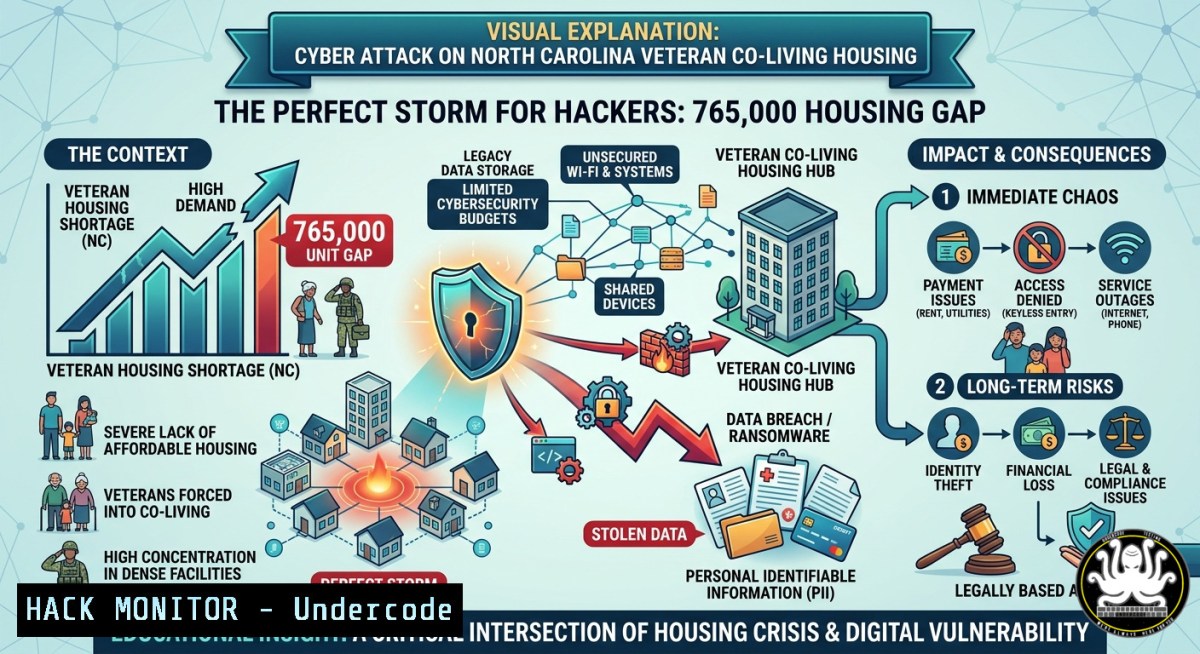
The TerraNova Alliance’s North Carolina Veteran Co-Living Initiative, while addressing a critical housing gap of 765,000 units for over 800,000 veterans in the state, inadvertently creates a prime target for cyber criminals. Housing providers are being forced to collect and store vast amounts of sensitive Personally Identifiable Information (PII)—including Social Security numbers, income verification for VA loans, and medical records related to veteran healthcare—making them irresistible targets for ransomware gangs like Qilin, which recently attacked a Georgia housing authority serving veterans, leaking payroll spreadsheets and utility reimbursement reports containing full names and addresses.
Learning Objectives:
- Identify the top three cyber threats targeting veteran housing and real estate developers in 2026
- Implement NIST SSDF secure software development practices for housing management platforms
- Apply step-by-step mitigation techniques against deepfake voice impersonation and BEC attacks
- Execute Linux and Windows commands for log analysis and ransomware detection
- Develop an FTC Safeguards Rule compliance checklist for housing authorities
You Should Know:
- Housing Under Siege: The 765,000-Unit Gap as an Attack Vector
As of May 2026, North Carolina faces a staggering projected housing unit gap of 765,000 over the next five years, with over 800,000 veterans concentrated in the state. This creates intense pressure on housing developers to rapidly deploy digital platforms for application processing, income verification, and tenant management—often bypassing basic cybersecurity protocols. The Augusta Housing Authority breach, disclosed on February 9, 2026, exposed over 15,000 low-income families’ data, including tax preparation agreements, employee payroll spreadsheets with medical benefit deductions, and utility reimbursement reports revealing full names, addresses, and exact payment amounts. The Rockrose Development breach affected nearly 47,400 individuals with exposed Social Security numbers, passport numbers, and bank account details—a clear sign that real estate holds a treasure trove of high-value PII.
Step‑by‑Step Guide: Ransomware Detection and Log Analysis for Housing Platforms
To detect a potential Qilin-style ransomware intrusion (Ransomware-as-a-Service model targeting housing authorities), run these commands on your systems:
Linux Log Analysis (Check for suspicious file modifications and unusual processes):
 Check for recent file modifications in critical directories
find /var/www/html -type f -mtime -1 -ls

Monitor for suspicious processes with high CPU usage
ps aux --sort=-%cpu | head -20

Review authentication logs for brute-force attempts
sudo grep "Failed password" /var/log/auth.log | awk '{print $1,$2,$3,$9,$11}'

Search for Qilin-specific indicators (known file extensions used in 2026 campaign)
find / -name ".qilin" -o -name ".encrypted" 2>/dev/null
Windows PowerShell Commands for Anomaly Detection:
 Get list of recently modified files in user directories
Get-ChildItem -Path "C:\Users\" -Recurse | Where-Object {$_.LastWriteTime -gt (Get-Date).AddDays(-1)}

Check for suspicious scheduled tasks (common ransomware persistence)
Get-ScheduledTask | Where-Object {$_.State -ne "Disabled"} | Format-Table -AutoSize

Review Windows Event Log for failed logins (Event ID 4625)
Get-WinEvent -FilterHashtable @{LogName='Security'; ID=4625} | Select-Object TimeCreated, Message -First 20

Monitor network connections to known malicious IPs (use any threat intel feed)
netstat -an | findstr "ESTABLISHED"
Tutorial: Set up a simple honeypot on a housing management server using `python3 -m http.server 8080` to log unauthorized access attempts, then parse logs with grep -E "([0-9]{1,3}\.){3}[0-9]{1,3}" access.log | sort | uniq -c | sort -nr.
- Deepfake-Driven Real Estate Fraud: The $40 Billion Threat by 2027
By 2027, AI-generated fraud is projected to cost $40 billion annually. Deepfake technology can clone a veteran’s voice from a few seconds of audio found on social media and impersonate them during a video call to reroute wire transfers. The Canadian Anti-Fraud Centre has already reported a rise in deepfake videos used in real estate scams, with at least 32 properties in Ontario and B.C. targeted by title fraud schemes where impostors used fake IDs and stolen credentials to sell condos out from under rightful owners. Scammers are now using AI-generated videos of trusted realtors or lawyers to issue fraudulent wiring instructions, with the FBI reporting nearly 21,500 business email compromise cases resulting in over $2.9 billion in losses.
Step‑by‑Step Guide: Mitigating Deepfake and BEC Attacks in Housing Transactions
For Windows Systems (Outlook Rules and Email Header Analysis):
 Extract and analyze email headers for BEC indicators
$email = Get-OutlookInbox | Where-Object {$_.Subject -like "wire transfer"}
$email.Headers | Select-String "Return-Path","Received-SPF","Authentication-Results"

Create PowerShell script to flag emails with mismatched display names and sender addresses
Add-Type -AssemblyName Microsoft.Office.Interop.Outlook
$outlook = New-Object -ComObject Outlook.Application
$namespace = $outlook.GetNamespace("MAPI")
$inbox = $namespace.GetDefaultFolder(6)
$inbox.Items | ForEach-Object {
if ($<em>.SenderName -ne $</em>.SenderEmailAddress.Split('@')[bash]) {
Write-Host "Suspicious: $($<em>.SenderName) <$($</em>.SenderEmailAddress)>"
}
}
For Linux (DKIM, SPF, and DMARC Verification):
 Install email authentication tools
sudo apt-get install opendkim-tools

Verify SPF records for a domain (check if sender is authorized)
dig +short txt example.com | grep spf

Check DMARC policy (prevents domain spoofing)
dig +short _dmarc.example.com txt

Analyze email source for anomalies (run after saving email as .eml)
cat suspicious_email.eml | grep -E "Received:|From:|Return-Path:|Message-ID:"
Tutorial for Security Teams: Implement a “two-person approval” workflow for all wire transfers exceeding $5,000, using an out-of-band verification channel (phone call to a known number, not the one in the email). Train staff to use the “Can you turn your head slightly?” test during video calls—deepfakes often struggle with rapid, unexpected head movements.
- FTC Safeguards Rule Compliance: Why Housing Developers Are “Financial Institutions” Under the Law
The FTC Safeguards Rule applies to any business “significantly engaged” in providing financial products or services—including real estate settlement service providers handling escrow or title services, mortgage brokers, and even tax preparers. Non-compliance carries civil penalties up to $46,517 per violation per day. The rule requires a qualified individual to lead the security program, written risk assessments, and specific technical safeguards including access controls, encryption of PII both at rest and in transit, and continuous monitoring or annual penetration testing plus vulnerability assessments at least every six months.
Step‑by‑Step Guide: FTC Safeguards Rule Implementation Checklist for Housing Providers
- Designate a Qualified Individual (QI): Assign accountability for the information security program, reporting to senior leadership annually. Even solo operations with fewer than 5,000 customers must meet all technical controls.
- Conduct a Written Risk Assessment: Document risks to customer information across paper records, employee access patterns, and vendor interactions. Update this assessment regularly and maintain audit logs for all access to loan files and PII—including read-only access.
- Implement Access Controls: Limit who can access customer financial data. Use the principle of least privilege. For Linux systems, use:
sudo setfacl -m u:username: /path/to/sensitive/directory. For Windows:icacls "C:\HousingData" /deny "Domain\User:RX". - Encrypt PII at Rest and in Transit: For Linux, use LUKS for full-disk encryption:
sudo cryptsetup luksFormat /dev/sda5. For Windows, enable BitLocker via PowerShell:Manage-bde -on C: -UsedSpaceOnly -RecoveryPassword. For data in transit, enforce TLS 1.3 on web servers: Apache configurationSSLProtocol -all +TLSv1.3. - Deploy Continuous Monitoring or Penetration Testing: Install a SIEM solution. For small deployments, use Wazuh (open-source). Configure file integrity monitoring:
sudo /var/ossec/bin/ossec-control enable full. - Develop an Incident Response Plan: Test it annually with tabletop exercises. Include specific regulatory notification procedures—FHA-approved mortgagees must report suspected cyber incidents within 12 hours to HUD.
-
Secure Software Development for Housing Platforms: NIST SSDF Pillars
The NIST Secure Software Development Framework (SSDF) (SP 800-218) provides four practice groups to build security into housing management software from the start: Prepare the Organization (PO), Protect the Software (PS), Produce Well-Secured Software (PW), and Respond to Vulnerabilities (RV). This is critical for housing platforms that handle VA loan applications, income verifications, and veteran medical data—all of which are prime targets for attackers.
Step‑by‑Step Guide: Implementing NIST SSDF in Your Housing Development Pipeline
- PO (Prepare): Integrate security champions into development teams. Use threat modeling during sprint planning. For each user story, ask: “How could an attacker exploit this feature?”
- PS (Protect): Implement software supply chain security. Scan all third-party dependencies for known vulnerabilities: `npm audit –json > vulnerabilities.json` (Node.js) or `safety check –json` (Python).
- PW (Produce): Enforce secure coding standards. For Python, use Bandit:
bandit -r /path/to/code -f json -o bandit_report.json. For Java, use SpotBugs. Run static analysis in CI/CD pipeline (e.g., GitHub Actions or Jenkins). - RV (Respond): Establish a vulnerability disclosure program. Use `gitleaks detect –source . –report-format json` to scan for hardcoded secrets before each commit. Implement an SBOM (Software Bill of Materials) generation:
syft packages . -o json > sbom.json.
5. Military-to-Cybersecurity Career Pathways: Free Training for Veterans
The CyberSkills2Work program, funded by a $6 million NSA and CISA grant, offers free, fully online cybersecurity training to veterans, transitioning military personnel, and first responders. Three specialized training pathways are offered in 2026: Digital Forensics, Network Operations, and Technical Support. The IBM SkillsBuild program through the VA offers courses in cybersecurity, AI, cloud computing, and IT support. The University of West Florida’s CyberSkills2Work program offers free training for AI/ML Specialist and Cyber Defense Analyst roles. Microsoft’s MSSA program provides 17-week training in cloud development, cloud administration, and cybersecurity operations.
Step‑by‑Step Guide: Enrolling in Free Veteran Cybersecurity Training
 Step 1: Verify eligibility and apply
 Visit https://cyberskills2work.org to check for openings
 Applications close Dec 22, 2026 for many programs

Step 2: Prepare your environment for digital forensics training (recommended for veterans)
 Install CAINE (Computer Aided INvestigative Environment) forensic Linux distro
wget https://www.caine-live.net/download/caine14.iso
 Verify SHA256 checksum
sha256sum caine14.iso

Step 3: Set up a Windows forensic workstation (for Autopsy and FTK Imager)
 Download and install Autopsy (open-source digital forensics platform)
 https://www.autopsy.com/download/ (PowerShell)
Invoke-WebRequest -Uri "https://github.com/sleuthkit/autopsy/releases/download/autopsy-4.21.0/autopsy-4.21.0.zip" -OutFile "autopsy.zip"
Expand-Archive -Path autopsy.zip -DestinationPath "C:\Tools\Autopsy"

Step 4: Join the CyberSkills2Work Employers Network for job placement support
What Undercode Say:
- Key Takeaway 1: The housing gap creates a “security by urgency” disaster where developers deploy platforms without proper encryption or monitoring, making them soft targets. The Qilin ransomware attack on Augusta Housing Authority in February 2026 shows how quickly a RaaS gang can exfiltrate and leak PII for 15,000+ families.
- Key Takeaway 2: Deepfake and BEC attacks are the most underrated threats to housing transactions. A single deepfake video call can reroute hundreds of thousands of dollars. The lack of specific federal deepfake legislation in the U.S. means legal frameworks are lagging far behind the technology, requiring organizations to implement out-of-band verification protocols immediately.
Prediction:
By Q3 2026, we will see the first major class-action lawsuit against a North Carolina housing developer for failure to comply with the FTC Safeguards Rule, following a breach of veteran PII similar to the Rockrose or AHA incidents. The convergence of state-level housing shortages, federal compliance deadlines (full enforcement since June 2023), and the rise of AI-driven fraud will force the real estate industry to adopt cybersecurity standards comparable to healthcare. Within 18 months, cyber insurance for housing developers will require proof of NIST SSDF implementation and regular penetration testing—or policies will become unaffordable. The veteran co-living sector, with its concentrated PII, will become a test case for how critical infrastructure security applies to housing. Expect a surge in demand for military-trained cybersecurity professionals to fill this gap, with programs like CyberSkills2Work expanding to meet the need.
▶️ Related Video (76% Match):
🎯Let’s Practice For Free:
IT/Security Reporter URL:
Reported By: Marketdemand Veteranhousing – Hackers Feeds
Extra Hub: Undercode MoN
Basic Verification: Pass ✅


