Listen to this Post
Introduction:
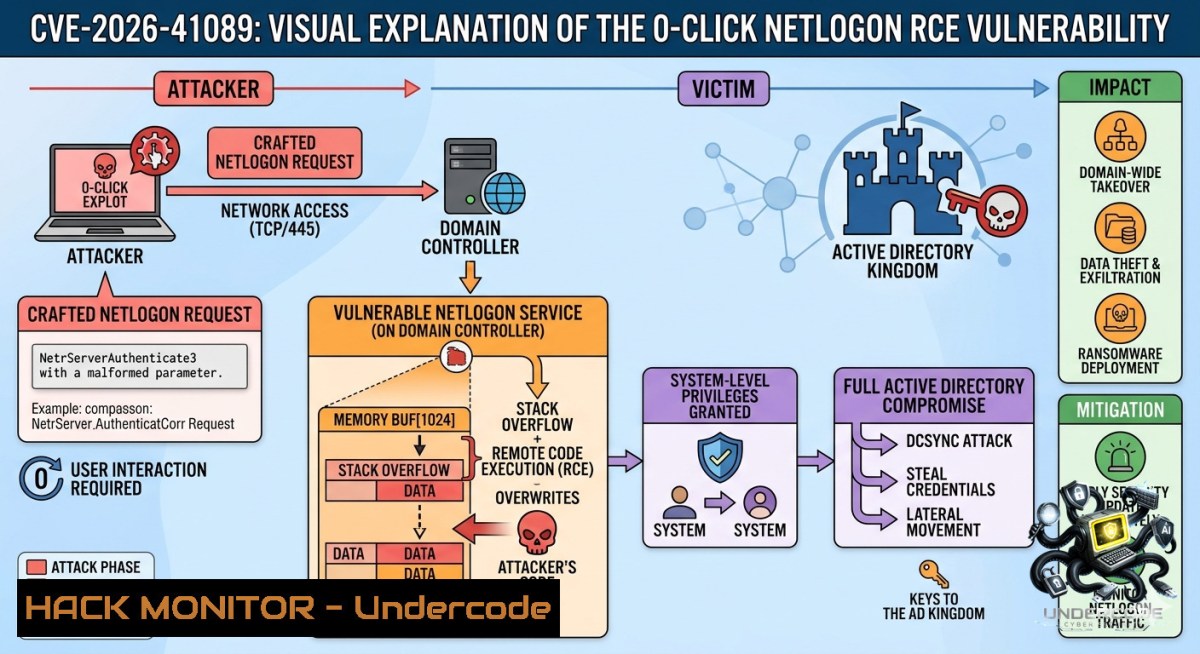
The Windows Netlogon service, the crown jewel of Active Directory authentication, is under active assault. A critical stack-based buffer overflow vulnerability, designated CVE-2026-41089, allows any unauthenticated remote attacker to execute arbitrary code with SYSTEM-level privileges on a domain controller via a single, malformed network packet. With a near-perfect CVSS score of 9.8, this 0-click pre-authentication Remote Code Execution (RCE) flaw represents the most severe threat to identity infrastructure since the infamous ZeroLogon, and it is currently being weaponized in the wild.
Learning Objectives:
- Analyze the Root Cause: Understand the stack-based buffer overflow vulnerability in the `NetrServerAuthenticate3` RPC function and why inadequate input validation leads to complete system compromise.
- Implement Operational Mitigations: Learn to identify vulnerable systems, deploy the official patch, apply temporary workarounds, and hunt for signs of active exploitation using both GUI and command-line methods.
- Master Active Defense: Integrate network-level detection, PowerShell auditing, and Sigma-based SIEM rules to create a layered defense strategy against exploitation attempts.
You Should Know:
- Technical Deep Dive: From a Malformed Packet to Domain Admin
CVE-2026-41089 is a memory corruption flaw stemming from a classic stack-based buffer overflow (CWE-121) within the `NetrServerAuthenticate3` function of the Netlogon Remote Protocol (MS-1RPC). The service fails to validate the length of the `ComputerName` parameter before copying it into a fixed-size stack buffer, allowing a remote, unauthenticated attacker to overwrite the return address and redirect execution flow to malicious shellcode.
Step-by-step guide explaining what this does and how to use it:
Because the exploit grants immediate SYSTEM privileges, an attacker can disable security controls, dump the NTDS.dit database (containing all domain hashes), and deploy ransomware across the entire network without leaving a single log entry on the compromised endpoint.
Lab Simulation (Educational Use Only):
To understand the impact, security researchers can simulate the overflow using a vulnerable Windows Server 2019/2022 domain controller in an isolated lab environment.
– Tools: Python (Scapy or Impacket) and a Windows Debugger (WinDbg).
– Conceptual Attack Vector:
 Example Python Pseudocode using Impacket-like structure
from impacket.dcerpc.v5 import nrpc
from impacket.dcerpc.v5.transport import DCERPCTransportFactory

Connect to the target DC's Netlogon RPC endpoint
target = r'\10.10.10.10'
transport = DCERPCTransportFactory(f'ncacn_ip_tcp:{target}[bash]')
transport.connect()
dce = transport.DCERPC_class(transport)
dce.bind(nrpc.MSRPC_UUID_NRPC)

Craft a malicious ComputerName string larger than the 512-byte stack buffer.
 The overflow overwrites the return address on the stack.
evil_computer_name = b"A"  600 + b"\x90"100 + shellcode

Send the malicious request to the vulnerable function.
try:
resp = nrpc.hNetrServerAuthenticate3(dce, evil_computer_name, ...)
except Exception as e:
print("Exploit attempt sent. Checking for reverse shell...")
2. Immediate Patching and Vulnerability Assessment
The only complete mitigation is applying the May 2026 Patch Tuesday security update released by Microsoft. Patches are available for all affected versions of Windows Server from 2012 onward.
Step-by-step guide explaining what this does and how to use it:
– Automated Patch Management: Use enterprise tools like Windows Server Update Services (WSUS) or Microsoft Endpoint Configuration Manager to approve and deploy the May 2026 cumulative update across all domain controllers immediately.
– Manual PowerShell Verification: After patching, run the following script to audit your domain controllers and ensure they are no longer vulnerable.
 Run this in PowerShell ISE or console as Domain Admin
$DomainControllers = Get-ADDomainController -Filter  | Select-Object -ExpandProperty Name

foreach ($DC in $DomainControllers) {
 Check for missing updates related to CVE-2026-41089 using the May 2026 KB number
$session = New-CimSession -ComputerName $DC
$hotfix = Get-CimInstance -CimSession $session -ClassName Win32_QuickFixEngineering |
Where-Object { $<em>.HotFixID -like "MAY2026" -or $</em>.Description -like "KB5012345" }
if ($hotfix) {
Write-Host "[+] $DC : PATCHED" -ForegroundColor Green
} else {
Write-Host "[!] $DC : VULNERABLE - Immediate action required!" -ForegroundColor Red
}
}
– Temporary Network Workaround: If patching is delayed, restrict inbound traffic to TCP/UDP port 135 and dynamic RPC high ports (49152-65535) to only authorized management workstations. Alternatively, enable the Netlogon RPC hardening registry key (CVE-2025-49716) as a temporary mitigation.
3. Proactive Threat Hunting and Detection
Active exploitation in the wild requires SOC teams to hunt for anomalies immediately. Suspicious Netlogon RPC calls targeting the `NetrServerAuthenticate3` or `NetrServerReqChallenge` functions indicate an attack in progress.
Step-by-step guide explaining what this does and how to use it:
– Windows Event Log Analysis (PowerShell): Monitor Security logs for Event ID 4624 (logon) and 4672 (admin logon) that occur immediately after anomalous Netlogon traffic. A compromised DC will show suspicious process creations from `lsass.exe` or netlogon.dll.
 Query Security event log for suspicious logons after a potential Netlogon overflow
Get-WinEvent -FilterHashtable @{LogName='Security'; ID=4624} |
Where-Object { $<em>.Message -match "Logon Type:\s3" -and $</em>.TimeCreated -gt (Get-Date).AddHours(-72) } |
Select-Object TimeCreated, @{Name='TargetUser';Expression={$<em>.Properties[bash].Value}},
@{Name='Workstation';Expression={$</em>.Properties[bash].Value}},
@{Name='Process';Expression={$_.Properties[bash].Value}}
– Signature-Based Detection (Suricata/Snort): Deploy community-driven Suricata signatures that inspect traffic on port 135 for abnormally long `ComputerName` strings. A signature from the Sigma repository detects crafted traffic intended to exploit CVE-2026-41089.
– SIEM Integration (Sigma Rule): Convert and import Sigma rules for CVE-2026-41089 into your SIEM (Splunk, Sentinel, or QRadar). The official Sigma rule for this CVE focuses on detecting anomalous Netlogon event logs and buffer overflow patterns.
- Forensic Triage and Indicator of Compromise (IoC) Collection
If you suspect a domain controller has been compromised, immediate forensic triage is essential to determine the scope of the breach.
Step-by-step guide explaining what this does and how to use it:
– Command Line Triage: Run these commands on the suspected domain controller to capture a snapshot of its current state.
REM Capture a process list to identify suspicious children of lsass.exe
tasklist /svc /fo csv > C:\Forensics\process_list.csv

REM Query the Windows Firewall log for anomalous inbound connections on port 135
wevtutil qe "Microsoft-Windows-Windows Firewall With Advanced Security/Firewall" /f:text /c:50 > C:\Forensics\firewall_log.txt

REM Use netsh to dump the current RPC port configuration
netsh rpc show > C:\Forensics\rpc_config.txt

REM Check for new, unauthorized user accounts created in the last 24 hours
net user /domain > C:\Forensics\domain_users.txt
– Memory Analysis (Volatility): Use Volatility 3 to analyze a memory dump of the affected DC. Look for injected code within the Netlogon process (netlogon.dll). A key indicator is an anomalous thread stack that points to executable memory regions outside the normal module range.
5. Building a Resilient Defense Strategy
The exploitation of CVE-2026-41089 underscores the critical need for defense-in-depth strategies beyond patching, focusing on identity protection and network segmentation.
Step-by-step guide explaining what this does and how to use it:
– Implement the Principle of Least Privilege: Immediately review and remove any unnecessary administrative accounts. Use Group Policy to enforce Local Administrator Password Solution (LAPS) to prevent lateral movement using local admin credentials.
– Enable Windows Defender Credential Guard: This hardware-based virtualization security feature isolates the Local Security Authority (LSA) process, preventing attackers who gain SYSTEM access from dumping NT hashes directly from memory.
– Review and Harden Netlogon Settings: Apply the Netlogon RPC sealing and signing requirements as a group policy. This forces secure RPC channels and can mitigate some forms of Netlogon abuse, even if the buffer overflow is triggered.
What Undercode Say:
- Key Takeaway 1: CVE-2026-41089 is a “patch now” event, not a “patch soon” event. A single unpatched domain controller is a ticking time bomb that can lead to a complete Active Directory takeover within minutes.
- Key Takeaway 2: The shift from a cryptographic bypass (ZeroLogon) to a direct memory corruption flaw (CVE-2026-41089) is a worrying trend. It demonstrates that authentication services remain a prime target and that input validation failures at the most fundamental level continue to plague critical Windows components.
The weaponization of this vulnerability is a sobering reminder that in the Active Directory kill chain, the path to total compromise is often just one malicious RPC packet away. Defenders must shift from a reactive to a predictive security posture, treating every domain controller as a potential blast radius and implementing multi-layered detective controls as a matter of urgency.
Prediction:
- -1: Expect an explosive increase in ransomware activity targeting small and medium enterprises (SMEs) over the next 6-12 months, as automated attack toolkits integrating CVE-2026-41089 are sold on darknet forums, making privilege escalation trivial for low-skilled threat actors.
- -1: The time-to-exploit for Netlogon vulnerabilities will continue to shrink. Microsoft’s assessment of “less likely” will be proven dangerously optimistic, forcing organizations to adopt real-time vulnerability detection and automated patch deployment as the new baseline for identity infrastructure security.
- +1: This vulnerability will accelerate the industry’s inevitable migration towards “passwordless” and hardware-anchored authentication mechanisms (like FIDO2/WebAuthn) and cloud-1ative identity providers (Entra ID), as the risks and operational costs of maintaining on-premises legacy protocols like Netlogon become unsustainable.
▶️ Related Video (78% Match):
🎯Let’s Practice For Free:
🎓 Live Courses & Certifications:
Join Undercode Academy for Verified Certifications
🚀 Request a Custom Project:
Secure, high-velocity infrastructure and disruptive technological engineering. Contact our engineering team for high-tier development and proprietary systems:
[email protected]
💎 Smart Architecture | 🛡️ Secure by Design | ⭐ Trusted by Thousands
IT/Security Reporter URL:
Reported By: Cybersecuritynews Windows – Hackers Feeds
Extra Hub: Undercode MoN
Basic Verification: Pass ✅


