
Listen to this Post
Introduction:
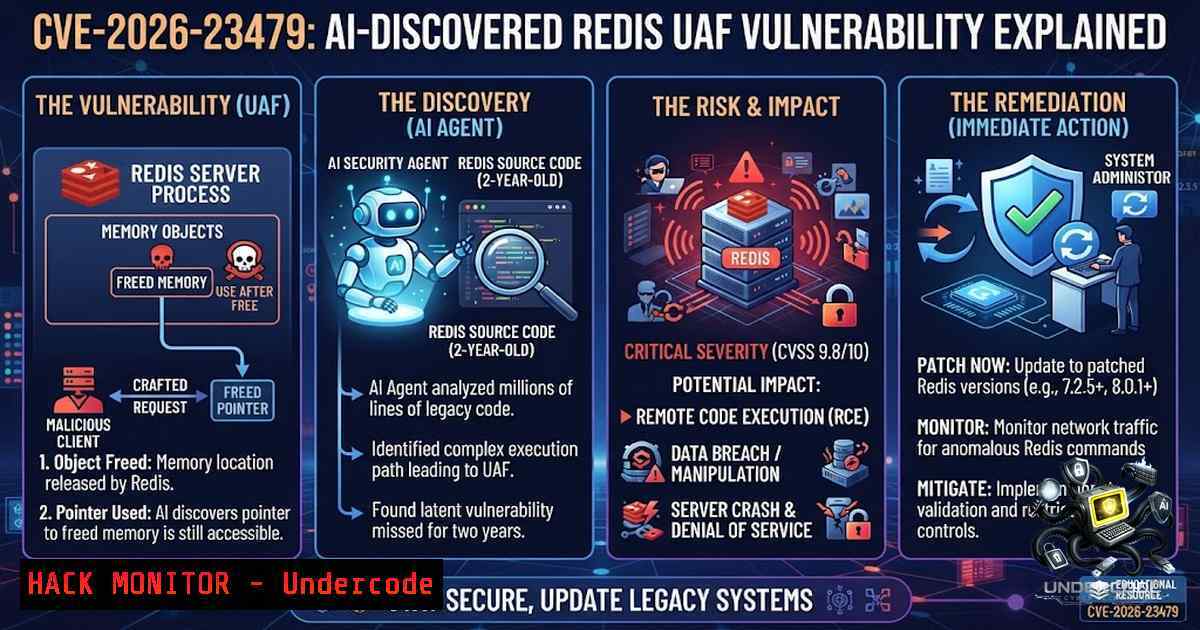
A critical use-after-free (UAF) vulnerability has been discovered in Redis, the world’s most widely deployed in-memory data structure store, affecting versions from 7.2.0 through 8.6.2. Discovered by Xint Code, a fully autonomous AI-powered security analysis tool, and publicly demonstrated at ZeroDay.Cloud 2025, CVE-2026-23479 allows an authenticated attacker to execute arbitrary operating system commands on the Redis host. What makes this vulnerability particularly alarming is its persistence—it remained hidden in stable Redis releases for nearly two years, and as of this writing, no public proof-of-concept has been released.
Learning Objectives:
- Understand the technical root cause of CVE-2026-23479 and the use-after-free mechanism in Redis’s blocking-client code path
- Learn to identify vulnerable Redis deployments using safe, read-only version checking tools
- Master the three-stage exploit chain from heap address leakage to function pointer overwrite
- Implement effective mitigation strategies including patching, ACL hardening, and network isolation
- Deploy detection mechanisms using Sigma rules and system monitoring to identify potential exploitation attempts
1. Understanding the Vulnerability: The `unblockClientOnKey()` Use-After-Free
The vulnerability resides in the `unblockClientOnKey()` function inside src/blocked.c—the code responsible for waking clients that have been blocked waiting for data on a key (for example, a client blocked on `BLPOP` waiting for an element to appear in a list).
The Technical Breakdown:
When a blocked client is re-executing a command, the `unblockClientOnKey()` function calls `processCommandAndResetClient()` without properly checking whether the client was freed as a side effect. If the blocked client is evicted during this flow, the function continues to hold a pointer to freed memory and dereferences it—producing a classic use-after-free condition.
Affected Versions:
| Release Series | Affected Versions | Fixed Version |
||||
| Redis 7.2.x | 7.2.0 – 7.2.13 | 7.2.14 |
| Redis 7.4.x | 7.4.0 – 7.4.8 | 7.4.9 |
| Redis 8.2.x | 8.2.0 – 8.2.5 | 8.2.6 |
| Redis 8.4.x | 8.4.0 – 8.4.2 | 8.4.3 |
| Redis 8.6.x | 8.6.0 – 8.6.2 | 8.6.3 |
Required Permissions to Exploit:
Triggering the bug requires an authenticated session with specific permissions:
– `CONFIG SET maxmemory-clients` (tune client memory limits)
– Lua execution via `EVAL`
– Stream commands (XREAD, XADD)
– Basic SET/GET operations
In ACL terms, this translates to @admin, @scripting, @stream, and @read/@write. In a default Redis deployment, the default user holds all these privileges, making most deployments vulnerable out of the box.
Safe Version Checking:
To determine if your Redis instance is vulnerable without triggering the exploit, use the safe, read-only version checker:
 Clone the checker repository
git clone https://github.com/pduggusa/redis-cve-2026-23479-check.git
cd redis-cve-2026-23479-check

Run the check (no dependencies beyond Python 3)
python3 check.py <host> [-p PORT] [-a PASSWORD] [--user ACL_USER] [--tls] [--insecure]

Examples:
python3 check.py 127.0.0.1
python3 check.py redis.internal -p 6380 -a "$REDIS_PASSWORD"
python3 check.py redis.example.com --tls

Exit code 0 = patched/unaffected, Exit code 1 = vulnerable
python3 check.py "$REDIS_HOST" -a "$REDIS_PASSWORD" || echo "::warning::Redis needs the CVE-2026-23479 patch"
- The Three-Stage Exploit Chain: From Heap Leak to Code Execution
The exploit for CVE-2026-23479 follows a sophisticated three-stage chain that demonstrates the practical exploitability of this vulnerability.
Stage 1: Heap Address Leakage
The attacker first triggers the use-after-free condition in a controlled manner to leak a heap address. This is accomplished by manipulating Redis’s memory accounting mechanisms. The leaked address reveals the memory layout of the Redis server process, providing the attacker with critical information needed for subsequent stages.
Stage 2: Client Structure Replacement
With the heap layout known, the attacker frees a legitimate client structure and then crafts a fake client structure in the same memory location. This is achieved through precise memory manipulation using Redis commands that allocate and free memory in predictable patterns.
Stage 3: Function Pointer Overwrite and RCE
The final stage turns Redis’s own memory accounting against itself. The attacker overwrites a function pointer within the fake client structure, redirecting execution flow to attacker-controlled code. When Redis subsequently calls the overwritten function pointer, the attacker’s code executes with the privileges of the Redis server process—typically running as root or a privileged user.
CVSS Score: 8.8 (High) per NVD, 7.7 per Redis
Attack Vector: Network-accessible, requiring Low privileges
3. Mitigation Strategies: Patch, Isolate, and Harden
Immediate Patching (Highest Priority):
Upgrade Redis to the patched versions released on May 5, 2026:
 For Debian/Ubuntu systems
sudo apt-get update
sudo apt-get install redis-server=8.6.3

For RHEL/CentOS/Fedora
sudo yum update redis

For Alpine Linux
apk add --upgrade redis=8.6.3-r0

Verify the version after upgrade
redis-server --version
If Immediate Patching Is Not Possible:
Option 1: Restrict Network Access
Block access to Redis ports (default 6379) from untrusted networks using iptables:
 Allow only specific trusted IP addresses
sudo iptables -A INPUT -p tcp --dport 6379 -s 192.168.1.0/24 -j ACCEPT
sudo iptables -A INPUT -p tcp --dport 6379 -j DROP

For Redis Cluster bus (port 16379)
sudo iptables -A INPUT -p tcp --dport 16379 -s 192.168.1.0/24 -j ACCEPT
sudo iptables -A INPUT -p tcp --dport 16379 -j DROP

Save rules (Ubuntu/Debian)
sudo iptables-save > /etc/iptables/rules.v4

Save rules (RHEL/CentOS)
sudo service iptables save
Option 2: Enable Redis Authentication and ACLs
Configure Redis to require authentication:
 Edit redis.conf
sudo nano /etc/redis/redis.conf

Set a strong password for the default user
requirepass your_very_strong_password_here

Or use ACL-based authentication (Redis 6.0+)
aclfile /etc/redis/users.acl

Create an ACL file with least privilege
cat > /etc/redis/users.acl << EOF
user default on nopass ~ & +@all
user app on >strong_password ~app: +@read +@write +@stream -@admin -@scripting
user monitoring on >monitor_pass ~ +INFO +1ING
EOF
Option 3: Disable Dangerous Command Categories
Prevent the exploitation chain by blocking the required command categories:
 In redis.conf or via ACL
 Block CONFIG command entirely
rename-command CONFIG ""

Or use ACL to restrict
user default on >password -@admin -@scripting +@read +@write

Restart Redis after configuration changes
sudo systemctl restart redis-server
4. Detection and Monitoring
Sigma Rule for Exploitation Detection:
A host-based Sigma rule has been developed to catch the outcome of any Redis RCE exploitation:
 redis-cve-2026-23479.sigma.yml
title: Redis CVE-2026-23479 RCE Detection
status: experimental
description: Detects potential exploitation of CVE-2026-23479 via suspicious process execution
references:
- https://github.com/pduggusa/redis-cve-2026-23479-check
logsource:
product: linux
service: auditd
detection:
selection:
- process.name: redis-server
- process.args:
- 'sh'
- 'curl'
- 'wget'
- 'nc'
- 'bash'
condition: selection
level: high
Monitoring Commands:
Monitor Redis logs for suspicious activity:
 Monitor Redis logs in real-time
sudo tail -f /var/log/redis/redis-server.log | grep -E "ERROR|WARNING|CONFIG|EVAL"

Check for unauthorized CONFIG changes
sudo grep "CONFIG" /var/log/redis/redis-server.log

Monitor for Lua script execution
sudo grep "EVAL" /var/log/redis/redis-server.log

Check for blocked client evictions (potential UAF trigger)
sudo grep -i "blocked" /var/log/redis/redis-server.log
Network Monitoring:
Detect unauthorized Redis connections:
 Monitor connections to Redis port
sudo tcpdump -i any port 6379 -1

Log all Redis connections
sudo iptables -A INPUT -p tcp --dport 6379 -j LOG --log-prefix "REDIS_CONN: "

Use netstat to identify active Redis connections
sudo netstat -tulpn | grep 6379
5. Windows-Specific Considerations for Redis Deployments
While Redis is primarily deployed on Linux, Windows deployments exist and require additional attention:
Windows Firewall Configuration:
 Block Redis port 6379 from untrusted networks
New-1etFirewallRule -DisplayName "Block Redis Port" -Direction Inbound -LocalPort 6379 -Protocol TCP -Action Block

Allow only specific IP ranges
New-1etFirewallRule -DisplayName "Allow Redis Internal" -Direction Inbound -LocalPort 6379 -Protocol TCP -RemoteAddress 192.168.1.0/24 -Action Allow

Block Redis Cluster bus port 16379
New-1etFirewallRule -DisplayName "Block Redis Cluster Bus" -Direction Inbound -LocalPort 16379 -Protocol TCP -Action Block
Redis Service Hardening on Windows:
 Check Redis service status
Get-Service Redis

Restart Redis after configuration changes
Restart-Service Redis

Check Redis logs (default location)
Get-Content "C:\Program Files\Redis\redis.log" -Tail 50
6. Cloud Environment Hardening
Wiz’s analysis reveals that 80% of cloud environments use Redis, and almost 85% are configured without a password. This significantly increases the attack surface.
AWS Security Group Rules:
{
"SecurityGroup": {
"IpPermissions": [
{
"IpProtocol": "tcp",
"FromPort": 6379,
"ToPort": 6379,
"UserIdGroupPairs": [
{"GroupId": "sg-application-servers"}
]
}
]
}
}
Azure Network Security Group:
 Restrict Redis port to specific subnets
$nsg = Get-AzNetworkSecurityGroup -1ame "redis-1sg"
Add-AzNetworkSecurityRuleConfig -1etworkSecurityGroup $nsg `
-1ame "AllowRedisInternal" `
-Priority 100 `
-Direction Inbound `
-Access Allow `
-Protocol Tcp `
-SourceAddressPrefix "10.0.0.0/8" `
-SourcePortRange "" `
-DestinationAddressPrefix "" `
-DestinationPortRange "6379"

Set-AzNetworkSecurityGroup -1etworkSecurityGroup $nsg
What Undercode Say:
- Key Takeaway 1: CVE-2026-23479 represents a critical wake-up call for the Redis community—a two-year-old vulnerability discovered not by human researchers but by an autonomous AI tool. This signals a paradigm shift in vulnerability research where AI-powered tools will increasingly outpace human discovery, making proactive security measures more critical than ever.
-
Key Takeaway 2: The “authenticated” requirement provides a false sense of security. With 85% of cloud Redis instances lacking password protection and default users holding all privileges, this vulnerability is effectively accessible to any attacker who can reach the Redis port.
-
Key Takeaway 3: The absence of a public PoC is a temporary reprieve, not a permanent shield. Organizations must patch now while they have the advantage of being “left of the boom”. The exploit chain has been demonstrated publicly at ZeroDay.Cloud 2025, and it is only a matter of time before weaponized exploits emerge.
-
Key Takeaway 4: Defense-in-depth is non-1egotiable. Network isolation, authentication, and least-privilege ACLs must work in concert. No single control is sufficient—layered security is the only effective approach against sophisticated memory corruption vulnerabilities.
-
Analysis: This vulnerability exposes fundamental tensions in modern infrastructure deployment. The convenience of “no password by default” that made Redis so popular is now its greatest liability. Organizations must balance developer productivity with security rigor, implementing automated scanning, continuous monitoring, and strict access controls. The AI-discovered nature of this bug also raises questions about the future of security research—as AI tools become more sophisticated, the gap between vulnerability discovery and patch deployment will need to narrow dramatically. The Redis security team’s response was exemplary (coordinated disclosure, prompt patching across all maintained branches), but the two-year window between introduction and discovery highlights the limitations of traditional security testing.
Prediction:
-
+1 The Redis ecosystem will see accelerated adoption of AI-powered security analysis tools in CI/CD pipelines, leading to faster vulnerability discovery and shorter exposure windows for critical flaws.
-
+1 This vulnerability will drive significant improvements in Redis default security configurations, with future versions likely enforcing authentication by default and implementing more restrictive ACL policies.
-
-1 Organizations that fail to patch within the next 30-60 days will face increasing exploitation attempts as threat actors reverse-engineer the demonstrated exploit chain and develop weaponized PoCs.
-
-1 The incident will trigger a wave of retrospective security audits across organizations running Redis, potentially uncovering additional misconfigurations and vulnerabilities that have been overlooked for years.
-
+1 Cloud providers will respond by implementing enhanced security guardrails for Redis deployments, including automated vulnerability scanning, default network isolation, and mandatory authentication requirements.
-
-1 The two-year discovery window highlights a systemic problem in open-source security—critical vulnerabilities can persist for years before detection, underscoring the need for more robust, continuous security testing methodologies.
-
+1 The success of AI-powered discovery of this vulnerability will accelerate investment in autonomous security research tools, potentially leading to a new era of proactive vulnerability identification before human researchers would typically find them.
▶️ Related Video (86% Match):
https://www.youtube.com/watch?v=4aaE5IdYZGI
🎯Let’s Practice For Free:
🎓 Live Courses & Certifications:
Join Undercode Academy for Verified Certifications
🚀 Request a Custom Project:
Secure, high-velocity infrastructure and disruptive technological engineering. Contact our engineering team for high-tier development and proprietary systems:
[email protected]
💎 Smart Architecture | 🛡️ Secure by Design | ⭐ Trusted by Thousands
IT/Security Reporter URL:
Reported By: Omar Aljabr – Hackers Feeds
Extra Hub: Undercode MoN
Basic Verification: Pass ✅


