
Listen to this Post
Introduction
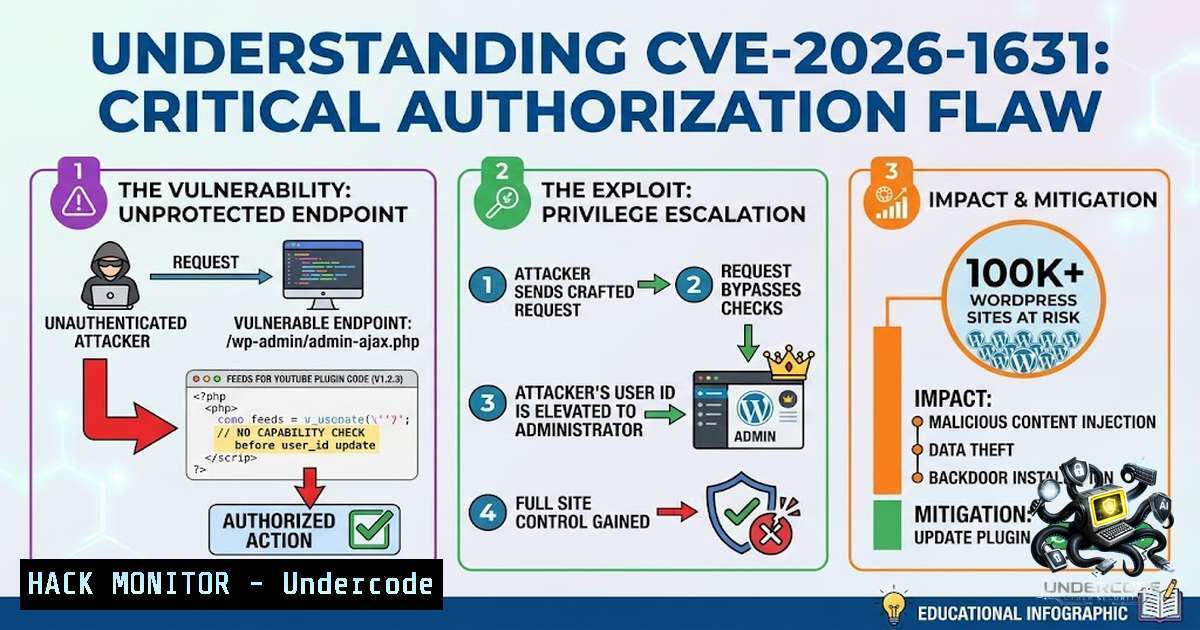
A critical security vulnerability discovered in the Feeds for YouTube WordPress plugin, tracked as CVE-2026-1631, exposes over 100,000 websites to unauthorized license key manipulation. This flaw allows any authenticated user—even those with the lowest subscriber-level privileges—to delete or modify the plugin’s license key, potentially disabling premium functionality and compromising site integrity.
Learning Objectives
- Understand the technical root cause of CVE-2026-1631 and its impact on WordPress licensing security
- Learn to identify vulnerable plugin versions and assess exploitation risk
- Master the step-by-step patching process and implement defensive hardening measures
You Should Know
- Understanding the Vulnerability: Missing Capability Check in AJAX Handler
The vulnerability resides in the `inc/Services/LicenseNotification.php` file, where the `sby_recheck_connection()` method is registered as a WordPress AJAX action (wp_ajax_sby_recheck_connection) without proper permission validation. This flaw allows any authenticated user with a subscriber role or higher to send a POST request that deletes the `sby_islicence_upgraded` and `sby_upgraded_info` license options, effectively rendering the license validation mechanism useless.
What This Means in Practice:
The plugin’s licensing system is designed to restrict premium features to valid license holders. By exploiting this vulnerability, an attacker with a simple subscriber account can:
- Delete the license key entirely, causing the plugin to lose its legitimate license status
- Potentially disable premium plugin functionality
- Gain unauthorized access to premium features
- Undermine the plugin’s integrity and potentially compromise the entire WordPress installation
Step-by-Step Guide: Understanding the Exploitation Flow
- Attacker Prerequisites: The attacker only needs a subscriber-level account on the target WordPress site—the most basic authenticated role.
-
The Attack Vector: The attacker sends a crafted POST request to the WordPress AJAX endpoint
wp_ajax_sby_recheck_connection. -
What Happens: The vulnerable plugin executes the `sby_recheck_connection()` function without checking if the user has administrative privileges.
-
License Key Deletion: The function deletes license-related options from the WordPress database, causing the plugin to believe no valid license exists.
-
Impact Realization: Premium features become inaccessible, or in some cases, the attacker may manipulate the license state to gain unauthorized access.
Verification Commands for System Administrators:
To check if your site is vulnerable, use the following commands:
 Check current plugin version via WP-CLI
wp plugin list --field=name,version | grep -i "feeds-for-youtube"

Alternative: Check via WordPress database
mysql -u [bash] -p -e "SELECT option_value FROM [bash].wp_options WHERE option_name = 'active_plugins'" | grep -i "youtube"

Check for the vulnerable AJAX action registration
grep -r "wp_ajax_sby_recheck_connection" /path/to/wp-content/plugins/feeds-for-youtube/
For Windows Server Administrators (PowerShell):
 Check plugin version via WP-CLI (if installed)
wp plugin list --field=name,version | Select-String "feeds-for-youtube"

Search for vulnerable code
Get-ChildItem -Path "C:\inetpub\wwwroot\wp-content\plugins\feeds-for-youtube\" -Recurse | Select-String "wp_ajax_sby_recheck_connection"
The Fix Implemented in Version 2.6.4:
The patch introduces two critical security checks:
// Added security validation
check_ajax_referer('sby-admin', 'nonce');
current_user_can('manage_options');
These additions ensure that:
- A valid nonce token is required for the AJAX request
- Only users with the `manage_options` capability (typically administrators) can modify license keys
2. The Technical Root Cause: CWE-862 Missing Authorization
This vulnerability is classified under CWE-862: Missing Authorization. The plugin fails to perform an authorization check when an actor attempts to access a resource or perform an action. This violates the principle of least privilege and aligns with ATT&CK technique T1068 (Exploitation for Privilege Escalation).
Step-by-Step Guide: Security Analysis and Code Review
- Identify the Vulnerable Code Pattern: Look for AJAX-registered functions that lack capability checks:
// VULNERABLE CODE (pre-2.6.4)
add_action('wp_ajax_sby_recheck_connection', 'sby_recheck_connection');
function sby_recheck_connection() {
// No capability check - ANY authenticated user can call this
delete_option('sby_islicence_upgraded');
delete_option('sby_upgraded_info');
wp_send_json_success();
}
2. Secure Code Pattern (2.6.4 and later):
// SECURE CODE (2.6.4+)
add_action('wp_ajax_sby_recheck_connection', 'sby_recheck_connection');
function sby_recheck_connection() {
// Validate nonce
check_ajax_referer('sby-admin', 'nonce');

// Verify user has administrative capabilities
if (!current_user_can('manage_options')) {
wp_send_json_error('Unauthorized');
return;
}

delete_option('sby_islicence_upgraded');
delete_option('sby_upgraded_info');
wp_send_json_success();
}
- Database Impact Analysis: The vulnerability manipulates the following database options:
-- Check if license options exist
SELECT option_name, option_value FROM wp_options
WHERE option_name IN ('sby_islicence_upgraded', 'sby_upgraded_info');

-- Monitor for unauthorized deletions (audit log recommended)
-- If these options are missing unexpectedly, investigate immediately
4. Recommended Monitoring Implementation:
 Create a monitoring script to detect license key tampering
!/bin/bash
 Check if license options exist
if ! wp option get sby_islicence_upgraded --skip-plugins --skip-themes &>/dev/null; then
echo "ALERT: License key may have been deleted! Investigate immediately."
 Send alert to security team
fi
3. CVSS Scoring and Risk Assessment
The vulnerability carries a CVSS base score of 5.4 (Medium) with the following vector:
- Attack Vector: Network (AV:N) – Remotely exploitable
- Attack Complexity: Low (AC:L) – Easy to execute
- Privileges Required: Low (PR:L) – Subscriber account sufficient
- User Interaction: None (UI:N) – No user action required
- Scope: Unchanged (S:U)
- Confidentiality Impact: None (C:N)
- Integrity Impact: Low (I:L) – License key deletion
- Availability Impact: Low (A:L) – Potential feature disruption
VulDB Meta Score: 6.3 (Base) / 6.0 (Temporal) – Classified as Critical
Current Exploit Price Estimate: $0-$5,000 – No public exploit exists, but technical details are available
4. Mitigation Strategies and Hardening
Immediate Actions Required:
- Update to Version 2.6.4 or Later – This is the primary and most effective mitigation
 Using WP-CLI to update
wp plugin update feeds-for-youtube

Using WP-CLI to check if update was successful
wp plugin status feeds-for-youtube

Verify version after update
wp plugin get feeds-for-youtube --field=version
- Restrict Subscriber-Level Access – Where possible, limit subscriber capabilities or implement role-based access controls
// Add to theme's functions.php or a custom plugin
// Remove subscriber ability to access admin-ajax.php for sensitive actions
add_action('init', function() {
if (current_user_can('subscriber') && wp_doing_ajax()) {
// Log and block suspicious AJAX requests
error_log('Subscriber AJAX request blocked: ' . $_REQUEST['action']);
wp_die('Unauthorized');
}
});
- Implement Additional Monitoring – Use security plugins that log and alert on unauthorized license key modifications
 Monitor WordPress options table for changes to license keys
 Add to wp-config.php for enhanced logging
define('WP_DEBUG', true);
define('WP_DEBUG_LOG', true);
define('WP_DEBUG_DISPLAY', false);

Then monitor the debug.log for license option changes
tail -f /path/to/wp-content/debug.log | grep -i "license|sby_"
- Review User Role Assignments – Audit all user accounts and minimize the attack surface
-- Check for suspicious subscriber accounts
SELECT user_login, user_email, user_registered
FROM wp_users
WHERE ID IN (SELECT user_id FROM wp_usermeta WHERE meta_key = 'wp_capabilities' AND meta_value LIKE '%subscriber%')
ORDER BY user_registered DESC;
- Apply Web Application Firewall (WAF) Rules – Block requests to the vulnerable AJAX endpoint
 .htaccess rule to block wp_ajax_sby_recheck_connection
<IfModule mod_rewrite.c>
RewriteCond %{REQUEST_URI} ^/wp-admin/admin-ajax.php$
RewriteCond %{REQUEST_METHOD} POST
RewriteCond %{HTTP_REFERER} !^https?://[^/]+/wp-admin/admin-ajax.php
RewriteCond %{QUERY_STRING} action=sby_recheck_connection [bash]
RewriteRule . - [F,L]
</IfModule>
For Nginx servers:
 Block vulnerable AJAX endpoint
location /wp-admin/admin-ajax.php {
if ($arg_action = "sby_recheck_connection") {
return 403;
}
try_files $uri $uri/ /index.php?$args;
}
5. The Discovery and Disclosure Timeline
The vulnerability was discovered and reported by Legion Hunter, a security researcher with over 250 CVEs to their name. The timeline reveals a responsible disclosure process:
- CVE Allocation: January 29, 2026
- Public Disclosure: May 18, 2026
- Patch Availability: Version 2.6.4 released
- WPScan Advisory: Published with technical details
- NVD Publication: May 18, 2026
The vulnerability affects all versions prior to 2.6.4, which means any site running versions 2.6.3 or earlier is at risk.
What Undercode Say:
- Immediate Patching Is Non-1egotiable – The vulnerability is trivial to exploit (subscriber-level access, no user interaction required). With over 100,000 active installations, the attack surface is massive. Delaying the update to version 2.6.4 exposes your site to unauthorized license manipulation that could disable premium features or serve as a foothold for further attacks.
-
Beyond the License: A Systemic Warning – This CVE exposes a broader issue in the WordPress ecosystem: the proliferation of plugins that fail to implement proper capability checks on administrative functions. The missing `current_user_can(‘manage_options’)` check is a fundamental oversight that should never have reached production. Site administrators must treat plugin security audits as a critical component of their maintenance routine, particularly for plugins handling licensing and premium features.
The exploitation of CWE-862 vulnerabilities often serves as an entry point for more severe attacks. While this specific flaw only allows license key deletion, a determined attacker could chain it with other vulnerabilities to achieve complete site compromise. The fact that the exploit price is estimated at $0-$5,000 indicates that while no public exploit exists, the technical details are sufficiently clear that attackers could develop one. Organizations running vulnerable versions should treat this as a critical priority—the 5.4 CVSS score may underestimate the business impact of losing premium plugin functionality or the cascading effects of a compromised licensing system. The responsible disclosure by Legion Hunter and the prompt patching by Smash Balloon demonstrate the importance of coordinated vulnerability disclosure in protecting the broader WordPress community.
Prediction:
- +1 The swift patching and disclosure timeline (CVE allocation in January, public disclosure in May) suggests that responsible disclosure processes are maturing in the WordPress ecosystem. This sets a positive precedent for future vulnerability handling.
-
-1 The ease of exploitation (subscriber-level access) means that attackers will likely attempt to weaponize this vulnerability through automated scanning. Sites that delay patching face imminent risk of unauthorized license manipulation and potential business disruption.
-
-1 This vulnerability highlights a systemic weakness in WordPress plugin development: the failure to implement proper capability checks in AJAX handlers. Similar flaws likely exist in other popular plugins, suggesting that we can expect more CVE disclosures of this nature in the coming months.
-
+1 The patch implementation using WordPress’s built-in `current_user_can(‘manage_options’)` function serves as a model for other plugin developers. This standardized approach to permission verification could reduce the prevalence of similar vulnerabilities if widely adopted.
▶️ Related Video (78% Match):
https://www.youtube.com/watch?v=1VI1upQiIuo
🎯Let’s Practice For Free:
🎓 Live Courses & Certifications:
Join Undercode Academy for Verified Certifications
🚀 Request a Custom Project:
Secure, high-velocity infrastructure and disruptive technological engineering. Contact our engineering team for high-tier development and proprietary systems:
[email protected]
💎 Smart Architecture | 🛡️ Secure by Design | ⭐ Trusted by Thousands
IT/Security Reporter URL:
Reported By: Abhirup Konwar – Hackers Feeds
Extra Hub: Undercode MoN
Basic Verification: Pass ✅


