Listen to this Post
Introduction:
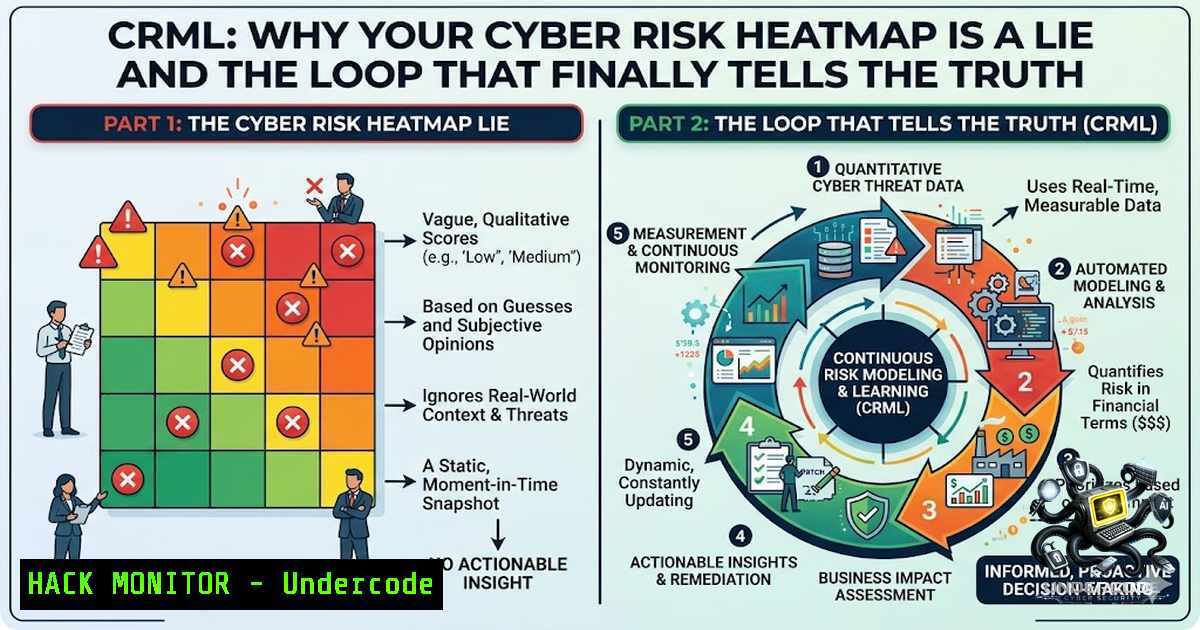
Most organizations believe they understand their cyber risk because they have a beautifully color-coded heatmap. Red, amber, green—a photograph of exposure frozen in time. But a photograph cannot tell you whether the controls you deployed yesterday made that red any less red. In the age of Agentic AI, where assets connect, expand, and create their own API-driven relationships by the hour, a static assessment is not merely insufficient—it is dangerously deceptive. The Cyber Risk Management Lifecycle (CRML) reframes risk as a continuous loop of inventory, contextualization, calculation, mitigation, and—crucially—recalculation, providing the only verifiable proof that a control actually reduced anything.
Learning Objectives:
- Understand why traditional cyber risk assessments are photographs and why management requires a continuous film loop.
- Learn to implement the five-phase CRML framework, from asset discovery to dynamic reassessment.
- Master the technical commands and configurations to inventory assets, calculate a Cyber Risk Index, and validate control effectiveness across Linux, Windows, and cloud environments.
You Should Know:
1. Inventory, Contextualize, and Value Every Digital Asset
The lifecycle begins not with vulnerabilities, but with identity. You cannot protect what you do not know, and you cannot prioritize what you have no context for. Assets today extend beyond servers to include every device, identity, application, and API connection. In Agentic AI environments, this inventory must be dynamic—agents create new connections and use identities to reach data through APIs and MCP servers faster than any quarterly spreadsheet can capture.
Step‑by‑step guide: Dynamic Asset Discovery
On Linux, use `nmap` for network discovery and `curl` to query cloud provider APIs for asset inventories:
 Discover active hosts in a subnet
nmap -sn 192.168.1.0/24

Query AWS EC2 instances via CLI (requires AWS CLI configured)
aws ec2 describe-instances --query 'Reservations[].Instances[].[InstanceId,State.Name,PrivateIpAddress]' --output table

List all Azure VMs
az vm list --output table --show-details
On Windows, leverage PowerShell for AD and local asset enumeration:
 Get all Active Directory computers
Get-ADComputer -Filter  | Select-Object Name,OperatingSystem,LastLogonDate

List all installed software (potential attack surface)
Get-WmiObject -Class Win32_Product | Select-Object Name,Version,Vendor
For API-driven discovery in AI environments, enumerate exposed endpoints:
 Use OWASP Amass to discover subdomains and API endpoints
amass enum -d yourdomain.com

Use ffuf to fuzz for hidden API paths
ffuf -u https://api.yourdomain.com/FUZZ -w /usr/share/wordlists/dirb/common.txt
Contextualization means tagging each asset with business criticality, data sensitivity, and connectivity. Integrate this with a CMDB or a cloud asset inventory tool that supports tagging (e.g., AWS Tags, Azure Tags). Without this context, a vulnerability on a development server receives the same weight as one on a payment gateway—a fundamental failure of prioritization.
2. Identify Vulnerabilities, Threats, and Consequences
Vulnerability scanning is table stakes. The critical addition is threat modeling—understanding not just what is weak, but who would exploit it, how, and what the business consequence would be. This shifts the question from “Is this patched?” to “If this is exploited, what is the actual business impact?”
Step‑by‑step guide: Vulnerability and Threat Correlation
Run a vulnerability scan with Nessus or OpenVAS on Linux:
 OpenVAS scan via gvm-cli
gvm-cli --gmp-username admin --gmp-password password socket --socket-path /var/run/gvmd.sock --xml "<create_task><name>Scan</name><target id='target-id'/></create_task>"
On Windows, use PowerShell to check for missing patches and map them to known exploits:
 Get missing updates
Get-HotFix | Select-Object HotFixID,Description,InstalledOn

Check if a specific CVE is patched (example for CVE-2021-44228 - Log4Shell)
Get-HotFix | Where-Object { $_.HotFixID -like "KB500" }
Correlate vulnerabilities with threat intelligence using MITRE ATT&CK mappings. For each CVE, query the ATT&CK framework to see if there is a known technique:
 Use the ATT&CK Navigator or STIX data to map
curl -s https://raw.githubusercontent.com/mitre/cti/master/enterprise-attack/enterprise-attack.json | jq '.objects[] | select(.external_references[bash].external_id=="T1190")'
Then, model consequences: if an attacker exploits an unpatched Tomcat server (CVE-2025-XXXX), what is the worst-case scenario? Data exfiltration? Ransomware? Business interruption? This consequence modeling feeds directly into the risk calculation.
3. Calculate and Consolidate a Cyber Risk Index
Qualitative scoring (red/amber/green) is useful for communication but fails to justify security spend or show measured reduction. A quantified Cyber Risk Index (CRI) treats risk as an estimable distribution, combining threat, vulnerability, and consequence into a measurable score. Modern CRI algorithms incorporate CVSS, EPSS for exploit likelihood, and business impact weightings.
Step‑by‑step guide: Quantified Risk Calculation
A simplified CRI can be calculated as:
`CRI = (Threat_Likelihood × Vulnerability_Score × Business_Impact) / Total_Assets`
Where:
- Threat_Likelihood = EPSS score (0-1) or internal threat intelligence feed
- Vulnerability_Score = CVSS v3.1 base score (0-10)
- Business_Impact = 1-5 based on asset criticality (1=low, 5=critical)
Linux script to calculate CRI from a vulnerability report:
!/bin/bash
 Sample CRI calculator - assumes CSV input with asset, cvss, impact
echo "Asset,CVSS,Impact,CRI"
while IFS=',' read -r asset cvss impact; do
threat=$(echo "scale=4; $cvss / 10" | bc)
cri=$(echo "scale=4; $threat  $impact  10" | bc)
echo "$asset,$cvss,$impact,$cri"
done < vulnerabilities.csv
For enterprise-grade quantification, leverage CRML (Cyber Risk Modeling Language) —an open, declarative YAML/JSON format for describing risk models, enabling Risk as Code (RaC):
 CRML example for an asset
asset:
id: "payment-gateway-01"
type: "web-application"
criticality: 5
vulnerabilities:
- cve: "CVE-2025-XXXX"
cvss: 9.8
epss: 0.85
threats:
- actor: "ransomware-group"
likelihood: 0.7
consequences:
- type: "data-breach"
financial_impact: 5000000
Run the CRML model through a simulation engine (e.g., FAIR-style Monte Carlo) to produce a distribution of expected loss, not a single point estimate.
4. Mitigate
Mitigation is not a checklist of controls. It is a prioritized set of actions targeting the highest CRI items first. This includes patching, configuration hardening, network segmentation, and identity controls. But mitigation is only half the story—the proof is in the recalculation.
Step‑by‑step guide: Prioritized Mitigation with Hardening
Linux hardening using CIS benchmarks:
 Install and run Lynis for security auditing
sudo lynis audit system

Apply CIS recommendations (example: disable unused services)
sudo systemctl disable bluetooth.service
sudo systemctl disable cups.service

Harden SSH configuration
sudo sed -i 's/PermitRootLogin yes/PermitRootLogin no/' /etc/ssh/sshd_config
sudo sed -i 's/PasswordAuthentication yes/PasswordAuthentication no/' /etc/ssh/sshd_config
sudo systemctl restart sshd
Windows hardening via PowerShell and Group Policy:
 Disable unnecessary services
Set-Service -1ame "Spooler" -StartupType Disabled

Enable Windows Defender real-time protection
Set-MpPreference -DisableRealtimeMonitoring $false

Apply CIS benchmarks using PowerStig (requires DSC)
Install-Module -1ame PowerStig
Invoke-StigCompliance -Type Windows -Version 2022
Cloud hardening for AWS using Prowler (open-source CIS assessment tool):
 Install Prowler
pip install prowler

Run CIS benchmark assessment
prowler aws --compliance cis_1.5
For API and Agentic AI security, enforce OWASP best practices:
– Implement least privilege with fine-grained RBAC for all API calls
– Use short-lived credentials (e.g., AWS STS tokens) instead of long-lived API keys
– Sign every HTTP request with RFC 9421 Message Signatures to prevent tampering
– Scan LLM prompts for jailbreak patterns and PII leakage
5. Recalculate and Validate
This is the step most programs skip—and it is the only proof that a control reduced anything. After mitigation, you must recalculate the CRI. If the number did not fall, the control did not work. This validation transforms security from faith-based to evidence-based.
Step‑by‑step guide: Recalculation and Validation
Repeat the CRI calculation from Step 3 using the same methodology. Compare pre- and post-mitigation scores:
 Compare CRI before and after
echo "Asset,Pre-CRI,Post-CRI,Reduction"
paste pre_cri.csv post_cri.csv | awk -F',' '{print $1","$2","$4","($2-$4)}'
Automate this with a CI/CD pipeline that triggers a CRI recalculation after every deployment or patch cycle. Use CTEM (Continuous Threat Exposure Management) principles to continuously validate exposure rather than relying on point-in-time scans.
For MCP (Model Context Protocol) security, use the MCPSafetyScanner tool to audit MCP servers before deployment:
 Clone and run MCPSafetyScanner
git clone https://github.com/johnhalloran321/mcpSafetyScanner
cd mcpSafetyScanner
python mcp_safety_scanner.py --server-url http://your-mcp-server.com
This tool automatically determines adversarial samples, searches for vulnerabilities, and generates a security report.
6. Continuous Loop, Not a Calendar
The CRML is not a project with a start and end date. It is a continuous loop: Inventory → Contextualize → Calculate → Mitigate → Recalculate → (repeat). In the age of AI, this loop must run at machine speed because assets connect and expand faster than ever.
Step‑by‑step guide: Automating the Loop
Set up a scheduled pipeline using Jenkins or GitHub Actions:
 GitHub Actions workflow for weekly CRI recalculation
name: Cyber Risk Index Recalculation
on:
schedule:
- cron: '0 0   0'  Every Sunday at midnight
jobs:
recalculate:
runs-on: ubuntu-latest
steps:
- name: Run asset discovery
run: ./discovery.sh
- name: Run vulnerability scan
run: ./vuln_scan.sh
- name: Calculate CRI
run: python cri_calculator.py
- name: Compare with previous CRI
run: ./compare_cri.sh
- name: Notify on significant change
run: ./notify.sh
Integrate with a SIEM (e.g., Splunk, Elastic) for real-time monitoring and anomaly detection. Every significant change in the CRI should trigger an alert and a review of the controls.
What Undercode Say:
- Key Takeaway 1: Assessment is a photograph; management is the film. A heatmap can tell you a risk is red, but it can never tell you that your last control made it less red. The only proof of risk reduction is recalculation.
- Key Takeaway 2: In the age of Agentic AI, static risk management is obsolete. Agents create new connections by the hour through APIs and MCP, rendering annual or even quarterly assessments dangerously out of date. The loop must run continuously.
Analysis: The fundamental flaw in most cyber risk programs is the conflation of assessment with management. Organizations invest heavily in scoring and reporting but rarely in the validation loop that proves whether their investments actually reduced risk. This is not a technical failure—it is a philosophical one. The CRML framework corrects this by demanding evidence. In the AI era, where attack surfaces expand dynamically, this evidence-based, continuous approach is not a nice-to-have; it is the only viable defense. The tools and commands outlined above provide the technical foundation, but the real transformation is cultural: moving from “we assessed it” to “we proved it.”
Prediction:
- +1 Organizations that adopt a continuous CRML loop will demonstrate measurable risk reduction within 12–18 months, gaining a competitive advantage in cyber insurance and regulatory compliance.
- +1 The rise of Risk as Code (RaC) and frameworks like CRML will standardize risk quantification, enabling automated, auditable risk decisions integrated directly into DevOps pipelines.
- -1 Organizations that remain on annual risk assessment cycles will experience more frequent and severe breaches as Agentic AI expands their attack surface faster than their risk management can keep pace.
- -1 The security debt from unvalidated controls will compound, leading to a crisis of confidence in cybersecurity leadership and increased regulatory scrutiny.
▶️ Related Video (74% Match):
🎯Let’s Practice For Free:
🎓 Live Courses & Certifications:
Join Undercode Academy for Verified Certifications
🚀 Request a Custom Project:
Secure, high-velocity infrastructure and disruptive technological engineering. Contact our engineering team for high-tier development and proprietary systems:
[email protected]
💎 Smart Architecture | 🛡️ Secure by Design | ⭐ Trusted by Thousands
IT/Security Reporter URL:
Reported By: Jpcastro Cyberrisk – Hackers Feeds
Extra Hub: Undercode MoN
Basic Verification: Pass ✅


