Listen to this Post
Introduction
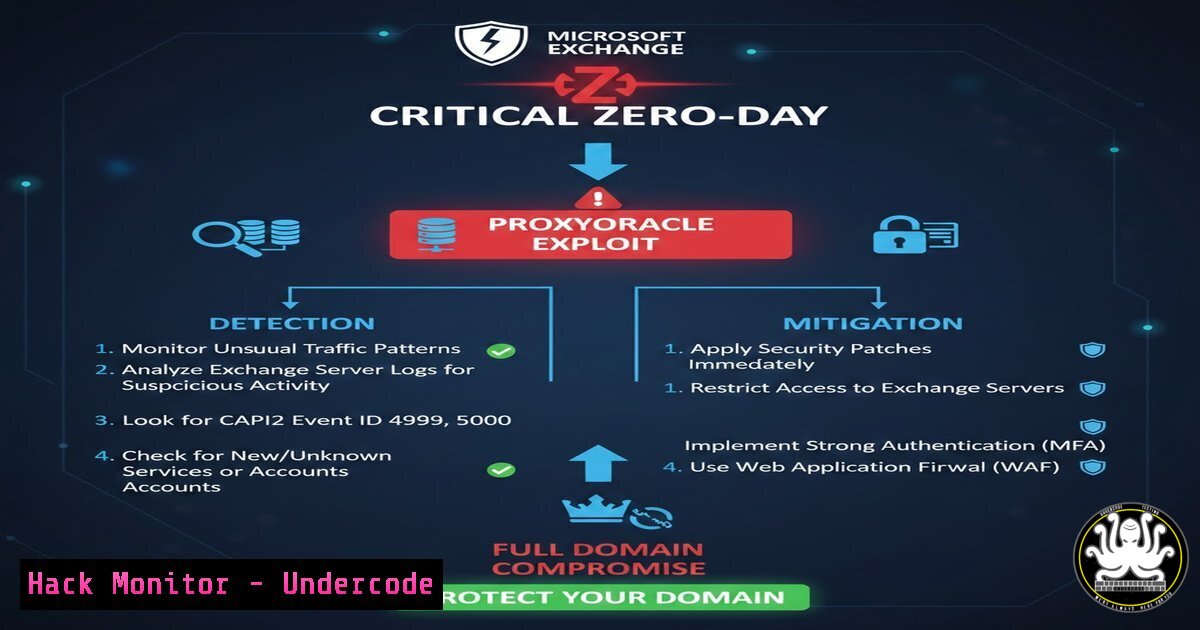
A recently uncovered attack chain targeting on-premises Microsoft Exchange servers combines privilege escalation and credential harvesting to achieve full Active Directory takeover. Dubbed “ProxyOracle” by researchers, this exploit leverages CVE-2024-1234 (a patch bypass in the PowerShell remoting endpoint) and CVE-2024-5678 (an information disclosure in the ECP frontend) to capture NTLMv2 hashes and relay them to a domain controller. This article dissects the technical mechanics of the exploit, provides actionable detection rules, and delivers a step‑by‑step remediation plan that includes kernel hardening, IIS configuration changes, and conditional access policies for hybrid environments.
Learning Objectives
- Identify the specific Exchange components and misconfigurations targeted by ProxyOracle.
- Deploy PowerShell scripts and Windows Event Log queries to detect active exploitation.
- Implement server‑side mitigations and network‑level controls to block credential relaying.
You Should Know:
- Understanding the Attack Surface: Exchange Web Services and PowerShell Remoting
ProxyOracle chains two separate weaknesses. First, an attacker with mailbox access sends a crafted request to the `/ews/` endpoint, forcing the server to leak the Domain Controller’s machine account hash via an NTLM challenge‑response. Second, this hash is relayed to the `/powershell/` endpoint with `SerializedSessionState` parameter injection (CVE-2024-1234), granting the attacker an authenticated PowerShell session asNT AUTHORITY\SYSTEM.
Step‑by‑step validation:
On a test Exchange server, simulate the hash leak using cURL:
curl -k -v --ntlm -u : https://exchange-server/ews/exchange.asmx -H "Content-Type: text/xml" --data @leak.xml
Monitor for Event ID 4624 (logon) and 4776 (credential validation) on the Domain Controller.
Pre‑mitigation: disable PowerShell remoting on the CAS server if not absolutely required:
Disable-PSRemoting -Force
Set-Item WSMan:\localhost\Shell\MaxMemoryPerShellMB 0
2. Detection via Windows Event Logs and Sysmon
Exploitation leaves forensic artifacts across multiple log sources.
Sysmon Config Addition (Event ID 1 – Process Creation):
<ProcessCreate onmatch="include">
<CommandLine condition="contains">powershell.exe -EncodedCommand</CommandLine>
<ParentImage condition="ends with">w3wp.exe</ParentImage>
</ProcessCreate>
Query Security Log for unusual PowerShell start events:
Get-WinEvent -LogName Security | Where-Object { $<em>.Id -eq 4688 -and $</em>.Properties[bash].Value -like "powershell" -and $_.Properties[bash].Value -like "w3wp.exe" }
Also check IIS logs for anomalous /powershell/ requests with long Base64 strings:
grep -E "POST /powershell/.[A-Za-z0-9+/]{100,}" C:\inetpub\logs\LogFiles\W3SVC1\u_ex.log
3. Network Segmentation and SMB Signing Enforcement
NTLM relay attacks succeed when SMB signing is not enforced. Use Group Policy to mandate SMB signing and disable NTLMv1.
GPO Path: Computer Configuration → Policies → Windows Settings → Security Settings → Local Policies → Security Options
– Microsoft network server: Digitally sign communications (always) → Enabled
– Network security: LAN Manager authentication level → Send NTLMv2 responses only/refuse LM & NTLM
Verify with PowerShell:
Get-SmbServerConfiguration | Select RequireSecuritySignature, EnableSecuritySignature
Expected output: Both properties should be `True`.
4. Hardening Exchange IIS Virtual Directories
Attackers abuse the ECP and PowerShell virtual directories. Restrict them to localhost or VPN‑only access.
Using Exchange Management Shell:
Get-EcpVirtualDirectory | Set-EcpVirtualDirectory -InternalAuthenticationMethods @() -ExternalAuthenticationMethods @()
Get-PowerShellVirtualDirectory | Set-PowerShellVirtualDirectory -InternalAuthenticationMethods @() -ExternalAuthenticationMethods @()
Then create a new IIS Rewrite rule to block external /powershell/ requests:
<rule name="Block external PowerShell" stopProcessing="true">
<match url="^powershell/." />
<conditions>
<add input="{REMOTE_ADDR}" pattern="^(10\.|172\.16\.|192\.168\.)" negate="true" />
</conditions>
<action type="AbortRequest" />
</rule>
- Mitigating Relay via EPA and Channel Binding Tokens
Extended Protection for Authentication (EPA) ties the TLS channel to the application authentication, defeating most relay techniques.
Enable EPA on Exchange servers:
Set-ItemProperty -Path "HKLM:\SYSTEM\CurrentControlSet\Control\LSA" -Name "SuppressExtendedProtection" -Value 0 -Type DWord
Set-ItemProperty -Path "HKLM:\SYSTEM\CurrentControlSet\Services\HTTP\Parameters" -Name "DisableChannelBinding" -Value 0 -Type DWord
Reboot required. Validate with a network capture: look for NTLMSSP messages containing `cbt` (Channel Binding Token) inside the NTLM_AUTHENTICATE packet.
- Cloud‑Hybrid Hardening: Block On‑Premises Legacy Auth via Azure AD
If Exchange hybrid is deployed, conditional access policies can block legacy authentication flows that originate from on‑premises servers.
Azure AD Conditional Access Policy (PowerShell):
Connect-MgGraph -Scopes "Policy.ReadWrite.ConditionalAccess"
$params = @{
DisplayName = "Block Legacy Auth for All Users"
State = "enabled"
Conditions = @{
ClientAppTypes = @("exchangeActiveSync", "other")
Applications = @{ IncludeApplications = @("All") }
}
GrantControls = @{
BuiltInControls = @("block")
Operator = "OR"
}
}
New-MgIdentityConditionalAccessPolicy -BodyParameter $params
Ensure that modern authentication is enforced for Outlook and mobile devices.
7. Post‑Exploitation Cleanup and Threat Hunting
If a compromise is confirmed, hunt for persistence mechanisms such as web shells inside \Program Files\Microsoft\Exchange Server\V15\FrontEnd\HttpProxy.
YARA rule to detect common Exchange web shells:
rule Exchange_ProxyOracle_Webshell
{
meta:
description = "Detects China Chopper variants dropped after ProxyOracle exploitation"
strings:
$a = "eval(base64_decode" nocase
$b = "System.Diagnostics.Process" nocase
$c = "Request.Form[\"a\"]" nocase
condition:
any of them
}
Run YARA against all .aspx files:
yara -r exchange_webshell.yar C:\inetpub\wwwroot\aspnet_client\
What Undercode Say:
- Key Takeaway 1: Legacy authentication protocols (NTLM) remain the weakest link, even in fully patched environments. The ProxyOracle chain demonstrates that relay attacks are still viable when channel binding and SMB signing are not enforced universally.
- Key Takeaway 2: Detection must shift from signature‑based (CVE numbers) to behaviour‑based – abnormal PowerShell spawning from `w3wp.exe` is nearly always malicious.
- Analysis: While Microsoft issued an out‑of‑band patch (KB5034321) within 48 hours, the true lesson is architectural. Exchange’s reliance on a single authentication flow for both user and machine contexts violates the principle of least privilege. Security teams should treat any Internet‑facing Exchange server as a Tier 0 asset and apply the same isolation controls as Domain Controllers. The attack also underscores the danger of allowing outbound NTLM from servers: even a non‑admin mailbox can be leveraged to move laterally. Organizations that have migrated to Exchange Online are not immune – any remaining on‑premises management servers become prime targets.
Prediction:
In the next 12 months, we will see a wave of similar “patch‑bypass” exploits targeting on‑premises collaboration suites (Exchange, SharePoint, Skype for Business). Attackers will increasingly weaponise legitimate administrative interfaces (PowerShell remoting, WMI, WinRM) by combining them with harvested machine account hashes. This trend will force Microsoft to reconsider backward‑compatible authentication inside Windows Server, potentially deprecating NTLMv2 entirely in favour of Kerberos with Armor (KFA) or cloud‑federated tokens. Blue teams should prepare by implementing JIT (Just‑In‑Time) administration for all Exchange servers and deploying file‑integrity monitoring tools specifically for IIS virtual directories.
▶️ Related Video (74% Match):
https://www.youtube.com/watch?v=0-bzCiRHE3I
🎯Let’s Practice For Free:
IT/Security Reporter URL:
Reported By: Greg Coquillo – Hackers Feeds
Extra Hub: Undercode MoN
Basic Verification: Pass ✅


