Listen to this Post
Introduction:
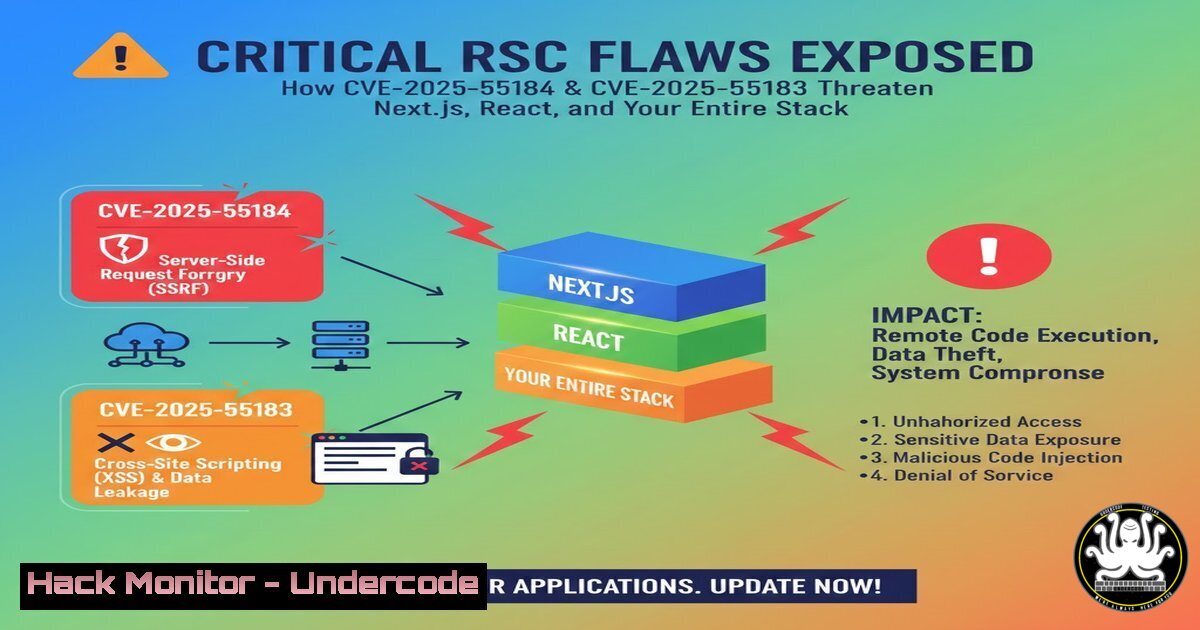
The React Server Components (RSC) paradigm, designed to enhance performance and developer experience in modern web frameworks, has become the latest attack vector for critical security vulnerabilities. Two newly disclosed flaws, CVE-2025-55184 (High severity) and CVE-2025-55183 (Medium severity), expose applications built with popular frameworks like Next.js, React Router, and Vite to severe Denial-of-Service (DoS) and source code disclosure attacks. This incident underscores the cascading risks inherent in deeply integrated meta-frameworks and the urgent need for proactive dependency management in DevOps pipelines.
Learning Objectives:
- Understand the exploit mechanisms behind the RSC deserialization DoS (CVE-2025-55184) and source code leakage (CVE-2025-55183) vulnerabilities.
- Learn the immediate patching and mitigation steps for affected frameworks including Next.js, React, and related bundlers.
- Implement security hardening measures and monitoring for RSC-enabled applications to detect exploitation attempts.
You Should Know:
1. Understanding the Vulnerability Landscape: RSC’s Attack Surface
The core of these vulnerabilities lies in the RSC protocol’s handling of serialized data between client and server. RSC allows server-side components to be streamed to the client. The serialization/deserialization process, particularly for Server Function arguments, was found to be unsafe.
CVE-2025-55184 – DDoS via Unsafe Deserialization: An attacker can send a maliciously crafted HTTP request to a Server Function endpoint. The payload triggers unsafe deserialization that creates an infinite loop within the server process. This consumes 100% CPU, hangs the process, and can render the application unresponsive to all future requests—a classic resource exhaustion attack.
CVE-2025-55183 – Server Function Source Code Disclosure: This vulnerability requires a Server Function that exposes a stringified argument. By sending a specially crafted HTTP request, an attacker can trick the server into returning the source code of any Server Function, not just the targeted one. This leads to intellectual property theft and can expose hardcoded secrets, business logic, and other sensitive information.
2. Immediate Patching: Framework-Specific Upgrade Commands
The primary mitigation is immediate upgrading to the patched versions. Here is a step-by-step guide for the most common frameworks.
For Next.js Applications:
- Identify your current Next.js version. Check your `package.json` file or run:
npm list next
or
yarn why next
- Based on your major version, upgrade to the minimum patched version using npm or yarn:
For npm users
npm install [email protected] [email protected] [email protected] [email protected] [email protected] [email protected] [email protected] [email protected]

For yarn users
yarn add [email protected] [email protected] [email protected] [email protected] [email protected] [email protected] [email protected] [email protected]
- Run your test suite and staging deployment to ensure compatibility.
4. Deploy the updated application to production.
For React and React Server Components (via `react-dom` & react-server-dom-webpack):
1. Update both the core React packages and the RSC server package:
npm install [email protected] [email protected] [email protected]
 Or for version 18: [email protected], [email protected], [email protected]
2. If using frameworks like Waku, Parcel RSC, or Vite RSC Plugin, consult their respective security advisories (links in original post) for specific patched versions.
3. Detection and Monitoring for Exploitation Attempts
While patching is critical, you must also monitor for active exploitation attempts. Implement logging and monitoring rules.
Step-by-Step Guide for Log Analysis:
- Enable Detailed HTTP Logging: Ensure your application (or upstream proxy like Nginx) logs full request URLs, headers, and payload sizes for requests to RSC endpoints (typically paths like `/_next/rsc/` or
/_rsc). - Create Alert Rules: In your monitoring tool (e.g., Splunk, Datadog, Elastic SIEM), set up alerts for patterns indicative of exploitation:
For CVE-2025-55184 (DoS): Alert on a sudden spike in CPU usage on application servers coupled with HTTP requests containing unusually large or malformed payloads sent to RSC endpoints.
For CVE-2025-55183 (Source Code Leak): Alert on HTTP responses from RSC endpoints with a `Content-Type` of `text/javascript` or `application/javascript` that are unusually large, as they may contain source code instead of serialized data. - Sample Linux Command for Quick Server-Side Inspection: To check for processes stuck in high CPU loops potentially caused by the DoS attack:
top -b -n 1 | head -20  Check overall CPU usage
ps aux --sort=-%cpu | head -10  Identify the top CPU-consuming processes
If a Node.js process is at ~100% CPU, investigate immediately.
4. Hardening RSC Implementations: Defense-in-Depth
Beyond patching, apply security hardening specific to RSC.
- Input Validation & Sanitization: Implement strict validation for all arguments passed to Server Functions. Treat all client-supplied data as untrusted.
- Rate Limiting: Enforce strict rate limiting on all RSC endpoints (
/_next/rsc/,/rsc) using a Web Application Firewall (WAF) or middleware (e.g.,express-rate-limit). This mitigates the DoS impact.// Example using express-rate-limit for Next.js API routes/proxy const rateLimit = require('express-rate-limit'); const rscLimiter = rateLimit({ windowMs: 15 60 1000, // 15 minutes max: 100 // limit each IP to 100 requests per windowMs }); // Apply to RSC path pattern app.use('/_next/rsc/', rscLimiter); - Function Isolation: Review Server Functions to ensure they do not implicitly expose stringified arguments unnecessarily. Minimize the attack surface.
5. Integrating Security Advisories into Your CI/CD Pipeline
Proactively prevent deploying vulnerable dependencies.
- Use Dependency Scanning Tools: Integrate tools like
npm audit,yarn audit,OWASP Dependency-Check, or Snyk into your CI pipeline. - Fail the Build on Critical Vulnerabilities: Configure your pipeline to break the build when a critical or high-severity vulnerability (CVSS >= 7.0) is detected.
Example GitHub Actions snippet</li>
</ol>

- name: Audit for vulnerabilities
run: npm audit --audit-level=high
continue-on-error: false  This will fail the workflow if high/critical vulns are found
3. Subscribe to Security Feeds: Follow the GitHub Security Advisories for key dependencies (
react,next.js) and use tools like Dependabot or Renovate to auto-generate pull requests for security updates.What Undercode Say:
- The Meta-Framework Risk is Systemic: Vulnerabilities in a foundational layer like RSC don’t just affect one library; they propagate instantly to every major framework that adopts it, creating a widespread security event. This demands a shift from monitoring single packages to monitoring architectural paradigms.
- The Line Between DoS and Data Breach is Blurring: CVE-2025-55183 is not a typical info-disclosure bug. It weaponizes the RSC protocol’s core data-fetching mechanism to exfiltrate source code, demonstrating how functionality designed for performance can be subverted for novel attack paths.
Analysis: This disclosure is a canonical example of modern application security challenges. The vulnerabilities exist not in application code but in the opaque abstraction layer (RSC) that developers rely on. The remediation path is clear—patch—but the real lesson is operational. Security teams must now map their application’s dependency tree not just to libraries, but to underlying rendering protocols and serialization mechanisms. The silent propagation of these flaws through automatic updates of frameworks like Next.js means many were vulnerable before they knew the component existed. Future exploits will likely target similar serialization boundaries in other meta-frameworks, making input validation at these protocol junctions a new priority for secure development lifecycles.
Prediction:
The exploitation of serialization protocols within meta-frameworks marks the beginning of a new attack frontier. We predict a rise in similar vulnerabilities targeting other server-client data exchange mechanisms in frameworks like Nuxt (Vue), SvelteKit, and Fresh (Deno). Within 12-18 months, this will lead to the development of specialized security tooling—static analysis tools and runtime application security protection (RASP) agents—specifically designed to audit and protect the integrity of data serialization/deserialization paths in full-stack JavaScript frameworks. Organizations that fail to incorporate protocol-level security analysis into their threat models will be disproportionately affected by these coming waves of framework-level exploits.
▶️ Related Video (78% Match):
https://www.youtube.com/watch?v=4g54JTyXcmo
🎯Let’s Practice For Free:
IT/Security Reporter URL:
Reported By: Mohamed Oosman – Hackers Feeds
Extra Hub: Undercode MoN
Basic Verification: Pass ✅🔐JOIN OUR CYBER WORLD [ CVE News • HackMonitor • UndercodeNews ]
📢 Follow UndercodeTesting & Stay Tuned:


