
Listen to this Post
Introduction:
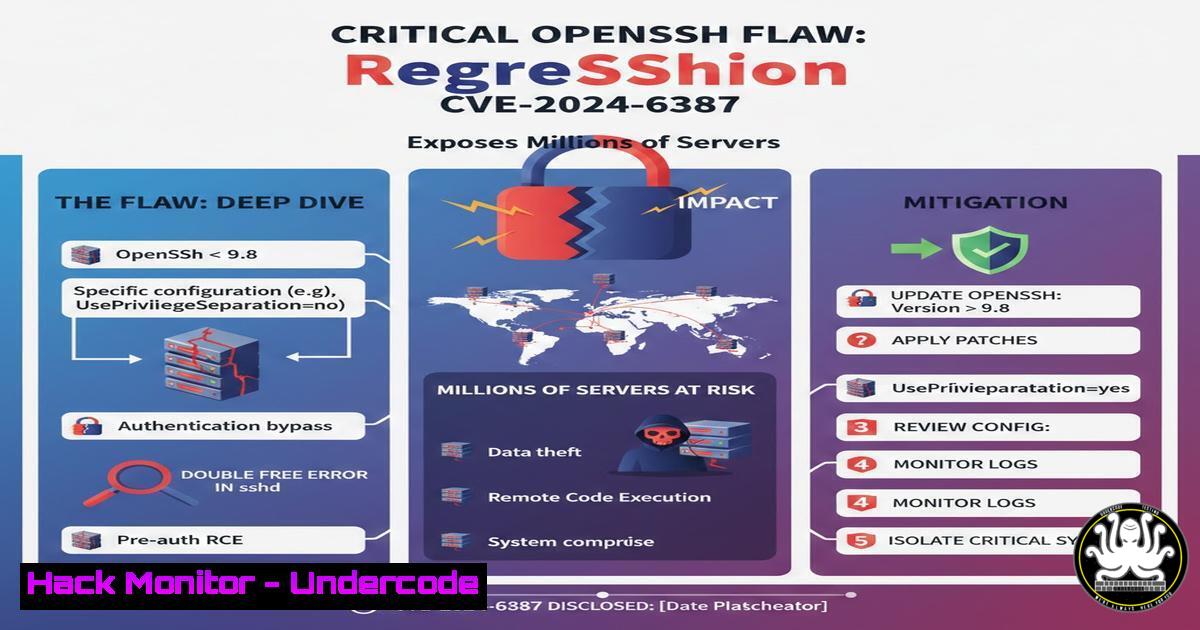
A critical signal handler race condition vulnerability, dubbed RegreSSHion (CVE-2024-6387), has been discovered in OpenSSH’s server component (sshd) on glibc-based Linux systems. This flaw, a regression of a previously patched issue from 2006 (CVE-2006-5051), allows unauthenticated remote attackers to execute arbitrary code as root, effectively granting full control over vulnerable servers. With a CVSS score of 8.1, the exploitability depends on timing and race conditions, but successful attacks can lead to complete system compromise, making immediate action essential for administrators.
Learning Objectives:
- Understand the technical nature of CVE-2024-6387 and why it poses a significant risk to Linux servers.
- Learn how to identify vulnerable OpenSSH versions and implement both temporary mitigations and permanent patches.
- Master practical Linux commands and configuration changes to harden SSH services against this and similar threats.
You Should Know:
1. Identifying Vulnerable OpenSSH Versions
The vulnerability affects OpenSSH versions between 8.5p1 and 9.8p1 on glibc-based Linux distributions. To check your system’s version, use the following commands. First, connect to your server via SSH or console, then run:
ssh -V
 Example output: OpenSSH_8.9p1 Ubuntu-3ubuntu0.6, OpenSSL 3.0.2 15 Mar 2022
Alternatively, check the installed package version:
 On Debian/Ubuntu
dpkg -l | grep openssh-server

On RHEL/CentOS/Fedora
rpm -qa | grep openssh-server
If your version falls within the affected range (8.5p1 to 9.8p1), your system is potentially vulnerable. Additionally, some distributions backport security patches without changing the version number, so it’s crucial to verify whether your package manager has released an updated version. For example, Ubuntu might have released a fixed package labeled `1:8.9p1-3ubuntu0.7` while keeping the base version number. Always cross-reference with your distribution’s security advisories.
2. Understanding the Exploit Mechanism
The vulnerability resides in the `sigalarm()` handler of sshd. When a client fails to authenticate within the login grace period (default 120 seconds), `sshd` receives a SIGALRM signal. The handler calls a non-async-signal-safe function, which can lead to a race condition if interrupted by other signals (e.g., SIGUSR1). An attacker can trigger this by establishing multiple partial connections and timing them to cause memory corruption, leading to remote code execution as root. This is a classic signal-handling vulnerability, reminiscent of the earlier CVE-2006-5051. The exploit requires precise timing and multiple attempts, making it less trivial but still dangerous in automated attack scenarios.
3. Immediate Mitigation: Adjusting Login Grace Time
If patching is not immediately possible, you can reduce the attack surface by shortening the `LoginGraceTime` and limiting concurrent unauthenticated connections. Edit the SSH daemon configuration file (/etc/ssh/sshd_config) and set:
LoginGraceTime 30
MaxStartups 2:30:10
LoginGraceTime 30: reduces the window for the race condition from 120 seconds to 30.MaxStartups 2:30:10: starts dropping connections when more than 2 unauthenticated connections are pending, with a probability of 30% when reaching 10.
After changes, restart SSH:
sudo systemctl restart sshd or sudo service ssh restart
Note that these settings may affect legitimate users during high-load scenarios, but they significantly increase the difficulty of exploitation.
4. Permanent Patching and Verification
The most effective solution is to update OpenSSH to version 9.8p1 or later, or install the patched package from your distribution’s repositories. For Ubuntu/Debian:
sudo apt update && sudo apt upgrade openssh-server
For RHEL/CentOS:
sudo yum update openssh-server or dnf on Fedora
After updating, verify the version again. Also, check that the SSH service is running and no errors are present:
sudo sshd -T | grep -E "version|grace|maxstartups"
Monitor logs for any unusual activity:
sudo journalctl -u ssh | grep -i "fatal|error|alarm"
5. Hardening SSH Beyond the Patch
Defense in depth is crucial. Implement additional layers to protect SSH:
- Use SSH key-based authentication and disable password authentication (
PasswordAuthentication noinsshd_config). - Enable fail2ban to block IPs with multiple failed attempts. Example configuration for SSH jail in
/etc/fail2ban/jail.local:
[bash]
enabled = true
port = ssh
filter = sshd
logpath = /var/log/auth.log
maxretry = 3
bantime = 3600
- Restrict SSH access by IP using firewall rules (e.g.,
ufw allow from 192.168.1.0/24 to any port 22). - Use a non-standard port for SSH (e.g.,
Port 2222) to reduce automated scanning, but this is not a security control—only obscurity.
6. Exploit Detection and Response
Administrators should look for signs of exploitation attempts. The race condition requires multiple connections within a short time. Monitor logs for repeated connection attempts from the same IP within the grace period:
sudo grep "Did not receive identification string" /var/log/auth.log
sudo grep "Connection closed by" /var/log/auth.log
Unusual patterns like many incomplete handshakes could indicate scanning. Also, enable audit logging for process execution to detect post-exploitation activity:
sudo auditctl -w /usr/sbin/sshd -p wa -k sshd_mod
sudo ausearch -k sshd_mod --start today
7. Windows Environments and SSH
Although the vulnerability primarily affects glibc-based Linux, Windows systems running OpenSSH via WSL or third-party ports (like MSYS2) may be impacted if they use glibc. Native Windows OpenSSH (PowerShell) uses different libraries and is not affected. To check on Windows with OpenSSH installed:
ssh -V
If using WSL, treat it as a Linux subsystem and follow the Linux steps. For Windows Server with the OpenSSH feature, ensure it’s updated via Windows Update or manually:
Get-WindowsCapability -Online | Where-Object { $_.Name -like 'OpenSSH.Server' }
Add-WindowsCapability -Online -Name 'OpenSSH.Server~~~~0.0.1.0'  for update
What Undercode Say:
- Key Takeaway 1: CVE-2024-6387 highlights how old vulnerabilities can resurface due to code regressions, emphasizing the need for rigorous regression testing in security-critical components.
- Key Takeaway 2: Mitigation must balance security and usability; reducing login grace time and connection limits can impede exploits but may affect legitimate users in high-traffic environments.
- Analysis: This vulnerability is a stark reminder that SSH, often considered a secure backbone, is not immune to critical flaws. The race condition exploitation is complex but automation tools will inevitably emerge, making patching urgent. Organizations should prioritize updating OpenSSH across all Linux servers, especially those exposed to the internet. Additionally, this incident underscores the value of defense-in-depth: even if SSH is compromised, additional controls like firewalls, intrusion detection, and least privilege can limit damage. The cybersecurity community must also advocate for memory-safe languages in critical infrastructure to prevent such classes of bugs. While the RegreSSHion vulnerability is now patched, its existence signals that similar issues may lurk in other long-lived codebases, warranting continuous code audits and modern secure development practices.
Prediction:
In the coming weeks, we will likely see proof-of-concept exploits released, followed by mass scanning and automated attacks targeting unpatched servers. This will lead to a spike in SSH-based intrusions, particularly in cloud environments and among organizations slow to patch. The incident will also spark renewed debate on the security of C-based network daemons and may accelerate adoption of alternatives like Mosh or even SSH implementations in Rust (e.g., RustySSH). Furthermore, regulatory bodies might tighten compliance requirements around timely patching of critical infrastructure components. Administrators who fail to act swiftly risk becoming part of botnets or suffering data breaches. The long-term impact will be a heightened awareness of signal-handling vulnerabilities and more aggressive default security configurations in SSH distributions.
▶️ Related Video (82% Match):
🎯Let’s Practice For Free:
IT/Security Reporter URL:
Reported By: Deepak Saini – Hackers Feeds
Extra Hub: Undercode MoN
Basic Verification: Pass ✅


