Listen to this Post
Introduction:
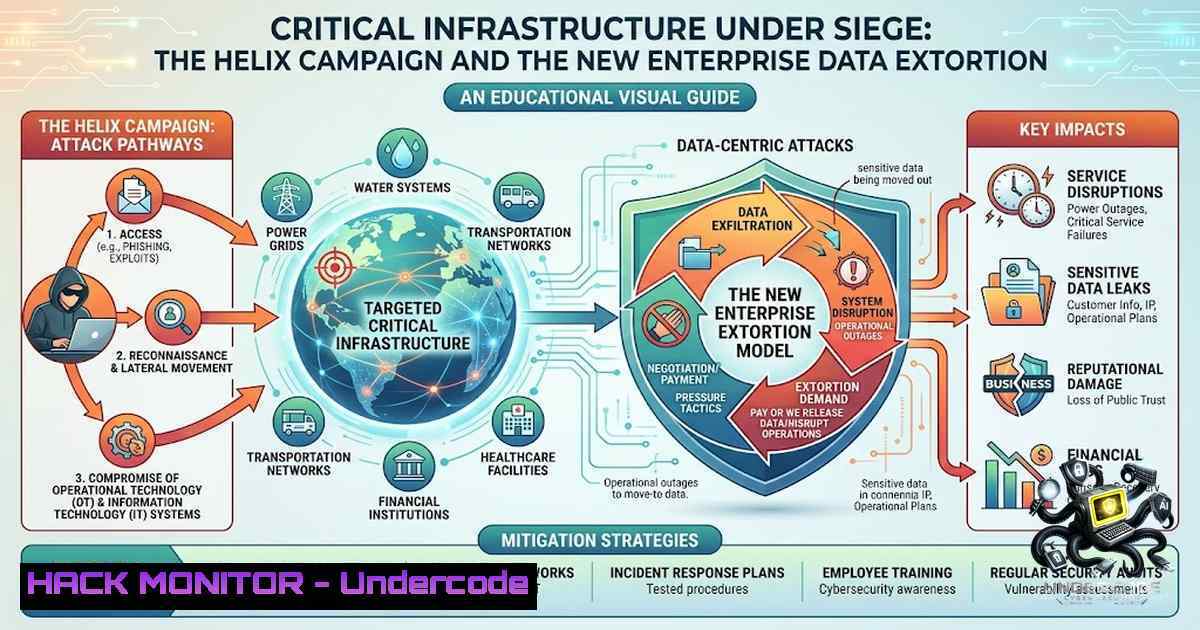
The recent cybersecurity incident targeting Uber Freight, in which the Helix hacking group claimed to have exfiltrated nearly one million files, represents a watershed moment in the evolution of enterprise cyber threats. This attack is not an isolated event but part of a sophisticated, coordinated campaign that has targeted over 200 prominent financial institutions, private equity firms, and corporations—including Blackstone, Bridgewater Associates, Apollo Global Management, and KKR. The incident underscores a critical shift: cyberattacks are no longer merely about service disruption but are increasingly focused on data exfiltration, extortion, and long-term strategic compromise, making cybersecurity a fundamental pillar of business continuity and data protection.
Learning Objectives:
- Understand the technical mechanics of the Helix campaign and its multi-vector approach to initial access, including social engineering and credential theft.
- Master the incident response lifecycle—identification, containment, remediation, and recovery—as demonstrated by Uber Freight’s response.
- Learn to implement proactive defense strategies, including advanced email filtering, endpoint detection and response (EDR), and cloud repository hardening.
You Should Know:
- Anatomy of the Helix Attack: From Social Engineering to Data Staging
The Helix campaign, also tracked by Google Threat Intelligence under aliases including Redact, Pink, and Falcon, represents a sophisticated evolution in ransomware and extortion operations. Unlike traditional ransomware that encrypts files and demands payment for decryption, Helix focuses on pure data exfiltration and extortion—stealing sensitive files and threatening to release them unless a ransom is paid.
The attackers have demonstrated a preference for low-tech but highly effective initial access vectors. According to Google’s Threat Intelligence Group, the hackers used phone calls—a form of vishing (voice phishing)—to compromise victims. As Lee Clark, a cyberthreat intelligence production manager, noted, “Because the fence is now so fancy and high-tech, we just have to trick the guard into opening the door for us”. This human element remains the most consistent vulnerability in even the most technologically advanced organizations.
In the Uber Freight case, the attackers successfully gained unauthorized access to a portion of the company’s systems and repositories, including SharePoint libraries. The attackers staged the stolen data in a tiered release system, with T1 (least sensitive) through T4 (most sensitive) being unlocked progressively as countdown timers expired. This psychological pressure tactic is designed to coerce victims into paying ransoms quickly, fearing the progressive release of increasingly sensitive information.
Step‑by‑step guide: Investigating and containing a SharePoint data exfiltration incident
- Initial Detection and Triage: Upon detection of unusual activity (e.g., anomalous SharePoint access patterns, unexpected data export commands), immediately engage the incident response team. In Uber Freight’s case, the incident was “identified, contained and remediated”.
- Isolate Affected Systems: Use Azure/SharePoint administrative controls to restrict access to the compromised repositories. Commands to audit and restrict access in SharePoint Online (PowerShell):
Connect to SharePoint Online Connect-SPOService -Url https://<tenant>-admin.sharepoint.com Identify unusual access patterns (review audit logs) Search-UnifiedAuditLog -StartDate (Get-Date).AddDays(-30) -EndDate (Get-Date) -Operations "FileAccessed","FileDownloaded" | Where-Object {$_.UserId -1e "[email protected]"} Restrict external sharing and disable anonymous links Set-SPOSite -Identity https://<tenant>.sharepoint.com/sites/<site> -SharingCapability Disabled -
Contain the Breach: Reset credentials for compromised accounts, enforce multi-factor authentication (MFA) globally, and revoke session tokens. In Azure AD:
Revoke all sessions for a compromised user Revoke-AzureADUserAllRefreshToken -ObjectId <user-object-id> Force MFA registration for all users Get-AzureADUser -All $true | ForEach-Object { Update-MgUser -UserId $_.Id -StrongAuthenticationRequirements @(@{RelyingParty=""; State="Enabled"}) } - Remediate Vulnerabilities: Patch any exploited vulnerabilities and review firewall and endpoint protection logs.
- Engage Law Enforcement: As Uber Freight did, promptly engage federal law enforcement to aid in the investigation and potentially disrupt the threat actor’s operations.
-
Post-Incident Review: Conduct a thorough forensic analysis to determine the full scope of data accessed or exfiltrated and implement lessons learned.
-
The Broader Campaign: A Coordinated Assault on Financial Infrastructure
The Uber Freight incident is part of a larger, coordinated wave of attacks targeting the financial sector and major corporations. According to Reuters, the hackers built over 72 malicious websites designed to steal passwords from employees of private equity firms and companies. The campaign has targeted a “wide swath of major companies,” including Blackstone, Bridgewater Associates, Apollo Global Management, Bain Capital, KKR, TPG, CME Group, Clearlake Capital, and Moody’s.
Levi Strauss also recently disclosed a cybersecurity incident in which an unauthorized third party gained access to its systems through a social engineering attack targeting three employees. The apparel maker confirmed that certain corporate information was accessed and extracted.
This coordinated campaign demonstrates a strategic shift in attacker focus. As Google noted, the hackers have recently turned their attention to private equity, law firms, and financial ratings agencies, “generally target
 industries based on financial calculations, often successfully". The attackers are making calculated decisions based on the potential financial return from extortion.

Step‑by‑step guide: Defending against vishing and social engineering attacks

<ol>
<li>Implement Caller Verification Protocols: Establish a clear policy that no sensitive information or credentials are provided over the phone unless the caller's identity can be independently verified through a separate, trusted channel.</li>
<li>Conduct Regular Security Awareness Training: Train employees to recognize and report vishing attempts. Simulate vishing attacks to test and improve organizational resilience.</li>
<li>Deploy Advanced Email and Voice Threat Protection: Use AI-driven solutions to detect and block phishing and vishing attempts. In Microsoft 365, enable and configure Defender for Office 365 anti-phishing policies:
[bash]
Enable anti-phishing policy in Microsoft 365 Defender
Set-AntiPhishPolicy -Identity "Default" -EnableOrganizationDomainsProtection $true -EnableTargetedUserProtection $true -TargetedUserProtectionAction "Quarantine"
Cloud Repository Hardening: Protecting SharePoint, S3, and Azure Blob Storage
The Helix group’s targeting of SharePoint libraries highlights a critical vulnerability in modern enterprises: the vast, often poorly secured repositories of sensitive data stored in the cloud. With the rapid migration to cloud environments, organizations have created massive attack surfaces that are attractive targets for data extortionists.
The attackers’ ability to stage and potentially exfiltrate nearly one million files from Uber Freight’s repositories underscores the need for rigorous cloud security posture management (CSPM). Organizations must treat their cloud storage as a critical asset, implementing defense-in-depth strategies that include encryption, access controls, and continuous monitoring.
Step‑by‑step guide: Hardening SharePoint, AWS S3, and Azure Blob Storage
1. SharePoint Online Hardening:
- Disable external sharing for sensitive sites.
- Implement sensitivity labels to classify and protect data.
- Regularly audit site permissions and remove unused or excessive access.
- Use Microsoft Purview to discover, classify, and protect sensitive information.
2. AWS S3 Bucket Hardening:
- Block public access at the account and bucket levels.
- Enable default encryption (SSE-S3 or SSE-KMS).
- Implement bucket policies that restrict access to specific IAM roles or users.
- Enable S3 Object Lock to prevent deletion or alteration of critical data.
AWS CLI: Block public access for a bucket
aws s3api put-public-access-block --bucket <bucket-1ame> --public-access-block-configuration "BlockPublicAcls=true,IgnorePublicAcls=true,BlockPublicPolicy=true,RestrictPublicBuckets=true"

AWS CLI: Enable default encryption
aws s3api put-bucket-encryption --bucket <bucket-1ame> --server-side-encryption-configuration '{"Rules":[{"ApplyServerSideEncryptionByDefault":{"SSEAlgorithm":"AES256"}}]}'
3. Azure Blob Storage Hardening:
- Disable public access at the storage account level.
- Enable Azure Defender for Storage for threat detection.
- Implement shared access signatures (SAS) with least privilege and short expiration times.
-
Use Azure RBAC to restrict access to specific identities.
Azure CLI: Disable public access for a storage account
az storage account update --1ame <storage-account> --resource-group <resource-group> --allow-blob-public-access false

Azure CLI: Enable Azure Defender for Storage
az security pricing create -1 StorageAccounts --tier Standard
- Advanced Persistent Threat (APT) Mitigation: Beyond the Perimeter
The Helix campaign exhibits characteristics of an Advanced Persistent Threat (APT): sophisticated, well-resourced, and persistent. The attackers’ use of multiple aliases (Redact, Pink, Falcon, Helix), their ability to target over 200 companies, and their strategic focus on high-value financial targets indicate a highly organized operation.
Traditional perimeter-based security is insufficient against such threats. Organizations must adopt a Zero Trust architecture, assuming breach and verifying every access request. Google’s Threat Intelligence Group has been tracking this cluster of activity, highlighting the importance of threat intelligence sharing and collaboration.
Step‑by‑step guide: Implementing Zero Trust controls for enterprise environments
- Implement Conditional Access Policies: Enforce access controls based on user identity, device health, location, and risk level. In Azure AD:
Create a conditional access policy requiring MFA for all cloud apps New-AzureADMSConditionalAccessPolicy -DisplayName "Require MFA for all cloud apps" -State "enabled" -Conditions @{Applications=@{IncludeApplications="All"}} -GrantControls @{BuiltInControls="Mfa"} - Deploy Endpoint Detection and Response (EDR): Use EDR solutions like Microsoft Defender for Endpoint or CrowdStrike Falcon to provide continuous monitoring and response capabilities.
– Configure EDR to block suspicious processes and scripts.
– Enable automated investigation and remediation.
3. Implement Network Segmentation: Use micro-segmentation to limit lateral movement. In Azure, use Network Security Groups (NSGs) and Azure Firewall to restrict traffic between subnets.
4. Adopt a Privileged Access Workstation (PAW): Require administrators to use dedicated, hardened workstations for privileged tasks, reducing the risk of credential theft.
5. Continuous Monitoring and Threat Hunting: Proactively search for indicators of compromise (IoCs) and anomalies. Use SIEM solutions to correlate and analyze logs from across the environment.
5. The Human Element: The Most Critical Vulnerability
The Helix campaign’s success, as demonstrated by the Levi Strauss breach, relies heavily on social engineering. Attackers are not just exploiting technical vulnerabilities; they are exploiting human psychology. The use of phone calls to trick employees into divulging credentials or performing actions that compromise security is a low-tech but highly effective tactic.
Organizations must recognize that their employees are both their greatest asset and their greatest vulnerability. A robust security awareness program, combined with technical controls, is essential to mitigating this risk.
Step‑by‑step guide: Building a human-centric security awareness program
- Develop a Comprehensive Training Curriculum: Include modules on phishing, vishing, smishing, and social engineering. Tailor content to different roles and risk levels.
- Conduct Simulated Attacks: Regularly test employees with simulated phishing and vishing campaigns. Use the results to identify areas for improvement and provide targeted training.
- Foster a Security-First Culture: Encourage employees to report suspicious activity without fear of reprisal. Celebrate successes and learn from failures.
- Implement a “Verify Before Trusting” Policy: Train employees to always verify the identity of individuals requesting sensitive information or actions, even if they appear to be from a trusted source.
- Integrate Security into Onboarding and Ongoing Development: Make security awareness a continuous process, not a one-time event.
What Undercode Say:
- Key Takeaway 1: The Uber Freight incident is a stark reminder that no organization is immune to sophisticated, data-focused cyber extortion campaigns. The attackers’ ability to compromise a major logistics provider and stage nearly one million files for release demonstrates the scale and sophistication of modern threats.
- Key Takeaway 2: The coordinated nature of the Helix campaign, targeting over 200 prominent financial and corporate entities, signals a strategic shift in the threat landscape. Attackers are now focusing on high-value data exfiltration and extortion, making cybersecurity a critical business continuity and data protection issue.
Analysis: The Uber Freight breach, while contained without operational disruption, highlights a critical gap in enterprise security: the protection of cloud-based data repositories. The attackers’ ability to access and stage SharePoint libraries underscores the need for organizations to treat their cloud storage as a critical asset, implementing rigorous access controls, encryption, and continuous monitoring. Furthermore, the campaign’s reliance on social engineering and vishing demonstrates that technical controls alone are insufficient; organizations must invest in comprehensive security awareness training and foster a security-first culture. The involvement of Google Threat Intelligence and federal law enforcement also emphasizes the importance of public-private collaboration in combating sophisticated cyber threats.
Prediction:
- +1 The increased awareness and scrutiny resulting from high-profile incidents like the Uber Freight breach will likely drive significant investment in cloud security posture management (CSPM), Zero Trust architecture, and advanced threat detection solutions, strengthening the overall security posture of the enterprise sector.
- -1 The success of the Helix campaign and the potential for financial gain will likely embolden other threat actors, leading to a surge in similar data extortion campaigns targeting cloud repositories and leveraging social engineering.
- -1 The reliance on social engineering and vishing highlights a persistent vulnerability that is difficult to fully mitigate. Unless organizations fundamentally change their security culture and implement phishing-resistant authentication, human error will continue to be a primary entry point for attackers.
- +1 The incident will accelerate the adoption of AI-driven threat intelligence and automated incident response, enabling organizations to detect and contain breaches faster and more effectively.
- -1 The long-term consequences of data exfiltration, including regulatory fines, reputational damage, and loss of customer trust, will continue to plague affected organizations for years after the initial breach is contained.
- +1 The collaboration between Google Threat Intelligence, federal law enforcement, and affected companies sets a positive precedent for information sharing and coordinated defense against sophisticated cyber threats.
▶️ Related Video (82% Match):
🎯Let’s Practice For Free:
🎓 Live Courses & Certifications:
Join Undercode Academy for Verified Certifications
🚀 Request a Custom Project:
Secure, high-velocity infrastructure and disruptive technological engineering. Contact our engineering team for high-tier development and proprietary systems:
[email protected]
💎 Smart Architecture | 🛡️ Secure by Design | ⭐ Trusted by Thousands
IT/Security Reporter URL:
Reported By: https://lnkd.in/p/eNFpuwKG – Hackers Feeds
Extra Hub: Undercode MoN
Basic Verification: Pass ✅


