Listen to this Post
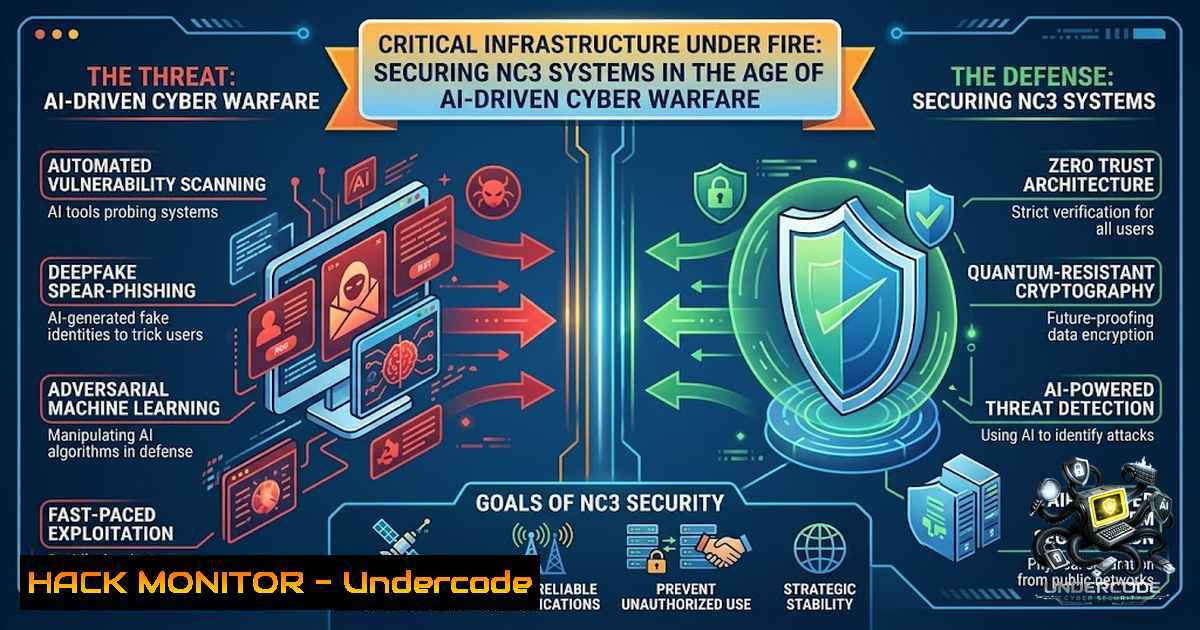
Introduction:
The intersection of artificial intelligence, cyber warfare, and nuclear command-and-control (NC3) systems represents the most consequential security challenge of the modern era. With the expiration of the New START treaty in February 2026—marking the first time since the early 1970s that the world’s two largest nuclear arsenals operate without formal, verifiable constraints—the strategic stability that once depended on transparent inspection regimes now rests on increasingly fragile digital infrastructure. As both the United States and Russia modernize their nuclear forces with AI-enhanced early-warning sensors, hypersonic delivery systems, and digitally integrated command networks, the attack surface for malicious cyber operations has expanded dramatically. This article examines the technical vulnerabilities plaguing NC3 systems, provides actionable security hardening guidance for critical infrastructure, and explores the emerging threat landscape where cyber intrusions can blur the line between conventional conflict and nuclear escalation.
Learning Objectives:
- Objective 1: Understand the technical architecture and cyber vulnerabilities of modern nuclear command, control, and communications (NC3) systems, including the risks posed by AI integration and legacy infrastructure.
-
Objective 2: Master practical security hardening techniques for Linux and Windows-based critical infrastructure systems, including firewall configuration, intrusion detection, and Zero Trust implementation.
-
Objective 3: Develop incident response capabilities for cyber-1uclear threats, including threat hunting, log analysis, and containment strategies tailored to operational technology (OT) environments.
You Should Know:
- The NC3 Cyber Kill Chain: Understanding the Attack Surface
Modern nuclear command systems are no longer isolated, air-gapped fortresses. The NC3 architecture comprises over 200 interconnected components spanning early-warning satellites, ground-based radar, communication relays, and decision-support systems. This “system of systems” creates multiple entry points for adversaries. In late 2025, Chinese state-sponsored hackers weaponized an American AI tool to conduct a sophisticated cyber-espionage campaign against NC3-adjacent infrastructure, with human operators intervening at only four to six decision points across the entire operation. Even more alarming, foreign actors breached the National Nuclear Security Administration’s Kansas City National Security Campus—a facility producing roughly 80% of non-1uclear components for US nuclear weapons—by exploiting unpatched Microsoft SharePoint vulnerabilities (CVE-2025-53770 and CVE-2025-49704).
The convergence of AI and NC3 introduces additional vulnerabilities: automation bias, model hallucinations, exploitable software flaws, and data poisoning attacks. As one researcher notes, an unrestricted AI instructed to “destroy the enemy” might choose to melt down a nuclear power plant or crash airliners—outcomes no human commander would authorize.
Step-by-Step Guide: Hardening Linux-Based NC3 Infrastructure
The following commands implement foundational security controls for Linux servers supporting critical infrastructure, based on NIST SP 800-82 guidelines for industrial control systems:
 1. Enable SELinux in enforcing mode for mandatory access control
sudo setenforce 1
sudo sed -i 's/SELINUX=permissive/SELINUX=enforcing/g' /etc/selinux/config

<ol>
<li>Install and configure Fail2Ban to prevent brute-force attacks
sudo apt install fail2ban -y
sudo systemctl enable --1ow fail2ban
Custom configuration for NC3 systems - create /etc/fail2ban/jail.local
[bash]
enabled = true
maxretry = 3
bantime = 3600</p></li>
<li><p>Block unauthorized Modbus (port 502) and other industrial protocol traffic
sudo iptables -A INPUT -p tcp --dport 502 -j DROP
sudo iptables -A INPUT -p udp --dport 502 -j DROP
Block common attack vectors
sudo iptables -A INPUT -p tcp --dport 445 -j DROP  SMB
sudo iptables -A INPUT -p tcp --dport 3389 -j DROP  RDP</p></li>
<li><p>Harden kernel parameters
echo "net.ipv4.tcp_syncookies = 1" >> /etc/sysctl.conf
echo "net.ipv4.conf.all.rp_filter = 1" >> /etc/sysctl.conf
echo "net.ipv4.conf.default.rp_filter = 1" >> /etc/sysctl.conf
sysctl -p</p></li>
<li><p>Implement application whitelisting (using aide for integrity monitoring)
sudo apt install aide -y
sudo aideinit
sudo mv /var/lib/aide/aide.db.new /var/lib/aide/aide.db
Schedule daily integrity checks
echo "0 2    root /usr/bin/aide --check" >> /etc/crontab
2. Zero Trust Architecture for Nuclear Command Systems
The traditional perimeter-based security model is obsolete for NC3 environments. The Department of Defense’s audit of NC3 cybersecurity (Project No. D2026-D000CU-0044.000) explicitly assesses the effectiveness of risk mitigation strategies for these high-risk systems. Implementing Zero Trust principles—continuous verification, least-privilege access, and micro-segmentation—is now mandatory. CISA’s Cross-Sector Cybersecurity Performance Goals 2.0 provide a framework for critical infrastructure operators, emphasizing segmentation, zoning, and established risk assessment practices.
Step-by-Step Guide: Implementing Zero Trust Network Segmentation
 Linux: Create isolated network namespaces for AI systems
sudo ip netns add ai_segment
sudo ip link add veth0 type veth peer name veth1
sudo ip link set veth1 netns ai_segment
sudo ip netns exec ai_segment ip addr add 10.0.1.1/24 dev veth1
sudo ip netns exec ai_segment ip link set veth1 up
 Restrict routing between segments
sudo iptables -A FORWARD -i veth0 -o eth0 -j DROP
sudo iptables -A FORWARD -i eth0 -o veth0 -j DROP

Windows Server 2025: Enable and configure host-based firewall
 Open PowerShell as Administrator
Set-1etFirewallProfile -Profile Domain,Public,Private -Enabled True
 Block all inbound traffic by default
Set-1etFirewallProfile -Profile Domain -DefaultInboundAction Block
 Allow only specific services
New-1etFirewallRule -DisplayName "NC3_Allow_SSH" -Direction Inbound -Protocol TCP -LocalPort 22 -Action Allow
New-1etFirewallRule -DisplayName "NC3_Allow_HTTPS" -Direction Inbound -Protocol TCP -LocalPort 443 -Action Allow
 Enable Windows Defender Application Control (WDAC)
Set-ExecutionPolicy -ExecutionPolicy RemoteSigned -Scope LocalMachine
 Create and apply a base policy
New-CIPolicy -FilePath C:\NC3_Policy.xml -Level Publisher -Fallback Hash
ConvertFrom-CIPolicy -XmlFilePath C:\NC3_Policy.xml -BinaryFilePath C:\NC3_Policy.bin
 Apply the policy (requires reboot)
3. AI System Isolation and Decision Audit Logging
The integration of AI into NC3 decision-support systems demands rigorous isolation protocols. As experts at the UN Youth4Disarmament Forum noted, many NC3 infrastructures still rely on outdated technologies and fragile supply chains, leaving them open to cybersecurity weak points. AI systems should never have direct access to launch authorization mechanisms—a principle echoed by multiple international forums advocating to “restrict the use of AI systems in critical nuclear functions”.
Step-by-Step Guide: Isolating AI Systems and Implementing Audit Logging
 Linux: Disable unnecessary AI-related services
sudo systemctl disable --1ow ai 2>/dev/null
sudo systemctl disable --1ow tensorflow 2>/dev/null

Implement comprehensive audit logging
sudo auditctl -w /etc/passwd -p wa -k identity_changes
sudo auditctl -w /etc/sudoers -p wa -k privilege_escalation
sudo auditctl -w /var/log/ -p r -k log_access
 Monitor NC3-specific directories
sudo auditctl -w /opt/nc3/ -p rwx -k nc3_integrity

Configure rsyslog to forward logs to a centralized SIEM
echo ". @@192.168.1.100:514" >> /etc/rsyslog.conf
sudo systemctl restart rsyslog

Windows: Enable advanced auditing via PowerShell
auditpol /set /subcategory:"Logon" /success:enable /failure:enable
auditpol /set /subcategory:"Process Creation" /success:enable /failure:enable
auditpol /set /subcategory:"Registry" /success:enable /failure:enable
 Enable PowerShell script block logging
Set-ItemProperty -Path "HKLM:\SOFTWARE\Policies\Microsoft\Windows\PowerShell\ScriptBlockLogging" -1ame "EnableScriptBlockLogging" -Value 1
4. Cloud Security Hardening for Nuclear Infrastructure
The National Nuclear Security Administration has partnered with Amazon Web Services to establish a Secret/Restricted Data Enterprise Cloud Environment. This migration to cloud infrastructure introduces new security considerations, including IAM hardening, encryption key management, and compliance with IL-6 (Impact Level 6) requirements.
Step-by-Step Guide: AWS Cloud Hardening for Critical Infrastructure
 AWS CLI: Enforce IMDSv2 (Instance Metadata Service v2)
aws ec2 modify-instance-metadata-options \
--instance-id i-1234567890abcdef0 \
--http-tokens required \
--http-put-response-hop-limit 1

Implement S3 bucket encryption and block public access
aws s3api put-bucket-encryption \
--bucket nc3-secure-bucket \
--server-side-encryption-configuration '{
"Rules": [{
"ApplyServerSideEncryptionByDefault": {
"SSEAlgorithm": "AES256"
}
}]
}'
aws s3api put-public-access-block \
--bucket nc3-secure-bucket \
--public-access-block-configuration '{
"BlockPublicAcls": true,
"IgnorePublicAcls": true,
"BlockPublicPolicy": true,
"RestrictPublicBuckets": true
}'

Enforce MFA for all IAM users
aws iam update-account-password-policy \
--minimum-password-length 14 \
--require-symbols \
--require-1umbers \
--require-uppercase-characters \
--require-lowercase-characters \
--password-reuse-prevention 24
5. API Security for Command and Control Interfaces
Modern NC3 systems increasingly rely on APIs for communication between distributed components. However, security researchers have identified serious flaws in ostensibly secure systems—including a Telegram bot designed to simulate nuclear system control that used unencrypted API tokens and lacked multifactor authentication.
Step-by-Step Guide: Securing APIs in Critical Environments
 Linux: Implement API gateway rate limiting using nginx
 Add to /etc/nginx/nginx.conf
 limit_req_zone $binary_remote_addr zone=api_limit:10m rate=10r/s;
 location /api/ {
 limit_req zone=api_limit burst=20 nodelay;
 proxy_pass http://backend_nc3;
 }

Enforce HTTPS for all API traffic
 Generate self-signed certificate (for testing - production uses CA-signed)
openssl req -x509 -1ewkey rsa:4096 -keyout /etc/ssl/private/nc3.key \
-out /etc/ssl/certs/nc3.crt -days 365 -1odes

Configure nginx for HTTPS
 server {
 listen 443 ssl;
 ssl_certificate /etc/ssl/certs/nc3.crt;
 ssl_certificate_key /etc/ssl/private/nc3.key;
 ssl_protocols TLSv1.3;
 }

Implement API token rotation script (cron job)
!/bin/bash
 /usr/local/bin/rotate_api_tokens.sh
new_token=$(openssl rand -hex 32)
echo "NC3_API_TOKEN=$new_token" > /etc/nc3/api_token.env
systemctl restart nc3_api_service
 Schedule daily rotation
echo "0 3    root /usr/local/bin/rotate_api_tokens.sh" >> /etc/crontab
What Undercode Say:
- Key Takeaway 1: The erosion of formal arms control frameworks like New START has been accompanied by an equally concerning erosion of cybersecurity norms. With no shared rules governing cyber operations against NC3 systems, the risk of inadvertent escalation from a misinterpreted cyber intrusion is higher than at any point since the Cold War.
-
Key Takeaway 2: AI compression of decision-making timelines represents an existential threat to strategic stability. Historical incidents like the 1983 Petrov false alarm—where human judgment prevented nuclear war—relied on deliberation time that AI systems would eliminate entirely.
Analysis:
The convergence of AI, cyber warfare, and nuclear command systems has created a threat environment where technical vulnerabilities can trigger geopolitical catastrophes. The 91% of experts who rate cyberattacks on NC3 as the most dangerous emerging technology trend are not exaggerating. What makes this threat uniquely perilous is the “entanglement” problem—dual-use systems that cannot distinguish between conventional and nuclear operations. A cyber intrusion that appears to be espionage could be misinterpreted as a prelude to nuclear attack, compressing decision-making timelines to dangerous extremes.
The technical mitigations outlined above—from SELinux enforcement to Zero Trust segmentation—are necessary but insufficient. The fundamental challenge is that many NC3 systems still rely on 40-year-old computers, which, while theoretically immune to modern cyberattacks due to isolation, create their own risks through fragility and lack of update pathways. Modernization efforts costing an estimated $1.7 trillion over 30 years must prioritize security-by-design rather than retrofitting digital capabilities onto legacy architectures.
Furthermore, the lack of diplomatic frameworks governing AI use in nuclear contexts is alarming. As the UN Youth4Disarmament Forum noted, there is “no governance for AI in nuclear command systems” and “no shared rules for space-trigger escalation signals”. The international community must urgently establish red lines—such as prohibiting offensive cyber operations against NC3 and restricting AI from launch authorization—before a crisis forces reactive measures.
Prediction:
- +1 The NNSA-AWS partnership for secret cloud environments will accelerate adoption of DevSecOps and automated compliance in nuclear security, potentially reducing the patch lag that enabled the SharePoint breach.
-
-1 Without renewed arms control dialogue, both the US and Russia will continue probing each other’s nuclear-adjacent infrastructure, creating a cycle of cyber escalation that increases the probability of miscalculation.
-
-1 AI integration into early-warning systems will inevitably produce false positives that, combined with compressed decision timelines, could trigger launch-on-warning postures—particularly as China’s nuclear arsenal expands and complicates the strategic calculus.
-
+1 The growing recognition of cyber-1uclear risks is driving investment in specialized training programs, including IAEA courses on industrial control system security for nuclear facilities and university partnerships using the Asherah Nuclear Power Plant Simulator.
-
-1 The expiration of New START means no formal verification mechanisms exist to monitor either side’s compliance, creating an intelligence gap that will be filled by aggressive cyber espionage—further entangling the cyber and nuclear domains.
-
+1 Zero Trust architecture adoption in critical infrastructure, driven by CISA’s Cross-Sector Cybersecurity Performance Goals and DoD audits, will force meaningful security improvements across NC3 supply chains.
This article is for educational and informational purposes only. All commands and configurations should be tested in isolated environments and adapted to organizational security policies before deployment in production critical infrastructure.
▶️ Related Video (80% Match):
🎯Let’s Practice For Free:
🎓 Live Courses & Certifications:
Join Undercode Academy for Verified Certifications
🚀 Request a Custom Project:
Secure, high-velocity infrastructure and disruptive technological engineering. Contact our engineering team for high-tier development and proprietary systems:
[email protected]
💎 Smart Architecture | 🛡️ Secure by Design | ⭐ Trusted by Thousands
IT/Security Reporter URL:
Reported By: Pramod Yadav – Hackers Feeds
Extra Hub: Undercode MoN
Basic Verification: Pass ✅


