Listen to this Post
Introduction:
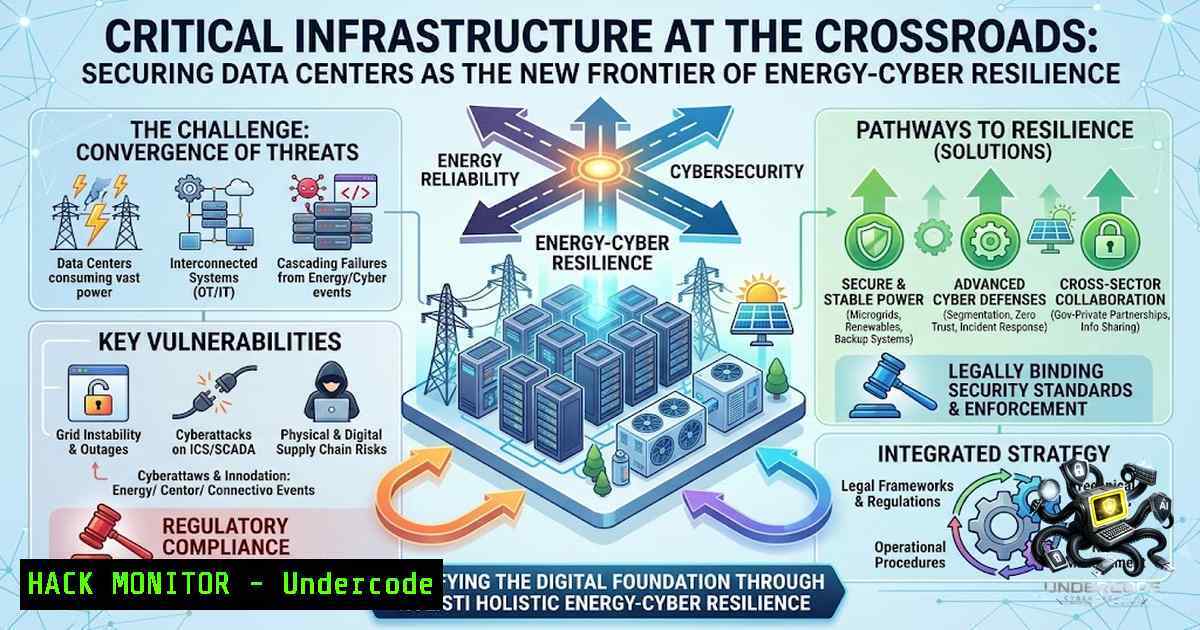
The 2025 annual report from Italy’s Parliamentary Committee for the Security of the Republic (COPASIR) has drawn a clear and urgent line connecting energy security, geopolitical instability, and the protection of digital infrastructure. As data centers evolve from mere IT facilities into the physical backbone of national competitiveness and AI-driven economies, their operational continuity is no longer just a business concern—it is a matter of national security. This convergence demands that cybersecurity, energy resilience, and sustainability be treated as a single, integrated strategic imperative rather than separate operational silos.
Learning Objectives:
- Understand the strategic interconnection between energy geopolitics, data center operations, and national cybersecurity frameworks.
- Master technical commands and procedures for monitoring energy consumption, UPS systems, and physical security parameters across Linux and Windows environments.
- Learn how cogeneration and trigeneration systems can enhance both energy efficiency and operational resilience in critical digital infrastructure.
You Should Know:
- The Geopolitical Energy-Cyber Nexus: From COPASIR to the Data Center Floor
The COPASIR report emphasizes that energy security is now an integral component of national security. This is not an abstract policy concern—it translates directly into operational realities for data center architects and security teams. The report highlights three primary drivers: foreign energy dependence, price volatility, and international instability, all of which increase the vulnerability of the production system. For data centers, this means that a disruption in energy supply is no longer a purely logistical problem but a potential national security incident with cascading effects on digital services, financial systems, and public safety.
The technical response to this challenge begins with understanding the threat surface. Data centers are now recognized as critical national infrastructure in several jurisdictions, including the United Kingdom, and there is active legislative debate in the U.S. about granting them a standalone critical infrastructure designation. This designation brings with it rigorous compliance requirements, including frameworks like NIST SP 800-53, ISO/IEC 27001, and sector-specific cybersecurity mandates.
To operationalize these frameworks, security teams must implement continuous monitoring and response capabilities. Below are essential commands for establishing a baseline of security and energy posture on critical servers:
Linux Commands for System Integrity and Energy Monitoring:
 Check for unauthorized kernel modules (a common persistence mechanism)
lsmod | grep -v -e "^Module" -e "usb" -e "video" | sort

Monitor real-time system logs for anomalies (authentication failures, service crashes)
sudo journalctl -f -p err -o short-iso

Use PowerTOP to identify power-hungry processes and tune idle power states
sudo powertop --csv=power_report.csv
sudo powertop --auto-tune

Query Intel RAPL (Running Average Power Limit) energy estimates via perf
sudo perf stat -a -e power/energy-pkg/,power/energy-ram/,power/energy-cores/ sleep 10

Monitor CPU temperature and throttling (critical for thermal management)
sensors | grep -E "Package|Core|Temp"
Windows Commands for Energy and Security Posture:
 Get detailed power configuration and battery status (for UPS-connected systems)
powercfg /energy
powercfg /batteryreport

Monitor system event logs for security-related events (Event ID 4624 = successful logon)
Get-WinEvent -LogName Security | Where-Object { $<em>.Id -eq 4624 -or $</em>.Id -eq 4625 } | Select-Object TimeCreated, Id, Message -First 20

Check for unauthorized services and scheduled tasks
Get-Service | Where-Object { $<em>.Status -eq 'Running' -and $</em>.StartType -eq 'Automatic' }
Get-ScheduledTask | Where-Object { $_.State -1e 'Disabled' }
- Resilience Through Cogeneration and Trigeneration: A Technical Implementation Guide
COPASIR’s findings point to a critical insight: the transition to renewables requires greater system flexibility, balancing capacity, and operational continuity. For data centers, this is where cogeneration (Combined Heat and Power, or CHP) and trigeneration (Combined Cooling, Heating, and Power, or CCHP) become strategically vital. These systems generate electricity, heating, and cooling simultaneously from a single fuel source—typically a high-efficiency gas engine—achieving overall efficiencies of up to 90%.
Implementing a trigeneration system in a data center is a complex engineering project, but security and IT teams must understand how to integrate these systems with their monitoring and control infrastructure. Below is a step-by-step guide for connecting a trigeneration plant to your existing data center monitoring stack:
Step 1: Network Integration and Segmentation
- Deploy the trigeneration plant’s control systems on a dedicated operational technology (OT) network segment, isolated from the corporate IT network using VLANs and firewalls.
- Configure SNMP v3 on the plant’s control units (e.g., Jenbacher engines, absorption chillers) to enable secure, encrypted monitoring.
Step 2: Data Collection and Aggregation
- Install and configure a monitoring agent (e.g., Telegraf, Prometheus node_exporter) on a secure gateway host within the OT segment.
- Use `snmpwalk` to discover available OIDs for power output, thermal energy, fuel consumption, and cooling capacity:
 Discover SNMP OIDs for a generic trigeneration unit (requires MIB files)
snmpwalk -v3 -l authPriv -u monitor_user -a SHA -A "auth_pass" -x AES -X "priv_pass" 192.168.10.100 1.3.6.1.4.1

For APC UPS systems, monitor battery charge and load via SNMP
snmpget -v3 -l authPriv -u monitor_user -a SHA -A "auth_pass" -x AES -X "priv_pass" 192.168.10.101 .1.3.6.1.4.1.318.1.1.1.2.2.3.0
Step 3: Automated Shutdown and Load Balancing
- Integrate the trigeneration system with your UPS and battery storage to enable graceful shutdown procedures during grid failures. Use Network UPS Tools (NUT) on Linux to monitor UPS status and trigger scripts:
 Install NUT on Linux
sudo apt-get install nut nut-snmp

Configure /etc/nut/ups.conf with your UPS details
[my-ups]
driver = snmp-ups
port = 192.168.10.101
community = public
snmp_version = v3
privProtocol = AES
privPassword = "priv_pass"

Test UPS communication
sudo upsdrvctl start
sudo upsc my-ups

Create a shutdown script that triggers when battery reaches critical level
 /etc/nut/upsmon.conf
NOTIFYCMD /usr/local/bin/shutdown_script.sh
Step 4: Sustainability Reporting and PUE Optimization
- Collect data on total facility energy consumption, IT load, and recovered heat to calculate Power Usage Effectiveness (PUE) and Energy Reuse Effectiveness (ERE).
- Use the `ipmitool` command on servers with BMC (Baseboard Management Controller) to measure per-server power draw:
 Get power readings from a server's BMC (Dell iDRAC, HP iLO, etc.)
ipmitool dcmi power reading
ipmitool sdr list | grep -i power

On IBM Z or LinuxONE systems, use zpwr for partition-level power readings
zpwr -d 10 -o json
- Physical and Cyber Convergence: Protecting the Energy-Digital Interface
The COPASIR report underscores that energy assets must be protected not only physically but also on the cyber plane. This dual threat environment is particularly acute at the grid–data center interface. Recent DOE initiatives highlight vulnerabilities in UPS/BESS (Battery Energy Storage Systems) and cooling systems, which are increasingly network-connected and thus exposed to cyberattacks.
To harden this interface, implement the following measures:
Network Segmentation and Access Control:
- Deploy zero-trust architecture across all OT networks, enforcing strict identity verification and least-privilege access.
- Use `iptables` or `nftables` on Linux gateway hosts to restrict SNMP and other management protocols to authorized monitoring stations only:
 Allow SNMP only from the monitoring subnet (192.168.50.0/24)
sudo iptables -A INPUT -p udp --dport 161 -s 192.168.50.0/24 -j ACCEPT
sudo iptables -A INPUT -p udp --dport 161 -j DROP

Log all connection attempts to sensitive ports (e.g., 22, 443, 161)
sudo iptables -A INPUT -m state --state NEW -m limit --limit 5/minute -j LOG --log-prefix "FW: "
Firmware Integrity and Supply Chain Security:
- Implement NIST SP 800-193 guidelines for platform firmware resiliency, ensuring that BIOS, BMC, and other low-level firmware are protected against tampering.
- Regularly audit firmware versions and compare against known-good hashes:
 For Dell servers using iDRAC
racadm getversion

For HP servers using hponcfg
hponcfg -g -f /tmp/firmware_report.xml
Physical Access Control Integration:
- Integrate physical access control systems (PACS) with cybersecurity incident response. A failed login attempt at a data center door should trigger the same SIEM alerts as a failed SSH login.
- Use `auditd` on Linux to monitor physical console access (e.g., via IPMI or serial console):
 Configure auditd to monitor /dev/ttyS0 (serial console) access
sudo auditctl -w /dev/ttyS0 -p rwxa -k console_access

Search audit logs for console access events
sudo ausearch -k console_access
4. Operationalizing AI-Driven Load Balancing and Predictive Maintenance
The COPASIR report notes that artificial intelligence has entered the national security agenda, not merely as a technology but as an emerging issue for intelligence oversight. For data center operators, AI offers powerful tools for predictive energy management and threat detection.
Implementing AI-Driven Energy Optimization:
- Deploy machine learning models to predict IT load and optimize cooling and power distribution in real-time.
- Use open-source tools like Scaphandre to export energy metrics to Prometheus, then apply forecasting algorithms (e.g., ARIMA, LSTM) to anticipate demand spikes.
 Install Scaphandre on Linux
wget https://github.com/hubblo-org/scaphandre/releases/latest/download/scaphandre-linux-amd64
chmod +x scaphandre-linux-amd64
sudo ./scaphandre-linux-amd64 prometheus --port 8080

Query Prometheus for power consumption metrics (example)
curl 'http://localhost:9090/api/v1/query?query=scaphandre_power_consumption_microwatts{host="dc-rack-01"}'
Cybersecurity AI Integration:
- Integrate AI-based anomaly detection into SIEM platforms to identify unusual patterns in energy consumption that might indicate a cyberattack (e.g., cryptojacking, ransomware-induced CPU spikes).
- Use `ebpf` (Extended Berkeley Packet Filter) tools to monitor system calls and network traffic with minimal overhead, feeding data into AI models for real-time threat detection:
 Use bpftrace to monitor unusual outbound connections (potential data exfiltration)
sudo bpftrace -e 'kprobe:__tcp_transmit_skb { @[bash] = count(); }'
- Compliance and Reporting: Aligning with NIST, ISO, and Critical Infrastructure Mandates
The convergence of energy and cybersecurity demands a unified compliance strategy. Data centers must now align with multiple frameworks simultaneously:
- NIST SP 800-53 for security and privacy controls
- ISO/IEC 27001 for information security management
- NIST CSF 2.0 for cyber resilience architecture
- Sector-specific regulations for critical infrastructure (e.g., NIS Regulations in the UK)
Automated Compliance Checking:
- Use OpenSCAP on Linux to perform automated vulnerability and compliance scans against NIST and DISA STIG benchmarks:
 Install OpenSCAP
sudo apt-get install openscap-scanner

Perform a compliance scan against the NIST SP 800-53 profile
sudo oscap xccdf eval --profile xccdf_org.nist_800-53 --results compliance_results.xml /usr/share/xml/scap/ssg/ssg-ubuntu2204-ds.xml
- On Windows, use PowerShell to check for compliance against security baselines:
 Check if Windows Defender is enabled and up-to-date
Get-MpComputerStatus | Select-Object AntivirusEnabled, AntivirusSignatureVersion

Verify that BitLocker is enabled on system drives
Get-BitLockerVolume | Select-Object MountPoint, ProtectionStatus
What Undercode Say:
- Key Takeaway 1: Security, energy, sustainability, and digital competitiveness are no longer separate agendas—they are a single, indivisible strategic challenge for critical infrastructure operators.
- Key Takeaway 2: The COPASIR 2025 report serves as a wake-up call: data centers must evolve from passive consumers of energy to active participants in grid resilience, leveraging cogeneration, trigeneration, and AI-driven optimization to ensure operational continuity.
Analysis:
The integration of energy systems with digital infrastructure represents a paradigm shift in how we think about critical infrastructure protection. The traditional silos between IT security, facilities management, and corporate sustainability are no longer viable. The COPASIR report makes it clear that geopolitical energy risks are now cybersecurity risks, and vice versa. For practitioners, this means developing new skill sets that bridge electrical engineering, network security, and data science. The technical commands and procedures outlined above provide a starting point, but the real challenge lies in building organizational structures and cultures that can respond to this integrated threat landscape. The data center of the future will be a microgrid, a security operations center, and a sustainability hub all in one—and those who master this convergence will lead the next generation of digital infrastructure.
Prediction:
- -1: The next major cyberattack on a data center will not target servers directly but will instead exploit vulnerabilities in UPS systems or cooling controls, causing physical damage and prolonged outages that bypass traditional cybersecurity defenses.
- +1: The growing recognition of data centers as critical infrastructure will accelerate the adoption of standardized security frameworks and government-backed resilience programs, driving a new wave of innovation in cyber-physical security technologies.
- +1: AI-driven predictive maintenance and load balancing will become standard practice within 3–5 years, reducing PUE by 15-20% and significantly enhancing grid stability through demand-response integration.
- -1: The increasing energy demands of AI workloads will outpace the deployment of renewable energy and efficiency measures, creating a “green gap” that exposes data centers to regulatory penalties and public scrutiny.
- +1: Cogeneration and trigeneration systems will see a renaissance, not as niche technologies but as foundational components of data center design, driven by both sustainability mandates and the imperative for energy independence highlighted in the COPASIR report.
▶️ Related Video (78% Match):
🎯Let’s Practice For Free:
🎓 Live Courses & Certifications:
Join Undercode Academy for Verified Certifications
🚀 Request a Custom Project:
Secure, high-velocity infrastructure and disruptive technological engineering. Contact our engineering team for high-tier development and proprietary systems:
[email protected]
💎 Smart Architecture | 🛡️ Secure by Design | ⭐ Trusted by Thousands
IT/Security Reporter URL:
Reported By: Davide Maniscalco – Hackers Feeds
Extra Hub: Undercode MoN
Basic Verification: Pass ✅


