Listen to this Post
Introduction:
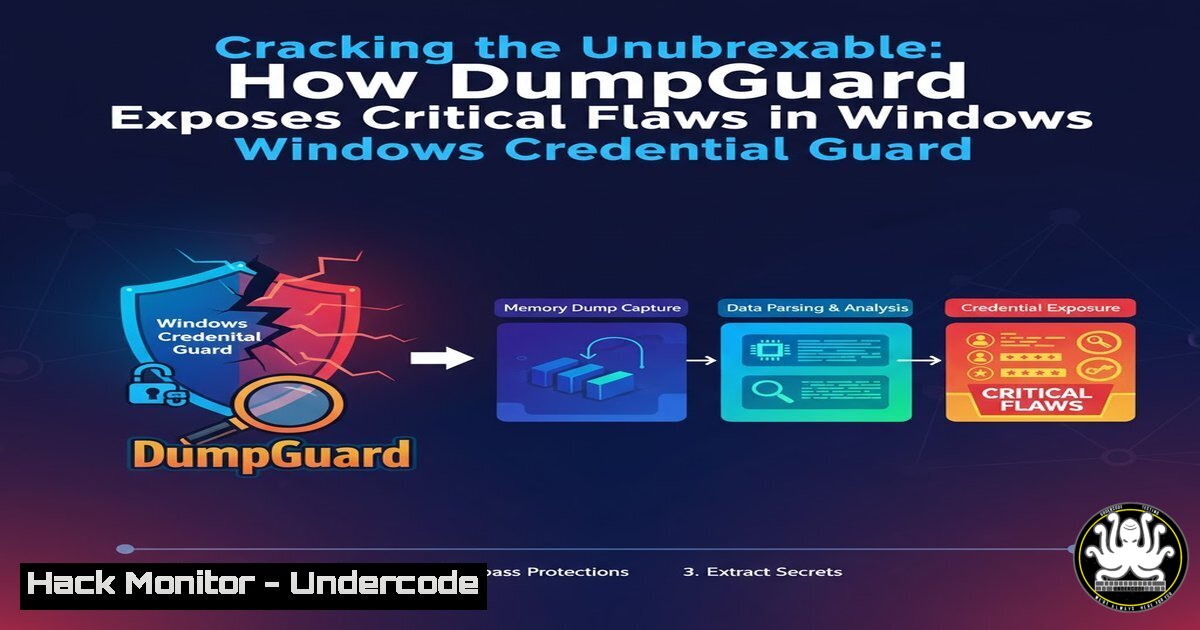
Windows Credential Guard has long been touted as a formidable barrier, designed to isolate and protect domain credentials from sophisticated theft techniques like Pass-the-Hash attacks. However, recent research from SpecterOps, culminating in the release of the “DumpGuard” tool, has demonstrated critical vulnerabilities, revealing that this defensive bastion can be bypassed in both privileged and unprivileged contexts. This breakthrough underscores a persistent threat landscape where even deprecated protocols like NTLMv1 remain a potent attack vector, as evidenced by the continued relevance of online cracking resources like ntlmv1.com.
Learning Objectives:
- Understand the technical mechanisms behind the Credential Guard bypass techniques.
- Learn how to use the DumpGuard tool for authorized security testing and mitigation verification.
- Identify and mitigate risks associated with NTLMv1 and other legacy authentication protocols.
You Should Know:
1. The Isolated LSA Subsystem and Its Weaknesses
The Local Security Authority (LSA) subsystem is responsible for managing authentication in Windows. Credential Guard uses virtualization-based security to isolate the LSA process (LSAISO.exe), making its secrets inaccessible from the host OS. The SpecterOps research focuses on manipulating the communication channels between the isolated LSA and the host.
Command: Enumerating LSA Processes
`Get-Process lsaiso`
Step-by-step guide: This PowerShell command is used to verify that Credential Guard is active on a system. If it is running, you will see the `lsaiso` process listed. For security professionals, this is a first step in assessing the defensive posture of a Windows endpoint. If Credential Guard is not running, the system is immediately more vulnerable to credential dumping attacks.
2. Exploiting the Backup Key Feature
A primary method explored involves the Backup Key functionality. When a system is joined to a domain, a backup key is stored to facilitate recovery. This key, while encrypted by the system’s public key, can be retrieved and potentially misused.
Command: Querying for the DPAPI Backup Key
`SharpDPAPI backupkey /list`
(Note: SharpDPAPI is a tool from the SharpCollection suite, not a built-in command.)
Step-by-step guide: This command, executed from a tool like SharpDPAPI, attempts to list the available Data Protection API (DPAPI) backup keys on the system. In a penetration testing scenario, if an attacker gains sufficient privileges (e.g., via administrator access), they can use this to identify the backup key. Once retrieved, this key can be used to decrypt credentials that were previously protected by DPAPI, effectively bypassing one layer of isolation.
3. Forging Kerberos Tickets with the Retrieved Key
After obtaining the backup key, an attacker can forge Kerberos tickets. This is a classic “Golden Ticket” attack, but it leverages the extracted key from the supposedly isolated environment.
Command: Forging a Golden Ticket with Mimikatz
`mimikatz kerberos::golden /user:Administrator /domain:undercode.local /sid:S-1-5-21-… /krbtgt: /ptt`
Step-by-step guide: This series of commands within the Mimikatz framework creates a forged Ticket-Granting-Ticket (TGT). The `/krbtgt` parameter is fed the AES 256-bit hash of the KRBTGT account’s password, which can be derived from the compromised backup key. The `/ptt` (Pass-the-Ticket) command injects this forged ticket directly into the current session’s memory, granting the attacker persistent domain administrator access across the network.
4. The Unprivileged NTLMv1 Attack Path
Perhaps more alarming is the unprivileged attack vector that relies on the legacy NTLMv1 protocol. By forcing or waiting for an NTLMv1 authentication challenge, an attacker can capture a challenge-response pair that is cryptographically weak enough to be cracked offline.
Command: Using Inveigh to Capture NTLMv1
`Invoke-Inveigh -ConsoleOutput Y -NTLMv1 Y -Tool 2`
Step-by-step guide: This PowerShell command, part of the Inveigh toolset, starts a network spoofer (like a malicious LLMNR/NBNS spoofer) that captures network authentication traffic. The `-NTLMv1 Y` flag specifically targets the weaker NTLMv1 protocol. Once a challenge-response is captured, it can be submitted to the online cracking service at `ntlmv1.com` to recover the user’s NT hash.
5. Cracking the NTLMv1 Challenge with ntlmv1.com
The `ntlmv1.com` service has effectively supplanted older methods like `crack.sh` by providing a streamlined, cloud-based cracking resource for these specific challenges.
Process: Submitting a Captured Hash
1. Capture an NTLMv1 SSHP hash (format: `NETNTLMv1::DOMAIN:USER:…`).
- Navigate to `https://ntlmv1.com` in a web browser.
3. Paste the captured hash into the provided field.
4. Submit the hash. The service typically returns the corresponding NT hash within seconds to minutes.
Step-by-step guide: This process demonstrates the shocking ease with which a legacy protocol can be broken. The recovered NT hash can then be used in Pass-the-Hash attacks to impersonate the user without ever knowing their plaintext password, completely bypassing Credential Guard’s protections for that specific authentication event.6. Mitigation: Disabling NTLMv1 and Enforcing Auditing
The most direct mitigation for the NTLMv1 attack vector is to eradicate the protocol from your environment.
Command: Group Policy to Disable NTLMv1
`Computer Configuration -> Windows Settings -> Security Settings -> Local Policies -> Security Options -> Network security: LAN Manager authentication level -> Send NTLMv2 response only. Refuse LM & NTLM`
Step-by-step guide: This Group Policy setting is critical for hardening your network. By configuring this policy, you instruct Windows clients to refuse to use the vulnerable LM and NTLMv1 protocols, forcing all authentication to use the more secure NTLMv2 or Kerberos. This should be deployed across the entire domain to effectively close this specific unprivileged bypass.
7. Proactive Detection with Sigma and SIEM Rules
Defense requires detection. Security teams should implement rules to detect the tools and techniques used in these attacks.
Sigma Rule Snippet: Detecting Mimikatz-like Activity
title: Mimikatz Command Line Arguments
logsource:
category: process_creation
detection:
selection:
CommandLine|contains:
- 'kerberos::golden'
- 'lsadump::dcsync'
condition: selection
Step-by-step guide: This is a simplified example of a Sigma rule, a generic signature format that can be converted for use in SIEMs like Splunk or Elasticsearch. It looks for the tell-tale command-line arguments of the Mimikatz tool. By ingesting and alerting on such process creation events, a Security Operations Center (SOC) can be alerted to active credential theft attempts in near-real-time, allowing for a rapid response.
What Undercode Say:
- No Silver Bullet: Credential Guard is a powerful security feature, but it is not an impenetrable magic box. It reduces the attack surface but does not eliminate the risk of credential theft entirely.
- Legacy Code is a Live Grenade: The persistence of NTLMv1 in modern enterprise networks represents one of the single greatest security liabilities. Its continued availability provides a reliable and easy-to-exploit backdoor for attackers.
The DumpGuard disclosure is a stark reminder that defense-in-depth is non-negotiable. Relying on a single, complex security control is a recipe for failure. The research highlights that the attack paths often lie not in breaking the core cryptographic isolation, but in exploiting the necessary supporting infrastructure and legacy components that interact with it. The fact that a protocol as ancient and broken as NTLMv1 can serve as a key to unlock a modern defensive technology like Credential Guard should be a wake-up call for every enterprise. This isn’t just a bug; it’s a systemic issue stemming from the industry’s challenge of balancing backward compatibility with robust security.
Prediction:
The techniques published by SpecterOps will be rapidly integrated into mainstream penetration testing frameworks like Metasploit and Cobalt Strike, lowering the barrier to entry for less sophisticated threat actors. Within the next 12-18 months, we predict a significant rise in incidents where Credential Guard bypass is a documented step in the attack chain, particularly in ransomware campaigns aiming for rapid domain-wide compromise. This will force a paradigm shift in defensive postures, moving from blind reliance on Credential Guard to a more holistic exposure management strategy that aggressively hunts for and eliminates legacy protocol use and continuously validates control efficacy.
🎯Let’s Practice For Free:
IT/Security Reporter URL:
Reported By: Hdmoore Catching – Hackers Feeds
Extra Hub: Undercode MoN
Basic Verification: Pass ✅


