Listen to this Post
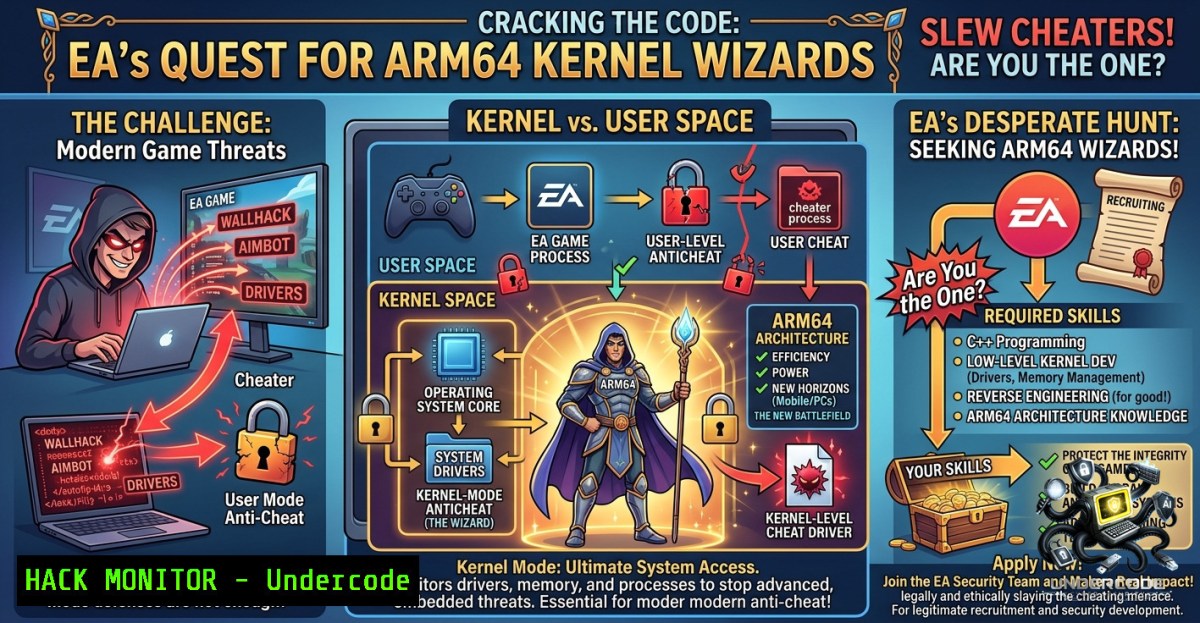
Introduction:
Game cheating has evolved from simple memory editors to sophisticated kernel‑rootkits that manipulate game state at the lowest levels. On ARM64 platforms – powering modern mobile devices, Apple Silicon Macs, and next‑gen consoles – anti‑cheat engineers must defend against threats that run with ring‑0 privileges. Electronic Arts’ recent call for a deep ARM64 kernel software engineer with an “attacker mindset” signals an industry‑wide shift: stopping cheaters now requires offensive security thinking at the hardware‑assisted virtualization layer.
Learning Objectives:
– Understand ARM64 kernel‑level security mechanisms (EL0/EL1, PAC, BTI) and how to enforce game integrity from privileged mode.
– Master debugging, reverse engineering, and kernel‑mode instrumentation on both Windows on ARM64 and Linux/Android kernels.
– Implement practical anti‑cheat techniques: memory scanning, syscall hooking, integrity validation, and cloud‑based behavioral detection.
You Should Know
1. Kernel‑Level Anti‑Cheat Architecture on ARM64
Step‑by‑step: A kernel driver must monitor process creation, validate code sections, and detect tampering without degrading performance. On Linux (ARM64) , a loadable kernel module (LKM) can register a `process_notifier` to track game process PID. On Windows ARM64, a WDF (Windows Driver Framework) driver uses `PsSetCreateProcessNotifyRoutineEx` and `ObRegisterCallbacks` to intercept handle operations.
Commands & code snippets:
Linux (ARM64) – compile and load a simple notifier:
 Build kernel module with cross‑compiler for ARM64
make -C /lib/modules/$(uname -r)/build M=$(pwd) ARCH=arm64 modules
insmod anti_cheat.ko
lsmod | grep anti_cheat
 View real‑time process events
dmesg -w | grep "game_pid"
Windows (ARM64) – deploy test‑signed driver:
 Enable test signing (requires reboot)
bcdedit /set testsigning on
 Install and start driver
sc.exe create AntiCheat type=kernel binPath=C:\drivers\anti_cheat.sys
sc.exe start AntiCheat
 Monitor debug output (WinDbg or DbgView)
What it does: The kernel notifier logs each new process; the game PID is passed to a system thread that periodically calls `get_user_pages_remote()` (Linux) or `MmCopyVirtualMemory()` (Windows) to read game memory and compute hash signatures of `.text` sections. If a mismatch is detected, the cheat is flagged.
2. Detecting Memory Tampering and Code Injection
Step‑by‑step: Cheats often modify game code or inject DLLs. Use kernel‑mode integrity checks that compare loaded code pages against a known‑good hash from the game’s on‑disk binary.
Linux implementation – using `kprobes` to hook memory access:
// Kernel module: hook copy_to/from_user to catch unauthorized writes to game memory
static int __init integrity_init(void) {
// Register kprobe on do_mprotect_pkey – detect when game .text is changed to RWX
memset(&kp, 0, sizeof(kp));
kp.symbol_name = "do_mprotect_pkey";
kp.pre_handler = mprotect_pre_handler;
register_kprobe(&kp);
}
// In handler, check if target VMA belongs to game process and flags contain PROT_EXEC
Windows approach – integrity check using driver:
// Enumerate game process threads, iterate over loaded modules
for (PLIST_ENTRY entry = PsLoadedModuleList->Flink; entry != PsLoadedModuleList; entry = entry->Flink) {
LDR_DATA_TABLE_ENTRY mod = CONTAINING_RECORD(entry, LDR_DATA_TABLE_ENTRY, InLoadOrderLinks);
if (strstr(mod->BaseDllName.Buffer, L"game.dll")) {
// Compare each page's hash with golden value
for (ULONG i = 0; i < mod->SizeOfImage; i += PAGE_SIZE) {
if (!VerifyPageHash(mod->DllBase + i, precomputed_hash[i/PAGE_SIZE]))
LogViolation("Memory tampering detected");
}
}
}
How to use: Compile the integrity driver, load it before the game starts, and schedule periodic scans (e.g., every 5 seconds). Use a secure channel (e.g., encrypted shared memory) to send violations to a user‑space anti‑cheat service.
3. ARM64‑Specific Cheat Techniques & Mitigations
Step‑by‑step: Attackers abuse ARM64’s EL0 (user) / EL1 (kernel) separation, Pointer Authentication (PAC), and Branch Target Identification (BTI). To fight back, leverage ARMv8.3‑v8.5 security extensions.
Enable PAC & BTI in game binary (GCC/Clang):
 Compile with pointer signing and branch protection
aarch64-linux-gnu-gcc -mbranch-protection=standard -msign-return-address=non-leaf game.c -o game_protected
 Check flags in ELF header
readelf -h game_protected | grep "Flags"
Kernel hardening – disable user‑space access to `msr` and `mrs` instructions:
// Inside kernel module, set SCTLR_EL1.UCI = 0 to block user cache instructions
unsigned long sctlr = read_sysreg(sctlr_el1);
sctlr &= ~SCTLR_EL1_UCI; // Disable EL0 access to IC/DC
write_sysreg(sctlr, sctlr_el1);
Cheat detection via PAC failure monitoring: Register a kernel handler for `ESR_EL1_EC_PACFAIL` exceptions – if a PAC authentication fails in the game process, treat it as a potential ROP‑based cheat and terminate the process.
4. Building an Attacker Mindset – Fuzzing & Reverse Engineering Anti‑Cheat Bypasses
Step‑by‑step: To think like a cheat developer, emulate the game environment on ARM64, fuzz its input parsers, and reverse engineer its anti‑tamper routines.
Set up QEMU user‑mode emulation for ARM64:
sudo apt install qemu-user-static binfmt-support
 Run game binary under emulation with fuzzing harness
qemu-aarch64-static -L /usr/aarch64-linux-gnu/ ./game_client --fuzz-input /seed/corpus
Use AFL++ to fuzz network protocol parsing (potential cheat injection vector):
afl-fuzz -Q -i fuzz_in/ -o fuzz_out/ -m none -- qemu-aarch64-static ./game_client @@
 -Q enables QEMU persistent mode, ideal for ARM64 binaries
Reverse engineer cheat engine drivers with Ghidra (ARM64 plugin):
 Load cheat.sys (kernel driver) into Ghidra, set language: ARMv8‑64 LE
 Identify syscall dispatch table and hooked function addresses
 Patch the driver to disable its integrity checks (write NOP to comparison instruction)
5. Cloud‑Side AI‑Powered Anomaly Detection for Aimbots
Step‑by‑step: Even with kernel protection, aimbots can use pixel capture + mouse_event injection. Deploy a cloud endpoint that ingests telemetry (aim angles, reaction time, shot accuracy) and runs an LSTM autoencoder to flag outliers.
Build the inference API (Python + FastAPI) on AWS/GCP with hardened IAM:
from fastapi import FastAPI
import tensorflow as tf
model = tf.keras.models.load_model("aimbot_detector.h5")  pre‑trained on legit/cheat datasets

@app.post("/detect")
async def detect_anomaly(session_id: str, aim_angles: list, timestamps: list):
features = np.array([aim_angles, timestamps]).reshape(1, -1, 2)
recon_error = np.mean(np.square(model.predict(features) - features))
 If recon_error > threshold, flag as aimbot
return {"cheat_probability": min(1.0, recon_error / 0.05)}
Cloud hardening commands (AWS CLI):
 Restrict API endpoint to VPC only, no public access
aws ec2 modify-security-group-rules --group-id sg-xxx --security-group-rules \
'SecurityGroupRuleId=sgr-xxx,SecurityGroupRule={IpProtocol=tcp,FromPort=443,ToPort=443,CidrIpv4=10.0.0.0/8}'

 Enable KMS encryption for telemetry logs
aws logs associate-kms-key --log-group-1ame /aws/game/telemetry --kms-key-id arn:aws:kms:...
6. Hardening the Anti‑Cheat Driver Against Bypasses (Obfuscation & Anti‑Debug)
Step‑by‑step: Cheaters will attempt to unload or patch your driver. Implement self‑protection: hide driver from `lsmod` / driver list, obfuscate critical strings, and add timing‑based debugger detection.
Linux – hide kernel module:
// Remove from module list after insertion
list_del_init(&__this_module.list); // breaks lsmod but module remains active
// Hook `kallsyms_lookup_name` to prevent symbol enumeration
static void hooked_kallsyms_lookup_name(const char name) {
if (strstr(name, "anti_cheat")) return NULL;
return original_kallsyms_lookup_name(name);
}
Windows – anti‑debug and driver concealment:
// Detect kernel debugger via KeQueryPerformanceCounter ticks
LARGE_INTEGER start, end;
KeQueryPerformanceCounter(&start);
__cpuid(0, 0); // tiny delay
KeQueryPerformanceCounter(&end);
if (end.QuadPart - start.QuadPart > 1000) DbgBreakPoint(); // potential debugger stepping

// Hide driver from NT object manager
RtlInitUnicodeString(&usDrive, L"\\Driver\\AntiCheat");
ObDeleteObject(NULL, &usDrive, OBJ_KERNEL_HANDLE, NULL);
What Undercode Say:
– Key Takeaway 1: The industry is pivoting to ARM64 kernel‑level defense – engineers must master low‑level architecture (MMU, exception levels, PAC) to stay ahead of cheat creators who already exploit these features.
– Key Takeaway 2: An attacker mindset is non‑negotiable – effective anti‑cheat requires regularly fuzzing your own code, reverse‑engineering cheat forums, and proactively hunting for bypasses before they are weaponized.
Analysis: EA’s job posting reveals a strategic recognition that client‑side anti‑cheat is no longer a signature‑based game. With ARM64’s rising dominance (mobile gaming, Nintendo Switch, Steam Deck, Apple Silicon), cheat developers are leveraging hypervisor‑based rootkits and hardware debugging interfaces. The ideal candidate must bridge kernel development with exploit research – understanding how to abuse ARM’s EL2 (hypervisor) to create a trusted execution environment, while also simulating attacks like DMA over PCIe or JTAG debugging. This role goes beyond “detection” into active defense: kernel‑level integrity monitoring that can survive attempts to unload or patch it. For the broader security community, this underscores the need for offensive training in low‑level ARM64 – from writing kernel modules to bypassing SMAP/SMEP – as the same skills protect games and defend critical infrastructure.
Prediction:
– +1 The adoption of ARM64 security extensions (PAC, BTI, MTE) will gradually raise the cost of memory corruption exploits, forcing cheat developers toward hardware‑in‑the‑loop attacks (e.g., FPGA‑based DMA readers).
– -1 Aggressive kernel anti‑cheat will escalate privacy backlash – player lawsuits over telemetry collection or ring‑0 driver vulnerabilities could follow the same trajectory as the 2021 “Genshin Impact kernel driver” incident.
– +1 Cloud‑based AI anomaly detection will mature into a standard complement to kernel defenses, reducing false positives and enabling server‑side bans without invasive client modules.
– -1 Small and indie studios will increasingly rely on third‑party “anti‑cheat as a service” (e.g., BattlEye, EasyAntiCheat), creating supply‑chain risks when those providers push intrusive updates or suffer breaches.
🎯Let’s Practice For Free:
🎓 Live Courses & Certifications:
[Join Undercode Academy for Verified Certifications](https://undercode.co.uk/certifications/)
🚀 Request a Custom Project:
Secure, high-velocity infrastructure and disruptive technological engineering. Contact our engineering team for high-tier development and proprietary systems:
[[email protected]](mailto:[email protected])
💎 Smart Architecture | 🛡️ Secure by Design | ⭐ Trusted by Thousands
IT/Security Reporter URL:
Reported By: [Mkreavey Senior](https://www.linkedin.com/posts/mkreavey_senior-anti-cheat-engineer-arm64-share-7467335113371103232-RxGd/) – Hackers Feeds
Extra Hub: Undercode MoN
Basic Verification: Pass ✅
🔐JOIN OUR CYBER WORLD [ CVE News • HackMonitor • UndercodeNews ]
[💬 Whatsapp](https://undercode.help/whatsapp) | [💬 Telegram](https://t.me/UndercodeCommunity)
📢 Follow UndercodeTesting & Stay Tuned:
[𝕏 formerly Twitter 🐦](https://x.com/undercodeupdate) | [@ Threads](https://www.threads.net/@undercodetesting) | [🔗 Linkedin](https://www.linkedin.com/company/undercodetesting/) | [🦋BlueSky](https://bsky.app/profile/undercode.bsky.social)


