Listen to this Post
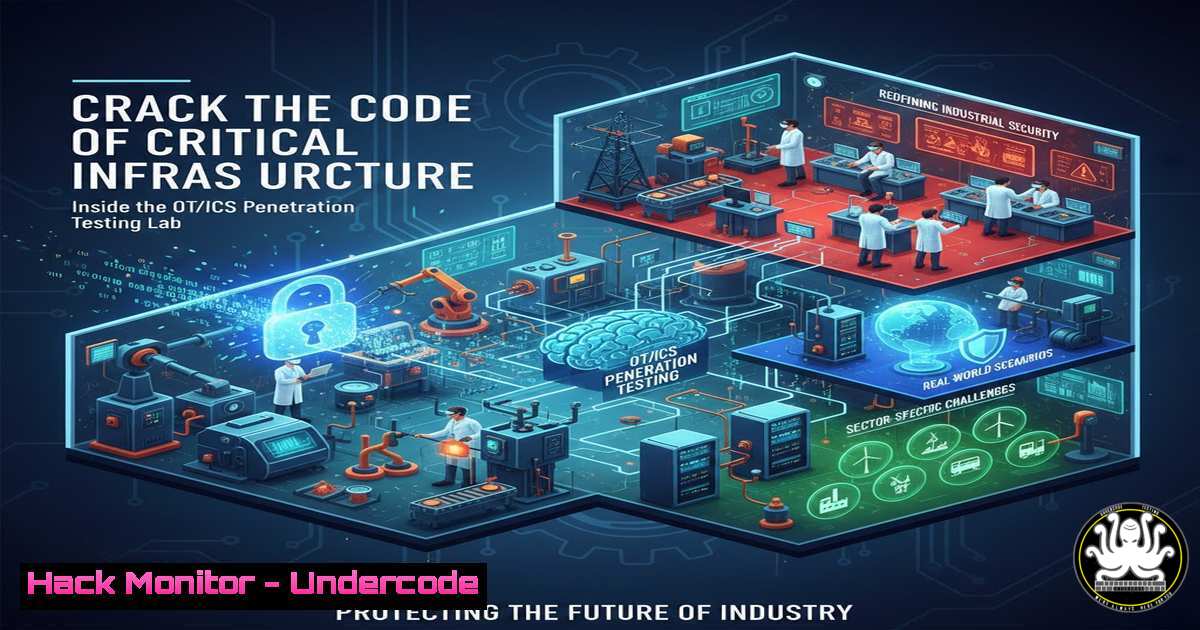
Introduction:
The convergence of Information Technology (IT) and Operational Technology (OT) has created a new frontier for cyber defenders and adversaries alike. Where traditional IT penetration testing focuses on data confidentiality and integrity, OT security prioritizes human safety and physical process availability. The Hack The Box Pro Lab “Alchemy,” developed in collaboration with industrial security leaders like Dragos, Inc., provides a rare, hands-on simulation for security professionals to ethically attack and understand these critical industrial control system (ICS) environments, moving beyond theory into the realm of programmable logic controllers (PLCs), ladder logic, and legacy protocols like Modbus.
Learning Objectives:
- Understand the fundamental architecture and security priorities of OT/ICS environments versus traditional IT networks.
- Learn to analyze, interact with, and attack the Modbus/TCP protocol to identify logical weaknesses in industrial processes.
- Develop a methodical approach to analyzing PLC code (Structured Text, Ladder Logic) and Human-Machine Interfaces (HMIs) to assess impact on physical safety and availability.
You Should Know:
- The OT Mindset: Safety and Availability Over Confidentiality
In IT, we often seek to escalate privileges, exfiltrate data, or achieve persistent access. In OT, the primary security triad is Safety, Availability, and Integrity—in that order. An attacker’s goal may be to alter a sensor reading to cause a tank to overflow (safety issue) or to stop a conveyor belt in a manufacturing plant (availability issue). Your approach must be cautious and informed; a reckless scan can crash a fragile PLC, causing a real-world physical shutdown.
Step‑by‑step guide:
Step 1: Reconnaissance with Caution. Use passive discovery where possible. Instead of aggressive port scanning, look for engineering workstations, documentation servers, or historians first.
Step 2: Identify Critical Assets. Map out PLCs, RTUs, HMIs, and engineering workstations. Tools like `Nmap` can be used with extreme care and tailored timing (-T0 or -T1).
Linux Command: `sudo nmap -sT -T1 -p 502,102,44818,161 –script modbus-discover
Step 3: Document Everything. Before any interaction, document the current state of processes. What is the normal pressure, temperature, or flow rate? This baseline is crucial for understanding the impact of an attack.
- Deconstructing Modbus/TCP: The Insecure Heart of Industrial Comms
Modbus is a clear-text, stateless protocol with no inherent authentication. Its simplicity is its weakness. Functions like Read Coils (0x01) or Write Multiple Registers (0x10) allow direct reading and manipulation of process variables.
Step‑by‑step guide:
Step 1: Traffic Capture & Analysis. Use Wireshark with a deep understanding of Modbus Protocol Data Units (PDUs). Filter for `modbus` and examine transactions between HMIs and PLCs.
Step 2: Active Interaction with mbclient. The `mbclient` tool from the `libmodbus` utilities allows you to directly query and command Modbus devices.
Linux Command: `mbclient -t 0 -a 1 -r 40001
Step 3: Exploitation with Metasploit. Metasploit contains modules for scanning and attacking Modbus.
Metasploit Commands:
use auxiliary/scanner/scada/modbus_client
set RHOSTS <target_IP>
set RHOST <target_IP>
run
This scanner can identify devices and read discrete inputs and coils.
- Analyzing PLC Code: Ladder Logic and Structured Text
Understanding the controller logic is key to crafting a impactful attack. Ladder Logic is a graphical programming language resembling relay logic diagrams, while Structured Text is a text-based language similar to Pascal.
Step‑by‑step guide:
Step 1: Acquire Logic Files. In a lab or during an authorized assessment, you may gain access to the engineering workstation’s programming software (e.g., Rockwell RSLogix, Siemens TIA Portal) or extracted logic files.
Step 2: Static Analysis. Look for hard-coded credentials, insecure default states, and logic that controls critical safety interlocks. For example, a rung that uses a single internal coil to enable an entire motor control system is a single point of failure.
Step 3: Dynamic Analysis (Lab-Only). In a simulated environment like HTB Alchemy, you can upload modified logic. An attack might involve changing a `Greater_Than` comparison to a `Less_Than` to prevent an alarm from triggering when a pressure limit is exceeded.
4. Attacking the HMI: The Human-Machine Interface
HMIs are often Windows-based systems running specialized software. They are frequent initial entry points due to their connectivity to both IT and OT networks.
Step‑by‑step guide:
Step 1: Vulnerability Assessment. Use standard IT techniques on the HMI OS (Windows). Missing patches, default credentials on the HMI software, or vulnerable services are common.
Windows Command (for reconnaissance): `systeminfo` – To check OS version and patch level.
Step 2: Exploit to Gain Foothold. Leverage an exploit for a public vulnerability to gain a shell or access to the HMI file system.
Step 3: Harvest Credentials and Project Files. HMI project files often contain connection strings, PLC IP addresses, and sometimes even credentials in plain text or weakly encrypted forms. These can be used to move laterally to the PLCs.
5. Defensive Hardening and Segmentation
The ultimate goal of offensive training is to inform defense. Proper network architecture is the most effective control in OT.
Step‑by‑step guide:
Step 1: Implement a Purdue Model. Enforce network segmentation aligning with the Purdue Model for ICS security, creating layers (Levels 0-5) with strict controls between them.
Step 2: Deploy Deep Packet Inspection (DPI) Firewalls. Use OT-aware firewalls that can understand Modbus, S7, and other industrial protocols to whitelist specific function codes (e.g., allow Read Coils but block Write Registers from the IT zone).
Step 3: Harden PLCs. Disable unused services, change default passwords (if supported), and implement logic change detection. Use tools like the CIS Benchmarks for specific ICS devices.
What Undercode Say:
- Key Takeaway 1: OT penetration testing is less about “owning the box” and more about “understanding the process.” The most critical skill is the ability to map a digital action to a physical consequence, requiring deep analysis of PLC logic and system documentation.
- Key Takeaway 2: Legacy protocols like Modbus are not going away. Security must be implemented around them through robust network segmentation, protocol-aware monitoring, and logical controls, as patching the protocol itself is often impossible.
The HTB Alchemy lab represents a vital bridge between IT security skills and OT domain expertise. It forces a paradigm shift from the fast-paced exploitation common in CTFs to a slow, deliberate, and documentation-heavy approach. The real-world lesson is that in OT environments, a successful attacker isn’t the one who gets root, but the one who can silently alter a register value to cause a catastrophic failure. Therefore, defenders must focus on anomaly detection at the protocol level, stringent segmentation, and comprehensive asset intelligence to protect these systems that underpin our physical world.
Prediction:
As IT/OT convergence accelerates with Industry 4.0 and IoT, the attack surface for critical infrastructure will expand exponentially. We will see a rise in automated tools tailored for OT exploitation, lowering the entry barrier for threat actors. Consequently, demand for professionals with hands-on, offensive OT security training will skyrocket. Defensively, the industry will move towards more encrypted and authenticated industrial protocols, but the long lifecycle of existing assets (20-30 years) means legacy insecurities will persist for decades, making ongoing offensive research and training like that provided by HTB Pro Labs not just valuable, but essential for national and economic security.
▶️ Related Video (76% Match):
🎯Let’s Practice For Free:
IT/Security Reporter URL:
Reported By: Lucasrezaioff Htb – Hackers Feeds
Extra Hub: Undercode MoN
Basic Verification: Pass ✅


