
Listen to this Post
Introduction:
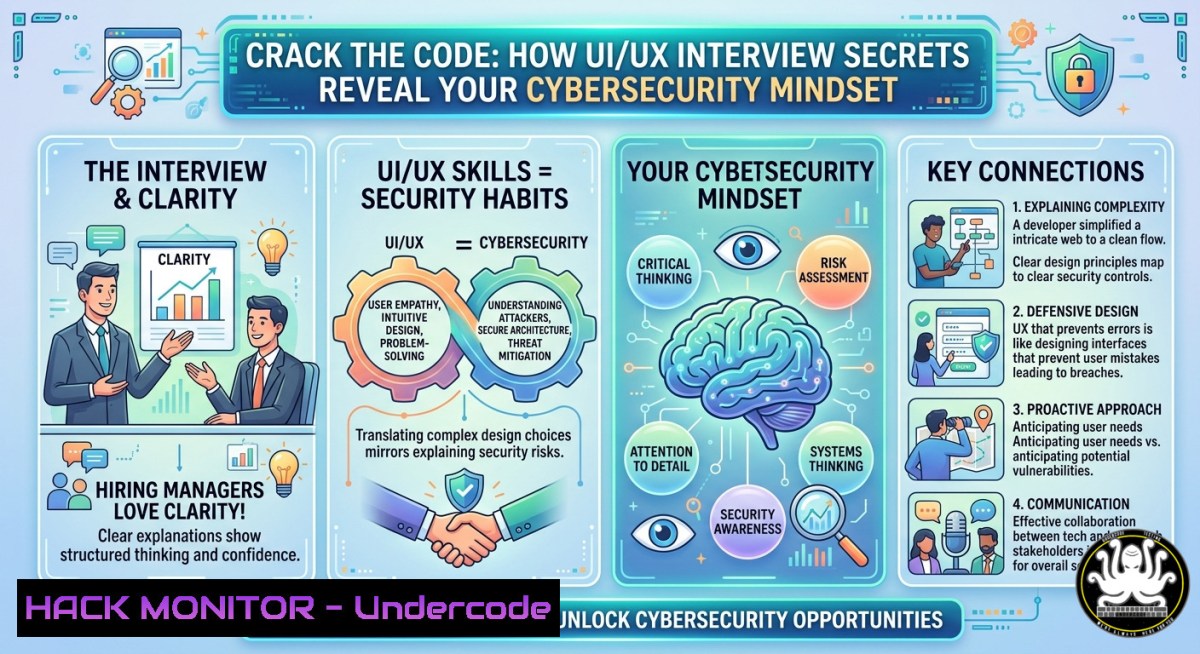
In both UI/UX design and cybersecurity, technical skills alone won’t land you the job—your ability to articulate your thought process, justify decisions, and communicate risk clearly is what separates candidates. The same interview principles that test a junior designer’s grasp of user-centered problem-solving apply directly to how security professionals explain threat models, incident response, and hardening strategies to stakeholders.
Learning Objectives:
- Translate design thinking interview frameworks into cybersecurity incident communication and risk assessment.
- Apply structured problem-solving methodologies (research, wireframing → threat modeling, attack trees) to security interviews and technical write-ups.
- Demonstrate clarity in explaining complex concepts like vulnerability exploitation and mitigation using real-world commands and configurations.
You Should Know:
- “Walk Me Through Your Process” – From Design Research to Threat Modeling
The original post emphasizes that hiring teams want to hear how you arrived at a solution, not just the final portfolio piece. In cybersecurity, the equivalent is explaining your threat modeling process. Instead of wireframes and user flows, you map attack surfaces and kill chains.
Step‑by‑step guide to adapting your security interview process:
- Step 1: Define the asset/user goal – Just as a designer identifies user needs, you identify what needs protection (e.g., a web application’s payment database).
- Step 2: Research threats – Use frameworks like MITRE ATT&CK. List potential attacker behaviors (e.g., T1190 – Exploit Public-Facing Application).
- Step 3: Create an attack tree (wireframe equivalent) – Map possible paths an attacker could take. Tools like Threat Dragon or even draw.io help visualize.
- Step 4: Prioritize mitigations – Rank risks by likelihood and impact. Propose controls (e.g., WAF rules, input validation).
- Step 5: Validate and iterate – Simulate attacks (e.g., using `sqlmap` or `nmap` scripts) and refine your model.
Linux command to simulate an attack path for demonstration:
 Use nmap to discover open ports and services (part of threat research)
nmap -sV -sC -p- 192.168.1.10

Then use nikto for web vulnerability scanning (like usability testing for security)
nikto -h http://192.168.1.10
Windows command (PowerShell) to check for exposed SMB shares (common misconfiguration):
Get-SmbShare | Where-Object { $<em>.Description -eq "" -or $</em>.Description -like "public" }
Explain in an interview: “First, I enumerate assets and entry points. For example, `nmap` reveals an open port 3306 (MySQL). That tells me we need to enforce connection whitelisting and parameterized queries.”
- “UI vs. UX” – The Security Analogy: Compliance vs. Actual Risk Reduction
The original post notes that interviewers still ask the basic distinction between UI (what users see) and UX (how they experience it). In security, the parallel is compliance checklists (visible controls) versus actual residual risk (the felt experience of an attacker). Many candidates list frameworks (NIST, ISO 27001) without explaining how they reduce real-world compromise.
Step‑by‑step guide to articulating this difference:
- Step 1: Acknowledge the visible layer – e.g., “We have an IDS/IPS, a WAF, and annual penetration tests.”
- Step 2: Explain the experiential layer – “But an attacker bypassed the WAF via a logic flaw in the API. The user (security team) experiences the breach despite all ‘UI’ controls being present.”
- Step 3: Provide a concrete mitigation that bridges both – “We added runtime API security (e.g., using Traceable or a custom Lua script in NGINX) to monitor anomalous sequences, not just signatures.”
Example NGINX configuration to harden an API (mitigating logic flaws):
 Limit request rate per IP to prevent brute-force logic abuse
limit_req_zone $binary_remote_addr zone=api:10m rate=10r/s;
server {
location /api/ {
limit_req zone=api burst=20 nodelay;
 Block common exploit patterns
if ($request_body ~ "(union.select|exec.xp_cmdshell)") {
return 403;
}
}
}
Windows command to enforce similar API throttling via IIS:
 Install URL Rewrite module, then add rule via appcmd
appcmd set config "Default Web Site" -section:system.webServer/security/ipSecurity /+"[ipAddress='',subnetMask='255.255.255.0',allowed='true']"
- “Introduce Yourself” – Framing Your Security Motivation and Experience Level
The post’s page 2 emphasizes showing direction, not just a list of degrees. In cybersecurity, many candidates rattle off certifications (CEH, CISSP, OSCP) without connecting them to a driving mindset. Instead, structure your introduction around a specific problem you love solving.
Step‑by‑step guide to crafting your security intro:
- Step 1: State your core motivation – “I’m passionate about reducing mean time to detect (MTTD) through automated log analysis.”
- Step 2: Give one concrete example – “In my last project, I built a Sigma rule to detect unusual Kerberos TGT requests, cutting detection time from 6 hours to 15 minutes.”
- Step 3: Mention your experience level honestly – “I’m junior in red teaming, but I’ve deep-dived into Purple Team exercises using Caldera.”
- Step 4: Show growth direction – “I’m currently learning KQL for advanced hunting in Microsoft Sentinel.”
Code snippet – a simple Sigma rule for detection (example):
title: Suspicious Kerberos TGT Request
status: experimental
logsource:
product: windows
service: security
detection:
selection:
EventID: 4768
TargetUserName: 'admin'
condition: selection
- “Why Should We Hire You?” – Bridging Technical Gaps and Communication
This question tests self-awareness and value alignment. In security, the answer should not be “I know all CVEs.” Instead, show that you understand the company’s risk appetite and can translate technical findings into business language.
Step‑by‑step guide to answering effectively:
- Step 1: Research the company’s recent breaches or compliance needs (e.g., “You process PII, so I’ll focus on data leakage prevention.”)
- Step 2: State a unique skill – “I combine Python scripting for automation with clear documentation for cross-team handoffs.”
- Step 3: Provide a metric – “In my last role, I reduced false positive alerts by 40% by tuning Snort rules and creating a decision tree for analysts.”
- Step 4: Show teachability – “I don’t know every cloud misconfiguration, but I use tools like `prowler` to audit AWS and learn from each finding.”
Linux command to run Prowler (AWS hardening assessment):
 Install and run prowler against a specific profile
prowler aws --profile my-account --services s3,iam,ec2
Windows command (using Azure CLI) to check for open network security groups:
az network nsg rule list --nsg-name myNsg --resource-group myRg --query "[?access=='Allow' && direction=='Inbound' && sourcePortRange=='']"
- “How Do You Differentiate Research from Design Thinking?” – Security Research vs. Incident Response Process
The post highlights that user research and design thinking are expected even at junior levels. Similarly, in security, you must distinguish proactive research (threat hunting) from reactive thinking (incident response). Both follow structured processes, but the goals differ.
Step‑by‑step guide to explaining both:
- Proactive research (Threat Hunting):
- Form a hypothesis – “Attackers may be using LOLBins (Living Off the Land Binaries) to evade detection.”
- Collect data – Use `Sysmon` logs or `auditd` on Linux.
- Hunt – Run `Get-WinEvent` or `grep` for patterns.
4. Document and create detection rules.
- Reactive thinking (Incident Response):
- Detect – Alert from SIEM (e.g., “Excessive failed logins from an IP”).
- Analyze – `netstat -an` or `ss -tulpn` to find backdoors.
- Contain – `iptables -A INPUT -s attacker_ip -j DROP` or Windows Firewall rule.
4. Eradicate and recover.
Linux command for live hunting (checking for unusual cron jobs):
 List all user crontabs and system timers
for user in $(cut -f1 -d: /etc/passwd); do crontab -u $user -l 2>/dev/null; done
cat /etc/crontab /etc/cron.d/
Windows PowerShell command for hunting LOLBins:
Get-WinEvent -FilterHashtable @{LogName='Microsoft-Windows-Sysmon/Operational'; ID=1} | Where-Object { $<em>.Message -match "rundll32.exe" -and $</em>.Message -match "javascript:" }
What Undercode Say:
- Clarity is a technical skill – Whether explaining a wireframe or a WAF bypass, your ability to communicate step-by-step logic determines trust and hiring decisions.
- Process over tools – Memorizing commands (
nmap,prowler) is useless if you can’t justify why you ran them in a specific sequence. Always frame commands within a threat model or design thinking loop. - Bridging UI/UX and security – The best security professionals understand user experience (of the defender and the attacker). Attackers exploit poor usability (e.g., confusing firewall rules) just as users abandon bad interfaces.
Prediction:
As cybersecurity roles become more cross-functional, interview formats will increasingly borrow from design thinking—expect more whiteboard sessions where you map attack flows rather than just answering trivia. Candidates who can visually articulate a kill chain, justify trade-offs, and present mitigations as “user stories for defenders” will outpace those who only list CVSS scores. The convergence of UX research and threat modeling will birth a new hybrid role: the Security Experience (SecX) designer, focusing on human-centered security controls.
▶️ Related Video (74% Match):
🎯Let’s Practice For Free:
IT/Security Reporter URL:
Reported By: Iamtolgayildiz Ux – Hackers Feeds
Extra Hub: Undercode MoN
Basic Verification: Pass ✅


