
Listen to this Post
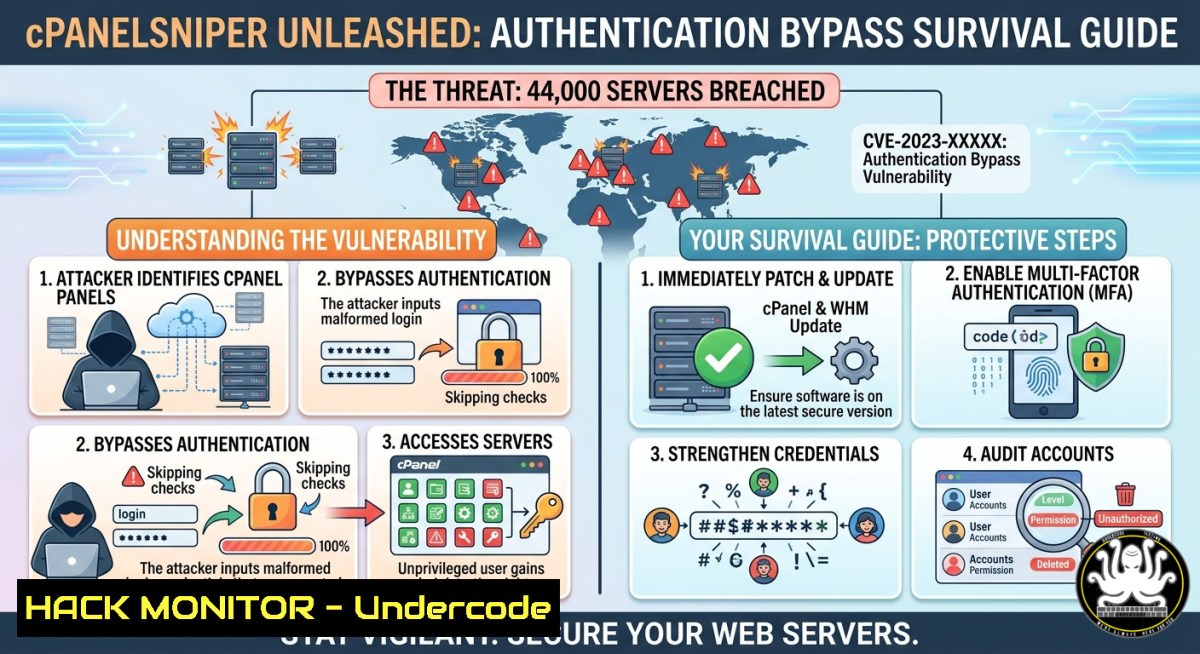
Introduction:
A critical authentication bypass vulnerability (CVE-2026-41940, CVSS 9.8) in cPanel & WHM has been weaponized into a public exploit framework called “cPanelSniper.” Attackers have been exploiting this zero-day since late February 2026, leading to the compromise of at least 44,000 unique IP addresses and potentially putting millions of web servers at risk of complete takeover.
Learning Objectives:
- Understand the technical root cause of CVE-2026-41940 and how CRLF injection leads to authentication bypass.
- Learn to detect indicators of compromise (IoCs) and determine if your server has been compromised.
- Master the step-by-step mitigation process, including patching, IP whitelisting, and service isolation.
You Should Know:
- Anatomy of the Hit: How cPanelSniper Forges a root Session
The “cPanelSniper” exploit, released by researcher Mitsec (@ynsmroztas), targets how cPanel handles HTTP Authorization headers. The root cause is an improper sanitization order: the `saveSession()` function writes session data to disk before `filter_sessiondata()` sanitizes it. This allows an attacker to inject Carriage Return Line Feed (CRLF) characters into a Basic authorization header, which are then written verbatim into the session file. Arbitrary fields like user=root, hasroot=1, and `tfa_verified=1` are directly injected, granting instant privileged access without credentials. The exploit chain is fully automated in Python.
Step‑by‑step guide to test/understand CVE-2026-41940 (for authorized auditing only):
Step 1: Check your cPanel version. Log into your server via SSH and run:
/usr/local/cpanel/cpanel -V
If your version is lower than the patched builds (11.110.0.97, 11.118.0.63, 11.126.0.54, 11.130.0.18, 11.132.0.29, 11.136.0.5, 11.134.0.20), you are vulnerable.
Step 2: Simulate the attack vector (ethical testing only). Using a tool like curl, you can replicate the CRLF injection attempt. Do not attempt this on production systems without explicit authorization.
 Example of a malformed Authorization header (conceptual)
curl -k -X POST "https://target-server.com:2087/login/" \
-H "Authorization: Basic $(echo -n 'anyuser:%0d%0auser=root%0d%0ahasroot=1%0d%0atfa_verified=1' | base64)"
This request injects fields that, in unpatched systems, would be written directly to the session file.
Step 3: Run the official cPanel detection script. cPanel provides an official script to detect exploitation artifacts, such as injected `cp_security_token` fields or `token_denied` entries in raw session logs.
wget https://raw.githubusercontent.com/cpanel/CVE-2026-41940-detection/main/ioc_check.sh
chmod +x ioc_check.sh
sudo bash ioc_check.sh
Detection Example Output:
`[!] CRITICAL: Exploitation artifact – token_denied with injected cp_security_token: /var/cpanel/sessions/raw/:Q3f8Ag2epeBuTaIZ`
- Patch First, Ask Questions Later: Emergency Mitigation Blueprint
When cPanel disclosed this issue on April 28, they released emergency patches alongside temporary workarounds. Because the exploit targets services on specific ports (2083, 2087, 2095, and 2096), immediate isolation and patching are paramount.
Step‑by‑step patching and workaround guide:
Step 1: Apply the official patch via CLI. As per cPanel’s advisory, update your server immediately using the command:
/scripts/upcp --force
After the update, verify the version number:
/usr/local/cpanel/cpanel -V
Then restart the cPanel service:
/scripts/restartsrv_cpsrvd
Step 2: If patching is delayed, implement firewall IP whitelisting. Use `iptables` to restrict access to the cPanel/WHM ports. Only allow your trusted IP addresses.
 Flush existing rules for cPanel ports (optional)
iptables -D INPUT -p tcp --dport 2083 -j DROP 2>/dev/null
iptables -D INPUT -p tcp --dport 2087 -j DROP 2>/dev/null

Allow your specific IP (replace 192.168.1.100 with your admin IP)
iptables -A INPUT -p tcp -s 192.168.1.100 --dport 2083 -j ACCEPT
iptables -A INPUT -p tcp -s 192.168.1.100 --dport 2087 -j ACCEPT

Block all others
iptables -A INPUT -p tcp --dport 2083 -j DROP
iptables -A INPUT -p tcp --dport 2087 -j DROP

Save rules (debian/ubuntu)
iptables-save > /etc/iptables/rules.v4
Step 3: Stop vulnerable services if patching is impossible. As a last resort, disable the `cpsrvd` and `cpdavd` services entirely to break the attack path:
whmapi1 configureservice service=cpsrvd enabled=0 monitored=0
whmapi1 configureservice service=cpdavd enabled=0 monitored=0
/scripts/restartsrv_cpsrvd --stop
/scripts/restartsrv_cpdavd --stop
3. Post-Compromise Forensics: Eradicating the Attacker
Given that this vulnerability has been exploited since February 2026, many systems are likely already compromised. A standard patch alone is insufficient. Attackers may have installed backdoors, created rogue admin accounts, and established persistence mechanisms.
Step 1: Reset all credentials. Change the root password, all cPanel account passwords, database credentials, and API keys. Review the `/etc/passwd` file and the WHM interface for unexpected or newly created administrative users.
Step 2: Hunt for malicious session artifacts. Examine the `/var/cpanel/sessions/raw/` directory for suspicious entries containing injected fields. The official detection script (above) automates this process.
Step 3: Review system logs for indicators. Look for unusual `whostmgrd` activity in the cPanel logs.
 Search for repeated pre-auth failures (badpass events) from single IPs
grep "badpass" /usr/local/cpanel/logs/access_log | awk '{print $1}' | sort | uniq -c | sort -nr

Look for successful token injections
grep -i "cp_security_token" /usr/local/cpanel/logs/error_log
If a compromise is confirmed, isolate the server, restore from known-clean backups, and rebuild. Assume all hosted websites and databases on that machine are also compromised (e.g., database credentials extracted).
4. Advanced Hardening: Securing the Control Plane
The cPanelSniper incident highlights the fragility of web-based control panels. Long-term security requires moving beyond reactive patching to proactive security architecture.
Step 1: Implement a jump box / bastion host. Deploy a dedicated locked-down server (e.g., a small Linux VM) that acts as an SSH tunnel. Disable direct cPanel/WHM port exposure to the internet and allow access only through authenticated SSH port forwarding.
 On the jump box, forward local port to cPanel server
ssh -L 2087:localhost:2087 user@cpanel-server-ip
Then, access `https://localhost:2087` from your browser. The cPanel ports are never directly exposed to the internet.
Step 2: Enforce IP validation for cookie-based logins. cPanel documentation highlights enabling “Cookie IP validation” under Tweak Settings. This prevents session cookie replay attacks that could follow an initial breach.
Step 3: Deploy a Web Application Firewall (WAF). Cloudflare and others have released emergency WAF rules to block CRLF injection patterns associated with CVE-2026-41940. Implement a WAF to add a layer of HTTP request inspection.
5. The cPanelSniper Code Deep Dive: Python Exploitation
The public exploit is written in pure Python 3.8+ and requires no external dependencies. Understanding its behavior is critical for building detection logic.
Stage 1 – Mint a Pre-Auth Session: The script intentionally uses invalid credentials against /login/, forcing cPanel to assign a `whostmgrsession` cookie.
Stage 2 – CRLF Injection: It sends a crafted `Authorization: Basic` header containing CRLF-encoded fields (user=root, hasroot=1, tfa_verified=1). These are appended directly to the session file.
Stage 3 – Trigger Cache Flush: It accesses /scripts2/listaccts, which forces the internal `do_token_denied` gadget to load the poisoned session into memory, activating the injected fields.
Stage 4 – Root Access Verification: The script queries /json-api/version. If it receives a 200 OK response, the injection succeeded, confirming a “PWNED” state.
Defensive Command: Monitor for repeated access to `/scripts2/listaccts` or `/json-api/version` from the same IP within a short timeframe as a potential post-exploit indicator.
What Undercode Say:
- Key Takeaway 1: The cPanelSniper exploit demonstrates that a single insecure file-write operation before sanitization can compromise millions of servers. Input validation must occur before data is persisted, not after.
-
Key Takeaway 2: The timeline is the real crisis. Attackers had a two-month head start (late February to late April) before a patch existed. This reinforces that security teams must assume compromise once a zero-day is confirmed and focus on rapid detection and response, not just prevention.
-
This event is a textbook example of the “asymmetric warfare” of cybersecurity. A single, relatively simple CRLF injection technique, automated in a few hundred lines of Python, has bypassed the authentication of one of the world’s most widely deployed hosting platforms. The Shadowserver Foundation’s detection of over 44,000 attacking IPs in a single day is a testament to how quickly such tools spread. The long-term solution is not just patching, but redesigning control plane architectures to be external-access ready. The lesson is harsh but clear: expose your management interface to the global internet at your own peril.
▶️ Related Video (90% Match):
https://www.youtube.com/watch?v=Cn7BVja3OHk
🎯Let’s Practice For Free:
IT/Security Reporter URL:
Reported By: Cybersecuritynews Vulnerability – Hackers Feeds
Extra Hub: Undercode MoN
Basic Verification: Pass ✅


