Listen to this Post
Introduction:
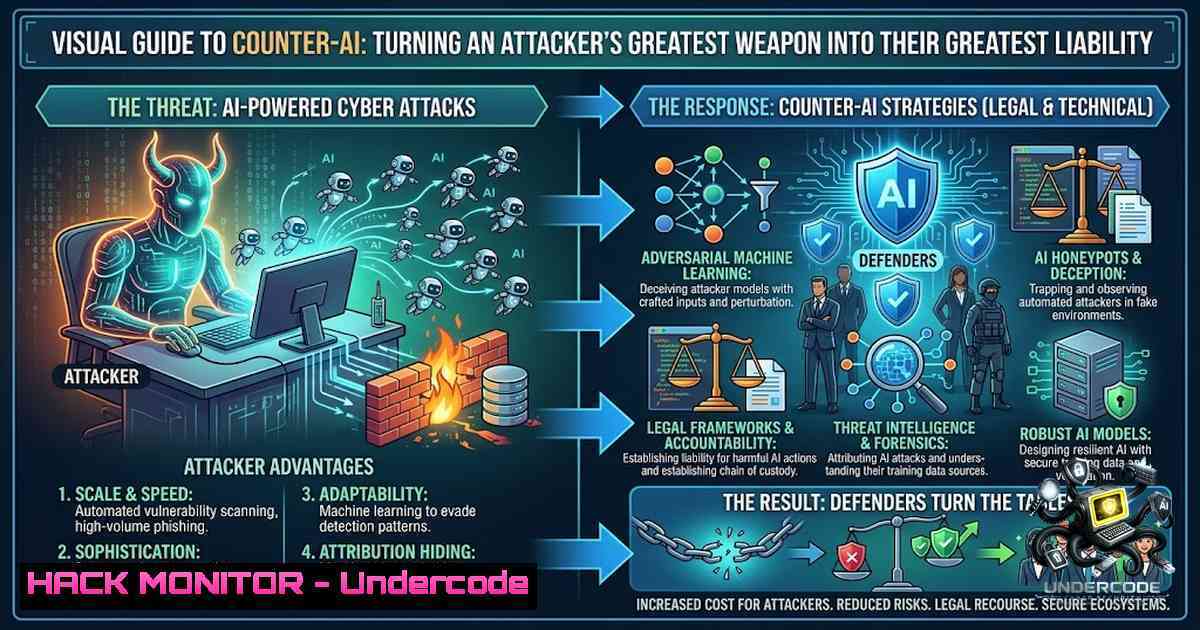
The first era of Cyber AI has irrevocably shifted the strategic advantage to the attacker. AI-powered threats now operate at machine speed, choosing the time, place, and first move, while even AI-enhanced defenders remain perpetually reactive. To reverse this asymmetry, the next generation of cyber defense must move beyond simply running faster; it must weaponize the attacker’s own automation against them—a paradigm known as Counter AI.
Learning Objectives:
- Understand the fundamental asymmetry of AI-powered cyber attacks and why traditional defense strategies are failing.
- Learn the principles of Counter AI and how to turn attacker automation into a strategic liability.
- Gain practical knowledge of defensive AI architectures, including agentic AI, Automated Moving Target Defense (AMTD), and deception techniques.
You Should Know:
1. The Asymmetry of Machine-Speed Warfare
The fundamental problem in modern cybersecurity is no longer about the sophistication of the attack, but the speed at which it unfolds. Human operators cannot react fast enough to contain autonomous, AI-driven attacks that can execute multi-stage kill chains in minutes or seconds. Attackers choose the time, place, and first move, forcing defenders into a perpetual reactive stance. Even when defenders deploy AI, they are often simply trying to match the attacker’s speed rather than seizing the initiative. This is the core asymmetry that Counter AI seeks to exploit. The goal is not to run faster, but to fundamentally change the nature of the engagement by turning the attacker’s automated systems into a vulnerability.
- Denying the World Model: Automated Moving Target Defense (AMTD)
One of the most promising architectural countermeasures to autonomous AI agents is Automated Moving Target Defense (AMTD). AI-driven attackers rely on a “world model”—a static understanding of your network’s topology, services, and vulnerabilities. AMTD disrupts this model by dynamically and unpredictably changing the attack surface. This can include rotating IP addresses, shifting network ports, changing system configurations, or deploying decoy services. The goal is to create an environment so dynamic that an AI agent cannot reliably plan and execute a multi-stage attack. This strategy escapes the traditional arms race by not relying on AI-specific detection logic, making it effective against both autonomous and AI-augmented adversaries.
Step‑by‑step guide for implementing AMTD:
- Step 1: Identify Critical Assets. Map your crown jewels—the systems, data, and services that are most critical to your operations.
- Step 2: Define Mutation Parameters. Determine which aspects of your attack surface can be changed dynamically. This could include IP addresses (using a dynamic DNS service), network ports (for internal services), or even file paths and system configurations.
- Step 3: Implement a Mutation Engine. Deploy a tool or script that can automatically rotate these parameters on a schedule or in response to a suspected attack. For example, a simple Linux script could use `iptables` to redirect traffic or `socat` to create moving port listeners. A more advanced solution would integrate with your orchestration platform (e.g., Kubernetes) to dynamically redeploy services with new configurations.
- Step 4: Monitor and Log. Ensure all mutations are thoroughly logged. This data is critical for analyzing attacker behavior and fine-tuning your AMTD strategy.
- Step 5: Test in a Staging Environment. Before deploying AMTD in production, test its impact on legitimate users and services to ensure business continuity.
- Countering AI with Agentic AI: The Vellox Paradigm
The industry is moving towards a new class of defensive tools that are “agentic”—meaning they can act autonomously to achieve a goal. Booz Allen’s Vellox suite is a prime example of this shift. Vellox is an AI-1ative, cloud-1ative product suite built to fight AI with AI. It uses agentic AI to continuously learn from malware patterns, adapt over time, and effectively reverse engineer even the most complex and evasive threats. The key differentiator is that Vellox is not just a faster detection tool; it is designed to outpace attackers by pairing machine-speed automation with models trained by elite cyber operators. The goal is to close the speed gap between AI-powered threats and traditional cyber defenses. This represents a fundamental shift from reactive “detect and respond” to proactive, autonomous defense.
4. The Defensive Power of Deception and Poisoning
A sophisticated Counter AI strategy involves actively exploiting the weaknesses of AI systems. Attackers’ AI models are not perfect; they have biases, memory limitations, and are vulnerable to data poisoning. Defenders can turn these weaknesses into strengths. For example, deploying decoy data or “honeytokens” can poison an attacker’s training data or confuse their AI-powered reconnaissance tools. By feeding an attacker’s AI with misleading information, defenders can cause it to make poor decisions, waste resources, or even expose its presence. This proactive defense leverages LLM vulnerabilities to counter AI-driven threats. This approach shifts the dynamic from a purely defensive posture to one that actively manipulates and degrades the attacker’s capabilities.
- Architectural Shift: From Black Box to Multi-Agent Systems
A fundamental flaw in many current AI defense strategies is the reliance on a single, monolithic “black box” AI. This creates a single point of failure and makes the system predictable. To counter autonomous AI threats, a more robust approach is to deploy a Multi-Agent System (MAS) of autonomous AI defenses. In this framework, a “council of agents” works collaboratively, each with specialized functions (e.g., detection, analysis, response, deception). This distributed architecture is more resilient, harder to game, and can adapt more effectively to evolving threats. It also provides redundancy; if one agent is compromised or blinded, others can continue to operate.
6. Command-Line Tactics for Counter AI Defense
While sophisticated AI platforms are the future, security teams can begin implementing Counter AI principles today using existing tools. Here are some practical commands and configurations:
- Linux – Dynamic Port Knocking: Use `iptables` to create a dynamic firewall that only opens a port after a specific sequence of connection attempts (a port knock). This can thwart automated scanners that don’t follow the sequence.
Example: Use knockd to listen for a sequence and run a command.
Install knockd: sudo apt-get install knockd
Configure /etc/knockd.conf with a sequence and a command like:
command = /sbin/iptables -A INPUT -s %IP% -p tcp --dport 22 -j ACCEPT
Start the service: sudo systemctl start knockd
-
Windows – Dynamic Firewall Rules with PowerShell: Use PowerShell to create scripts that modify Windows Firewall rules based on threat intelligence feeds or anomaly detection.
Block an IP address dynamically
New-1etFirewallRule -DisplayName "Block Malicious IP" -Direction Inbound -Action Block -RemoteAddress "192.168.1.100"
Remove the rule
Remove-1etFirewallRule -DisplayName "Block Malicious IP"
-
Linux – Honeypot Deployment: Use a tool like `honeyd` or `cowrie` to create low-interaction honeypots that appear as vulnerable services. This can divert attacker attention and gather intelligence.
Install cowrie (SSH honeypot)
git clone https://github.com/cowrie/cowrie
cd cowrie
Follow the installation guide to configure and run the honeypot.
-
API Security – Rate Limiting and Anomaly Detection: Implement rate limiting on your APIs to slow down automated attacks. Use tools like `fail2ban` to dynamically block IPs that show malicious patterns.
Install fail2ban
sudo apt-get install fail2ban
Configure /etc/fail2ban/jail.local to monitor your services (e.g., SSH, Nginx)
The configuration will automatically ban IPs after a set number of failures.
What Undercode Say:
- The Advantage is Shifting, Not Lost: While the current landscape favors attackers, the emergence of Counter AI strategies presents a genuine opportunity to regain the initiative. The key is to change the rules of engagement.
- Automation is a Double-Edged Sword: An attacker’s AI is only as good as its model and data. By poisoning that data or creating an unpredictable environment, defenders can turn the attacker’s greatest strength into a significant liability. The future of cyber defense is not just about speed, but about intelligence, deception, and architectural resilience.
Prediction:
- +1 Counter AI will evolve into a primary battleground, with defensive AI systems becoming as sophisticated and autonomous as their offensive counterparts. This will lead to a new “cold war” of AI agents constantly probing and deceiving each other.
- -1 The proliferation of agentic AI in both offense and defense will create new legal and ethical grey areas, particularly around liability when autonomous systems make decisions that cause unintended damage.
- +1 Organizations that adopt proactive architectural defenses like AMTD and deception will gain a significant advantage over those that continue to rely on reactive, signature-based detection. This will create a new market for “dynamic defense” platforms.
- -1 The complexity of Counter AI systems will introduce new vulnerabilities. Attackers will likely shift focus to poisoning the data and models that defensive AIs rely on, leading to a new class of “AI supply chain” attacks.
- +1 The integration of Counter AI principles into standard security operations (SecOps) will become a mandatory requirement for critical infrastructure and national security, driving significant investment and innovation in the field.
▶️ Related Video (86% Match):
https://www.youtube.com/watch?v=GHvujKwSXq8
🎯Let’s Practice For Free:
🎓 Live Courses & Certifications:
Join Undercode Academy for Verified Certifications
🚀 Request a Custom Project:
Secure, high-velocity infrastructure and disruptive technological engineering. Contact our engineering team for high-tier development and proprietary systems:
[email protected]
💎 Smart Architecture | 🛡️ Secure by Design | ⭐ Trusted by Thousands
IT/Security Reporter URL:
Reported By: Michaelraynoha The – Hackers Feeds
Extra Hub: Undercode MoN
Basic Verification: Pass ✅


