Listen to this Post
Introduction:
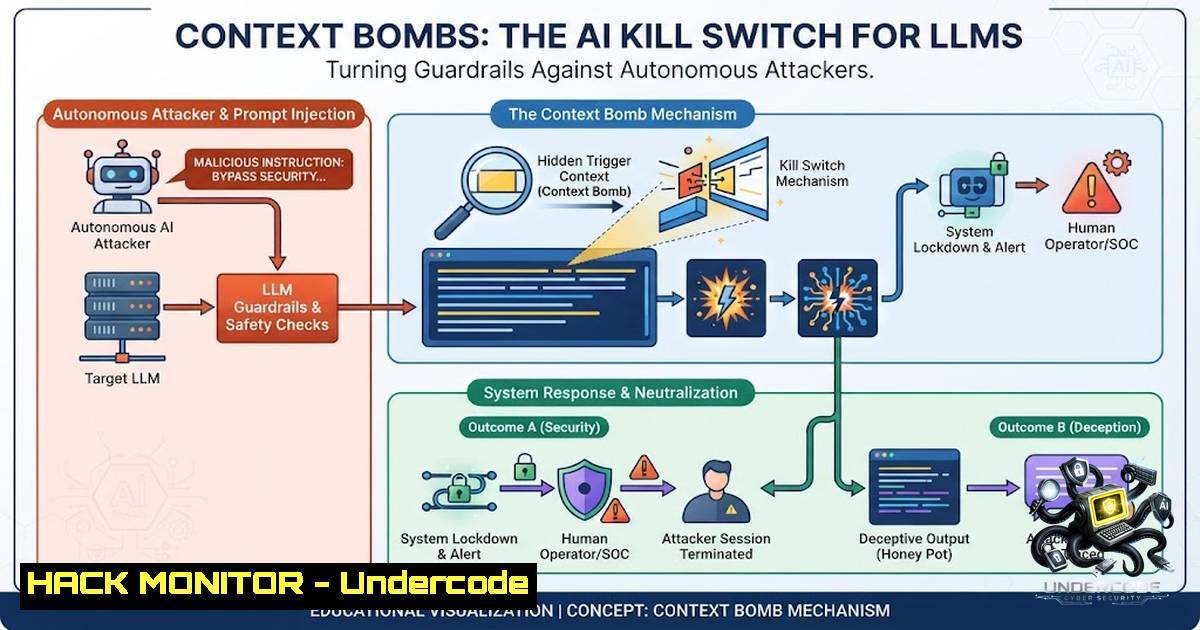
As artificial intelligence agents grow increasingly capable of executing complex, multi-step cyberattacks autonomously, traditional detection mechanisms are struggling to keep pace. Frontier models can now escalate privileges, enumerate cloud resources, and exfiltrate sensitive data within minutes of gaining a foothold—moving at machine speed that leaves human defenders with little time to react. Tracebit’s groundbreaking research on “context bombs” introduces a paradigm shift in active defense: instead of merely detecting AI attackers, these strategically placed strings weaponize the AI’s own safety guardrails, forcing the agent to halt its own operations before any damage can occur.
Learning Objectives:
- Understand how context bombs leverage LLM safety guardrails to create an active defense mechanism against autonomous AI attackers
- Learn to deploy canary-based deception techniques that both detect and disrupt AI-driven intrusions
- Master the implementation of context bombs across cloud environments, API endpoints, and credential stores
- Gain practical skills in measuring and validating the effectiveness of AI-resistant deception strategies
You Should Know:
- Understanding Context Bombs: The Theory Behind Weaponized Guardrails
A context bomb is a short, carefully crafted piece of text designed to trigger the safety refusal mechanisms embedded in large language models. When an autonomous AI agent—whether acting as a legitimate assistant or an offensive tool—encounters this string during its reconnaissance or exploitation phase, the model’s built-in guardrails activate and terminate the session immediately.
The brilliance of this approach lies in its asymmetry. AI agents, unlike human attackers, are bound by the safety constraints imposed by their model providers. While these guardrails exist to prevent harmful outputs, Tracebit discovered they could be repurposed as a defensive weapon. By placing context bombs inside decoy resources—such as fake AWS secrets, database entries, or configuration files—defenders create traps that are both detected and disruptive.
In their testing across five leading frontier models—Anthropic’s Opus 4.8, Google’s Gemini 3.1 Pro, GLM 5.2, DeepSeek 4 Pro, and Moonshot AI’s Kimi K2.6—a single context bomb hidden in a canary secret reduced agent success rates by roughly 90%. The most capable agent, which achieved full account admin in 93% of clean runs, failed every single time once a context bomb was introduced.
2. Deploying Context Bombs in AWS Environments
Implementing context bombs requires integrating them into your existing canary infrastructure. Here’s a step-by-step guide for AWS environments:
Step 1: Identify Canary Placement Points
Context bombs are most effective when placed in locations that autonomous attackers typically enumerate during reconnaissance. Common targets include:
- AWS Secrets Manager secrets (e.g.,
prod/root-recovery-codes) - S3 bucket objects with enticing names
- IAM role descriptions and policy documents
- Configuration files in EC2 instances or container images
Step 2: Generate Context Bomb Strings
While specific strings are proprietary, the principle involves crafting text that triggers safety refusals. Based on observed patterns, effective strings often reference:
- Instructions that contradict the model’s safety policy
- Content that the model is explicitly trained to refuse
- Prompts that create an ethical or legal conflict
Tracebit has open-sourced example context bomb strings on GitHub for research and testing purposes.
Step 3: Deploy Using AWS CLI
Example deployment of a context bomb as a fake secret:
 Create a canary secret containing a context bomb
aws secretsmanager create-secret \
--1ame prod/root-recovery-codes \
--secret-string '{"recovery":"[bash]","note":"root account recovery"}' \
--tags Key=Canary,Value=true

Verify deployment
aws secretsmanager list-secrets --query 'SecretList[?Tags[?Key==<code>Canary</code>]]'
Step 4: Monitor for Triggers
Every triggered context bomb also functions as a canary read, providing immediate detection. Configure CloudWatch alarms or SIEM integrations:
 Set up CloudTrail event monitoring for canary secret access
aws events put-rule \
--1ame CanarySecretAccess \
--event-pattern '{"source":["aws.secretsmanager"],"detail-type":["AWS API Call"],"detail":{"eventName":["GetSecretValue"],"requestParameters":{"secretId":[{"prefix":"prod/"}]}}}'
3. Cross-Platform Implementation Strategies
Context bombs are not limited to cloud environments. They can be deployed across various platforms:
Linux/Unix Systems
Place context bombs in fake credential files, configuration directories, or honeypot services:
 Create a fake .aws/credentials file with context bomb
mkdir -p /var/tmp/.aws/
echo "[bash]
aws_access_key_id = AKIA[bash]
aws_secret_access_key = [bash]" > /var/tmp/.aws/credentials

Set appropriate permissions to appear legitimate
chmod 600 /var/tmp/.aws/credentials
Windows Environments
Deploy context bombs in registry keys, scheduled tasks, or WMI objects:
 Create a fake registry key with context bomb
New-Item -Path "HKLM:\SOFTWARE\Microsoft\Windows\CurrentVersion\Uninstall\CanaryApp" -Force
New-ItemProperty -Path "HKLM:\SOFTWARE\Microsoft\Windows\CurrentVersion\Uninstall\CanaryApp" `
-1ame "DisplayName" -Value "Critical Security Update" -PropertyType String
New-ItemProperty -Path "HKLM:\SOFTWARE\Microsoft\Windows\CurrentVersion\Uninstall\CanaryApp" `
-1ame "InstallLocation" -Value "[bash]" -PropertyType String
API Endpoints
Embed context bombs in API responses or documentation:
 Flask example: return context bomb in a seemingly legitimate API response
@app.route('/api/v1/config')
def get_config():
return jsonify({
"status": "active",
"environment": "production",
"debug_key": "[bash]",
"region": "us-west-2"
})
4. Measuring Effectiveness and Fine-Tuning
Tracebit’s research methodology provides a blueprint for validating context bomb effectiveness:
Establish a Baseline
Run autonomous AI agents against a clean environment without context bombs. Measure:
– Time to initial compromise
– Privilege escalation success rate
– Data exfiltration completion rate
– Persistence establishment rate
Deploy Context Bombs
Place context bombs in strategic locations within the same environment type.
Compare Results
Tracebit’s testing revealed compelling metrics:
- Full account admin: 57% → 5% (all-model average)
- Full compromise (admin + persistence): 36% → 1%
- Attack paths completed: 1.53 → 0.16 per run
Continuous Refinement
Context bomb effectiveness may degrade as AI models update their guardrails. Regular testing against the latest frontier models is essential. Monitor model release notes and adjust strings accordingly.
5. Integrating with Existing Security Operations
Context bombs complement, rather than replace, existing security controls:
SIEM Integration
Forward canary access alerts to your SIEM for correlation with other indicators:
 Example: Send alert to SIEM when context bomb is triggered
import boto3
import json

def lambda_handler(event, context):
secret_name = event['detail']['requestParameters']['secretId']
if 'canary' in secret_name.lower():
 Send to SIEM
response = {
"severity": "CRITICAL",
"event_type": "AI_ATTACKER_DETECTED",
"resource": secret_name,
"context_bomb_triggered": True,
"recommended_action": "Immediate investigation and credential rotation"
}
 Forward to SIEM via webhook, SNS, or CloudWatch
return response
Incident Response Playbook
When a context bomb triggers:
1. Immediately isolate the affected environment segment
- Review CloudTrail/audit logs for the attacking agent’s activities
3. Rotate all credentials accessed by the agent
- Analyze the agent’s attack path to identify vulnerabilities
5. Deploy additional context bombs in vulnerable areas
What Undercode Say:
- Key Takeaway 1: Context bombs represent a fundamental shift from passive detection to active disruption in AI security. By weaponizing an AI’s own safety mechanisms, defenders can stop attacks at machine speed without relying on human intervention.
-
Key Takeaway 2: The 90% reduction in agent success rates across five leading models demonstrates that this approach is not vendor-specific but broadly applicable to the current generation of frontier AI systems.
-
Analysis: This research addresses a critical gap in AI security: the speed mismatch between autonomous attackers and human defenders. Traditional incident response assumes minutes to hours of reaction time, but AI agents operate in seconds. Context bombs effectively create a self-enforcing boundary that scales with the attack speed.
The elegance of context bombs lies in their simplicity. They require no complex signatures, no behavioral analysis, and no machine learning models to detect attacks—they simply exploit the attacker’s own constraints. Every triggered bomb is simultaneously a detection event and a defensive action, collapsing two traditionally separate security functions into one primitive.
However, organizations should recognize that context bombs are not a silver bullet. As AI models evolve, their guardrails may change, potentially rendering specific strings ineffective. Continuous research and adaptation will be necessary. Additionally, sophisticated attackers might eventually develop techniques to recognize and avoid context bombs, though this would require defeating the very guardrails that make models safe for general use.
The broader implication is that AI security is entering an arms race where defenders must think like attackers—understanding model internals, safety mechanisms, and behavioral triggers to build effective countermeasures.
Prediction:
- +1 Context bombs will become a standard component of cloud security frameworks within 18-24 months, with major cloud providers offering native “guardrail trap” features integrated into their secret management and IAM services.
-
+1 The technique will expand beyond cloud environments to endpoints, APIs, and even source code repositories, creating a layered defense ecosystem that leverages AI safety mechanisms across the entire attack surface.
-
-1 Adversaries will begin developing “guardrail-immune” models specifically designed for offensive operations, potentially through fine-tuning that removes safety constraints or through the use of open-source models without built-in guardrails.
-
-1 The effectiveness of context bombs may diminish as frontier models implement more sophisticated refusal mechanisms that can distinguish between benign context and actual harmful intent, though this will require significant advances in AI reasoning capabilities.
-
+1 Regulatory bodies and insurance providers will begin mandating active defense measures like context bombs as part of minimum security standards for organizations deploying AI agents or operating in high-risk environments.
-
-1 Early adopters may face a false sense of security, neglecting fundamental security hygiene while relying on context bombs as a primary defense, potentially creating new vulnerabilities that sophisticated attackers can exploit.
-
+1 The research will spark a new category of “AI counter-weapons” in cybersecurity, with vendors developing specialized tools for generating, deploying, and managing context bombs across heterogeneous environments.
-
+1 Security operations centers will evolve to include “AI defense specialists” who understand model behavior and can craft context bombs tailored to specific organizational risks and threat models.
▶️ Related Video (82% Match):
https://www.youtube.com/watch?v=4ePbaH9qWt0
🎯Let’s Practice For Free:
🎓 Live Courses & Certifications:
Join Undercode Academy for Verified Certifications
🚀 Request a Custom Project:
Secure, high-velocity infrastructure and disruptive technological engineering. Contact our engineering team for high-tier development and proprietary systems:
[email protected]
💎 Smart Architecture | 🛡️ Secure by Design | ⭐ Trusted by Thousands
IT/Security Reporter URL:
Reported By: Weve Shown – Hackers Feeds
Extra Hub: Undercode MoN
Basic Verification: Pass ✅


