Listen to this Post
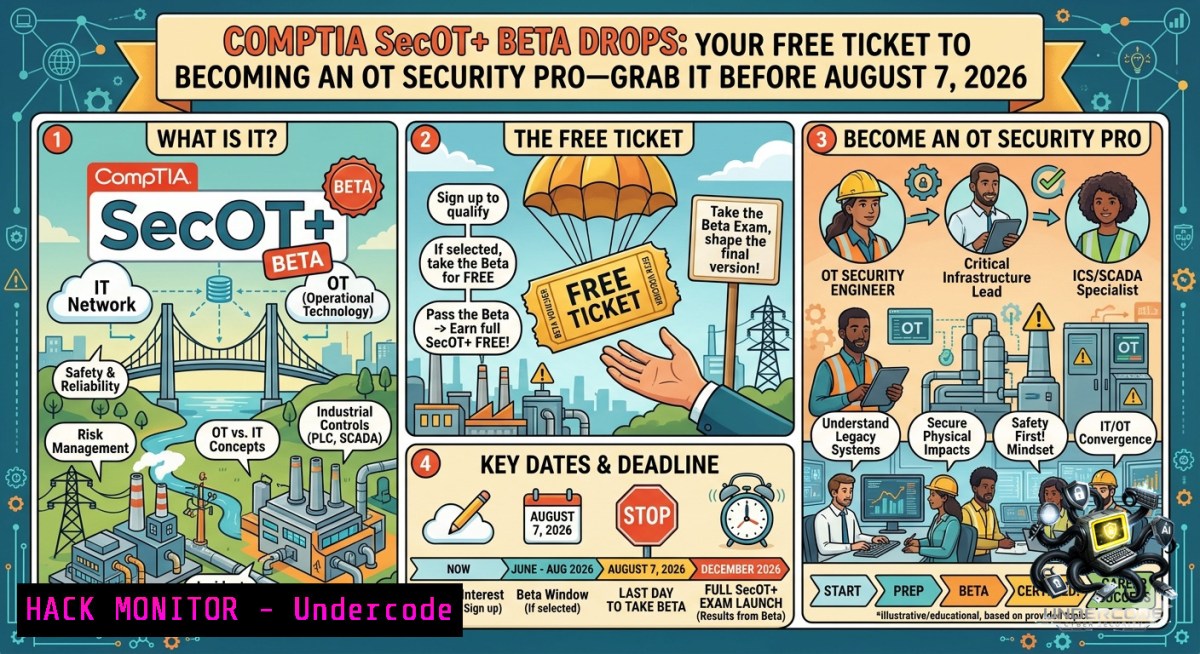
Introduction:
As critical infrastructure becomes an increasingly attractive target for cyber adversaries, the demand for specialized operational technology (OT) security expertise has never been higher. A recent Fortinet survey revealed that a staggering 73% of OT organizations have experienced cyber intrusions, yet a significant skills gap remains in protecting the systems that power our world. To address this challenge, CompTIA has introduced the SecOT+ beta exam (SO1-001), a groundbreaking certification designed exclusively for OT security professionals that you can earn for free.
Learning Objectives:
– Gain a comprehensive understanding of the SecOT+ certification domains, including OT safety, risk management, and incident response, while exploring practical, hands-on lab environments.
– Master the execution of essential Linux and Windows commands for OT asset discovery, network mapping, and vulnerability assessment within simulated industrial control systems.
– Learn step-by-step how to configure critical security tools, perform network hardening, and apply threat intelligence frameworks like MITRE ATT&CK for OT to safeguard industrial environments.
You Should Know:
1. OT Asset Discovery and Network Enumeration (Linux)
Before any security controls can be applied, you must first understand the composition of your industrial network. OT environments rely heavily on legacy protocols like Modbus, DNP3, and Profinet, often organized using the Purdue Enterprise Reference Architecture (PERA). The following commands demonstrate how to perform reconnaissance on an OT network segment using Nmap, a powerful open-source tool.
Step-by-step guide explaining what this does and how to use it:
This process involves scanning for live hosts, discovering devices on specific industrial protocols, and enumerating Modbus devices for security assessment.
1. Perform a Ping Sweep: To identify active devices on the OT network without aggressive scanning, which could disrupt sensitive equipment. It is critical to exercise extreme caution when active scanning on operational networks due to device sensitivity.
 Sweep the supervisory network using ARP ping only
sudo nmap -sn -PR 192.168.3.0/24 -oG l3_hosts.txt
2. Scan for Industrial Protocols: To detect devices communicating on standard OT protocol ports, such as Modbus on port 502 or Siemens S7 on port 102.
 Discover devices on OT subnet with common industrial ports
sudo nmap -sS -p 502,20000,44818,102,2222 192.168.1.0/24 -oG ot_hosts.txt
3. Enumerate a Modbus Device: To query a specific Programmable Logic Controller (PLC) for detailed information about its Unit Identifier and other discoverable properties.
 Run a Modbus discovery script on a target IP (e.g., 192.168.1.100)
nmap --script modbus-discover -p 502 192.168.1.100
4. Map the Purdue Model Layers: For a more structured approach, use a tool like `nmap` in a lab to distinguish between Level 2 (Control) and Level 3 (Supervisory) assets.
 Sweep the field device layer (L2) with ARP requests
sudo nmap -sn -PR 192.168.2.0/24
2. Vulnerability Assessment and Exploitation in OT Labs (Linux)
Hands-on practice in a safe environment is the most effective way to learn OT security. Using a free, virtualized lab like Labshock, which mimics a real-world industrial network, professionals can safely simulate attacks on a PLC and SCADA system.
Step-by-step guide explaining what this does and how to use it:
This guide sets up an OT lab and demonstrates the exploitation of unauthenticated Modbus commands and a VNC console with no authentication.
1. Provision Your Virtual OT Environment: Use Docker to launch an air-gapped industrial environment.
 Clone the Labshock repository
git clone https://github.com/zakharb/labshock.git
cd labshock/labshock
 Build the Docker containers
docker-compose build
 Launch the environment
docker-compose up -d
2. Access the Plant Floor: After the environment is up, access the SCADA HMI (http://localhost:1881) and an Engineering Workstation (http://localhost:5911/vnc.html) to understand the operational topology.
3. Exploit Unauthenticated Modbus: Use a Python script or a tool like `modbus-cli` to write arbitrary values to a PLC coil, simulating a process disruption.
 Example using pyModbus to write to a holding register
from pymodbus.client import ModbusTcpClient
client = ModbusTcpClient('192.168.2.100')  Target PLC IP
client.write_register(0, 0x0001, unit=1)  Write a value to coil 0
client.close()
4. Exploit No-Auth VNC: Connect to the Engineering Workstation (EWS), which often has a default or no password, to gain full control of the operator’s interface. In the Labshock lab, this is accessible via `http://localhost:5911/vnc.html`.
3. OT System Hardening and Secure Configuration (Windows/Linux)
Hardening is the process of reducing the attack surface of an ICS environment to strengthen its defenses against cyber threats. This involves a combination of technical controls and strategic planning to make systems more resilient.
Step-by-step guide explaining what this does and how to use it:
This section provides a checklist for hardening both the OT boundary and individual assets, crucial for any SecOT+ professional.
1. Change Default Passwords: Immediately change all default credentials on PLCs, HMIs, routers, and engineering workstations. Use a password manager to generate and store complex, unique passwords.
2. Enforce the Principle of Least Privilege (PoLP): Implement Role-Based Access Control (RBAC) to ensure users and devices have only the minimum access necessary to perform their functions. Regularly review and audit permissions.
3. Restrict Unused Services and Ports: On Windows-based HMIs and engineering stations, disable unnecessary services.
 Get a list of running services and filter for unwanted ones
Get-Service | Where-Object {$_.Status -eq "Running"}
 Stop and disable a service (e.g., Print Spooler if not needed)
Stop-Service -1ame Spooler
Set-Service -1ame Spooler -StartupType Disabled
4. Implement Network Segmentation: Use firewalls and VLANs to segment the OT network from the corporate IT network, and create a Demilitarized Zone (DMZ) for data historians and remote access servers. This prevents an attacker from moving laterally from IT to OT.
5. Patch and Firmware Management: Develop a risk-based methodology to determine which patches are critical. Always test patches in a staging environment before deploying to live OT systems.
4. Incident Response and Threat Intelligence in OT (Windows/Linux)
OT incident response is unique due to the need to prioritize safety and uptime over traditional IT forensics. The NIST SP 800-82 Rev. 3 guide recommends the use of OT-specific frameworks for threat analysis.
Step-by-step guide explaining what this does and how to use it:
This process demonstrates how to use Shodan for threat hunting and gather forensic data from a Windows-based HMI.
1. Use Shodan for Threat Hunting: Proactively search for exposed OT devices and infrastructure associated with your organization.
 Find devices using the Modbus protocol in a specific country
port:502 country:"US"
 Search for Siemens S7 devices
product:"Siemens S7"
 Identify devices with expired SSL certificates, indicating potential lack of maintenance
ssl.cert.expired:true
2. Leverage MITRE ATT&CK for ICS: Map observed attacker behavior to the MITRE ATT&CK for ICS framework to understand TTPs (Tactics, Techniques, and Procedures). This helps in structured analysis and reporting of incidents.
3. Collect Forensic Data from a Windows HMI: In the event of an incident, it is crucial to collect volatile data first.
 List all running processes
tasklist /V > running_processes.txt
 Check network connections for suspicious outbound links
netstat -ano > network_connections.txt
 View all scheduled tasks for persistence mechanisms
schtasks /query /fo LIST /v > scheduled_tasks.txt
5. OT Governance, Risk, and Compliance (GRC)
OT GRC involves connecting security and operational objectives to business continuity and compliance drivers. Frameworks like ISA/IEC 62443 and NIST SP 800-82 are cornerstones of OT security governance.
Step-by-step guide explaining what this does and how to use it:
This section provides a strategic overview of how to approach risk assessments and change management in OT.
1. Conduct an OT Risk Assessment: Identify and classify all OT cyber assets. Perform a thorough risk assessment to evaluate potential threats, vulnerabilities, and the likelihood of exploitation for each asset.
2. Establish a Change Management Process: Always follow a formal process for OT changes, including identification, testing, communication, and approval. This is critical for maintaining system integrity.
3. Align to a Compliance Framework: Map your security controls to the requirements of a recognized standard like ISA/IEC 62443. Determine the target Security Level (SL) for each zone and conduit.
What Undercode Say:
– Key Takeaway 1: The launch of the free CompTIA SecOT+ beta exam is a watershed moment, democratizing access to specialized OT security credentials for thousands of experienced practitioners and directly addressing a critical global skills gap.
– Key Takeaway 2: This opportunity transcends a mere certification; it’s a direct call to action for security professionals to gain foundational, hands-on proficiency with the actual protocols, frameworks, and commands required to defend the industrial control systems that underpin modern society.
Prediction:
– +1: The release of SecOT+ will catalyze a wave of career transitions into OT security, leading to a more standardized baseline of expertise across critical infrastructure sectors within the next 18 months.
– +1: The formalization of OT security training and certification will drive increased investment in immersive, cloud-based lab environments, making practical skills training more accessible and accelerating the development of a robust talent pipeline.
– -1: As more professionals enter the field with a standardized certification, niche skills and experience with highly specific, legacy industrial systems could become a premium, potentially leading to wage disparities based on rare, non-standardized knowledge.
– -1: The initial demand for the new SecOT+ certification may initially flood the market with junior-level professionals, temporarily diluting the perceived value of “OT security expertise” before the certification establishes long-term credibility.
– +1: The convergence of IT and OT security best practices, formalized through certifications like SecOT+, will lead to more resilient cyber-physical systems and a measurable reduction in successful ransomware attacks against manufacturing and utilities by 2028.
▶️ Related Video (72% Match):
🎯Let’s Practice For Free:
🎓 Live Courses & Certifications:
[Join Undercode Academy for Verified Certifications](https://undercode.co.uk/certifications/)
🚀 Request a Custom Project:
Secure, high-velocity infrastructure and disruptive technological engineering. Contact our engineering team for high-tier development and proprietary systems:
[[email protected]](mailto:[email protected])
💎 Smart Architecture | 🛡️ Secure by Design | ⭐ Trusted by Thousands
IT/Security Reporter URL:
Reported By: [Renish10 Comptia](https://www.linkedin.com/posts/renish10_comptia-secot-beta-exam-share-7467682685096873984-4-am/) – Hackers Feeds
Extra Hub: Undercode MoN
Basic Verification: Pass ✅
🔐JOIN OUR CYBER WORLD [ CVE News • HackMonitor • UndercodeNews ]
[💬 Whatsapp](https://undercode.help/whatsapp) | [💬 Telegram](https://t.me/UndercodeCommunity)
📢 Follow UndercodeTesting & Stay Tuned:
[𝕏 formerly Twitter 🐦](https://x.com/undercodeupdate) | [@ Threads](https://www.threads.net/@undercodetesting) | [🔗 Linkedin](https://www.linkedin.com/company/undercodetesting/) | [🦋BlueSky](https://bsky.app/profile/undercode.bsky.social)


