
Listen to this Post
Introduction:
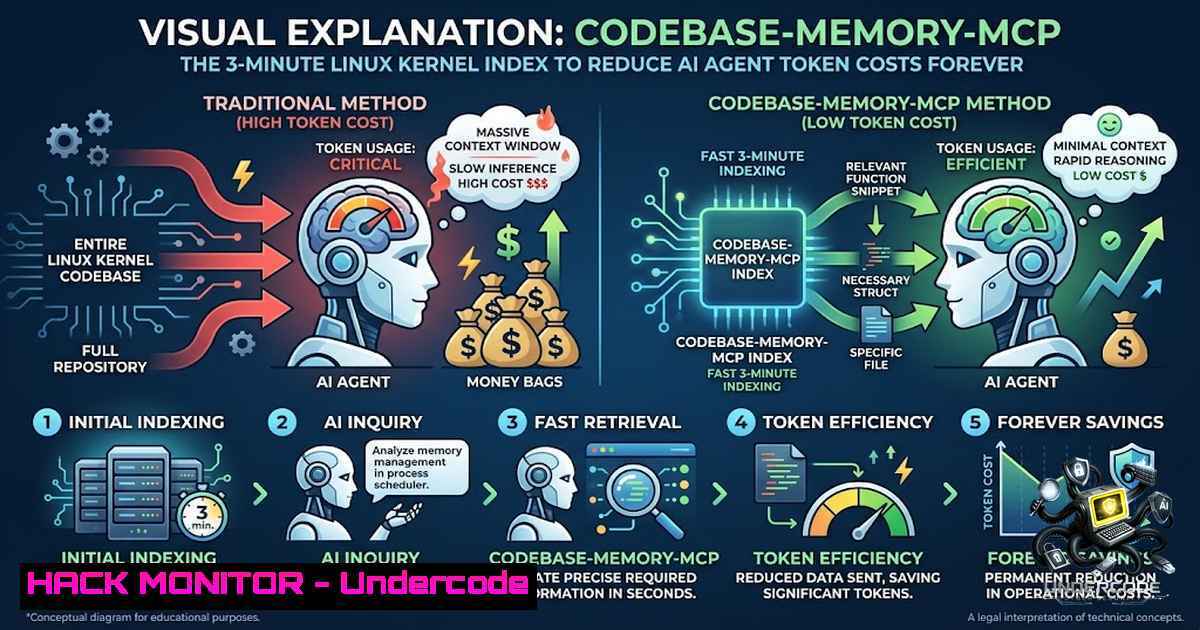
AI coding agents have long been shackled by an inefficient ritual: reading files one by one, grepping through endless lines of code, and burning through tokens like digital kindling. The result? A single structural query can consume over 400,000 tokens — and your budget along with it. Enter Codebase-Memory-MCP, an open-source code intelligence engine that swaps this antiquated approach for high-speed AST knowledge graphs, indexing the entire 28-million-line Linux kernel in just three minutes.
Learning Objectives:
- Understand how Tree-Sitter-based AST parsing and knowledge graphs reduce token consumption by up to 99% for structural queries
- Learn to deploy Codebase-Memory-MCP as a zero-dependency static binary across Linux, Windows, and macOS environments
- Master the 14 MCP tools for querying functions, classes, call chains, HTTP routes, and cross-service links
- Implement security-hardened local code intelligence with no API keys, no Docker, and no external dependencies
You Should Know:
1. The Architecture: From File-Scanning to Graph-Based Intelligence
Traditional AI agents explore codebases through repeated file-reading and grep-searching — a process that consumes thousands of tokens per query without any structural understanding. Codebase-Memory-MCP revolutionizes this by constructing a persistent knowledge graph via a multi-phase pipeline with parallel worker pools, call-graph traversal, impact analysis, and community discovery.
The engine uses vendored Tree-Sitter grammars compiled directly into the binary to parse 158 programming languages. For enhanced semantic resolution, it employs Hybrid LSP analysis across Python, TypeScript/JavaScript/JSX/TSX, PHP, C, Go, C, C++, Java, Kotlin, and Rust. This isn’t just parsing — it’s structural understanding at machine speed.
Step-by-Step: What This Does and How to Use It
- Download the binary for your platform from the GitHub releases page:
– macOS: `codebase-memory-mcp-darwin-arm64` or `amd64`
– Linux: `codebase-memory-mcp-linux-arm64` or `amd64`
– Windows: `codebase-memory-mcp-windows-amd64.exe`
2. Run the install command — it auto-detects 11 coding agents including Claude Code, Codex CLI, Gemini CLI, Zed, OpenCode, Antigravity, Aider, KiloCode, VS Code, OpenClaw, and Kiro:
./codebase-memory-mcp install
- Point it to your repository and let the indexing begin. For the Linux kernel (28M LOC, 75K files), this takes approximately 3 minutes.
-
Query the graph using any of the 14 MCP tools — responses arrive in under 1 millisecond.
-
Visualize your knowledge graph in 3D at `localhost:9749` (UI variant).
2. Performance Metrics That Redefine Efficiency
The research behind Codebase-Memory-MCP, detailed in arXiv:2603.27277, evaluated the system across 31 real-world repositories. The results are staggering:
- 99% reduction in tokens for structural queries — a single graph query replaces dozens of grep/read cycles
- 83% answer quality across complex tasks, compared to 92% for file-exploration agents, at ten times fewer tokens and 2.1 times fewer tool calls
- For graph-1ative queries such as hub detection and caller ranking, it matches or exceeds the explorer on 19 of 31 languages
Step-by-Step: Benchmarking Your Own Repositories
1. Clone a large repository for testing:
git clone https://github.com/torvalds/linux.git
2. Run the indexer with timing enabled:
time ./codebase-memory-mcp index --path ./linux
- Compare token consumption between graph queries and traditional file exploration. A typical structural query that would require ~412,000 tokens via file-by-file search consumes just ~3,400 tokens via the graph — a 120x reduction.
-
Monitor memory usage — the RAM-first pipeline uses LZ4 compression and in-memory SQLite, with memory released after indexing completes.
3. Zero-Dependency Deployment: Security-First Design
Security is prioritized throughout the architecture. All processing happens 100% locally on your machine — your code never leaves your environment. The tool ships as a single static binary with no Docker, no Ollama, no runtime dependencies, and no API keys required.
Every release binary is signed, checksummed, and scanned by 70+ antivirus engines. The full source code is available for audit, and a dedicated SECURITY.md outlines responsible disclosure procedures.
Step-by-Step: Secure Deployment Across Platforms
Linux/macOS:
 Download and verify checksum
wget https://github.com/DeusData/codebase-memory-mcp/releases/latest/download/codebase-memory-mcp-linux-amd64
sha256sum codebase-memory-mcp-linux-amd64
chmod +x codebase-memory-mcp-linux-amd64
./codebase-memory-mcp-linux-amd64 install
Windows (PowerShell):
 Download and verify
Invoke-WebRequest -Uri "https://github.com/DeusData/codebase-memory-mcp/releases/latest/download/codebase-memory-mcp-windows-amd64.exe" -OutFile "codebase-memory-mcp.exe"
Get-FileHash -Algorithm SHA256 codebase-memory-mcp.exe
.\codebase-memory-mcp.exe install
Verify installation:
 Check that MCP entries were configured for your agent
cat ~/.config/claude-code/mcp.json  Example for Claude Code
4. Infrastructure-as-Code and Enterprise Integration
Beyond traditional codebases, Codebase-Memory-MCP indexes infrastructure-as-code assets including Dockerfiles, Kubernetes manifests, and Kustomize overlays. This makes it invaluable for DevSecOps teams needing to map complex microservice architectures, API routes, and cross-service dependencies.
The tool automatically maps HTTP routes and cross-service links into the knowledge graph, enabling agents to understand not just what code does, but how services interact in production environments.
Step-by-Step: Indexing Infrastructure Code
1. Index a Kubernetes-heavy repository:
./codebase-memory-mcp index --path ./my-k8s-infra
2. Query for all services and their dependencies:
- Use the graph to identify which services call which APIs
- Map cross-service communication patterns
- Detect potential security boundaries and attack surfaces
3. Integrate with CI/CD pipelines:
 Example GitHub Action snippet
- name: Index Codebase
run: |
wget https://github.com/DeusData/codebase-memory-mcp/releases/latest/download/codebase-memory-mcp-linux-amd64
chmod +x codebase-memory-mcp-linux-amd64
./codebase-memory-mcp-linux-amd64 index --path ${{ github.workspace }}
- The 14 MCP Tools: Your Agent’s New Superpowers
Codebase-Memory-MCP exposes 14 Model Context Protocol tools that transform how agents interact with code:
- Symbol resolution — Find function definitions, class hierarchies, and variable references instantly
- Call graph traversal — Map who calls whom, enabling impact analysis for changes
- HTTP route discovery — Identify all API endpoints and their handlers
- Community detection — Find clusters of related code and potential modularity boundaries
- Hub detection — Identify central functions or classes that serve as architectural linchpins
- Caller ranking — Determine which functions are most frequently invoked
Step-by-Step: Querying the Graph
1. Find all HTTP routes in a codebase:
./codebase-memory-mcp query --type routes --path ./my-api
2. Map call chains for a specific function:
./codebase-memory-mcp query --type callers --symbol "authenticateUser" --path ./app
3. Detect architectural hubs:
./codebase-memory-mcp query --type hubs --threshold 0.8 --path ./microservices
4. Export the graph for external analysis:
./codebase-memory-mcp export --format json --output graph.json --path ./repo
What Undercode Say:
- The token economy is dead — Codebase-Memory-MCP proves that structural understanding, not brute-force file reading, is the path forward for AI coding agents. The 99% token reduction isn’t just a cost-saving measure; it’s a fundamental rethinking of how agents should interact with codebases.
-
Local-first is the only secure way — In an era of data breaches and API key leaks, running entirely locally with no external dependencies is a security paradigm that more AI tools should adopt.
The implications extend far beyond developer productivity. When an AI agent can index the entire Linux kernel in three minutes and answer structural queries in under a millisecond, we’re looking at a future where code understanding is no longer the bottleneck. The research behind this tool — evaluated across 31 real-world repositories — demonstrates that graph-based exploration achieves 83% of the answer quality of file-by-file exploration while consuming 10 times fewer tokens and making 2.1 times fewer tool calls.
For security teams, this means faster vulnerability discovery and more comprehensive code review. For developers, it means agents that actually understand architecture, not just surface-level syntax. And for the industry as a whole, it suggests that the era of token-burning AI agents may finally be coming to an end.
The question isn’t whether we’ll adopt this approach — it’s how quickly the ecosystem will pivot to make graph-based code intelligence the new standard.
Prediction:
- +1 The open-source nature of Codebase-Memory-MCP will accelerate adoption across the AI developer tooling ecosystem, with major coding agents integrating similar graph-based intelligence within 12-18 months.
-
+1 The 158-language support and infrastructure-as-code indexing capabilities will make this the de facto standard for DevSecOps teams conducting large-scale security audits and dependency mapping.
-
-1 Organizations that continue relying on traditional file-by-file agent exploration will face significant competitive disadvantages in developer velocity and AI operational costs as the industry shifts toward graph-1ative architectures.
-
+1 The local-first, zero-dependency deployment model will inspire a new wave of security-conscious AI tools that prioritize data sovereignty and eliminate the risks associated with cloud-based code processing.
-
-1 Legacy agent configurations and enterprise approval processes may slow adoption in heavily regulated industries, despite the clear security and efficiency advantages.
▶️ Related Video (82% Match):
https://www.youtube.com/watch?v=0DDAngEOsJ4
🎯Let’s Practice For Free:
🎓 Live Courses & Certifications:
Join Undercode Academy for Verified Certifications
🚀 Request a Custom Project:
Secure, high-velocity infrastructure and disruptive technological engineering. Contact our engineering team for high-tier development and proprietary systems:
[email protected]
💎 Smart Architecture | 🛡️ Secure by Design | ⭐ Trusted by Thousands
IT/Security Reporter URL:
Reported By: Charlywargnier How – Hackers Feeds
Extra Hub: Undercode MoN
Basic Verification: Pass ✅


