
Listen to this Post
Introduction:
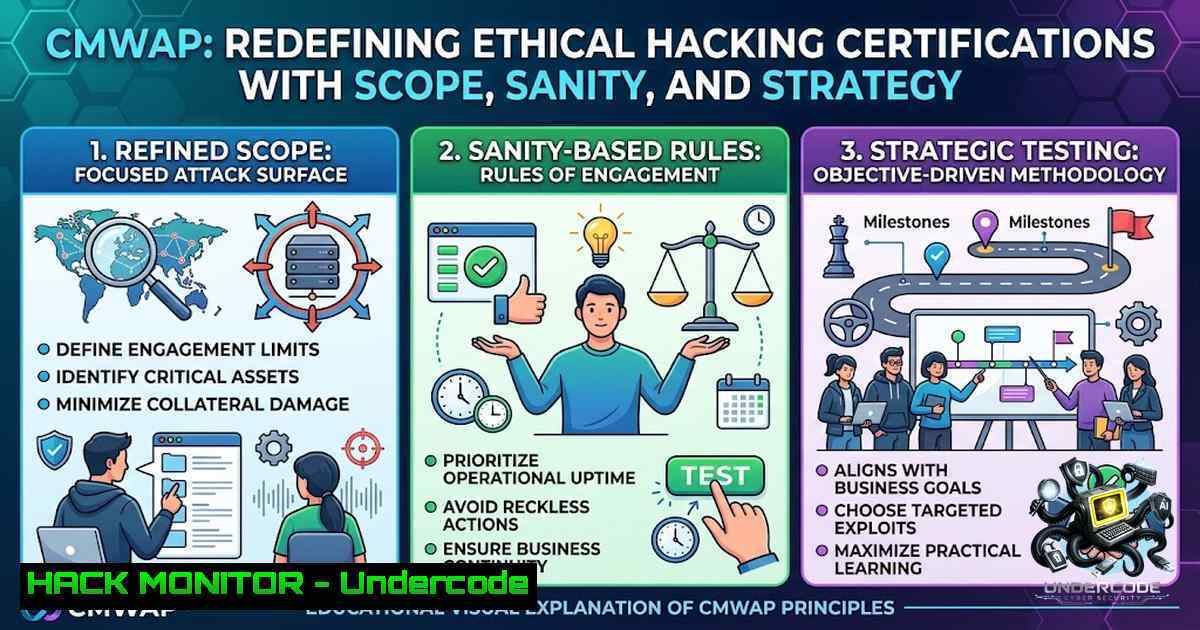
The cybersecurity industry is saturated with certifications that prioritize marathon exam sessions over real-world operational logic. Wesley Thijs, an OWASP Speaker and OSCP-certified ethical hacker, has disrupted this model with the launch of the Certified Modern Web App Pentester (CMWAP). This new format shifts the grading paradigm from the sheer volume of exploits found to the rigor of testing methodology and scope adherence, reflecting the actual workflow of a professional pentester where planning, pacing, and precise execution are valued over reckless exploration. The exam integrates a hard 90-minute planning window followed by an 8-hour active hacking window, with an automatic fail for exceeding 14 hours of active engagement, emphasizing that rest and strategic pacing are integral to the job.
Learning Objectives & Secrets:
- Objective 1: Mastering Scope Adherence – Learn to define a precise testing perimeter and execute exactly that plan. The secret is that in the CMWAP exam, missing a bug inside your scope is less penalized than finding an out-of-scope vulnerability and exploiting it; walking through an out-of-scope door is an instant automatic fail.
- Objective 2: Strategic Time Management Under Pressure – The exam enforces a strict 24-hour period with a maximum of 14 active hacking hours. The secret tip is to use the initial 90-minute window to create a detailed, timestamped attack plan that maps directly to the target’s attack surface, ensuring you allocate time efficiently for reconnaissance, exploitation, and reporting.
- Objective 3: Leveraging AI Without Losing Your Mind – AI tools are permitted as assistants for tasks like generating payloads or parsing data, but they are strictly prohibited from writing the plan or final report. The secret is to use AI for noise reduction (e.g., fuzzing automation) while ensuring all strategic decision-making and evidence of thought remain human-generated.
You Should Know:
- Mastering Reconnaissance and Network Port Scanning for Modern Web Apps
A successful web application pentest begins with exhaustive reconnaissance. The CMWAP philosophy emphasizes that if you don’t scan it, you don’t own it. For Linux, a comprehensive scan involves using `nmap` with scripting and version detection to map the attack surface. The following command performs a stealthy SYN scan on common web ports while running default scripts and service enumeration:
Linux Command (Nmap):
nmap -sS -sC -sV -p 80,443,8080,8443,3000,5000,8000,9000 <target_IP> -oA cmwap_recon_initial
This command performs a TCP SYN scan (-sS), runs default scripts (-sC), and identifies service versions (-sV) on the most common web application ports. The `-oA` flag outputs the results in all formats for later analysis. For Windows environments, port scanning is often achieved via PowerShell using `Test-1etConnection` in a loop:
Windows PowerShell Command (Port Scan):
1..1024 | ForEach-Object { Test-1etConnection <target_IP> -Port $_ -InformationLevel Quiet | Where-Object {$_ -eq $true} }
This scans the first 1024 ports and returns only the open ones. The secret tip here is to correlate open ports with common web server signatures (e.g., Apache, Nginx, IIS) to immediately profile the technology stack. A proper step-by-step guide involves: 1) Running the initial broad scan, 2) Identifying live hosts, 3) Conducting a deep scan on discovered web services with UDP enumeration for services like SNMP, and 4) Saving the output to a structured format (e.g., XML or JSON) to feed into automated vulnerability scanners later.
- Web Application Hacking Core: XSS and Broken Access Control (BAC)
The core of modern web pentesting revolves around client-side vulnerabilities like Cross-Site Scripting (XSS) and logic flaws like Broken Access Control (BAC). In the CMWAP exam, these are central focuses. For XSS testing, using Burp Suite is essential. However, manual validation is critical. To test a reflected XSS, you can use a simple Python script to fuzz parameters with common payloads:
Python Fuzzing Snippet for XSS (Linux/macOS):
import requests
payloads = ["<script>alert(1)</script>", "\"><script>alert(1)</script>", "javascript:alert(1)"]
url = "http://target.com/search?q=test"
for payload in payloads:
response = requests.get(url.replace("test", payload))
if payload in response.text:
print(f"Potential XSS with payload: {payload}")
For BAC, the methodology involves identifying IDOR (Insecure Direct Object References). This requires intercepting requests in Burp Suite and manipulating user IDs, order numbers, or document IDs. On Linux, you can use `curl` to automate sequential ID enumeration:
Linux Curl Command for IDOR Enumeration:
for i in {1000..2000}; do curl -s -o /dev/null -w "%{http_code} %{url_effective}\n" "https://target.com/api/user/$i"; done | grep 200
This command loops through user IDs from 1000 to 2000, checks the HTTP status code, and outputs only those returning a 200 OK, which likely indicates valid resources. The secret tip is to always check for URL encoding and API versioning (e.g., /v1/user/, /v2/user/) as different endpoints may have varying access controls.
3. Burp Suite Configuration for High-Efficiency Testing
Burp Suite is the Swiss Army knife for web pentesters. A common mistake is using it without proper scope configuration. Set up a project with a specific scope targeting only the IPs/Domains in your engagement letter. To automate parameter discovery, use the Intruder tool with a wordlist of common parameters (e.g., id, user, file, redirect).
Recommended Intruder Payloads (Sniper Attack):
- Parameter names:
id,uid,user_id,file,path,redirect,url, `return_to`
– Values:../,../../../etc/passwd,admin,1,2, `true`
Macro Setup for Session Handling:
If the application uses CSRF tokens, create a macro in Burp that extracts the token from a login response and automatically inserts it into subsequent requests. This is crucial for automated scanning.
1. Go to Project Options -> Sessions.
- Define a session handling rule that checks for a logged-in state.
- Configure a macro to GET the login page, parse the CSRF token using a regular expression, and POST the credentials.
The secret to maximizing Burp efficiency is the “Target Analyzer” tool, which maps the entire application structure to identify hidden parameters and files, reducing the time spent on manual navigation.
4. API Security Hardening and Testing
Modern web apps are API-driven. The CMWAP exam likely includes API endpoints. Testing API security involves checking for improper HTTP methods (e.g., PUT, DELETE, PATCH). On Linux, you can use `curl` to test for HTTP method override:
Linux Curl for Method Override:
curl -X PUT -H "X-HTTP-Method-Override: GET" https://target.com/api/resource
This attempts to bypass the standard method restrictions. Additionally, check for GraphQL introspection attacks. Using a simple Python script to query __schema:
Python GraphQL Introspection:
import requests
query = "{ __schema { types { name fields { name } } } }"
response = requests.post("https://target.com/graphql", json={"query": query})
print(response.json())
If the server returns the schema, it’s a critical misconfiguration. The secret tip is to always check for API versioning and deprecated endpoints, which often lack the same security controls as the current version.
5. Cloud Hardening and Misconfiguration Detection
Cloud services (AWS, Azure, GCP) are integral to modern web apps. Misconfigurations like publicly exposed S3 buckets or Azure Blob containers are common. For AWS, you can use the AWS CLI to check if a bucket is public:
AWS CLI Command:
aws s3api get-bucket-acl --bucket <target_bucket_name>
If the ACL lists `AllUsers` or `AuthenticatedUsers` with `READ` access, it’s vulnerable. For Azure, use `az storage blob list` to enumerate containers. The step-by-step guide involves:
1. Identifying the cloud provider via DNS records or HTTP headers (e.g., `x-amz-request-id` for AWS).
2. Bruteforcing bucket names based on company naming conventions (e.g., company-dev, company-prod).
3. Verifying if the bucket allows listing and downloading of files.
If the target uses Kubernetes, check for exposed dashboards. A misconfigured `kube-system` namespace can lead to cluster compromise. The command to test for open kubelet ports (10250) is:
nmap -p 10250 <target_IP> --script=http-vuln-cve2018-1002105
This script specifically checks for a known kubelet vulnerability.
6. Vulnerability Exploitation and Mitigation: SQL Injection
Despite being decades old, SQL Injection remains a top vulnerability. The CMWAP scope includes identifying and exploiting this. A classic exploitation technique is using sqlmap. However, manual detection is paramount. Using a `’ OR ‘1’=’1` payload in a login form is trivial. For a more advanced time-based blind SQLi on a REST API, you can use:
Time-Based Blind SQLi Payload:
?user=admin' AND SLEEP(5)--
If the response is delayed by 5 seconds, a vulnerability exists. The mitigation for this is using parameterized queries. For mitigation, if you are the defender, you must ensure that all dynamic SQL is parameterized. For example, in Python with SQLite:
cursor.execute("SELECT FROM users WHERE username = ?", (username,))
This ensures that input is treated as data, not executable code. On Windows, if using IIS and ASP.NET, the mitigation involves using `SqlCommand` with SqlParameter.
7. Pacing and Report Writing: The Final Frontier
The CMWAP exam grades the plan and report as the evidence of how you think. The report must be concise, focusing on the scope, methodology, and findings. A recommended template includes: Executive Summary, Scope, Testing Approach, Findings (with CVSS scores), and Remediation. The secret tip is to use a version control system (like Git) for your report to track changes and revert if necessary. For Linux, you can use `pandoc` to convert a Markdown report to PDF:
Linux Pandoc Command:
pandoc report.md -o report.pdf --pdf-engine=pdflatex
This ensures a clean, professional output. The report should not include out-of-scope findings, as per the grading criteria, but it should mention them as a “Note” without providing evidence to avoid the automatic fail.
What Undercode Say:
- Key Takeaway 1: The CMWAP certification represents a significant paradigm shift in cybersecurity education, prioritizing methodological rigor and professional discipline over the traditional “capture-the-flag” model of pure exploit hunting.
- Key Takeaway 2: The integration of a strict time management system, coupled with the allowance of AI as an assistant, reflects the modern pentester’s reality, where efficiency, rest, and strategic planning are as critical as technical prowess.
The strategic focus on scope adherence rather than exploitative volume is a brilliant move. It forces candidates to think like business owners and project managers, not just glorified script kiddies. The 90-minute planning phase is a crucial filter that separates those who can conceptualize a strategy from those who rely on brute-force trial and error. Furthermore, the prohibition against AI writing the plan or report ensures that the fundamental soft skills of communication and logical structuring are not eroded. The $22 price tag for the bundle is an aggressive play, likely aimed at democratizing high-quality training and weeding out candidates who aren’t willing to invest in comprehensive material. The “limited drop” and “2 left” verbiage adds a layer of scarcity marketing that drives immediate action, a tactic that works well in the FOMO-driven cybersecurity community.
Prediction:
-1 The strict 14-hour active hacking limit may disproportionately affect neurodivergent candidates or those requiring extended breaks, potentially leading to accessibility criticisms if not properly disclosed.
+1 The emphasis on planning and reporting will elevate the baseline quality of certified pentesters, making CMWAP a strong differentiator in the hiring market for security managers who value process over fireworks.
+1 The low-entry price point of the 906 bundle is likely to cause a disruption in the certification market, forcing larger entities to reevaluate their pricing models and course content structure.
-1 The automatic failure for exploiting out-of-scope doors, while pedagogically sound, might discourage the proactive discovery of critical vulnerabilities that lie just outside the stated boundary, potentially leading to a “tunnel vision” mindset.
▶️ Related Video (88% Match):
🎯Let’s Practice For Free:
🎓 Live Courses & Certifications:
Join Undercode Academy for Verified Certifications
🚀 Request a Custom Project:
Secure, high-velocity infrastructure and disruptive technological engineering. Contact our engineering team for high-tier development and proprietary systems:
[email protected]
💎 Smart Architecture | 🛡️ Secure by Design | ⭐ Trusted by Thousands
IT/Security Reporter URL:
Reported By: https://lnkd.in/p/eGKhdbX4 – Hackers Feeds
Extra Hub: Undercode MoN
Basic Verification: Pass ✅


