Listen to this Post
Introduction:
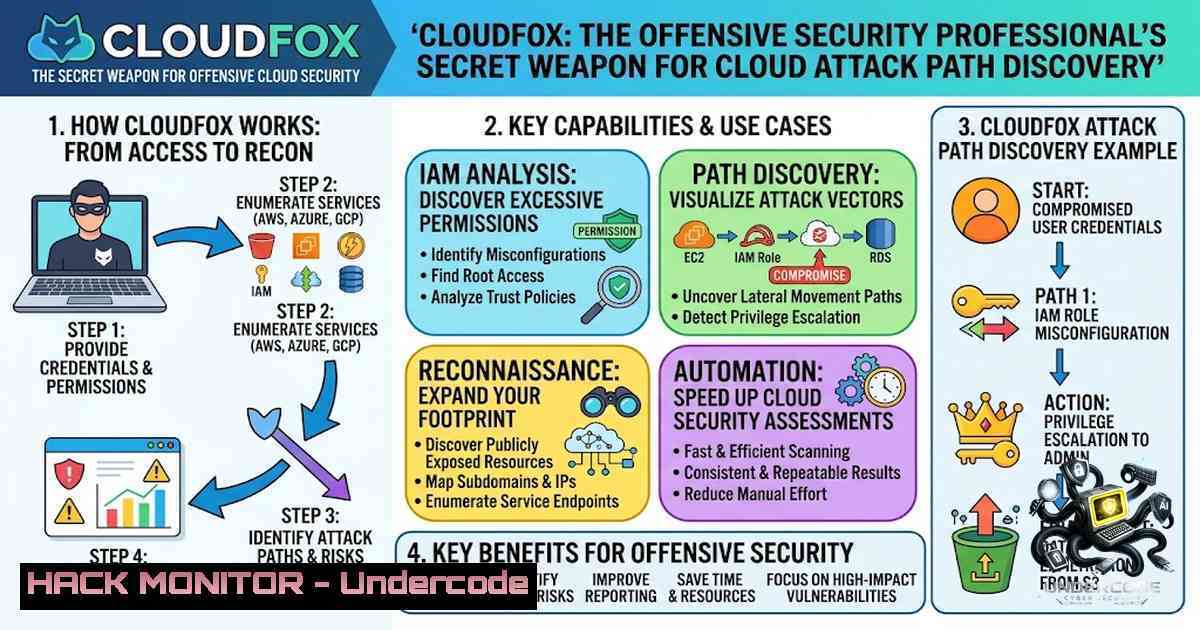
As organizations accelerate their cloud migration, the attack surface has expanded exponentially—and with it, the complexity of identifying exploitable paths within sprawling AWS, Azure, and GCP environments. CloudFox, an open-source command-line tool developed by Bishop Fox, empowers penetration testers and red teamers to rapidly establish situational awareness in unfamiliar cloud infrastructure, uncovering misconfigurations, overly permissive IAM roles, and hidden secrets that adversaries could leverage. Whether you’re conducting a white-box assessment with limited read-only permissions or a black-box engagement with “found” credentials, CloudFox automates the enumeration process, silently failing on denied requests while surfacing actionable intelligence.
Learning Objectives:
- Master the installation and configuration of CloudFox across AWS, Azure, and GCP environments
- Execute comprehensive cloud enumeration commands to identify attack paths, misconfigurations, and privilege escalation vectors
- Leverage CloudFox’s modular architecture to conduct both white-box and black-box cloud penetration tests efficiently
You Should Know:
1. Understanding CloudFox’s Architecture and Core Capabilities
CloudFox was designed with a modular philosophy, allowing security professionals to run individual commands or execute comprehensive sweeps across an entire cloud environment. The tool currently supports 34 distinct AWS commands, 4 Azure commands, and an impressive 60 GCP commands, with Kubernetes support planned for future releases. This extensive command set enables practitioners to answer critical questions during an assessment: Which regions is this AWS account using, and how many resources reside within them? What secrets are lurking in EC2 userdata or service-specific environment variables? Which workloads have administrative permissions attached? What role trusts are overly permissive or allow cross-account assumption?
The tool’s dual-mode operation is particularly noteworthy. In white-box scenarios—where the tester possesses legitimate read-only credentials—CloudFox systematically enumerates resources to uncover attack paths that could be exploited in simulated compromise scenarios. In black-box engagements, where credentials may have been obtained through other means, CloudFox behaves similarly to tools like weirdAAL or enumerate-iam: checks that fail due to insufficient permissions are handled silently, so any data returned immediately signals that the “found” credentials have the necessary access. This capability is invaluable for assessing the blast radius of compromised credentials.
2. Installation and Initial Configuration
Deploying CloudFox is straightforward, with multiple installation options catering to different workflows. For users comfortable with package managers, Homebrew offers the simplest route:
brew install cloudfox
Alternatively, practitioners can download the latest binary release directly from the GitHub releases page for their specific platform. For those who prefer building from source or require the absolute latest features, the repository can be cloned and compiled manually.
Critical Update Notice: As of December 2025, all versions of CloudFox prior to v1.17.0 have ceased functioning due to a format change in AWS’s public service mapping file. Users must ensure they are running v1.17.0 or greater before attempting any enumeration. This highlights the importance of maintaining up-to-date tooling in the rapidly evolving cloud security landscape.
Once installed, CloudFox requires authentication to the target cloud environment. For AWS, this typically involves configuring named profiles via the AWS CLI:
aws configure --profile target-account
For Azure, authentication leverages the Azure CLI’s established session:
az login
GCP authentication utilizes application default credentials or service account keys:
gcloud auth application-default login
3. Executing Comprehensive Cloud Enumeration
CloudFox’s most powerful feature is its ability to run a complete suite of checks against a target environment with a single command. For AWS, the `all-checks` command provides a comprehensive assessment:
cloudfox aws --profile target-account all-checks
This command executes all available AWS modules with sensible defaults, providing a holistic view of the account’s security posture. For more targeted assessments, individual commands can be invoked. For example, to enumerate EC2 instances:
cloudfox aws --profile target-account instances
Azure users can target specific subscriptions:
cloudfox azure --subscription SUBSCRIPTION_ID vms
GCP offers flexible targeting options, from individual projects to entire organizations:
cloudfox gcp --project my-project instances
cloudfox gcp --folder FOLDER_ID buckets
cloudfox gcp --organization ORG_ID whoami
The tool also supports batch processing via project lists:
cloudfox gcp -l projects.txt all-checks
For environments with complex hierarchies, GCP commands output to a hierarchical directory structure mirroring the org/folder/project hierarchy, while the `–flat` flag can be used to flatten this output when simpler parsing is desired.
4. Identifying and Exploiting Attack Paths
CloudFox excels at uncovering the specific attack paths that adversaries would pursue. The tool systematically identifies:
Overly Permissive IAM Roles and Trust Relationships: CloudFox enumerates role trusts, flagging configurations that allow cross-account assumption or excessively broad permissions. This is critical for identifying privilege escalation vectors where a compromised principal could assume a more powerful role.
Secrets in UserData and Environment Variables: EC2 userdata scripts and service-specific environment variables often contain hardcoded credentials, API keys, and other sensitive information. CloudFox automates the extraction and analysis of this data, significantly reducing manual review time.
External and Internal Attack Surfaces: The tool identifies endpoints, hostnames, and IPs that are reachable from the public internet, as well as those accessible from an assumed breach within the VPC. This dual perspective enables testers to map both external exposure and lateral movement opportunities.
Filesystem Mounting Opportunities: CloudFox can identify filesystems that could potentially be mounted from a compromised resource inside the VPC, enabling data exfiltration or further compromise.
To illustrate the practical application, consider a scenario where a tester has obtained low-privilege credentials. Running CloudFox’s `all-checks` might reveal an S3 bucket with public write permissions, an EC2 instance with userdata containing database credentials, and an IAM role with administrative privileges that can be assumed by the current principal. Each finding represents a potential attack path that can be further exploited.
- CloudFox in the Broader Cloud Native Security Ecosystem
CloudFox does not operate in isolation; it complements a broader ecosystem of cloud security tools and practices. For organizations implementing defense-in-depth strategies, CloudFox serves as an offensive counterpart to tools like AWS Trusted Advisor, Azure Security Center, and GCP Security Command Center. While these native tools provide compliance and security posture management, CloudFox offers the attacker’s perspective—identifying not just misconfigurations but exploitable paths that could lead to compromise.
The tool’s integration with intentionally vulnerable playgrounds like CloudFoxable—a gamified cloud hacking sandbox—provides a safe environment for practitioners to hone their skills. Additionally, the RedSec Discord server offers a community for discussing CloudFox techniques and sharing insights.
For enterprises, incorporating CloudFox into regular penetration testing workflows enables proactive identification of attack paths before adversaries can exploit them. The tool’s silent failure mode on denied permissions makes it particularly valuable for testing the blast radius of compromised credentials—an increasingly common concern in modern cloud environments.
6. Advanced Usage and Customization
Beyond the basic commands, CloudFox offers several advanced features for power users. The modular architecture allows for the creation of custom scripts that chain multiple CloudFox commands with other tools. For example, a penetration tester might combine CloudFox output with Nmap for network scanning or with Metasploit for exploitation.
The tool’s output is designed to be machine-readable, facilitating integration with SIEM systems, ticketing platforms, or custom reporting pipelines. Practitioners can redirect output to JSON files for further processing:
cloudfox aws --profile target-account all-checks > cloudfox_output.json
For organizations with stringent security requirements, CloudFox can be executed in air-gapped environments by pre-downloading the necessary binaries and dependencies. The open-source nature of the tool also allows for code review and customization to meet specific organizational needs.
What Undercode Say:
- CloudFox fundamentally changes the economics of cloud penetration testing by automating the most time-consuming aspects of cloud enumeration—what once required hours of manual reconnaissance can now be accomplished in minutes
- The tool’s ability to silently handle permission denials makes it uniquely suited for black-box scenarios where credential validity is uncertain, providing immediate feedback on the scope of compromised access
- As cloud environments continue to grow in complexity, tools like CloudFox that provide rapid situational awareness will become indispensable for both offensive and defensive security teams
- The recent v1.17.0 update requirement underscores a critical lesson: cloud security tools must evolve continuously to keep pace with changes in cloud provider APIs and data formats
- CloudFox’s support for AWS, Azure, and GCP within a single tool reduces the cognitive load on penetration testers who must navigate multiple cloud platforms
- The modular design allows organizations to adopt CloudFox incrementally, starting with specific commands and expanding usage as familiarity grows
- Integration with CloudFoxable provides a valuable training resource, enabling practitioners to develop and test their skills in a controlled environment
- The tool’s community-driven development model, with contributions welcomed via GitHub issues and discussions, ensures continuous improvement and adaptation to emerging threats
- For defensive teams, CloudFox offers a means to validate security controls by simulating attacker enumeration techniques
- The growing adoption of CloudFox in the offensive security community signals a broader shift toward automation-driven penetration testing methodologies
Prediction:
- +1 CloudFox and similar automation tools will become mandatory components of cloud penetration testing engagements, reducing assessment timelines by 60-80% while improving coverage
- +1 The tool’s open-source model will accelerate innovation, with community contributions expanding cloud provider support and adding new attack path detection capabilities
- -1 As automation increases, there is a risk that less experienced testers may rely too heavily on tools without understanding underlying cloud security concepts, potentially missing nuanced attack paths
- +1 Integration with CI/CD pipelines will enable continuous security validation, shifting cloud security left in the development lifecycle
- -1 Cloud providers may begin detecting and rate-limiting CloudFox’s enumeration patterns, necessitating the development of more stealthy scanning techniques
- +1 The gamified training approach exemplified by CloudFoxable will become a standard model for cloud security education, bridging the skills gap in the industry
- +1 Expect to see commercial offerings built on top of CloudFox, providing enterprise features like centralized reporting, multi-account management, and compliance mapping
- -1 The increasing sophistication of cloud attack paths will require continuous updates to CloudFox’s detection logic, creating a maintenance burden for organizations
- +1 CloudFox’s modular architecture will enable specialized extensions for vertical industries, such as healthcare (HIPAA compliance) and finance (PCI DSS)
- +1 The tool’s emphasis on situational awareness will drive adoption beyond penetration testing, with incident response teams using CloudFox for rapid breach investigation and containment
▶️ Related Video (84% Match):
🎯Let’s Practice For Free:
🎓 Live Courses & Certifications:
Join Undercode Academy for Verified Certifications
🚀 Request a Custom Project:
Secure, high-velocity infrastructure and disruptive technological engineering. Contact our engineering team for high-tier development and proprietary systems:
[email protected]
💎 Smart Architecture | 🛡️ Secure by Design | ⭐ Trusted by Thousands
IT/Security Reporter URL:
Reported By: 0xfrost Cloudfox – Hackers Feeds
Extra Hub: Undercode MoN
Basic Verification: Pass ✅


