Listen to this Post
Introduction:
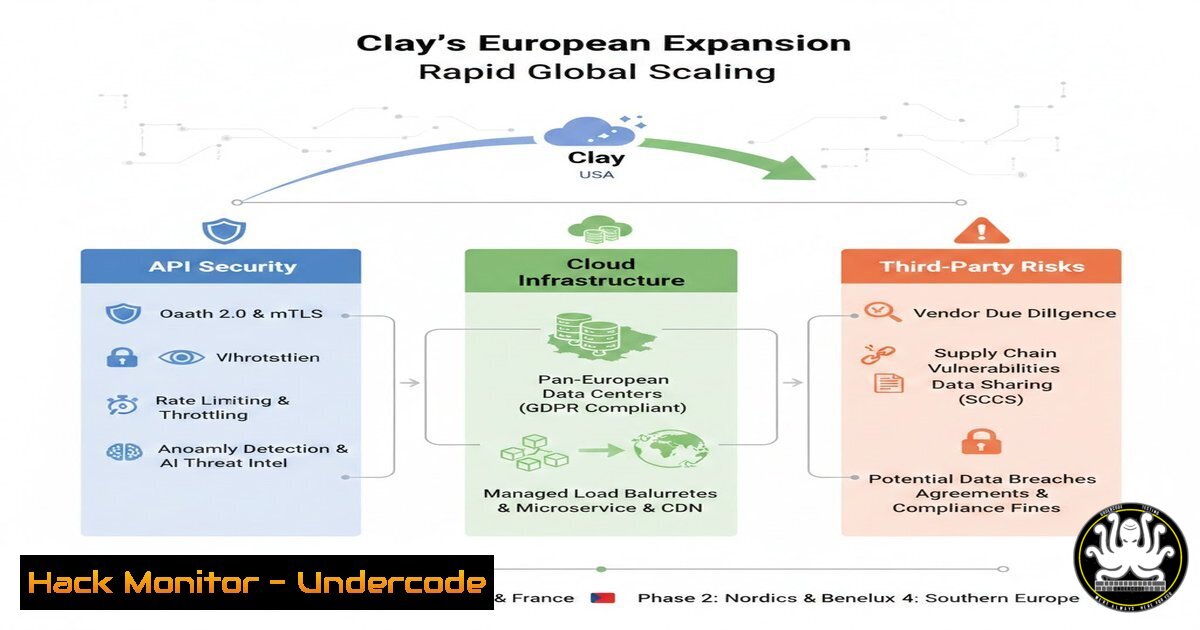
Clay’s recent expansion into the European market, marked by a new London office and strategic data partnerships with Lusha and Beauhurst, represents a significant milestone in SaaS growth. However, for cybersecurity professionals, such rapid international scaling introduces a complex web of compliance risks (GDPR), API security vulnerabilities, and third-party supply chain attack surfaces. As companies like Clay integrate new data sources and expand their digital footprint, the underlying infrastructure must be hardened against an evolving threat landscape. This article dissects the technical cybersecurity implications of such expansion, providing a roadmap for securing APIs, cloud environments, and partner integrations.
Learning Objectives:
- Understand the security risks associated with integrating third-party data APIs (Lusha, Beauhurst, Dealfront) into a core SaaS platform.
- Learn how to audit and harden cloud infrastructure (AWS/Azure/GCP) to maintain compliance during international expansion.
- Master the use of command-line tools (Linux/Windows) for monitoring API traffic and detecting anomalous behavior.
- Implement zero-trust principles for new international office network setups.
You Should Know:
- Auditing Third-Party API Integrations (The Lusha & Beauhurst Risk)
Clay’s announcement highlights new data partnerships. Every API connection is a potential entry point for attackers. When integrating external services, you inherit their security posture. A vulnerability in Lusha’s API could lead to data exfiltration from Clay.
Step‑by‑step guide to auditing an API endpoint using Linux CLI:
Before going live, security teams should perform basic reconnaissance and fuzzing on the API endpoints.
 1. Use Nmap to check for open ports on the partner's API domain (basic recon)
nmap -p 80,443,8080,8443 api.lusha.com

<ol>
<li>Use cURL to inspect response headers for security misconfigurations (e.g., missing HSTS)
curl -I https://api.beauhurst.com/v1/endpoint</p></li>
<li><p>Simulate a basic rate-limiting test to see if the API is protected against brute force
for i in {1..100}; do
curl -o /dev/null -s -w "%{http_code}\n" https://api.dealfront.com/test -H "Authorization: Bearer YOUR_TEST_KEY"
done | sort | uniq -c
If you get 200 OK for all 100 requests, rate limiting is weak/absent.</p></li>
<li><p>Check for data leakage in JavaScript files (useful for client-side APIs)
curl -s https://www.clay.com/static/main.js | grep -Eo 'https?://[^"]api[^"]' | sort -u
2. Hardening Cloud Infrastructure for GDPR Compliance
Moving operations into Europe (opening an office in London) often requires data residency controls. Companies must ensure customer data processed in the EU remains protected according to GDPR. This involves configuring cloud “regions” strictly and encrypting data at rest and in transit.
Step‑by‑step guide to enforcing regional data policies in AWS (CLI):
 1. List all S3 buckets and identify those not in the EU (eu-west-2 is London)
aws s3api list-buckets --query "Buckets[].Name" --output text | xargs -I {} aws s3api get-bucket-location --bucket {} --query "LocationConstraint"

<ol>
<li>Apply a bucket policy to deny access if the request originates outside the EU (example for eu-west-2)
aws s3api put-bucket-policy --bucket clay-eu-data --policy '{
"Version": "2012-10-17",
"Statement": [
{
"Effect": "Deny",
"Principal": "",
"Action": "s3:",
"Resource": "arn:aws:s3:::clay-eu-data/",
"Condition": {
"StringNotEquals": {
"aws:RequestedRegion": "eu-west-2"
}
}
}
]
}'</p></li>
<li><p>Enable default encryption for the bucket
aws s3api put-bucket-encryption --bucket clay-eu-data --server-side-encryption-configuration '{
"Rules": [
{
"ApplyServerSideEncryptionByDefault": {
"SSEAlgorithm": "AES256"
}
}
]
}'
- Securing the Internal Network for a New International Office
Opening a physical office in London means extending the corporate network. This is a classic vector for lateral movement if an attacker compromises an endpoint in the new office.
Step‑by‑step guide to configuring a Windows Firewall for a remote office site (PowerShell):
Run these commands on Windows Server or Windows 10/11 Pro to restrict inbound traffic.
 1. Block all inbound traffic by default (Whitelist approach)
Set-NetFirewallProfile -Profile Domain,Public,Private -DefaultInboundAction Block

<ol>
<li>Allow only specific IPs (the HQ VPN) to access RDP (Port 3389)
New-NetFirewallRule -DisplayName "Allow RDP from HQ Only" -Direction Inbound -LocalPort 3389 -Protocol TCP -Action Allow -RemoteAddress "203.0.113.0/24"</p></li>
<li><p>Log all blocked connection attempts for SIEM ingestion
Set-NetFirewallProfile -Profile Public -LogBlocked $True -LogFileName "%systemroot%\System32\LogFiles\Firewall\office_firewall.log" -LogMaxSize 4096</p></li>
<li><p>Check for listening ports to ensure no unauthorized services are exposed
netstat -an | findstr LISTENING
4. Monitoring for Anomalous Data Access (Insider Threats)
With thousands of new community members and enterprise clients (like Mistral AI, Verkada), the volume of data access logs explodes. Companies must monitor for unusual patterns, such as a user downloading an entire database at 3 AM.
Step‑by‑step guide to parsing authentication logs on a Linux server (Syslog/auditd):
 1. Check for failed SSH login attempts (potential brute force)
sudo grep "Failed password" /var/log/auth.log | awk '{print $11}' | sort | uniq -c | sort -nr

<ol>
<li>Monitor active user sessions and their originating IPs
sudo lsof -i -n | grep ESTABLISHED</p></li>
<li><p>Use auditd to monitor changes to sensitive configuration files
sudo auditctl -w /etc/nginx/nginx.conf -p wa -k nginx_config_change</p></li>
<li><p>Search for large file transfers in a short period (requires custom logging or using 'find')
find /data/clay_users -type f -size +100M -exec ls -lh {} \; | awk '{ print $9 ": " $5 }'
- API Gateway Security: Rate Limiting and JWT Validation
As Clay scales, its own API endpoints become targets. Implementing a robust API Gateway (like Kong or AWS API Gateway) is critical to prevent DDoS and validate tokens.
Step‑by‑step guide to configuring rate limiting on an Nginx reverse proxy:
 Edit /etc/nginx/nginx.conf
http {
 Define a shared memory zone for rate limiting (10MB storage, 5 requests per second)
limit_req_zone $binary_remote_addr zone=clay_api:10m rate=5r/s;

Define a zone for limiting connections
limit_conn_zone $binary_remote_addr zone=addr:10m;

server {
listen 443 ssl;
server_name api.clay.com;

Apply rate limiting to the main endpoint
location /v1/data/ {
limit_req zone=clay_api burst=10 nodelay;
limit_conn addr 10;  Max 10 connections per IP
proxy_pass http://backend_cluster;
}

Validate JWT tokens before proxying (using Lua or auth_request)
location /auth {
internal;
proxy_pass http://auth_service/validate;
proxy_pass_request_body off;
proxy_set_header Content-Length "";
proxy_set_header X-Original-URI $request_uri;
}

location /secure/ {
auth_request /auth;
auth_request_set $auth_status $upstream_status;
proxy_pass http://backend_cluster;
}
}
}
6. Container Security for Rapid Deployment
Companies scaling fast often use containers (Docker/Kubernetes). Misconfigured containers are a leading cause of breaches.
Step‑by‑step guide to scanning containers for vulnerabilities using Trivy (Linux):
 1. Install Trivy
sudo apt-get install wget apt-transport-https gnupg lsb-release
wget -qO - https://aquasecurity.github.io/trivy-repo/deb/public.key | sudo apt-key add -
echo deb https://aquasecurity.github.io/trivy-repo/deb $(lsb_release -sc) main | sudo tee -a /etc/apt/sources.list.d/trivy.list
sudo apt-get update && sudo apt-get install trivy

<ol>
<li>Scan the Clay application image for vulnerabilities (High/Critical)
trivy image --severity HIGH,CRITICAL clayapp:latest</p></li>
<li><p>Scan a filesystem for misconfigurations (IaC scanning)
trivy fs --scanners misconfig /path/to/clay/kubernetes/deployment.yaml</p></li>
<li><p>Run a compliance scan (CIS Docker Benchmark)
trivy image --compliance docker-cis clayapp:latest
- Simulating a Supply Chain Attack (Red Team Exercise)
Given the announcement involves “data partnerships,” a red team should simulate a compromise where an attacker poisons the data feed from a partner (Lusha/Beauhurst).
Step‑by‑step guide to testing input validation (Python script example for SQLi/XSS):
 tester.py - Simulate malicious payloads sent via the partner API
import requests
import json

Malicious payload attempting XSS and SQLi
payloads = [
"<script>alert('XSS')</script>",
"' OR '1'='1'; -- ",
"../../../etc/passwd"
]

url = "https://api.clay.com/v1/import/beauhurst"
headers = {"Authorization": "Bearer TEST_KEY", "Content-Type": "application/json"}

for payload in payloads:
data = {"company_name": "Acme Corp", "notes": payload}
response = requests.post(url, headers=headers, data=json.dumps(data))
if "error" not in response.text.lower():
print(f"[!] Potential injection vulnerability with payload: {payload}")
else:
print(f"[bash] Payload blocked: {payload}")
What Undercode Say:
- Key Takeaway 1: Rapid international expansion through third-party APIs drastically increases the “blast radius” of a potential breach. Security teams must treat every new partner integration as a code dependency that requires continuous monitoring and penetration testing.
- Key Takeaway 2: Cloud infrastructure must shift from a “default-permissive” to a “default-deny” model the moment a company crosses borders. Enforcing regional data policies (like keeping UK data in
eu-west-2) is not just a compliance checkbox but a critical defense against data spillage during a perimeter breach.
The announcement from Clay underscores a common growth pain: the business moves faster than the security architecture. By integrating the specific API security checks and infrastructure hardening steps outlined above, organizations can ensure that their “London calling” moment doesn’t become a “breach alert” moment. The focus must shift from merely connecting to partners to rigorously verifying the integrity of every byte exchanged between them.
Prediction:
We will see a rise in “Geo-Spoofing” attacks where adversaries compromise a small vendor in the target expansion region (e.g., a European marketing agency) specifically to use their clean IP reputation and legitimate access tokens to pivot into the main SaaS provider’s network, bypassing geo-fencing controls. This will make behavioral analytics (UEBA) far more critical than simple IP-based allow lists.
▶️ Related Video (70% Match):
🎯Let’s Practice For Free:
IT/Security Reporter URL:
Reported By: Kareemamin Europe – Hackers Feeds
Extra Hub: Undercode MoN
Basic Verification: Pass ✅


