Listen to this Post
Introduction:
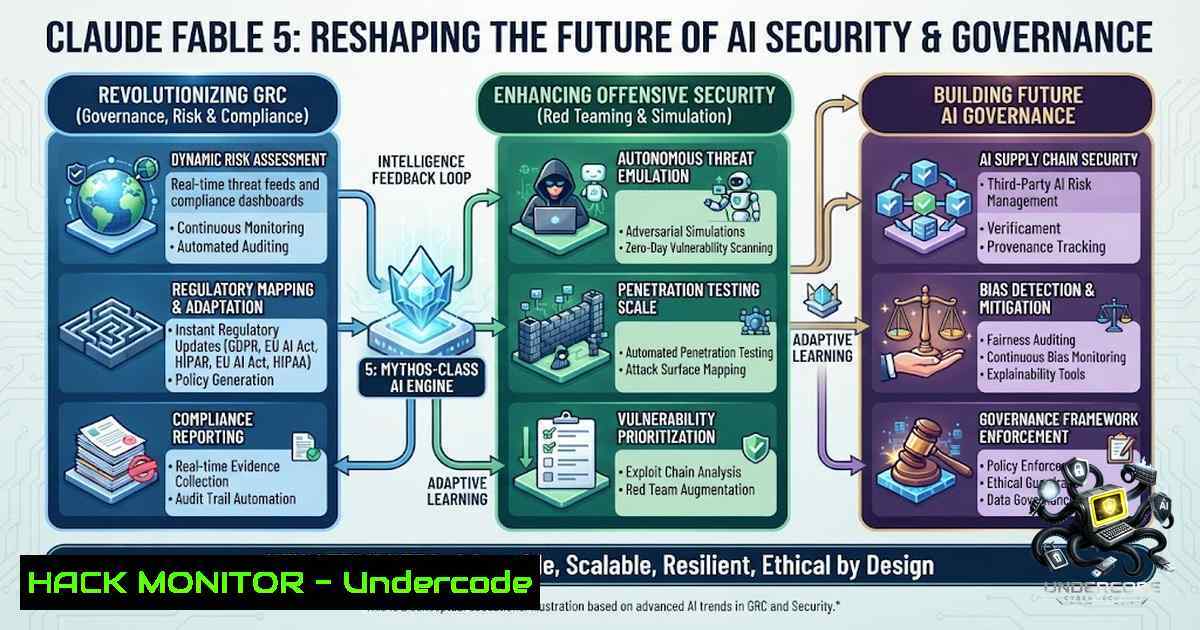
The release of Anthropic’s Claude Fable 5 marks a pivotal moment in the intersection of artificial intelligence and cybersecurity. As the first publicly available “Mythos-class” model, Fable 5 possesses the ability to identify and exploit software vulnerabilities with an 88.4% success rate—a staggering leap from the 8.8% achieved by its predecessor, Opus 4.8. This unprecedented capability, described as “agentic hacking”, forces governance, risk, and compliance (GRC) professionals to fundamentally rethink how AI is integrated into security frameworks, audit workflows, and risk management strategies.
Learning Objectives:
- Understand the architectural distinction between Fable 5 and Mythos 5, and how safety classifiers create a “governance layer” for AI capabilities.
- Master meta-prompting techniques to effectively brief Fable 5 as a senior security analyst for GRC-specific tasks.
- Learn to operationalize Fable 5 for end-to-end audit execution, including evidence analysis, exception flagging, and coverage reporting.
- Develop a cost-optimization strategy to delegate tasks between Fable 5 and more economical models like Opus 4.8 or Sonnet 5.
You Should Know:
- The Dual-Use Dilemma: Understanding Fable 5’s Safety Classifiers
Fable 5 and its restricted sibling, Mythos 5, share the exact same underlying model weights. The distinction lies entirely in a layer of independent AI systems called “safety classifiers”. These classifiers act as security guards positioned in front of the model. When a user query falls into high-risk domains—cybersecurity (specifically offensive tasks), biology, chemistry, or model distillation—the system does not issue a refusal. Instead, it silently routes the request to the less capable Claude Opus 4.8. The user is notified that a downgrade has occurred, but the interaction continues.
This mechanism is designed to block requests linked to ransomware, destructive sabotage, denial of service, data exfiltration, malware development, and internet backbone attacks. For more than 95% of user sessions, however, this fallback never triggers. The practical implication for GRC professionals is profound: you are interacting with a model that possesses the skills of a highly capable security researcher, but you must operate within a defined “capability boundary” that is enforced at the infrastructure level. This is a shift from traditional AI safety (refusing requests) to what can be described as AI governance (rerouting requests based on risk classification).
- The New Prompting Paradigm: Meta-Prompting for GRC Workflows
The “old playbook” of writing exhaustive, detailed prompts is obsolete with Fable 5. The model excels when given a high-level briefing rather than a granular instruction set. This technique, known as meta-prompting, involves defining the task, the desired outcome (“what done looks like”), and the context. The model then autonomously plans its approach, devises its own verification checks, and proactively seeks clarification when uncertain. You are no longer writing instructions; you are briefing a senior analyst.
For GRC applications, this means providing Fable 5 with a project folder containing audit evidence exports, control lists, and prior year workpapers. The model can then test full populations, flag exceptions with row-level citations, and generate a comprehensive coverage report. This represents a paradigm shift from using AI as a simple Q&A tool to deploying it as an autonomous agent capable of executing complex, multi-stage projects with minimal oversight.
- Hands-On: Operationalizing Fable 5 for End-to-End Audit Execution
To leverage Fable 5 for GRC work, you need a structured approach. The following is a step-by-step guide for setting up an autonomous audit agent:
- Step 1: Project Setup. Create a dedicated project folder that contains all relevant documentation: control matrices (e.g., SOC 2, NIST CSF), evidence exports (screenshots, logs, policy documents), and the previous year’s audit workpapers.
- Step 2: The Meta-Prompt. Formulate a brief that defines the scope and objective. Example: “You are a senior GRC analyst. Your task is to perform a control effectiveness review for the ‘Access Management’ domain. The controls are listed in ‘controls.csv’. Evidence is in the ‘evidence’ folder. ‘Done’ means a report summarizing control status, a list of exceptions with specific citations, and a risk rating for each exception. Ask me for any missing context.”
- Step 3: Autonomous Execution. Allow Fable 5 to process the folder. The model will plan its approach, cross-reference evidence against control requirements, and flag discrepancies. It will cite the specific row in the evidence export where an exception was found, providing a clear audit trail.
- Step 4: Report Generation. Instruct the model to generate a coverage report that includes a summary of findings, a risk heatmap, and recommendations for remediation. This output is ready for executive review with minimal manual editing.
- Step 5: Human-in-the-Loop Validation. While Fable 5 automates the heavy lifting, a human auditor must validate the findings. The model’s transparency in citing specific evidence makes this validation efficient and reliable.
- Code and Command Integration: Auditing Cloud Infrastructure with Fable 5
Fable 5 can be integrated with tools like Claude Code to analyze codebases and cloud configurations for security weaknesses. Below are examples of how you can use it to audit infrastructure, with commands for both Linux and Windows environments.
Linux/MacOS (Bash) Audit Commands:
 Check for S3 buckets with public read access (AWS CLI)
aws s3api list-buckets --query "Buckets[].Name" --output text | xargs -I {} aws s3api get-bucket-acl --bucket {} --query "Grants[?Grantee.URI=='http://acs.amazonaws.com/groups/global/AllUsers']"

Check for overly permissive IAM policies
aws iam list-policies --scope Local --query "Policies[?AttachmentCount>0]" | jq '.[] | select(.DefaultVersionId)'

Check for open network ports in security groups
aws ec2 describe-security-groups --query "SecurityGroups[?IpPermissions[?ToPort==0]]"
Windows (PowerShell) Audit Commands:
 Check for Azure storage accounts with public access
Get-AzStorageAccount | ForEach-Object {
$ctx = $<em>.Context
$blobs = Get-AzStorageContainer -Context $ctx
$blobs | Where-Object { $</em>.PublicAccess -1e 'Off' }
}

Check for Active Directory users with never-expiring passwords
Get-ADUser -Filter {Enabled -eq $true} -Properties PasswordNeverExpires, PasswordLastSet |
Where-Object { $_.PasswordNeverExpires -eq $true }
When using Fable 5 with Claude Code, you can point it to your entire code repository and instruct it to perform a comprehensive security review. The model can identify hardcoded secrets, misconfigured dependencies, and logic flaws, providing line-1umber citations and suggested fixes.
- Cost Economics: Task Allocation Across the Model Hierarchy
Fable 5 is priced at a premium: $10 per million input tokens and $50 per million output tokens—roughly double the cost of Opus 4.8 ($5/$25). Given this cost structure, it is not economically viable to route all tasks through Fable 5. The following is a guide for strategic task allocation:
- Delegate to Fable 5 (Premium Tier): Complex reasoning, multi-stage autonomous projects, threat modeling, security architecture reviews, and end-to-end GRC audit execution. This is where the model’s superior judgment and planning capabilities justify the cost.
- Delegate to Claude Opus 4.8 (Mid Tier): General knowledge work, drafting policies, summarizing documents, and tasks that do not require advanced reasoning or security analysis.
- Delegate to Claude Sonnet 5 (Economy Tier): High-volume, low-complexity tasks such as data extraction, simple text classification, and routine content generation. Fable 5 costs roughly 3-5 times more than Sonnet 5.
For premium users, Fable 5 was included for up to 50% of weekly usage limits through July 7, after which it moved to usage credits. Organizations must now carefully budget their Fable 5 usage, using it as an “orchestrator” for complex problems while delegating execution to cheaper models where possible.
- Advanced Techniques: Configuration for API and Data Residency
For developers and security teams integrating Fable 5 via the API, several advanced configurations are available:
- API Access: Use the model identifier `claude-fable-5` when calling the Claude API.
- US-Only Inference: For workloads that must remain within the United States, a US-only inference option is available at a 1.1x pricing multiplier for both input and output tokens.
- Prompt Caching: The existing 90% discount for input tokens with prompt caching still applies to Fable 5. This can significantly reduce costs for repetitive tasks like auditing large datasets with consistent instructions.
- Fallback Awareness: When a request is rerouted to Opus 4.8, you are not charged Fable 5 prices for that request. This is a critical cost-saving feature that makes the safety mechanism financially neutral.
- The Governance Philosophy: What This Means for GRC Leaders
The Fable 5/Mythos 5 architecture embodies a governance philosophy that GRC leaders must understand. Instead of locking away dangerous capabilities entirely, Anthropic has created a system where different users, in different contexts, access different levels of capability. This is no longer just an AI problem; it is a governance problem.
The practical implications for enterprise governance are significant:
- Tiered Access Models: Organizations can now adopt similar principles internally, restricting high-risk AI capabilities to vetted security teams (analogous to Mythos 5) while providing a safer version to the broader workforce (analogous to Fable 5).
- Proactive AI Governance: The release of Fable 5 underscores the urgent need for proactive, dynamic AI governance. Security leaders cannot afford to be reactive; they must assume that Mythos-caliber models are already in adversarial hands.
- The “Security Poverty Line”: Fable 5’s premium pricing creates a new dimension of inequality, where only well-funded organizations can afford the most advanced AI defenses. GRC strategies must account for this divide.
What Undercode Say:
- Key Takeaway 1: Fable 5 is not just a more powerful AI; it is a new governance paradigm. The model’s ability to autonomously plan, execute, and verify complex tasks transforms it from a tool into a virtual team member. GRC professionals must adapt their workflows to brief this “senior analyst” rather than micromanage it.
-
Key Takeaway 2: The dual-use nature of Fable 5—its capacity for both offensive and defensive cybersecurity—means that organizations must treat it as a high-risk, high-reward asset. The model’s safety classifiers are a form of external governance, but internal governance (who has access, for what purpose, with what oversight) is equally critical. The premium cost demands a strategic allocation of tasks across the model hierarchy, ensuring that the most expensive capability is reserved for the most complex and high-stakes problems.
Analysis:
Anthropic’s approach with Fable 5 represents a strategic and philosophical departure from traditional AI safety. By decoupling capability from access and implementing a “hardware-level” safety layer, they have created a model that is both extraordinarily powerful and demonstrably safe for general use. However, the export controls imposed by the U.S. government in June 2026 and the subsequent restoration with “extraordinarily strong” safeguards highlight the geopolitical and regulatory volatility surrounding frontier AI. For GRC leaders, this means operating in an environment where the rules of engagement can change overnight. The focus must shift from static compliance checklists to dynamic risk management that anticipates regulatory shifts, adversarial capabilities, and the continuous evolution of AI itself. The advice from the Cloud Security Alliance remains paramount: focus on security fundamentals—segmentation, egress filtering, multi-factor authentication, and defense in depth—because AI will not render these irrelevant; it will make them more important.
Prediction:
- +1 The adoption of Fable 5 will accelerate the automation of GRC workflows, reducing manual audit effort by up to 70% and enabling continuous compliance monitoring rather than point-in-time assessments.
- -1 The premium pricing of Fable 5 will exacerbate the “security poverty line,” creating a bifurcated security landscape where well-funded enterprises maintain a significant defensive advantage over smaller organizations and critical infrastructure providers.
- +1 The model’s 69.61x speedup in AI model training optimization will enable the rapid development of specialized security AI agents, democratizing advanced threat detection capabilities.
- -1 The existence of Mythos 5, even in restricted hands, means that a new class of AI-augmented cyberattacks is inevitable. Organizations must prepare for “machine-speed, AI-orchestrated hyperattacks” that chain reconnaissance, discovery, exploitation, and lateral movement faster than any human defender can react.
- +1 The Fable 5 release will trigger a wave of innovation in AI governance frameworks, leading to the development of new standards, certifications, and best practices that will ultimately strengthen the entire cybersecurity ecosystem.
- -1 The 88.4% vulnerability exploitation success rate of Mythos-class models means that the window for patching vulnerabilities will shrink dramatically. Security teams must adopt AI-assisted patching to keep pace.
- +1 The model’s ability to handle complex, multi-stage knowledge work with minimal oversight will free up senior security professionals to focus on strategic initiatives rather than tactical execution.
- -1 Regulatory fragmentation—with different countries imposing different access controls on frontier AI—will create compliance nightmares for multinational organizations, increasing the complexity and cost of global AI governance.
- +1 The open-source community will respond to Fable 5’s capabilities by developing new defensive AI tools, creating a virtuous cycle of innovation that benefits the entire security community.
- +1 The meta-prompting paradigm pioneered by Fable 5 will become the standard for interacting with advanced AI models, fundamentally changing how security professionals delegate work to AI agents.
▶️ Related Video (74% Match):
🎯Let’s Practice For Free:
🎓 Live Courses & Certifications:
Join Undercode Academy for Verified Certifications
🚀 Request a Custom Project:
Secure, high-velocity infrastructure and disruptive technological engineering. Contact our engineering team for high-tier development and proprietary systems:
[email protected]
💎 Smart Architecture | 🛡️ Secure by Design | ⭐ Trusted by Thousands
IT/Security Reporter URL:
Reported By: Kunal Rk – Hackers Feeds
Extra Hub: Undercode MoN
Basic Verification: Pass ✅


