Listen to this Post
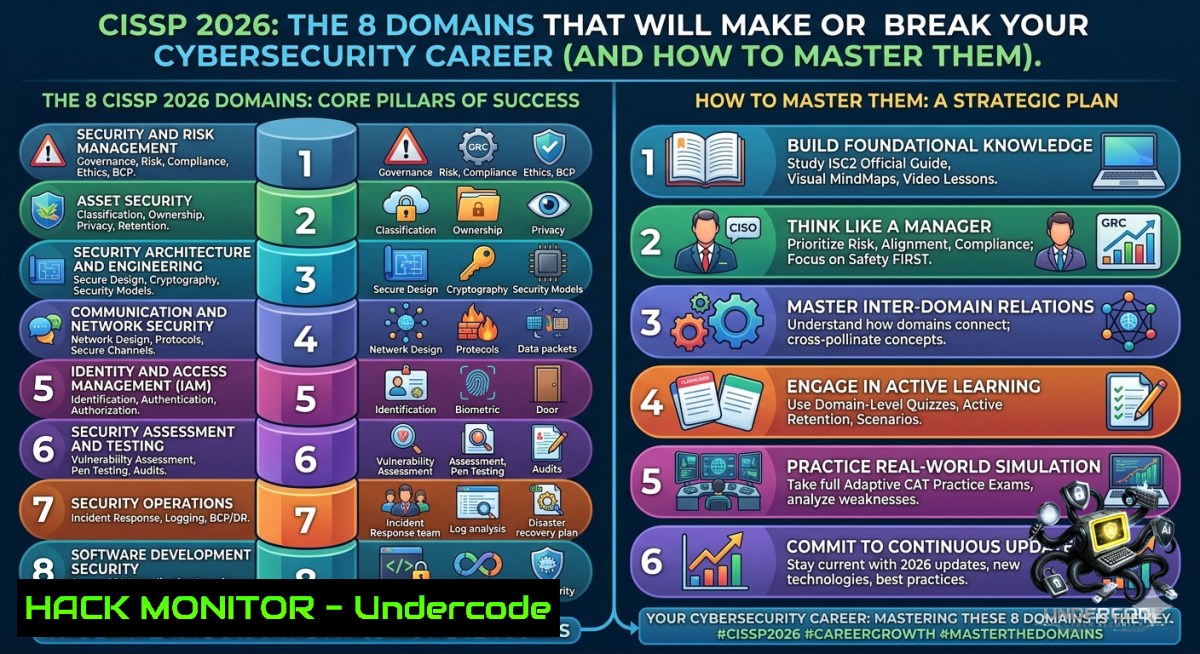
Introduction:
The CISSP certification is often misunderstood as a mere credential, but in reality it codifies a systems-level security mindset that integrates governance, architecture, operations, identity, and software development. As organizations rush to deploy SIEM, EDR, Zero Trust, and AI security controls, the foundational truth remains: without understanding how risk, compliance, and technical controls interconnect, even the most advanced tools fail.
Learning Objectives:
- Understand how the eight CISSP domains form an interconnected security ecosystem rather than isolated topics.
- Apply Linux and Windows commands to audit asset visibility, network segmentation, and identity controls in real environments.
- Implement step-by-step hardening techniques aligned with least privilege, defense in depth, and secure by design principles.
You Should Know:
- Security & Risk Management – From Governance to Grunt Work
This domain forces you to answer: what business risk justifies each control? Before touching a firewall, you must document risk appetite, compliance obligations (GDPR, HIPAA, PCI-DSS), and acceptable risk decisions.
Step‑by‑step guide to map risk to technical controls:
- Step 1: Identify assets and classify data sensitivity using `triage` on Windows (or `ls -la` with extended attributes on Linux). On Linux, use `find / -type f -exec ls -l {} \; 2>/dev/null` to list files with permissions, then manually tag based on data type.
- Step 2: Perform a simple risk assessment with the formula: Risk = Likelihood × Impact. Use command-line tools like `nmap -sV -p- target_ip` to discover exposed services (likelihood) and `curl -I https://target` to check missing security headers (impact).
– Step 3: Create a governance baseline. On Windows: `secedit /export /cfg C:\security\baseline.inf` to export local security policy. On Linux: `auditctl -l` to list active audit rules. - Step 4: Map findings to policies. For every open port, define an exception or mitigation. Document using a simple CSV:
echo "port,service,risk_owner,mitigation" > risk_register.csv.
- Asset Security – You Cannot Secure What You Cannot See
Asset visibility, ownership, and lifecycle management remain the most violated fundamentals. Without an accurate inventory, every control becomes an assumption.
Step‑by‑step asset discovery and classification:
- Linux: Use `lshw -short` for hardware, `df -h` for storage, and `ip addr` for network interfaces. For network discovery: `nmap -sn 192.168.1.0/24` to ping sweep live hosts.
- Windows: `Get-WmiObject -Class Win32_ComputerSystem` for system info, `Get-1etNeighbor` for ARP table, and `Get-SmbOpenFile` to see shared files. Run `Get-MpComputerStatus` to check Defender AV status on each asset.
- Classification: Create a script that tags assets by sensitivity. Example Bash snippet:
if grep -q "PII|SSN|credit" /data/files/; then
echo "High sensitivity: $(hostname)" >> asset_tags.csv
fi
- Lifecycle management: Document decommission dates using `date` commands and cron jobs. On Windows, use
schtasks /create /tn "AssetPurge" /tr "C:\scripts\wipe.bat" /sc monthly.
- Security Architecture – Least Privilege and Defense in Depth in Practice
Principles like least privilege, separation of duties, and fail secure are not theory – they directly stop real-world attacks. Here’s how to implement them on Linux and Windows.
Step‑by‑step least privilege enforcement:
- Linux: Review user privileges with
awk -F: '{print $1}' /etc/passwd. Remove unnecessary sudoers: `sudo visudo` and comment out unused entries. Set file permissions: `chmod 750 sensitive_dir/` andsetfacl -m u:backup_user:r-- secret.conf. - Windows: Use `net user` and `net localgroup administrators` to list privileged accounts. Remove domain users from local admin via GPO or
Remove-LocalGroupMember -Group "Administrators" -Member "Domain\User". Enable Windows Defender Application Control (WDAC) with `Set-RuleOption -FilePath policy.xml -Option 3` to block unsigned scripts. - Defense in depth example: Block lateral movement. On Linux, use `iptables -A INPUT -p tcp –dport 22 -s 10.0.0.0/8 -j ACCEPT` and
iptables -A INPUT -p tcp --dport 22 -j DROP. On Windows, useNew-1etFirewallRule -DisplayName "Restrict RDP" -Direction Inbound -Protocol TCP -LocalPort 3389 -RemoteAddress 192.168.1.0/24 -Action Allow.
- Communication & Network Security – Cloud Didn’t Kill Segmentation
Cloud environments abstract networking but still rely on protocols, segmentation, and trust boundaries. Misconfigured security groups and VPCs are the new flat networks.
Step‑by‑step cloud‑aware network hardening:
- Check for open protocols: `nmap -sV -p 22,3389,445,1433,3306 –script=brute target` to test for weak credentials. On AWS, use AWS CLI: `aws ec2 describe-security-groups –query ‘SecurityGroups[].[GroupName,IpPermissions]’` to list overly permissive rules (0.0.0.0/0).
- On Linux host inside cloud: `ss -tlnp` to list listening ports. Identify unexpected services (e.g., Redis bound to 0.0.0.0). Fix by editing `/etc/redis/redis.conf` and setting
bind 127.0.0.1. - Test lateral movement paths: Use `telnet target_ip 445` to check SMB connectivity. On Windows, use
Test-1etConnection -ComputerName target -Port 445. Mitigate with network policies: Azure NSG or AWS NACL denying inter‑subnet traffic for non‑critical flows. - Validate segmentation: `traceroute` (Linux) or `tracert` (Windows) between segments. Use `ping -c 4` to confirm isolation.
- Identity & Access Management (IAM) – The Modern Perimeter
With traditional perimeters dissolving, identity is the control plane. Implementing IAM correctly involves authentication, authorization, federation, and Privileged Access Management (PAM).
Step‑by‑step IAM hardening:
- Enforce multi-factor authentication (MFA): On Windows Server with AD DS, enable Azure AD MFA or Duo. For Linux SSH, configure `google-authenticator` and edit `/etc/pam.d/sshd` to add
auth required pam_google_authenticator.so. Then set `ChallengeResponseAuthentication yes` in/etc/ssh/sshd_config. - Audit privileged accounts: `Get-ADUser -Filter {AdminCount -eq 1} -Properties MemberOf | Select SamAccountName` on Windows (RSAT tools). On Linux, review `/etc/sudoers` and `/etc/group` for `wheel` or `sudo` membership.
- Implement PAM: For Linux, install `tlog` to session record: `sudo dnf install tlog` and configure
/etc/tlog/tlog-rec-session.conf. For Windows, enable PowerShell transcription via GPO:Computer Config > Admin Templates > Windows PowerShell > Turn on PowerShell Transcription. - Federation hardening: If using SAML, validate signatures with
xmlsec1 --verify saml_response.xml. Disable unused identity providers via `aws iam list-saml-providers` andaws iam delete-saml-provider.
- Security Operations & Software Development Security – Bridging Dev and Ops
The final two domains integrate detection, response, and secure coding. A step‑by‑step incident response workflow and a secure code review example.
Step‑by‑step incident response with Linux/Windows commands:
- Detection: Use `syslog` on Linux:
tail -f /var/log/auth.log | grep "Failed password". On Windows, use `Get-WinEvent -FilterHashtable @{LogName=’Security’; ID=4625}` for failed logins. - Containment: Kill malicious processes – Linux
kill -9 PID, Windowstaskkill /PID 1234 /F. Block IPs: Linuxiptables -A INPUT -s 10.0.0.5 -j DROP, WindowsNew-1etFirewallRule -Direction Inbound -RemoteAddress 10.0.0.5 -Action Block. - Eradication: Remove persistence. Linux: check
crontab -l,systemctl list-timers, and/etc/rc.local. Windows:schtasks /query,reg query HKLM\Software\Microsoft\Windows\CurrentVersion\Run. - Recovery: Restore from clean backups using `rsync -avz /backup/ /restored/` or Windows
wbadmin start recovery. - Software security: Example static analysis – `bandit -r /app/code` (Python) or on Windows, run
Invoke-ScriptAnalyzer -Path .\script.ps1. Fix SQL injection by replacing string concatenation with parameterized queries (e.g., `sqlite3`?placeholders).
What Undercode Say:
- Key Takeaway 1: CISSP is not about memorizing terminology or passing an exam; it forces a holistic view where governance, risk, and technical controls must align. Without this, even perfect IAM or network segmentation fails because the business accepts contradictory risks.
- Key Takeaway 2: The most difficult domain for most professionals is Security & Risk Management because it requires translating technical findings into business language and vice versa. Technical experts often skip governance, but that is exactly where security leaders differentiate themselves.
Analysis: The post correctly emphasizes that CISSP builds systems-level thinking – a skill increasingly rare as specialization deepens. Many certifications teach tool-specific knowledge (e.g., AWS Security, CEH), but CISSP’s eight domains create a mental model for how breaches actually happen: an IAM failure leads to lateral movement, which exploits a network misconfiguration, then a software vulnerability. Understanding those handoffs is what turns a technician into an architect. The commands and steps provided above are not exhaustive but demonstrate how each domain translates into actionable, verifiable configurations. Modern AI security tools still rely on these fundamentals – if your asset inventory is wrong, your AI-powered SOC will alert on phantom risks. Similarly, Zero Trust without proper identity federation is just buzzwords. The post’s lesson stands: master the ecosystem, not the shiny object.
Prediction:
+N CISSP and similar systems‑level certifications will see a resurgence as AI automates low‑level security tasks; the human value shifts to risk integration and architectural decision‑making.
-1 Organizations that skip governance and risk management will continue to suffer breaches despite deploying EDR, Zero Trust, and AI tools – because they never defined acceptable risk.
+N The 2026 CISSP update will likely add dedicated AI governance and supply chain security domains, forcing professionals to extend the eight‑domain mindset to third‑party and algorithmic risks.
+1 Cloud and identity controls will become even more dominant, but the core principles – least privilege, defense in depth, separation of duties – will remain unchanged, validating the CISSP framework.
-1 Without hands-on application of domains (like the commands above), certification alone will not prevent breaches; practical labs and continuous auditing will separate effective security leaders from paper holders.
▶️ Related Video (72% Match):
🎯Let’s Practice For Free:
🎓 Live Courses & Certifications:
Join Undercode Academy for Verified Certifications
🚀 Request a Custom Project:
Secure, high-velocity infrastructure and disruptive technological engineering. Contact our engineering team for high-tier development and proprietary systems:
[email protected]
💎 Smart Architecture | 🛡️ Secure by Design | ⭐ Trusted by Thousands
IT/Security Reporter URL:
Reported By: Yildizokan Cissp – Hackers Feeds
Extra Hub: Undercode MoN
Basic Verification: Pass ✅


