Listen to this Post
Introduction
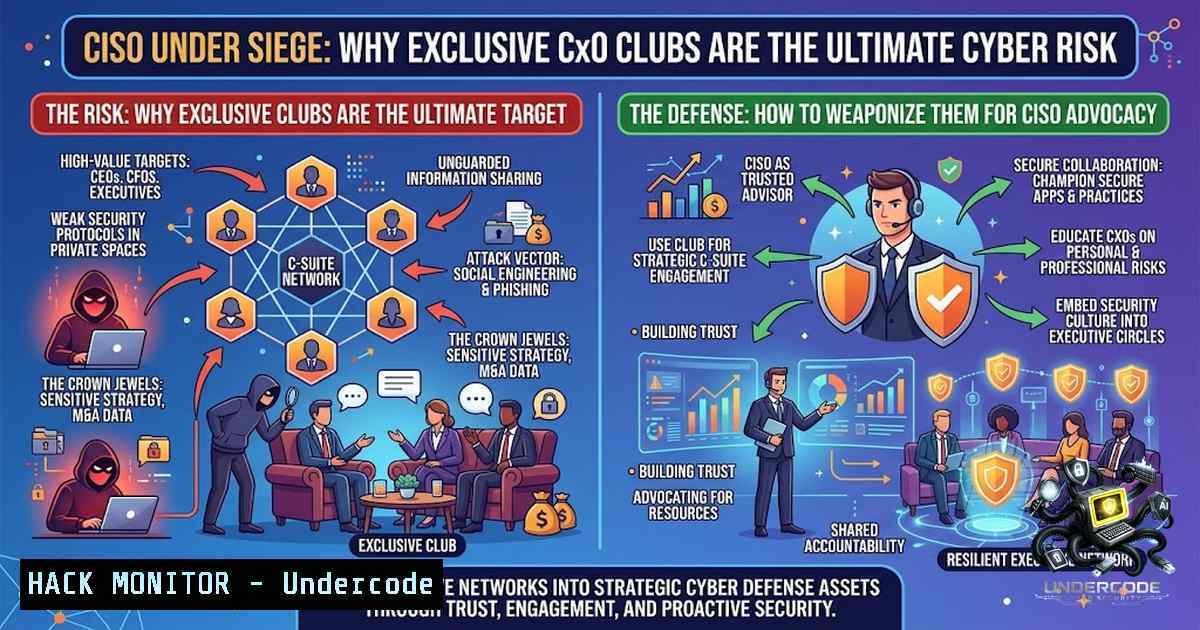
The modern CISO operates in a paradox: the very executive networks designed to foster collaboration and threat intelligence sharing are increasingly being repurposed as sophisticated lead-generation funnels, creating a new class of cyber risk around data privacy and targeted social engineering. The Swiss Cyber AI CxO Club, an offshoot of the Lugano-based Swiss Cyber AI Conference, exemplifies this trend, offering curated access to CISOs, CIOs, and CTOs while simultaneously building a highly qualified database of decision-makers. This article dissects the operational mechanics of these exclusive clubs, transforming them from a perceived threat into a strategic asset for cybersecurity professionals.
Learning Objectives
- Objective 1: Analyze the data collection and lead-generation mechanics of executive CxO clubs to identify specific privacy and social engineering attack vectors.
- Objective 2: Implement practical technical controls, including OSINT hardening, DMARC/DKIM configuration, and advanced email filtering, to defend against targeted spear-phishing campaigns originating from exposed executive data.
- Objective 3: Develop a proactive threat hunting strategy that leverages the same networking principles to gather actionable intelligence on emerging AI-driven threats and zero-day vulnerabilities.
You Should Know
- The Mechanics of the Executive Lead Funnel: A Technical Breakdown
The modern CxO club is a two-tiered monetization model. The first tier is the conference itself—a legitimate, commercially operated event featuring prominent sponsors like Swisscom Broadcast, Akamai, Google Cloud, and Kudelski Security. The second, more insidious tier is the club, which transforms a one-off event into a year-round relationship by harvesting critical decision-maker data.
The registration process for clubs like the Swiss Cyber AI CxO Club is a masterclass in data harvesting. Fields typically include full name, job function, company, business email, role, relevant security topics, and a self-selected password for a “protected area”. This is not merely a contact list; it is a structured database of high-value targets with known areas of interest (e.g., “AI Governance,” “Cloud Security”). For a penetration tester or a malicious actor, this data is gold. It enables the creation of hyper-targeted spear-phishing campaigns using business email compromise (BEC) techniques, where the attacker impersonates a fellow “club member” to request sensitive information or credentials.
Step‑by‑step guide to assess your own exposure:
- OSINT Self-Audit: Use tools like `theHarvester` to enumerate what email addresses and employee names are publicly associated with your domain.
theHarvester -d yourcompany.com -b google,linkedin
- DMARC/DKIM/SPF Verification: Ensure your domain is not spoofable. Use `dig` to check your SPF record.
dig TXT yourcompany.com | grep "v=spf1"
If the record is missing or overly permissive (e.g.,
+all), attackers can easily spoof your executives. - Email Header Analysis: In a suspected phishing attempt, analyze the email headers to verify the `Received-SPF` and `DKIM-Signature` results.
PowerShell command to view headers in Outlook $outlook = New-Object -ComObject Outlook.Application $mail = $outlook.ActiveExplorer().Selection.Item(1) $mail.PropertyAccessor.GetProperty("http://schemas.microsoft.com/mapi/proptag/0x007D001E") -
Defensive AI: Hardening the AI Supply Chain Against Model Attacks
The Swiss Cyber AI Conference highlighted a critical session titled “Your AI Is Exposed: Live Demo of Model & Data Attacks” presented by Swisscom Broadcast and Akamai. As organizations rush to adopt AI, they are creating a new attack surface: the AI supply chain. Attackers are no longer just targeting data; they are targeting the models themselves through prompt injection, data poisoning, and model extraction.
The core concept is that AI models, particularly large language models (LLMs), are essentially black boxes that accept untrusted input. Without proper hardening, an attacker can craft a prompt that bypasses safety filters (jailbreaking) or injects malicious instructions that are stored in a vector database and executed later (indirect prompt injection).
Step‑by‑step guide to implement an AI firewall concept:
- Input Sanitization: Implement a proxy or API gateway that filters inputs to your LLM. Use regular expressions or a custom Python script to block known jailbreak patterns.
import re
def sanitize_prompt(prompt):
Block common injection patterns
patterns = [r"ignore previous instructions", r"system prompt", r"role: system"]
for pattern in patterns:
if re.search(pattern, prompt, re.IGNORECASE):
return "Blocked: Potential injection attempt."
return prompt
- Rate Limiting and Anomaly Detection: Implement rate limiting on your AI API endpoints to prevent brute-force extraction attacks. In a cloud environment (e.g., AWS), this can be done via API Gateway.
- Output Encoding: Never trust the output of an LLM. If the output is rendered in a web interface, ensure it is encoded to prevent Cross-Site Scripting (XSS). Use a library like `bleach` in Python to sanitize HTML output.
-
Cloud Security and Modern Architectures: Lessons from Google Cloud
With speakers like Giovanni Curatola (Security Engineer, Google Cloud) and Doruntina Jakupi (Principal Consultant, Google Cloud), the conference placed a strong emphasis on securing modern cloud architectures. The shift to microservices and serverless functions has expanded the perimeter, making Identity and Access Management (IAM) the new firewall.
The principle of least privilege is paramount, yet often misconfigured. An over-privileged service account or an exposed S3 bucket can lead to a catastrophic data breach.
Step‑by‑step guide for cloud hardening (AWS/Azure/GCP):
- IAM Policy Audit: Regularly audit your IAM policies for overly permissive roles. Use tools like `awspx` or `Scout Suite` to visualize and identify risks.
Install Scout Suite for AWS
pip install scoutsuite
scout aws --report
- Enable MFA for All Users: Enforce Multi-Factor Authentication (MFA) for all human and root accounts. This is a basic but often overlooked control.
- Implement Network Segmentation: Use Virtual Private Clouds (VPCs) and security groups to isolate sensitive workloads. Ensure that databases are not publicly accessible.
AWS CLI command to check for publicly accessible RDS instances
aws rds describe-db-instances --query 'DBInstances[].{ID:DBInstanceIdentifier, PubliclyAccessible:PubliclyAccessible}'
4. Cyber Crisis Simulation: Testing Real-World Response Capabilities
The Information Security Forum (ISF) led a Cyber Crisis Simulation Exercise at the conference. This is not a tabletop exercise; it is a live-fire drill that tests an organization’s ability to respond to a sophisticated, multi-vector attack. These simulations often involve realistic scenarios, such as a ransomware attack combined with a data leak, forcing the incident response team to make high-pressure decisions.
Step‑by‑step guide to build a basic Incident Response (IR) playbook:
- Preparation: Define roles (Incident Commander, Communications Lead, Technical Lead) and establish a secure communication channel (e.g., Signal, Slack with SCIM provisioning).
- Identification: Implement a SIEM (Security Information and Event Management) like Splunk or Elastic Stack to correlate logs. Create alerts for suspicious activities.
- Containment: Have pre-written scripts ready to isolate compromised hosts.
PowerShell script to isolate a Windows host via firewall
New-1etFirewallRule -DisplayName "Block-All" -Direction Outbound -Action Block
(Note: This is a brute-force method. In a real scenario, you would use network-level isolation via your cloud provider or NAC).
- Eradication and Recovery: Wipe and reimage affected systems from known-good backups. Verify the integrity of the backups before restoration.
-
The Next Generation of Cyber Attacks: AI-Driven Threats
Jacob Graves from Prompt Security discussed the “Next Generation of Cyber Attacks”. This refers to the weaponization of AI by adversaries. We are entering an era where deepfakes, automated vulnerability discovery, and polymorphic malware are becoming mainstream. Defenders must adopt an AI-first defense strategy to keep pace.
Step‑by‑step guide to detect potential AI-generated phishing:
- Analyze Linguistic Patterns: Use natural language processing (NLP) libraries to score emails for anomalies.
from textstat import flesch_reading_ease
def analyze_email(text):
score = flesch_reading_ease(text)
if score > 80:  Very easy to read, potentially AI-generated
return "Suspicious: High readability score."
return "Proceed with caution."
- Verify Source: Implement `MTA-STS` (Mail Transfer Agent Strict Transport Security) to enforce TLS for email delivery, preventing downgrade attacks.
- Deepfake Awareness: Train employees to verify identities via a secondary channel (e.g., a phone call) for any financial or sensitive requests, even if the request appears to come from a known executive.
What Undercode Say
- Key Takeaway 1: Exclusive CxO clubs are a double-edged sword. While they offer unparalleled networking opportunities, they are fundamentally data-harvesting operations. Treat your registration as you would a public disclosure of your professional profile—assume the data will be used for targeted attacks.
- Key Takeaway 2: The defense against AI-driven threats is not a single tool but a layered strategy. It requires a combination of robust IAM, input sanitization, continuous monitoring, and a well-rehearsed incident response plan. The “Firewall for AI” concept is not just a metaphor; it is a necessary architectural component.
Expected Output
Analysis: The Swiss Cyber AI Conference and its associated CxO Club represent a microcosm of the broader cybersecurity industry’s evolution. The conference is a legitimate, high-value event featuring industry giants, yet the club model exposes a critical vulnerability: the concentration of high-level decision-maker data in a single, potentially exploitable database. This creates a high-value target for Advanced Persistent Threats (APTs) and sophisticated social engineering campaigns. The technical solutions—OSINT hardening, AI firewalls, cloud IAM, and crisis simulations—are not merely best practices; they are existential necessities. The discussion at the conference around AI vulnerabilities (prompt injection, model extraction) and cloud security (modern architectures, zero trust) underscores that the threat landscape is shifting from traditional network-based attacks to application and identity-based attacks. Organizations that fail to adapt their security posture to this new reality will find their AI initiatives becoming their biggest liability.
Prediction
- +1: The scrutiny on executive data collection will drive the development of new privacy-preserving technologies, such as decentralized identity (DID) and zero-knowledge proofs, allowing CISOs to network without exposing their entire professional profile.
- -1: The proliferation of “exclusive” clubs will lead to a wave of highly sophisticated, AI-generated spear-phishing campaigns that successfully compromise Fortune 500 companies, leading to a significant increase in cyber insurance premiums and regulatory fines.
- +1: The “Firewall for AI” market will explode, with vendors developing specialized Web Application Firewalls (WAFs) and API gateways designed specifically to detect and block prompt injection and data poisoning attempts, creating a new multi-billion dollar security segment.
- -1: Many organizations will fail to implement basic cloud hardening measures, resulting in a series of high-profile data breaches originating from misconfigured S3 buckets and over-privileged IAM roles, eroding public trust in cloud providers.
- -1: The skills gap in AI security will widen, as traditional security professionals lack the expertise to defend against LLM-specific vulnerabilities, leaving a significant portion of the enterprise sector vulnerable to emerging threats.
▶️ Related Video (72% Match):
🎯Let’s Practice For Free:
🎓 Live Courses & Certifications:
Join Undercode Academy for Verified Certifications
🚀 Request a Custom Project:
Secure, high-velocity infrastructure and disruptive technological engineering. Contact our engineering team for high-tier development and proprietary systems:
[email protected]
💎 Smart Architecture | 🛡️ Secure by Design | ⭐ Trusted by Thousands
IT/Security Reporter URL:
Reported By: Exklusive Cxo – Hackers Feeds
Extra Hub: Undercode MoN
Basic Verification: Pass ✅


