Listen to this Post
Introduction:
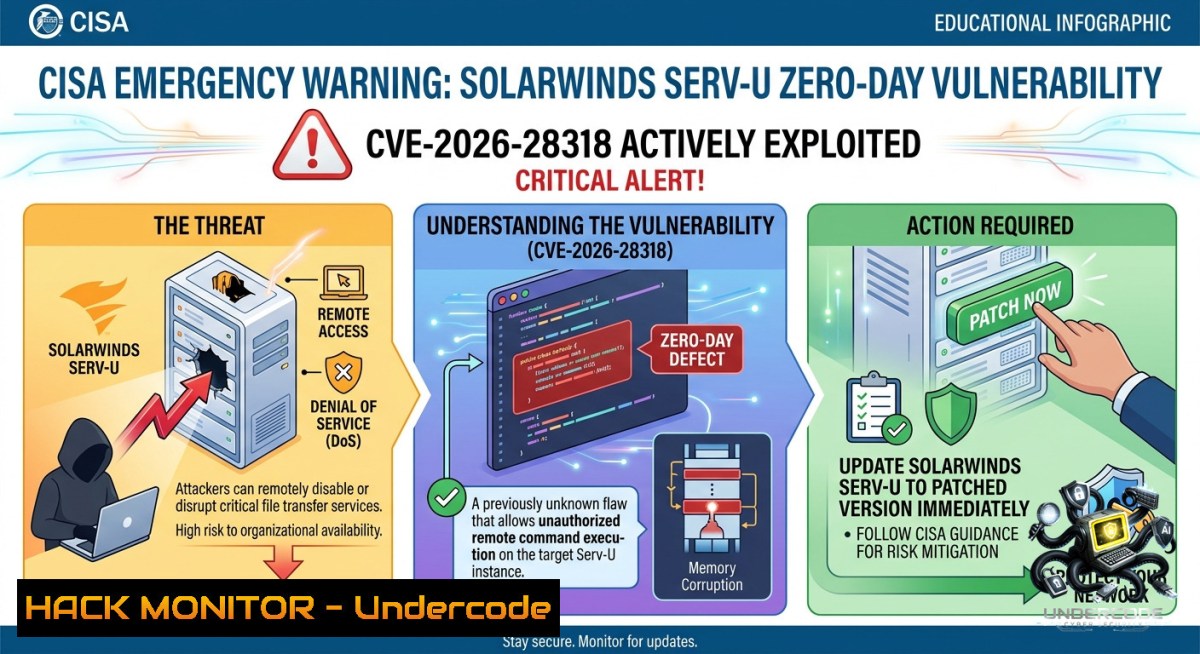
The SolarWinds Serv-U file transfer software, widely used for managed file transfer (MFT) across enterprises, has become the latest victim of active exploitation. CISA recently added CVE-2026-28318, an Uncontrolled Resource Consumption (CWE-400) vulnerability, to its Known Exploited Vulnerabilities (KEV) catalog after confirming that unauthenticated attackers can crash the Serv-U service using specially crafted HTTP requests – turning a critical flaw into an immediate business risk.
Learning Objectives:
– Understand the technical mechanics of CVE-2026-28318 and why uncontrolled resource consumption leads to denial-of-service (DoS) conditions.
– Learn to identify affected SolarWinds Serv-U versions, apply vendor-supplied patches, and implement temporary workarounds.
– Develop hands-on detection and hardening techniques using Linux/Windows commands, WAF rules, and AI-driven log monitoring.
You Should Know
1. Understanding CVE-2026-28318: Uncontrolled Resource Consumption in Serv-U
This vulnerability exists in the HTTP request parsing logic of SolarWinds Serv-U. By sending a sequence of malformed or excessively large HTTP headers, cookies, or multipart boundaries, an unauthenticated attacker can force the service to allocate memory, CPU cycles, or file handles without proper limits. Eventually, the service becomes unresponsive or crashes entirely. This is not a buffer overflow but a resource exhaustion flaw.
Step‑by‑step guide to verify if your Serv-U instance is vulnerable:
On Linux (Serv-U typically runs on Windows, but Linux versions exist for gateways):
 Check Serv-U service status
systemctl status serv-u

 Look for sudden restarts or excessive memory usage
ps aux | grep -i serv-u
journalctl -u serv-u --since "1 hour ago" | grep -i "out of memory\|crash\|error"

 Simulate a controlled test (do NOT run against production without authorization)
 Use curl to send a large cookie header
curl -X GET http://<Serv-U-IP>:8080/ -H "Cookie: $(python3 -c 'print("A"50000)')"
On Windows (primary Serv-U platform):
 Check Serv-U service status
Get-Service -1ame "Serv-U" | Select-Object Status, StartType

 Review Windows Event Logs for service crashes
Get-WinEvent -LogName System | Where-Object { $_.Message -match "Serv-U" -and $_.LevelDisplayName -eq "Error" } | Select-Object TimeCreated, Message -First 20

 Monitor process memory using PowerShell
Get-Process -1ame "Serv-U" | Select-Object Name, CPU, WorkingSet64, PeakWorkingSet64
Mitigation: Immediately apply the patch from SolarWinds (refer to vendor advisory via the CISA link: https://lnkd.in/gYYdRiS7). If patching is delayed, implement a WAF rule to limit HTTP request header size to 8KB and reject requests with more than 100 headers.
2. Detecting Active Exploitation via Log Analysis
Attackers exploiting CVE-2026-28318 often leave traces of abnormally large or malformed HTTP requests. Serv-U’s access and error logs become your primary hunting ground.
Step‑by‑step log inspection (Windows default path: `C:\Program Files\SolarWinds\Serv-U\Logs\`):
 Search for unusually long request lines
Select-String -Path "C:\Program Files\SolarWinds\Serv-U\Logs\.log" -Pattern "HTTP/1.1\" (GET|POST) .{1000,}"

 Find repeated requests from same source IP within short time
Get-Content serv-u.log | Select-String -Pattern "\d+\.\d+\.\d+\.\d+" | Group-Object | Where-Object { $_.Count -gt 50 }

 Look for HTTP 503 or connection reset errors
Get-Content serv-u.log | Select-String -Pattern "503 Service Unavailable|connection reset"
Linux-based SIEM query (example using grep):
 Extract suspicious large user-agent strings
grep -E "User-Agent: .{500,}" /var/log/serv-u/access.log
If you observe thousands of requests from a single IP with large payload sizes, assume compromise and apply network ACLs to block the source while patching.
3. Hardening Serv-U with Rate Limiting and Resource Controls
Since the flaw is resource exhaustion, proactive limits can reduce the blast radius.
Step‑by‑step hardening using built‑in Serv‑U options and external controls:
1. Within Serv-U Administration interface:
– Navigate to Server Settings → Advanced → Connection Limits.
– Set “Maximum simultaneous requests per IP” to 10.
– Enable “Request queue timeout” to 30 seconds.
2. Using Windows Firewall & IPSec (for Windows-based Serv-U):
 Rate limit new connections using New-1etFirewallRule with dynamic keyword (requires Windows Server 2016+)
New-1etFirewallRule -DisplayName "Serv-U Rate Limit" -Direction Inbound -Protocol TCP -LocalPort 21,80,443 -Action Block -RemoteAddress <IP_range> -Description "Temp block during CVE-2026-28318 investigation"
3. Deploy a reverse proxy (Nginx) in front of Serv‑U:
 /etc/nginx/sites-available/serv-u-proxy
limit_req_zone $binary_remote_addr zone=servu_limit:10m rate=5r/s;
server {
listen 443 ssl;
location / {
limit_req zone=servu_limit burst=10 nodelay;
proxy_pass http://<serv-u-internal-ip>:8080;
proxy_set_header Host $host;
client_max_body_size 10m;
proxy_buffering off;
}
}
This absorbs malformed requests before they hit the vulnerable Serv‑U process.
4. AI-Driven Anomaly Detection for Resource Exhaustion Attacks
Steve Christopher’s “AI + Cybersecurity Builder” insight suggests integrating machine learning to detect abnormal resource consumption patterns.
Step‑by‑step implementation using open‑source tools (Wazuh + custom ML):
1. Collect metrics: Export CPU, memory, and connection counters via Windows Performance Monitor or Linux `collectd`.
2. Train a baseline model: Use Python’s `scikit-learn` on 7 days of normal traffic.
 Example isolation forest for anomaly detection
from sklearn.ensemble import IsolationForest
import pandas as pd
df = pd.read_csv('serv-u-metrics.csv')  columns: cpu_pct, mem_mb, conn_count, req_size_avg
model = IsolationForest(contamination=0.01)
model.fit(df)
anomalies = model.predict(new_data)
3. Integrate with SIEM: Ship anomalies to Wazuh or Splunk as alerts labelled “CVE-2026-28318 potential exploitation.”
For real‑time detection, use ElastAlert rule:
name: Serv-U Memory Spike
type: spike
index: serv-u-metrics-
threshold_cur: 2.5
timeframe: minutes:5
filter:
- term: metric_name: "memory_usage"
alert:
- "slack"
5. Incident Response Steps When Exploitation is Confirmed
If you detect active crashes or unauthenticated resource exhaustion:
Immediate containment (Windows):
 Block all external access to Serv-U ports (except management network)
New-1etFirewallRule -DisplayName "EMERGENCY Block Serv-U" -Direction Inbound -Protocol TCP -LocalPort 8080,21 -Action Block

 Capture memory dump for forensic analysis
taskkill /F /IM Serv-U.exe
 Use ProcDump from Sysinternals
procdump -ma Serv-U.exe C:\forensics\
Apply vendor patch (if available) or manual workaround:
– Edit `Serv-U-config.xml` and add `
– Restart service: `Restart-Service “Serv-U”`
Post‑exploitation scanning:
 Linux: Check for backdoor files modified in the last 24h
find /opt/serv-u -type f -mtime -1 -ls
6. Validation and Patching Checklist
Use this verified checklist to confirm mitigation:
– [ ] Patch version: Run `Serv-U.exe –version` (should be ≥ 15.4.2.10 – check vendor advisory).
– [ ] No abnormal resource spikes: Monitor for 2 hours post-patch using:
watch -1 5 'ps aux | grep serv-u | awk "{print \$2, \$4, \$6}"'
– [ ] Test with safe exploit simulation (isolated environment only): Use Metasploit’s auxiliary module (once released) or custom Python script sending oversized cookies – verify service remains responsive.
7. Long-Term Cloud Hardening & API Security Lessons
This vulnerability highlights that file transfer APIs are prime targets. Extend hardening to cloud‑native deployments:
– AWS WAF rule to block requests exceeding 8KB header size:
{
"Name": "BlockLargeHeaders",
"Priority": 10,
"Statement": {
"SizeConstraintStatement": {
"FieldToMatch": { "AllQueryArguments": {} },
"ComparisonOperator": "GT",
"Size": 8192
}
},
"Action": { "Block": {} }
}
– Azure Front Door rate limiting: Set `rateLimitDurationInMinutes: 1`, `rateLimitThreshold: 100`.
– Kubernetes ingress (NGINX) annotation for Serv‑U pod:
annotations:
nginx.ingress.kubernetes.io/limit-rps: "10"
nginx.ingress.kubernetes.io/proxy-body-size: "10m"
nginx.ingress.kubernetes.io/configuration-snippet: |
client_header_buffer_size 1k;
large_client_header_buffers 2 1k;
What Undercode Say:
– Key Takeaway 1: CVSS scores are irrelevant once active exploitation begins – CISA’s KEV inclusion is the real alarm bell. Organizations must prioritize patching Serv-U instances within 48 hours or implement aggressive rate limiting and WAF controls as temporary shields.
– Key Takeaway 2: The shift from complex RCE to simple resource exhaustion flaws like CWE-400 is a wake‑up call: DoS attacks now require zero authentication and can cripple file transfer operations, which are often business‑critical for healthcare, finance, and logistics.
Analysis (10 lines):
This vulnerability underscores a growing trend where attackers choose reliability over sophistication. Why attempt a memory corruption exploit when a few malformed HTTP packets can take down a production MFT server? The SolarWinds brand carries historical baggage from the 2020 Sunburst attack, so any new active exploitation immediately triggers compliance and insurance scrutiny. Steve Christopher is correct – business risk materializes the moment a CVE appears in CISA’s KEV catalog. GuardianStack’s observation that “attackers care about what they can exploit today” rings true: CVE-2026-28318 is trivial to weaponize using off‑the‑shelf HTTP stress tools. Security teams must move beyond vulnerability scanning and implement real‑time resource monitoring, AI anomaly detection, and automated rate limiting. Training courses on API security and DoS mitigation should now include “uncontrolled resource consumption” as a first‑class module alongside SQLi and XSS. The absence of authentication makes this flaw particularly dangerous for internet‑facing Serv‑U instances – many organizations mistakenly assume MFT software is only internal. Finally, the ease of log‑based detection (large HTTP headers) means defenders have an advantage if they proactively hunt for these patterns.
Prediction:
– -1 The exploitation of CVE-2026-28318 will likely be incorporated into automated botnets within the next 30 days, leading to widespread disruption of managed file transfer services across SMEs that delay patching beyond CISA’s recommended 2‑week deadline.
– +1 However, this incident will accelerate adoption of AI‑driven anomaly detection (e.g., behavioral analysis of HTTP request sizes) and push vendors like SolarWinds to implement hard resource quotas by default, raising the bar for future resource exhaustion flaws.
– -1 Expect threat actors to pivot this technique to other MFT software (e.g., Ipswitch, GoAnywhere) using similar CWE-400 patterns, resulting in a wave of unauthenticated DoS attacks throughout Q3 2026.
▶️ Related Video (78% Match):
🎯Let’s Practice For Free:
🎓 Live Courses & Certifications:
[Join Undercode Academy for Verified Certifications](https://undercode.co.uk/certifications/)
🚀 Request a Custom Project:
Secure, high-velocity infrastructure and disruptive technological engineering. Contact our engineering team for high-tier development and proprietary systems:
[[email protected]](mailto:[email protected])
💎 Smart Architecture | 🛡️ Secure by Design | ⭐ Trusted by Thousands
IT/Security Reporter URL:
Reported By: [Cybersecuirtynews Share](https://www.linkedin.com/posts/cybersecuirtynews-share-7468926481159647232-uL2L/) – Hackers Feeds
Extra Hub: Undercode MoN
Basic Verification: Pass ✅
🔐JOIN OUR CYBER WORLD [ CVE News • HackMonitor • UndercodeNews ]
[💬 Whatsapp](https://undercode.help/whatsapp) | [💬 Telegram](https://t.me/UndercodeCommunity)
📢 Follow UndercodeTesting & Stay Tuned:
[𝕏 formerly Twitter 🐦](https://x.com/undercodeupdate) | [@ Threads](https://www.threads.net/@undercodetesting) | [🔗 Linkedin](https://www.linkedin.com/company/undercodetesting/) | [🦋BlueSky](https://bsky.app/profile/undercode.bsky.social)


