Listen to this Post
Introduction:
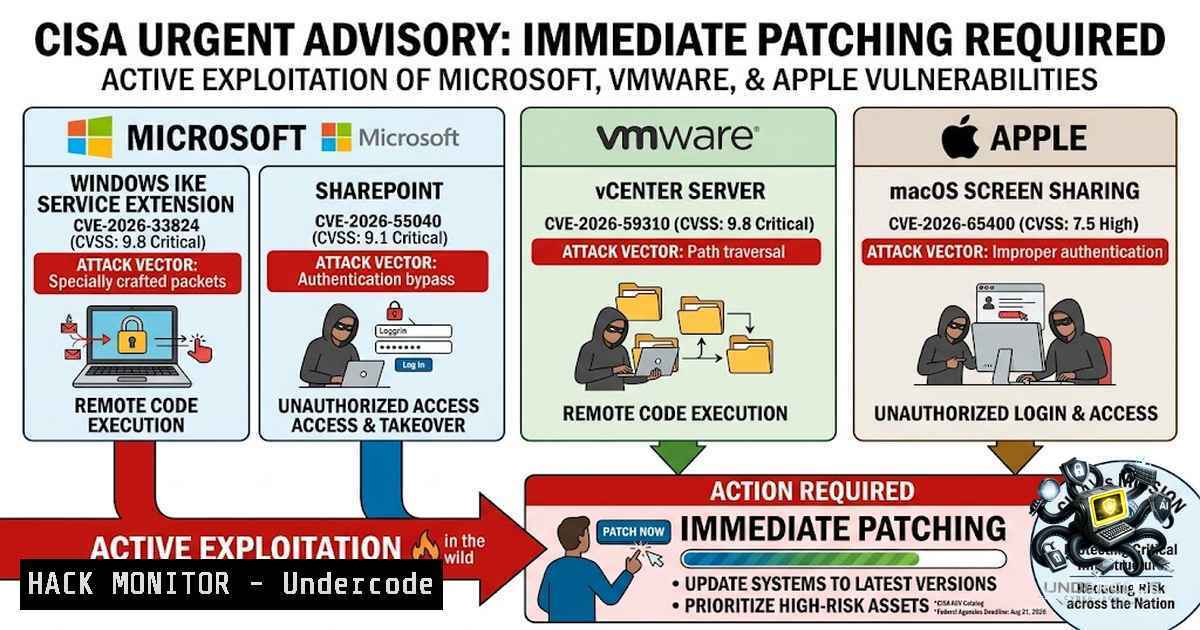
The U.S. Cybersecurity and Infrastructure Security Agency (CISA) has issued an urgent directive to federal agencies and all organizations to patch four critical vulnerabilities affecting Microsoft Windows, Microsoft SharePoint, VMware vCenter, and Apple macOS. These flaws—tracked as CVE-2026-33824 (CVSS 9.8), CVE-2026-55040 (CVSS 9.1), CVE-2026-59310 (CVSS 9.8), and CVE-2026-65400 (CVSS 7.5)—are under active exploitation in the wild, with threat actors leveraging them for remote code execution, authentication bypass, and even cryptocurrency mining. The addition of these vulnerabilities to CISA’s Known Exploited Vulnerabilities (KEV) catalog triggers a mandatory three-day patching deadline for Federal Civilian Executive Branch (FCEB) agencies under Binding Operational Directive (BOD) 26-04.
Learning Objectives & Secrets:
- Objective 1: Understand the Attack Vectors – Learn how each vulnerability is exploited, from crafted IKE packets targeting Windows VPN endpoints to JWT token forgery in SharePoint, directory traversal in VMware vCenter, and authentication bypass in macOS Screen Sharing.
-
Objective 2 Secret Tip: Prioritize Based on Exposure – Not all systems are equal. Focus patching efforts on internet-facing systems first. For CVE-2026-33824, block UDP ports 500 and 4500 if IKE is not in use. For CVE-2026-65400, disable Screen Sharing entirely unless absolutely required.
-
Objective 3 Secret Tip: Assume Breach for Unpatched Systems – If a system was unpatched before August 21, 2026, treat it as potentially compromised. Conduct forensic triage even after applying patches, as attackers may have established persistence.
You Should Know:
- CVE-2026-33824: Windows IKE Service Extensions Double Free (CVSS 9.8)
This critical remote code execution vulnerability resides in the Windows Internet Key Exchange (IKE) Service Extensions component, a set of capabilities added to the IKE Protocol for authentication via cryptographically generated addresses (CGAs) and denial-of-service protection. The flaw is a double-free memory management error (CWE-415) that allows an unauthenticated, remote attacker to execute arbitrary code by sending specially crafted packets to a Windows machine with IKE version 2 enabled through UDP ports 500 or 4500.
Patched by Microsoft in April 2026, this vulnerability impacts all supported Windows 10, Windows 11, and Windows Server releases. At the end of July, Palo Alto Networks flagged the weakness as being exploited by a Chinese-speaking threat actor in an AI-enabled autonomous hacking campaign that also involved manual exploitation.
Step‑by‑Step Guide – Mitigating CVE-2026-33824:
- Apply the Patch Immediately: Run Windows Update to apply the critical April/May 2026 cumulative updates.
- Block Inbound Traffic (Temporary Workaround): If patching is not immediately possible, configure firewall rules to block inbound traffic through UDP ports 500 and 4500 on systems that do not use IKE.
- Restrict IKE Peer Addresses: When IKE is required, configure firewall rules to allow inbound traffic only from known peer addresses.
- Verify Patch Status: Use the following PowerShell command to check if the security update is installed:
Get-HotFix | Where-Object { $_.HotFixID -like "KB" } | Select-Object HotFixID, InstalledOn - Monitor for Suspicious Activity: Review Windows Event Logs for unexpected IKEEXT service crashes or anomalous network traffic on UDP ports 500 and 4500.
-
CVE-2026-55040: Microsoft SharePoint Weak Authentication Bypass (CVSS 9.1)
This authentication bypass vulnerability in Microsoft SharePoint Enterprise Server 2016 and SharePoint Server 2019 allows unauthenticated attackers to impersonate any SharePoint site user or administrator. The flaw stems from “several issues” in the JWT token validation pipeline, specifically within the `SPJsonWebSecurityTokenHandlerV2` and `SPJsonWebSecurityBaseTokenHandlerV2` classes.
The exploitation chain works as follows: an attacker sends a JWT with `”alg: none”` in the outer header (no signature required), uses SharePoint’s own STS certificate thumbprint in the `x5t` header to resolve a signing key with no verification, and the resolved certificate is not in TrustedSecurityTokenServices, allowing the issuer to be accepted. Security firm Rapid7 released a Python-based proof-of-concept (PoC) on August 6, 2026, and threat actors began exploiting it within days. Telemetry data shows 12 exploitation attempts from eight unique IP addresses across Hong Kong, Japan, the Netherlands, Taiwan, and the U.S.
Step‑by‑Step Guide – Mitigating CVE-2026-55040:
- Apply Microsoft’s July 2026 Patch Tuesday Updates: This is the primary and most effective mitigation.
- Avoid Direct Internet Exposure: Do not expose SharePoint servers directly to the Internet unless necessary.
- Implement Reverse Proxy: If Internet exposure is required, place SharePoint servers behind a Layer 7 reverse proxy or similar application-layer security control.
- Restrict Communications: Block external access to SharePoint Central Administration and restrict farm and database communication to required systems only.
- Review Microsoft’s Hardening Guidance: Follow Microsoft’s official SharePoint Server security-hardening guidance.
- Monitor for JWT Anomalies: Audit SharePoint logs for unusual JWT tokens or authentication attempts from untrusted IPs.
3. CVE-2026-59310: VMware vCenter Path Traversal (CVSS 9.8)
This maximum-severity directory-traversal vulnerability (CWE-22) resides in the VMware vCenter Syslog server component and allows a malicious actor with network access to vCenter to execute arbitrary code. Patched by Broadcom on July 29, 2026, the flaw was exploited starting August 3 to drop an open-source SSH reverse shell framework.
A suspected China-1exus advanced persistent threat (APT) group has been attributed to the exploitation campaign, compromising 361 unique victim IP addresses across 47 countries, with most infections in Germany (55), the U.S. (41), Turkey (38), Iran (26), and France (25). The exploitation involves the cron daemon logging a malformed cron file called zz-poc59310-syslog.log, followed by a curl or wget command retrieving a backdoor from a remote server.
Step‑by‑Step Guide – Mitigating CVE-2026-59310:
- Apply VMware’s Security Patch: Update vCenter Server to the version released on July 29, 2026.
- Check for Indicators of Compromise: Look for the presence of `zz-poc59310-syslog.log` in `/etc/cron.d/` on vCenter Server Appliance.
- Review Outbound Connections: Investigate any outbound connections from vCenter to suspicious IPs (e.g.,
5.34.177.38:9861). - Audit Administrative Accounts: Check for unauthorized administrative accounts created on vCenter.
- Monitor REST API Activity: Review vSphere REST API access logs for unusual User-Agent strings like
"GoodMoodle-VCFleet/1.0". - Run the Following Verification Command on the vCenter Appliance:
ls -la /etc/cron.d/ | grep -i "poc|59310"
-
CVE-2026-65400: macOS Screen Sharing Authentication Bypass (CVSS 7.5 / Critical 9.8)
This improper authentication vulnerability affects macOS Screen Sharing, Apple’s built-in remote desktop feature that listens on TCP port 5900. The flaw allows a remote attacker on the network to authenticate to Screen Sharing without valid credentials. Apple patched the issue on August 6, 2026, in macOS Tahoe 26.6.1, macOS Sequoia 15.7.9, and macOS Sonoma 14.8.9 by improving state management.
The vulnerability involves macOS’s implementation of Secure Remote Password authentication inside the screensharing service—an error in frame-length validation causes the service to return an outdated success status, treating an unauthenticated connection as legitimate. Once connected, attackers can abuse Screen Sharing’s privileged file-handling components to read or create files with root-level permissions and install Monero cryptocurrency miners. Exploitation does not require a valid macOS account, a VNC password, or any action from the victim. In-the-wild exploitation was observed less than a week after Apple’s patch.
Step‑by‑Step Guide – Mitigating CVE-2026-65400:
- Update macOS Immediately: Install macOS Tahoe 26.6.1, macOS Sequoia 15.7.9, or macOS Sonoma 14.8.9 (released August 6, 2026).
- Disable Screen Sharing When Not in Use: Navigate to System Settings > General > Sharing and uncheck “Screen Sharing.”
- Check if Screen Sharing is Enabled: Run the following command in Terminal:
sudo systemsetup -getremotelogin
Or check the listening port:
sudo lsof -i :5900
4. Block Port 5900 at the Firewall: If Screen Sharing cannot be disabled, restrict access to TCP port 5900 to trusted IPs only.
5. Assume Breach for Unpatched Systems: If a Mac was running an unpatched version of macOS before August 6 and had Screen Sharing enabled, treat it as fully compromised—even after updating.
6. Check for Unauthorized Processes: Monitor for unexpected processes, particularly Monero miners:
ps aux | grep -i "xmrig|miner"
What Undercode Say:
- Key Takeaway 1: The AI-Enabled Threat Landscape is Here – The exploitation of CVE-2026-33824 by a Chinese-speaking threat actor in an AI-enabled autonomous hacking campaign marks a significant escalation. Palo Alto Networks demonstrated that AI agents can autonomously execute full attack chains, and attackers are now weaponizing these capabilities in real-world operations. Organizations must prepare for AI-driven attacks that operate at machine speed.
-
Key Takeaway 2: PoC-to-Exploit Timelines Are Shrinking – The SharePoint vulnerability (CVE-2026-55040) went from PoC release to active exploitation in less than 48 hours. The VMware vCenter flaw (CVE-2026-59310) was exploited just five days after public disclosure. This compressed timeline means organizations can no longer rely on the traditional “patch within 30 days” approach—zero-day and n-day exploitation is now the norm.
-
Key Takeaway 3: Cross-Platform Exposure Demands Unified Defense – This CISA advisory spans Windows, VMware, and Apple ecosystems, reminding us that modern enterprise environments are heterogeneous. A vulnerability in any layer—from the hypervisor (vCenter) to the operating system (Windows IKE, macOS Screen Sharing) to the application tier (SharePoint)—can serve as an entry point. Security teams must adopt a holistic vulnerability management strategy that covers all platforms.
-
Key Takeaway 4: CISA’s KEV Catalog is Now a Compliance Mandate – With BOD 26-04, the KEV Catalog has transitioned from a recommended reference to a binding requirement for federal agencies, with a strict three-day remediation window. Private sector organizations should adopt the same urgency—attackers are actively scanning for and exploiting these vulnerabilities, and the window for safe patching is measured in days, not weeks.
-
Key Takeaway 5: Patching is Not Enough—Assume Compromise – CISA explicitly requires agencies to check whether threat actors compromised systems before the patch was applied. For the macOS Screen Sharing flaw, attackers were observed gaining root access and deploying Monero miners within days of the patch. Organizations must combine rapid patching with thorough forensic investigation to identify and remediate prior breaches.
Prediction:
-
+1 The accelerated adoption of AI in both offensive and defensive cybersecurity will drive innovation in autonomous patching and automated threat response, with vendors racing to integrate AI into their security operations centers (SOCs) to match the speed of AI-driven attacks.
-
-1 The shrinking PoC-to-exploit timeline—now measured in hours rather than weeks—will overwhelm organizations with limited security resources, leading to a widening gap between well-resourced enterprises and smaller organizations that cannot keep pace with the patching cadence.
-
-1 The exploitation of infrastructure-level vulnerabilities (IKE, vCenter) by state-sponsored APT groups suggests that critical infrastructure and enterprise backbone systems will remain prime targets, with potential for widespread disruption if these flaws are weaponized in ransomware or destructive attacks.
-
+1 CISA’s aggressive KEV catalog updates and BOD 26-04 mandates will push vulnerability management to the forefront of organizational risk management, driving improved security hygiene across both public and private sectors.
-
-1 The cross-platform nature of these attacks—spanning Windows, VMware, and Apple—means that organizations with heterogeneous environments face compounding risk. A single unpatched system in any layer can serve as a beachhead for lateral movement, and the complexity of managing patches across multiple vendors will continue to be a significant operational challenge.
▶️ Related Video (80% Match):
https://www.youtube.com/watch?v=4BJ6JONIGzU
🎯Let’s Practice For Free:
🎓 Live Courses & Certifications:
Join Undercode Academy for Verified Certifications
🚀 Request a Custom Project:
Secure, high-velocity infrastructure and disruptive technological engineering. Contact our engineering team for high-tier development and proprietary systems:
[email protected]
💎 Smart Architecture | 🛡️ Secure by Design | ⭐ Trusted by Thousands
IT/Security Reporter URL:
Reported By: https://lnkd.in/p/e7tGGc2E – Hackers Feeds
Extra Hub: Undercode MoN
Basic Verification: Pass ✅


