Listen to this Post
Introduction:
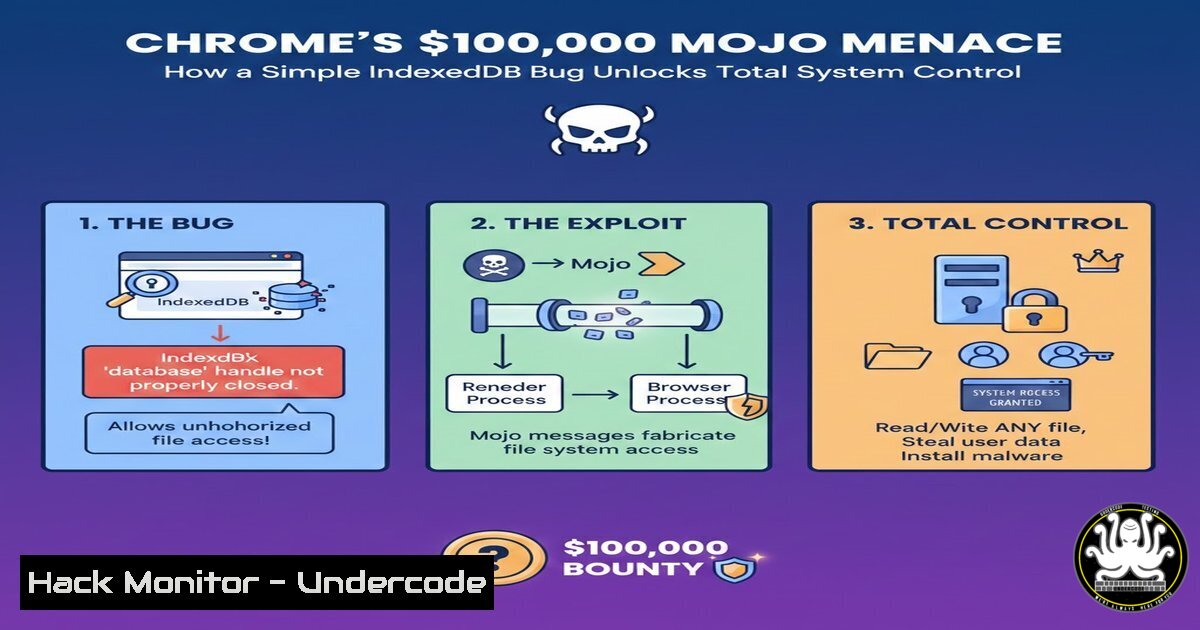
A critical vulnerability, designated CVE-2025-11460, exposes a fundamental weakness in the security architecture of Google Chrome. This use-after-free flaw within the Mojo Inter-Process Communication (IPC) framework allows attackers to achieve remote code execution, potentially compromising billions of users. The disclosed proof-of-concept underscores the sophisticated techniques, like heap spraying, required to weaponize such logic errors into full-system exploits.
Learning Objectives:
- Understand the architecture of Chrome’s Mojo IPC and IndexedDB service and how their interaction introduced a use-after-free condition.
- Analyze the step-by-step mechanics of a heap spray exploit that turns a dangling pointer into reliable Remote Code Execution (RCE).
- Identify defensive configurations and best practices to mitigate risks from similar memory corruption vulnerabilities in browser and system services.
You Should Know:
- Deconstructing the Attack Chain: Mojo, IndexedDB, and the Dangling Pointer
The exploit targets a specific failure logic in Chrome’s privileged backend services. IndexedDB, a web API for client-side storage, is implemented as a privileged service separate from the web page’s renderer process. Communication between the renderer and this service happens via the Mojo IPC framework. The bug, a logic issue in the async destruction of an IndexedDB database, created a scenario where a pointer to a database connection object was freed by the system but remained referenced (“dangling”). An attacker could then manipulate the sequence of Mojo messages to re-access this freed memory before it was reallocated, leading to memory corruption. -
From Corruption to Control: The Heap Spray Technique
A dangling pointer alone is not an exploit; it is a primitive. The proof-of-concept uses a heap spray to gain control. After triggering the use-after-free, the attacker floods the process’s heap memory with a controlled payload, often shellcode or a “spray” of specific pointers. The goal is to have the operating system’s memory manager place this attacker-controlled data at the memory address previously occupied by the freed IndexedDB connection object. When the compromised code path later dereferences the dangling pointer, it does not crash but instead executes instructions or reads data chosen by the attacker, transforming a crash into reliable code execution.
3. The Escalation Challenge: Renderer vs. Browser Process
A critical nuance is that the initial exploit often runs in Chrome’s sandboxed renderer process, which has limited permissions. The attached PoC demonstrates RCE “in an unsandboxed process.” In a real-world attack, achieving this often requires a second stage: a sandbox escape. The attacker would use the renderer RCE as a foothold to exploit another vulnerability in the Mojo interfaces or the Chrome kernel that allows breaching the sandbox and executing code in the higher-privilege browser process, ultimately gaining full system access. This multi-stage nature is why comprehensive browser exploit training covers the full stack from renderer bugs to kernel-level escapes.
- Investigation and Mitigation: System Commands and Security Flags
System administrators and security researchers can investigate suspicious memory patterns and harden environments. On Linux, tools like `gdb` can attach to a Chrome process (use the `–renderer-client-id` to find the right PID) to examine memory regions. The `pmap` command can show memory mappings:pmap -x <PID> | head -30. On Windows, PowerShell can help audit processes:Get-Process chrome -IncludeUserName | Format-Table Id, ProcessName, UserName. More critically, Chrome can be launched with security flags to mitigate exploitation, such as `–disable-features=MojoIpcd` (for testing, may break functionality) or `–js-flags=”–randomize-heap-spray”` if available. Enabling Strict Site Isolation (--site-per-process) is a paramount defense-in-depth measure that confines renderer processes. -
Proactive Defense: The Role of Advanced Exploit Training
Understanding these advanced attack patterns is the first step toward building robust defenses. Specialized training, such as the Browser Exploit Design program referenced in the source material, systematically covers over 80% of modern browser exploitation, including Mojo IPC flaws, DOM use-after-frees, and sandbox escapes. This knowledge is invaluable for vulnerability researchers, malware analysts, and security engineers tasked with designing and reviewing the security of complex applications. By studying real exploit chains, professionals can better anticipate attacker behavior, implement more effective security controls, and develop superior detection signatures.
What Undercode Say:
- The Price of a Bug: The $100,000 bounty attached to CVE-2025-11460 is a clear market signal. It reflects the extreme value—to both defenders and attackers—of vulnerabilities that chain memory corruption in high-privilege services with reliable exploitation techniques like heap spraying. This isn’t just a bug; it’s a key that can unlock a vast number of endpoints.
- The Training Imperative: The direct linkage of this critical vulnerability disclosure to an advanced exploitation training course is highly significant. It demonstrates that the cutting edge of offensive security research is being systematically codified and taught. For defensive teams, this means the attacker’s playbook is formalized and proliferating, making proactive, deep technical education not just an advantage but a necessity for effective cyber defense.
Prediction:
The disclosure of CVE-2025-11460 foreshadows a continued arms race in the realm of process isolation and IPC security. As main browser vendors harden renderer sandboxes, attackers will increasingly pivot towards privileged services and the IPC channels that connect them—Mojo in Chrome, Broker Services in Windows, XPC on macOS. Future high-impact vulnerabilities will likely target the complex, high-performance communication layers in browsers, cloud workloads, and IoT devices. We will see a rise in AI-assisted fuzzing discovering more subtle logic bugs in async operations (like the destruction sequence here) that are harder to spot than traditional memory errors. Consequently, mitigation strategies will evolve beyond sandboxing to include formal verification of critical IPC protocols, widespread adoption of memory-safe languages for system services, and hardware-assisted security features like Intel CET becoming a default requirement to disrupt exploit reliability.
▶️ Related Video (82% Match):
🎯Let’s Practice For Free:
IT/Security Reporter URL:
Reported By: Zero Day – Hackers Feeds
Extra Hub: Undercode MoN
Basic Verification: Pass ✅


