Listen to this Post
Introduction:
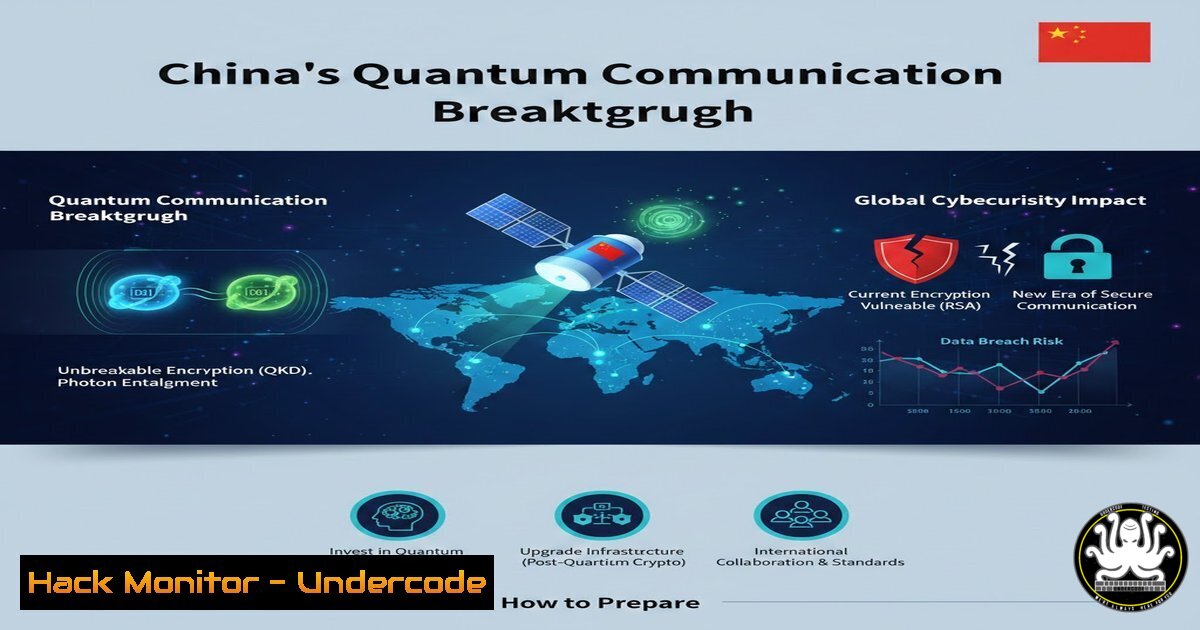
China has achieved a significant milestone in quantum communication, successfully transmitting quantum keys over a 3,000 km distance between satellites and ground stations. This breakthrough in Quantum Key Distribution technology represents a paradigm shift in secure communications, potentially rendering current encryption methods obsolete against quantum-powered attacks. As nations race for quantum supremacy, understanding this technology’s implications becomes critical for cybersecurity professionals worldwide.
Learning Objectives:
- Understand the fundamental principles of Quantum Key Distribution and quantum communication
- Learn practical steps to prepare systems for post-quantum cryptography
- Develop strategies for quantum-resistant security implementations
You Should Know:
1. Quantum Key Distribution Fundamentals
Quantum Key Distribution operates on quantum mechanical principles rather than mathematical complexity. Unlike traditional encryption that can be broken with sufficient computing power, QKD leverages the Heisenberg Uncertainty Principle – any attempt to measure quantum states inevitably disturbs them, immediately revealing eavesdropping attempts.
Step-by-step guide explaining what this does and how to use it:
Current QKD implementations use photons polarized in specific states to create unbreakable encryption keys. Here’s how the process works:
- Key Generation: The sender (Alice) generates random bit sequences encoded in photon polarization states
- Quantum Transmission: Photons are transmitted through fiber optics or free space to the receiver (Bob)
- Basis Comparison: Alice and Bob publicly compare measurement bases without revealing actual bit values
- Error Checking: Both parties check for transmission errors and potential eavesdropping
- Key Establishment: Error-free bits form the final cryptographic key
While practical QKD implementation requires specialized hardware, you can simulate the principles using quantum computing frameworks:
 QKD simulation using Qiskit
from qiskit import QuantumCircuit, Aer, execute
from qiskit.visualization import plot_histogram
import numpy as np

def bb84_protocol(num_bits=100):
 Alice's random bits and bases
alice_bits = np.random.randint(2, size=num_bits)
alice_bases = np.random.randint(2, size=num_bits)

Bob's random bases
bob_bases = np.random.randint(2, size=num_bits)

Simulate quantum transmission and measurement
bob_bits = []
for i in range(num_bits):
if alice_bases[bash] == bob_bases[bash]:
bob_bits.append(alice_bits[bash])
else:
bob_bits.append(np.random.randint(2))

return alice_bits, bob_bits, alice_bases, bob_bases

Run simulation
alice_bits, bob_bits, alice_bases, bob_bases = bb84_protocol()
2. Satellite Quantum Communication Infrastructure
China’s quantum satellite “Micius” demonstrates the scalability of quantum communications. The satellite acts as a trusted node creating entangled photon pairs distributed to ground stations separated by continental distances.
Step-by-step guide explaining what this does and how to use it:
Satellite QKD overcomes the distance limitations of terrestrial fiber-based systems, which typically max out around 200-300 km due to photon absorption. The space-based approach enables global-scale quantum networks:
- Satellite Preparation: Quantum source and transmission systems are hardened for space environment
- Ground Station Setup: Optical telescopes with adaptive optics compensate for atmospheric distortion
- Link Establishment: Satellite establishes simultaneous links with multiple ground stations
- Key Distribution: Entangled photons distributed to create correlated keys between distant locations
- Network Operation: Multiple satellites can form a constellation for continuous coverage
For organizations planning quantum-resistant infrastructure:
 Monitoring quantum computing developments
git clone https://github.com/microsoft/PQCrypto-LWEKE
cd PQCrypto-LWEKE
make && ./lweke_benchmark

Testing current encryption against quantum attacks
openssl speed -evp aes256
openssl speed -evp chacha20-poly1305
3. Post-Quantum Cryptography Migration Strategy
While QKD provides future-proof security, migrating existing systems to quantum-resistant algorithms requires immediate attention. The NSA and NIST have identified several post-quantum cryptography candidates.
Step-by-step guide explaining what this does and how to use it:
Migration to PQC should follow a phased approach to maintain security while ensuring compatibility:
- Inventory Assessment: Catalog all cryptographic assets and dependencies
- Risk Prioritization: Identify systems with longest lifecycle and highest sensitivity
- Algorithm Selection: Choose NIST-standardized PQC algorithms (CRYSTALS-Kyber, CRYSTALS-Dilithium)
- Hybrid Implementation: Deploy classical and quantum-resistant algorithms simultaneously
- Full Transition: Gradually phase out classical algorithms as PQC matures
Implementation example for hybrid certificates:
 Generating hybrid certificates using OpenSSL
openssl genpkey -algorithm x25519 -out x25519.key
openssl genpkey -algorithm ED448 -out ed448.key

Combining classical and PQC algorithms
openssl req -new -x509 -key x25519.key -keyform PEM -out cert.pem -days 365 \
-addext "subjectAltName = DNS:example.com"
4. Quantum Network Security Monitoring
Detecting quantum-based attacks requires enhanced monitoring capabilities. Traditional intrusion detection systems may miss sophisticated quantum attacks.
Step-by-step guide explaining what this does and how to use it:
Quantum-aware security monitoring involves both technical and procedural enhancements:
- Baseline Establishment: Document normal network behavior and cryptographic operations
- Anomaly Detection: Implement machine learning algorithms to detect unusual patterns
- Key Management Monitoring: Track encryption key generation and distribution anomalies
- Traffic Analysis: Monitor for unexpected quantum device communications
- Incident Response: Develop playbooks for potential quantum-based breaches
Linux-based monitoring setup:
 Monitor cryptographic operations
sudo auditctl -a always,exit -F arch=b64 -S keyctl -S request_key

Network traffic analysis for quantum research
tcpdump -i any -w quantum_research.pcap port 443 or port 22 or port 3389

System integrity monitoring
sudo aide --check
sudo tripwire --check
5. Cloud Quantum Security Integration
Major cloud providers now offer quantum-resistant services and quantum computing access. Understanding these services is crucial for modern security posture.
Step-by-step guide explaining what this does and how to use it:
Cloud quantum security integration follows these steps:
- Provider Evaluation: Assess AWS, Azure, and Google Cloud quantum offerings
- Service Configuration: Set up quantum key distribution services
- Integration Testing: Validate quantum-safe communications between cloud instances
- Performance Monitoring: Track quantum service performance and costs
- Compliance Verification: Ensure quantum implementations meet regulatory requirements
AWS Quantum Technologies setup:
 Install AWS quantum computing tools
pip install amazon-braket-sdk
pip install boto3

Configure quantum device access
aws configure set region us-west-2
aws configure set output json

Basic quantum circuit example
python3 -c "
from braket.aws import AwsDevice
from braket.circuits import Circuit
device = AwsDevice('arn:aws:braket:::device/quantum-simulator/amazon/sv1')
circuit = Circuit().h(0).cnot(0, 1)
task = device.run(circuit, shots=100)
print(task.result().measurement_counts)
"
6. Hardware Security Module Quantum Upgrades
HSMs require firmware updates and configuration changes to support quantum-resistant algorithms and key sizes.
Step-by-step guide explaining what this does and how to use it:
HSM quantum readiness involves both hardware and software considerations:
- Firmware Assessment: Check current HSM firmware for PQC support
- Algorithm Testing: Verify PQC algorithm performance on existing hardware
- Key Migration: Develop procedures for transitioning to larger quantum-safe keys
- Performance Benchmarking: Measure impact on transaction processing speeds
- Disaster Recovery: Update backup and recovery procedures for quantum keys
Thales HSM configuration example:
 Generate quantum-resistant keys
lunacm -command generate -key "PQC_Key_1" -type "PQC-DILITHIUM" -length 2048

Configure key attributes
lunacm -command edit -key "PQC_Key_1" -attr "PQCSignature=true"

Export key for backup
lunacm -command export -key "PQC_Key_1" -file "PQC_Key_1.backup"
7. Organizational Quantum Readiness Assessment
Beyond technical implementation, organizations need comprehensive quantum readiness programs addressing people, processes, and technology.
Step-by-step guide explaining what this does and how to use it:
Quantum readiness assessment framework:
- Skills Gap Analysis: Identify quantum knowledge gaps across IT teams
- Training Development: Create quantum awareness and technical training programs
- Policy Updates: Revise security policies to include quantum considerations
4. Vendor Assessment: Evaluate third-party quantum readiness
5. Continuous Monitoring: Establish ongoing quantum threat intelligence
Sample assessment script:
 Quantum readiness scoring
def calculate_quantum_readiness(technical_score, training_score, policy_score):
weights = {'technical': 0.5, 'training': 0.3, 'policy': 0.2}
total_score = (technical_score  weights['technical'] +
training_score  weights['training'] +
policy_score  weights['policy'])
return total_score

Assess organizational readiness
tech_score = 65  Based on crypto inventory and PQC implementation
training_score = 40  Based on staff quantum awareness
policy_score = 30  Based on quantum security policies

readiness = calculate_quantum_readiness(tech_score, training_score, policy_score)
print(f"Organization Quantum Readiness Score: {readiness}%")
What Undercode Say:
- Quantum communication advancements represent both an existential threat to current encryption and an opportunity for unprecedented security
- Organizations starting PQC migration now will be 3-5 years ahead of competitors when quantum attacks become practical
The quantum race isn’t just about technological superiority—it’s about controlling the future of global secure communications. China’s demonstrated capability to operationalize quantum communications at scale should serve as a wake-up call for Western governments and enterprises. While practical quantum computing attacks may still be years away, the “harvest now, decrypt later” threat means encrypted data intercepted today could be decrypted once quantum computers achieve sufficient scale. The window for preparing our digital infrastructure is closing faster than most organizations realize, requiring immediate investment in quantum-resistant technologies and workforce development.
Prediction:
Within 5-7 years, quantum communication networks will become standard for government and financial sector communications, rendering traditional encryption methods obsolete. Nations leading in quantum technology will gain significant intelligence and economic advantages, potentially creating a new global digital divide. Organizations failing to adopt quantum-resistant security will face catastrophic data breaches as quantum computers become capable of breaking current public-key encryption, fundamentally reshaping the cybersecurity landscape and creating unprecedented attack surfaces for critical infrastructure.
🎯Let’s Practice For Free:
IT/Security Reporter URL:
Reported By: Keith King – Hackers Feeds
Extra Hub: Undercode MoN
Basic Verification: Pass ✅


